

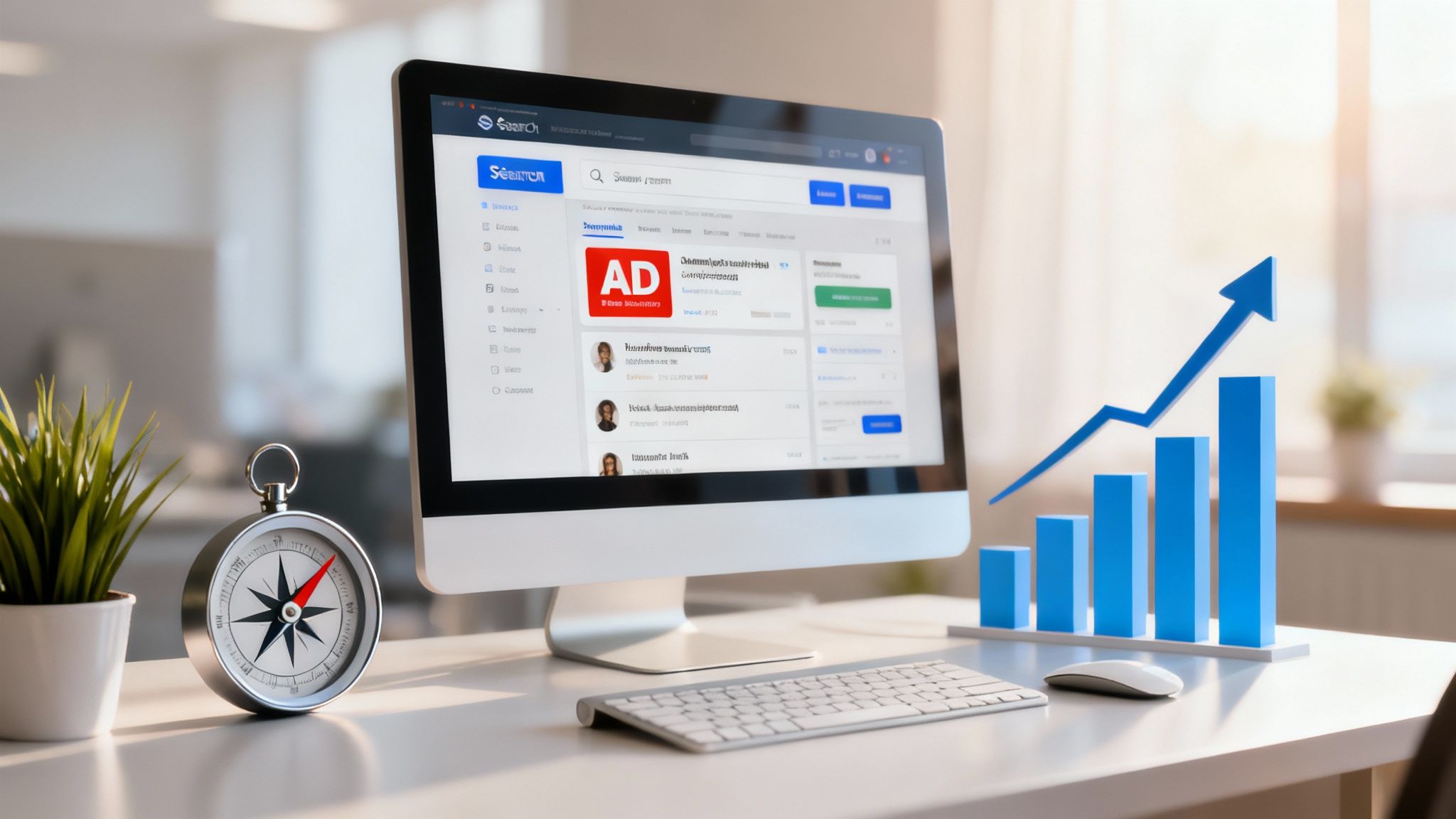
Think of a search engine marketing agency as your expert guide in the world of digital advertising. Their main job is to put your business in front of the right customers on search engines like Google, at the exact moment they’re looking for what you offer. It's a strategic, paid approach designed to capture high-value traffic, right now.
What Does a Search Engine Marketing Agency Do
A search engine marketing agency specialises in getting your business seen by potential customers through paid advertising on search engines. Unlike organic methods that can take months to build momentum, an SEM agency focuses on driving immediate, targeted traffic straight to your website.
Imagine a busy digital marketplace where people are actively searching for products or services. Your business is just one of many stalls. An SEM agency acts as your promoter, making sure your ads are placed in the best spots so interested buyers find you first. This direct approach is all about generating leads and sales quickly.
At its core, the agency’s role is to manage your advertising budget effectively. They handle everything from creating campaigns and picking the right keywords to writing ad copy and tracking performance, making sure every dollar you spend delivers the best possible return.
Clarifying SEM and SEO
It's easy to get SEM and SEO mixed up, but they're really two different sides of the same coin. Nailing the difference is key to building a powerful online presence.
- Search Engine Marketing (SEM): This is the paid route. It involves paying for ads to appear in search engine results. The biggest advantage? Speed. Your ads can start bringing in traffic almost instantly.
- Search Engine Optimisation (SEO): This is the organic, long-term game. It's all about improving your website's structure and content so it ranks higher in search results naturally, without you having to pay for clicks.
While they’re different, SEM and SEO work best when they work together. The data you get from your paid ads can give you powerful insights for your organic strategy, and strong organic rankings can actually improve how well your ads perform. A good agency knows how to balance both for comprehensive growth. You can dive deeper into this in our detailed guide on what is search engine marketing.
The Agency's Role in Business Growth
Ultimately, a search engine marketing agency is a strategic partner focused on one thing: turning clicks into customers. They dig deep into market research, see what your competitors are doing, and constantly fine-tune your campaigns based on real-world data.
This isn’t just about buying a few ads and hoping for the best. It’s a calculated process of bidding on the right keywords, targeting specific demographics, and crafting compelling messages that connect with your audience. By taking care of these complex tasks, they free you up to focus on running your business while they deliver measurable results and a clear return on your investment.
The Core Services That Drive SEM Success
At its core, a search engine marketing agency is a team of specialists, each focused on a different, yet connected, advertising channel. They don't just "run ads"; they build a complete strategy where every service supports the others, creating a powerful engine for your business growth. Understanding these moving parts is the first step to seeing how a professional agency turns your budget into real results.
The Australian search engine marketing (SEM) industry has exploded in recent years, with revenue hitting an estimated $3.7 billion. This growth, climbing at a 7.4% compound annual rate between 2020 and 2025, shows just how much local businesses rely on digital advertising to find new customers and build their brands.
Mastering Google Ads for Maximum Reach
Google Ads is the undisputed giant of paid search, and it’s usually the first stop for any SEM agency. But it's not just one platform; it's a whole toolkit designed to reach customers at different points in their buying journey. Good advertising account planning is the blueprint for any successful campaign, mapping out how to use these tools effectively.
An agency's work here breaks down into a few key areas:
- Search Campaigns: These are the text ads you see right at the top of Google. They’re incredibly effective because they catch people who are actively looking for a solution, making them high-intent and much more likely to convert.
- Display Campaigns: Unlike search ads, these are visual banners that pop up across a massive network of websites, apps, and videos. Their main job is to build brand awareness, keeping your business top-of-mind even when people aren't searching for you directly.
- Video Campaigns: Run mostly on YouTube, video ads are perfect for telling a story and connecting with an audience on a deeper level. An agency uses these to build a brand following and get people thinking about your products.
For businesses that need to make an impact right away, a well-built campaign is non-negotiable. If you want to see how this works in a specific area, take a look at our guide on Google Ads management on the Gold Coast.
The diagram below shows how paid advertising fits into the bigger SEM picture.
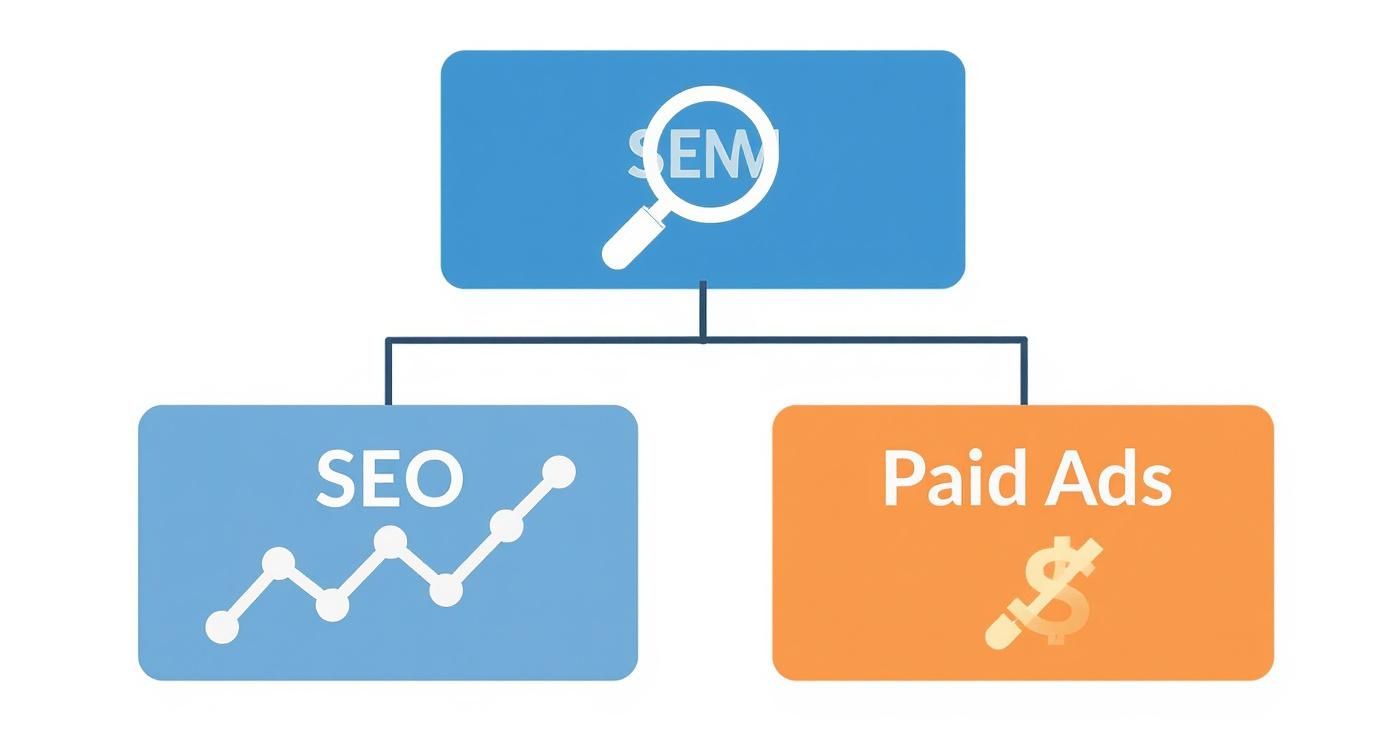
As you can see, SEM is a mix of paid ads for immediate visibility and organic SEO for long-term, sustainable growth.
Tapping into Niche Audiences with Bing Ads
While Google gets most of the attention, ignoring Bing Ads (now Microsoft Advertising) is a rookie mistake. A smart SEM agency knows that Bing offers access to a unique and often untapped audience. The platform tends to attract an older demographic that might not be as active on Google, which is a golden opportunity for the right business.
On top of that, there’s often less competition on Bing. This can lead to a lower Cost Per Click (CPC) and a higher Return On Ad Spend (ROAS). For businesses in certain niches or those targeting a more mature customer, Bing Ads can be a surprisingly profitable move.
Driving E-commerce Sales with Google Shopping
For any online retailer, Google Shopping is an absolute must. These are the product ads you see at the top of a search—complete with images, prices, and store names. They are fantastic at turning casual browsers into buyers because they give people all the key info at a glance.
An SEM agency’s role here is both technical and strategic.
- Product Feed Optimisation: The agency makes sure your product data is perfectly structured with accurate titles, descriptions, and high-quality images to meet Google's strict rules.
- Campaign Management: They build and manage Shopping campaigns, setting bids to get your most profitable products seen.
- Performance Analysis: The team constantly watches which products are selling, tweaking the strategy to push top performers and improve listings that are lagging behind.
The Power of Remarketing to Recapture Interest
Have you ever looked at a product on a website, left without buying, and then suddenly started seeing ads for it everywhere you go online? That’s remarketing, and it's a powerful way to close sales that would otherwise be lost.
Remarketing works by tracking visitors who have already shown interest in your business. An agency then creates targeted ad campaigns designed to bring those specific people back to your site to finish what they started. This strategy is incredibly effective because it focuses on a "warm" audience that already knows your brand, making them far more likely to convert than a cold lead. Think of it as a friendly digital reminder, keeping your business top-of-mind and guiding customers back to the checkout.
How to Measure Real Results and ROI
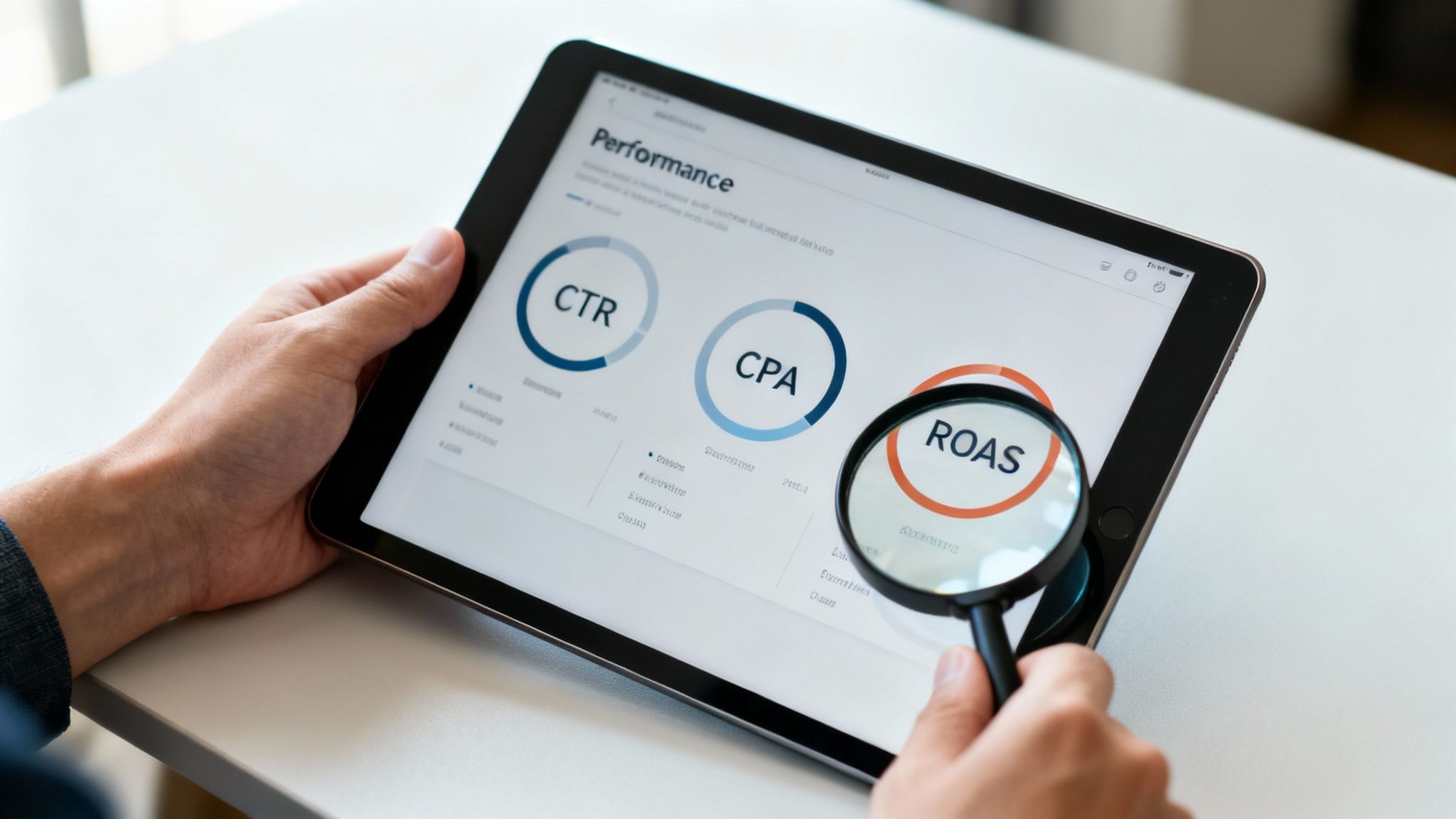
So, you're investing in a search engine marketing agency. That's a big step. But how do you actually know if your money is working for you? It’s far too easy to get buried in a mountain of data, so a good agency cuts through the noise and zeroes in on the key performance indicators (KPIs) that directly impact your bottom line.
It's crucial to move beyond "vanity metrics" like impressions or clicks. Sure, those numbers give you some context, but they don't paint the whole picture of your campaign's success. The real story is in the metrics that measure efficiency, cost, and, most importantly, profit.
A professional agency doesn't just use this data for a fancy monthly report; they use it as a live roadmap. Every metric is a clue that guides ongoing adjustments to sharpen targeting, improve ad creative, and squeeze more value out of every single dollar you spend.
Unpacking the Core SEM Metrics
To get a real grip on how your campaigns are doing, you need to understand a few core metrics. These KPIs are the language of paid advertising, and they work together to show what’s working, what isn’t, and where the biggest opportunities for growth are hiding.
Think of it like the dashboard of your car. Clicks are like the odometer—they show how far you've gone, but they don’t tell you anything about your fuel efficiency or the health of your engine. For that, you need to look at more specific gauges.
Here are the essential metrics any decent SEM agency will be watching like a hawk:
- Click-Through Rate (CTR): This is the percentage of people who see your ad and are compelled enough to actually click on it. A high CTR is a great sign that your ad copy and targeting are hitting the mark with your audience.
- Cost Per Acquisition (CPA): This is your total ad spend divided by the number of conversions (like a sale or a lead). CPA tells you exactly how much it costs to win a new customer, which is a make-or-break number for any business.
- Conversion Rate: This metric tracks the percentage of clicks that turn into a desired action. A strong conversion rate means your landing page is doing its job and effectively turning curious visitors into paying customers.
If you’re not sure how your ads are stacking up, you can use tools to get a better read on your campaign’s health. To see where you stand, try our handy click-through rate calculator to analyse your current ad effectiveness.
Focusing on the Ultimate Goal: ROAS
While all these metrics are important pieces of the puzzle, the one that truly matters to the health of your business is Return On Ad Spend (ROAS). This is the ultimate measure of profitability for your advertising.
ROAS tells you exactly how much revenue you’re generating for every dollar you put into your ads. For instance, a ROAS of 5:1 means you’re making $5 in revenue for every $1 you spend. When you're assessing the financial success of your SEM campaigns, it’s vital to understand how to calculate Return on Ad Spend (ROAS).
ROAS cuts through all the other metrics to answer the most important question: "Is my ad spend actually making me a profit?" An expert agency is relentlessly focused on improving this figure, as it's the clearest indicator of business growth.
Choosing the Right SEM Agency for Your Business
Finding the right search engine marketing agency is one of the most important calls you'll make for your business’s growth. This isn't just about hiring another supplier; it's about finding a strategic partner who becomes an extension of your own team, someone genuinely invested in your success.
A great agency doesn't just run ads. They align their expertise with your specific business goals, turning your advertising budget into tangible, measurable results. The ideal partner brings both the technical skill to manage complex campaigns and a real-world understanding of your industry. It means looking past the flashy sales pitches and digging into how they actually operate, communicate, and deliver value.
Evaluating Expertise and Proven Success
Before you even think about signing a contract, you need to see hard evidence of an agency's capabilities. Don't just take their word for it—ask for proof. Any reputable agency will be more than happy to show off its track record and industry credentials.
Start by looking for official accreditations. Being a Google Premier Partner, for instance, is a massive indicator of expertise. This status is only awarded to the top 3% of participating companies each year, which means they’ve demonstrated a high level of skill, client growth, and performance in managing Google Ads accounts. It’s a clear signal that the agency meets Google's toughest standards.
Next, you absolutely must ask for case studies. These aren’t just testimonials; they are detailed accounts of their past work that show you what they can really do.
- Request Industry-Relevant Examples: Ask to see results from businesses similar to yours, whether in size or sector. This proves they understand the unique challenges of your market.
- Look for Specific Metrics: The case studies should be packed with key performance indicators like Return On Ad Spend (ROAS), Cost Per Acquisition (CPA), and conversion rate improvements.
- Understand the Narrative: A good case study tells a story. It should outline the initial problem, the strategy they implemented, and the specific, data-backed results they achieved.
This level of due diligence helps you move from simply trusting what an agency says to knowing what they can actually do.
Understanding Communication and Reporting
How an agency communicates can make or break the partnership. Vague updates and confusing reports are major red flags. You need a partner who champions transparency and keeps you in the loop every step of the way, so you always know how your investment is performing.
Clarity is everything. A skilled agency will provide regular, easy-to-understand reports that focus on the metrics that matter most to your business goals, not just vanity numbers. Before signing on, get straight answers to a few key questions about their process.
- Who is my main point of contact? Having a dedicated account manager means you have one consistent person to speak with who understands your business inside and out.
- How often will we receive reports? A monthly reporting cycle is pretty standard, but some agencies offer more frequent updates, especially when a campaign is just getting started.
- What format will the reports be in? Ask for a sample report. You want to see if it's clear, concise, and focused on business outcomes, not just buried in technical jargon.
Open and honest communication builds the trust needed for a successful long-term partnership. It ensures you and your agency are always on the same page, working towards the same goals. For a deeper dive, explore our guide on what to look for when researching search engine marketing agencies.
Finding the Right Cultural Fit
Finally, don't underestimate the importance of a good cultural fit. The best agency relationships feel less like a client-vendor dynamic and more like a true partnership. You want a team that is genuinely excited about your brand and dedicated to helping you win.
An agency should feel like a part of your team, not just an outsourced service. This alignment in values, work ethic, and goals is often the secret ingredient to achieving extraordinary results together.
Think about whether their approach aligns with your own. Do they take the time to listen and properly understand your business challenges? Are they proactive with new ideas and strategies? The right partner will be just as committed to hitting your targets as you are, making your success their absolute top priority.
How Do SEM Agencies Structure Their Fees?
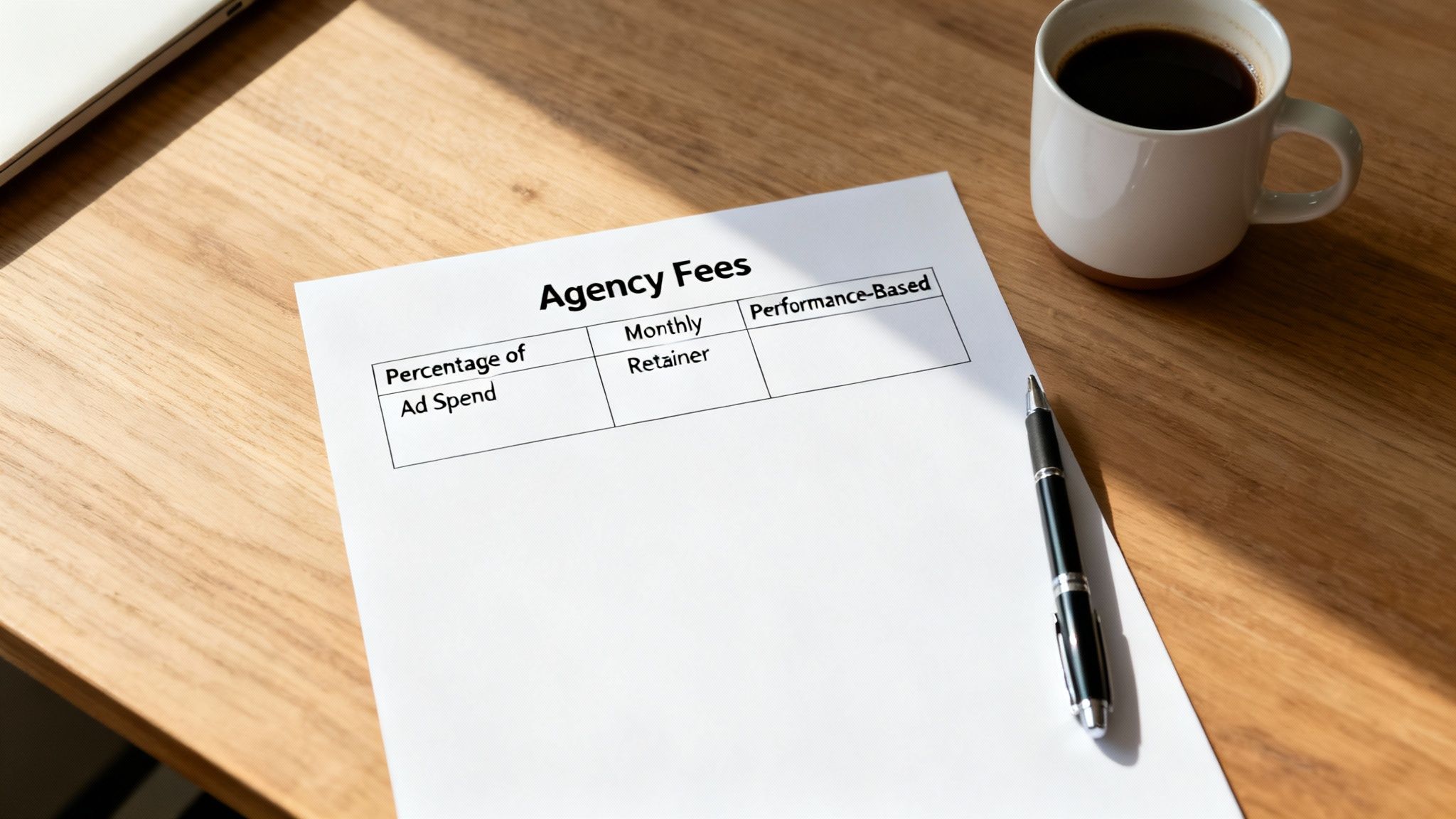
When you’re ready to partner with a search engine marketing agency, one of the first questions you'll have is about the cost. Figuring out how agencies structure their fees is critical for budgeting and making sure the financial arrangement works for your business goals. There’s no single "standard" price, but most agencies stick to a few common models.
Each pricing structure has its pros and cons, and what’s right for a large national e-commerce store will be totally different from what works for a local service business. Your goal is to find a model that feels transparent, predictable, and gives you a clear path to a positive return on investment.
Percentage of Ad Spend
This is one of the most popular pricing models out there, especially for businesses with bigger advertising budgets. With this setup, the agency’s management fee is simply a set percentage of whatever you spend on ads each month.
It's a straightforward model that scales directly with your marketing efforts. As your ad spend grows, so does the agency's fee, which gives them a natural incentive to manage an expanding budget effectively. This is a great fit for businesses focused on aggressive growth who need a pricing structure that can keep up.
Flat Monthly Retainer
For many small and medium-sized businesses, a flat monthly retainer is the way to go. It offers maximum predictability. You pay a fixed fee every month for the agency to manage your SEM campaigns, no matter how much you spend on ads.
The main advantage here is budget certainty. You know exactly what your management costs are going to be each month, making financial planning a whole lot simpler. This model is perfect for businesses that need consistent, ongoing management and prefer a stable expense over a variable one tied to ad spend. To get a better feel for this, it helps to understand how much Google Ads cost in the Australian market.
Performance-Based Fees
A performance-based model ties the agency's paycheque directly to the results they deliver. For obvious reasons, this is often the most appealing structure for business owners, as it creates a powerful incentive for the agency to produce real, tangible outcomes.
Payment is usually linked to specific key performance indicators (KPIs) you agree on beforehand. These could include:
- Cost Per Lead (CPL): The agency earns a fee for every qualified lead they generate.
- Cost Per Acquisition (CPA): Payment is based on each new customer you get from the campaigns.
- Revenue Share: The agency takes a slice of the sales revenue driven by their advertising.
This "pay-for-performance" approach means you’re only paying for measurable results. It puts your agency’s success in direct alignment with your own, creating a true partnership focused on hitting your most important business goals. Ultimately, choosing the right model comes down to your budget, your goals, and the level of risk you're comfortable with.
The Titan Blue Approach to Modern SEM
In a crowded market, picking an SEM agency really boils down to two things: experience and innovation. A lot of agencies just run the same old playbook for every client. Our approach, however, is built on 25 years of being at the forefront of the industry, paired with a forward-thinking mindset that gets your business ready for what’s next in search.
We know that real growth happens when you move beyond the standard way of doing things. Our strategies aren’t just about keeping up; they're designed to give our clients a real edge, especially here in the Australian market. This means blending decades of hands-on experience with the smarts of modern technology.
Integrating AI for Precision and Insight
At the heart of our SEM strategy is our own AI Search technology. Think of it as a powerful lens that lets us spot opportunities everyone else misses. Managing campaigns by hand can only get you so far. Our AI tools dig through massive amounts of data to find hidden keywords, predict what the market will do next, and fine-tune ad bidding with a precision that’s just not humanly possible.
This technology allows us to:
- Find Untapped Audiences: Discover valuable groups of customers that your competitors have completely overlooked.
- Optimise Bids in Real-Time: Automatically adjust your ad spend to squeeze the most value out of every dollar, maximising your return on ad spend (ROAS).
- Predictive Performance Analysis: Forecast how a campaign might perform, letting us make smarter decisions before you commit your full budget.
By bringing AI into the mix, we make sure every dollar you spend on ads is working as hard as it possibly can, delivering results that are both more efficient and more impactful.
A Partnership Built on Custom Strategy
We’re firm believers that the best strategies are never one-size-fits-all. A generic approach gets you generic results, and that’s why we’ve built our entire process around a true, collaborative partnership. Your business has its own unique challenges, specific goals, and a distinct place in the market. Our job is to create a custom roadmap that lines up perfectly with those realities.
A true strategic partnership is about more than just managing ads. It’s about building a shared vision for growth and working together to achieve measurable, future-proof results that last.
It all starts with listening. We take the time to really understand your business—inside and out—before we even think about putting together a bespoke SEM plan. As your dedicated partner, we’re committed to transparent communication, clear reporting, and a strategy that grows and changes right alongside your business. It’s this commitment that turns a typical client-agency relationship into a powerful alliance geared for long-term success.
A Few Common Questions About SEM Agencies
Deciding to bring in a search engine marketing agency is a big step, so it’s completely normal to have a few questions. To help you get a clearer picture, we’ve answered some of the most common queries we hear from business owners.
How Quickly Can I Expect To See Results?
While paid ad campaigns can start sending traffic to your website almost right away, getting them to perform at their best isn't an instant fix. A good agency needs time to gather real-world data, experiment with different ad concepts, and fine-tune your targeting to find what truly works.
You should generally plan for a 2-3 month optimisation period. This timeframe is essential for building a campaign that delivers consistent, profitable, and scalable results, making sure you get a strong return on your investment for the long haul.
What’s the Real Difference Between SEM and SEO?
It helps to think of it like this: SEM is like paying for a massive billboard on the busiest highway in town. It guarantees your brand gets immediate visibility (paid ads).
On the other hand, SEO is like building such a fantastic reputation that people naturally want to come and visit your store (organic traffic). SEM gives you speed, while SEO builds lasting authority. The most successful digital strategies don't choose one or the other—they blend both to completely dominate the search results.
How Do I Set a Realistic Ad Spend Budget?
There’s no magic number here. The right ad budget really depends on how competitive your industry is and what you’re trying to achieve. The smartest way to start is with an initial test budget.
This gives a search engine marketing agency the chance to figure out your baseline cost-per-acquisition (CPA). Once they have that proven data, they can help you scale up your investment with confidence, ensuring every dollar is put to work for the best possible impact and a return you can actually measure.
Ready to partner with a digital agency that combines 25 years of experience with modern AI-driven strategies? Contact Titan Blue Australia today to build a custom roadmap for your business growth at https://titanblue.com.au.
Make Titan Blue a preferred source in Google
One click tells Google to surface our articles more often in Top Stories, AI Overviews and AI Mode.

Solar Installer Website Design Australia: The 2026 Guide
How solar installer websites in Australia should show CEC accreditation, real install proof and AI-ready…

Hotel & Hospitality Website Design Australia: 2026 Guide
Hotel and hospitality website design in Australia explained: booking flow, schema, AEO and what actually…

Restaurant Website Design Australia: The 2026 Guide
What a restaurant website in Australia needs: HTML menus, bookings, GBP sync, schema, and AI-ready…