


Last updated:
For agencies, content marketing isn't just about writing a few blog posts. It's a two-pronged attack: you're marketing your own agency while simultaneously building a profitable content service for your clients. This is about moving beyond random acts of content and establishing a proper system—one that positions your firm as an authority and creates a scalable new revenue stream.
The end game? A well-oiled machine that pulls in ideal clients for you, while delivering real, measurable results for them.
Building Your Agency's Content Service Foundation
Getting past the theory and into the practical is the first real hurdle. You need to build a content marketing service that clients are actually excited to buy, and that starts with the operational bedrock of a profitable, scalable offering.
So many agencies get this wrong. Their content might be decent, but they fall down because their foundation—the packaging, team roles, and workflows—is a chaotic mess. Without that solid groundwork, you’re just setting yourself up for inconsistent delivery and an awkward conversation when the client asks to see their ROI.
The demand for these services is definitely there. Just look at the digital advertising agency market in Australia, which is where most content marketing gets executed. It’s projected to hit $3.7 billion in revenue by 2025, after growing at a compound rate of 7.4% for the last five years. The opportunity is huge for agencies that can deliver high-quality digital and content services.
How to Package Your Content Services
The way you package your services is how you sell value. Clients aren't buying "blogs" or "social posts"; they're buying solutions to their problems, whether that's generating more qualified leads or becoming the go-to name in their industry. Because of this, you need to structure your offerings into clear, outcome-focused tiers.
A simple tiered approach works wonders here because it caters to clients at different stages of their journey.
Here's a structure I've seen work time and time again:
-
The "LaunchPad" Package: This is perfect for new businesses or those just dipping their toes into content. Think foundational blog content (maybe two articles a month), basic on-page SEO for each piece, and some social media snippets for promotion. It’s an easy yes and a great way to show value quickly.
-
The "Growth Engine" Package: Aimed at established businesses that are ready to scale up. This could include four long-form articles per month, a monthly email newsletter, one lead magnet per quarter (like a checklist or a short guide), and more detailed performance reports.
-
The "Authority" Package: Your top-tier offering for market leaders. This is a comprehensive service that might involve creating pillar pages, scripting video content, managing guest post outreach, and holding in-depth monthly strategy sessions backed by deep-dive analytics.
A tiered structure like this makes it simple for prospects to see where they fit and understand exactly what they're paying for. It also gives you a natural upsell path as their business grows.
Defining Your Core Content Team Roles
You don't need a huge department to deliver great content, but you absolutely need clearly defined roles. A lean, effective content team ensures every part of the process is handled by someone who knows what they're doing, which leads to better quality and more efficiency.
Even if you’re a small agency where people wear multiple hats, it’s still crucial to think in terms of these roles.
Here are the key players you need to have covered:
-
The Strategist: This is your architect. They’re the one doing the audience research, digging into keyword analysis, mapping out the customer journey, and building the editorial calendar. Their job is to make sure every single piece of content has a clear purpose and ties back to the client's business goals.
-
The Writer/Creator: The storyteller. This person brings the strategy to life. It’s about more than just good grammar; they need to be able to nail a client's brand voice, research topics like a pro, and write compelling copy that actually connects with the target audience.
-
The Editor/QA Specialist: Your quality gatekeeper. They take the writer's draft and polish it until it shines, checking for clarity, accuracy, tone, and SEO alignment. This role is completely non-negotiable if you want to maintain professional standards.
-
The Promotion Specialist: The amplifier. Once the content is live, their job is to make sure people actually see it. This means handling social media distribution, email marketing, and sniffing out opportunities for outreach.
To really nail the foundation, it pays to dive into proven content marketing strategies for professional services that are built around trust and client acquisition. You can also get more practical tips from our guide on essential content marketing best practices designed for modern agencies.
Designing Your Modern Content Production Workflow
For any agency serious about scaling content marketing, a slick, high-quality production workflow is non-negotiable. Forget a simple to-do list; we're talking about a finely tuned system that blends today’s tech with the human expertise that clients actually pay for. This is your playbook for turning business goals into high-performing content, time and time again.
A solid workflow gets rid of the guesswork. It stops the chaos that so often derails creative projects and makes sure every team member knows exactly what they need to do and when. It’s what separates the agencies drowning in scope creep from those that deliver amazing results on schedule, every time.
The whole thing rests on three core pillars: how you package your services, who’s on your team, and the systems that hold it all together.
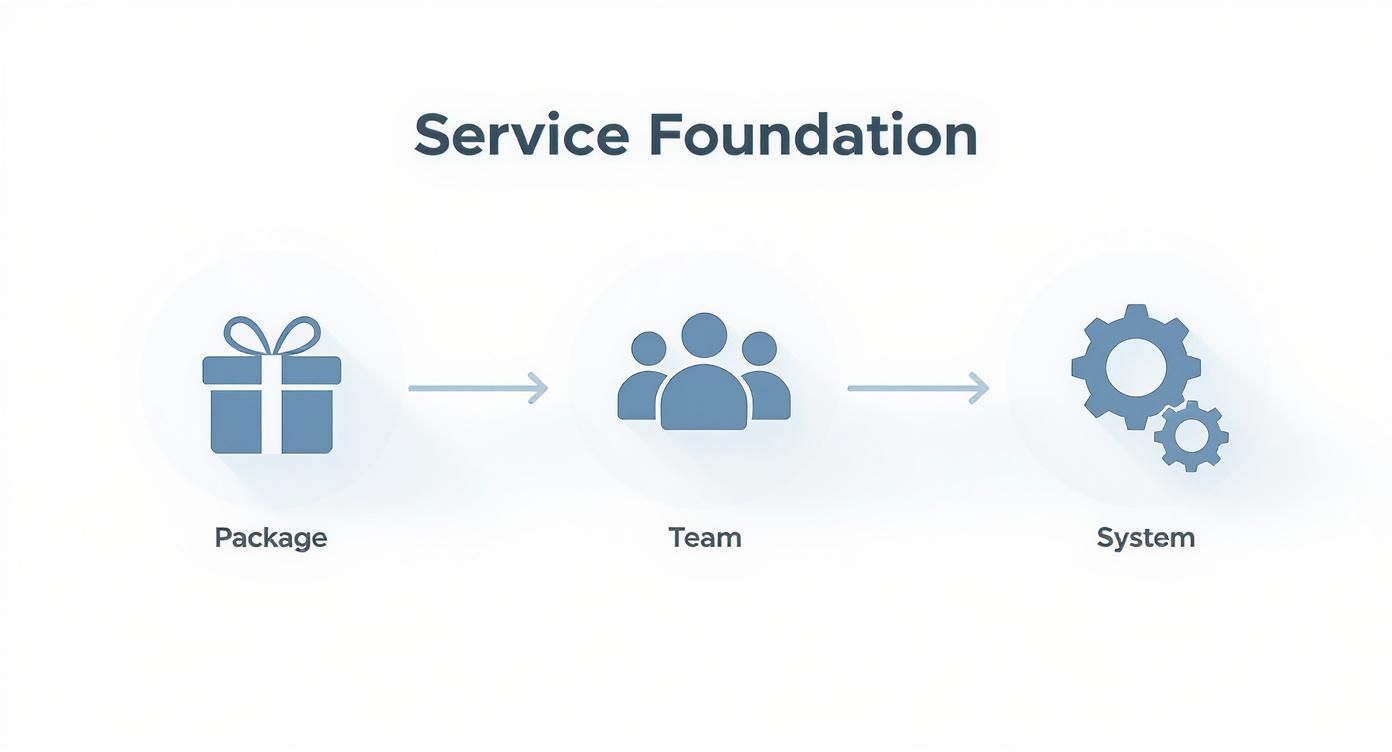
This isn’t just a pretty diagram. It shows that a scalable workflow is built on purpose. Your packages, team, and systems have to work in sync to create a rock-solid foundation.
The Five Stages of a Modern Workflow
To keep client work transparent and under control, break your process into clear, manageable stages. This gives you natural checkpoints for quality control and client feedback, keeping everything on track from the first idea to the final report.
A modern workflow really boils down to five distinct phases:
-
Discovery and Strategy: This is where the real work begins, long before anyone writes a single word. We're talking deep-dive client sessions, mapping out audience personas, sizing up the competition, and doing thorough keyword research to find those golden topic clusters. The deliverable? A signed-off content strategy and a detailed editorial calendar.
-
Creation and Collaboration: Now, the magic happens. Guided by detailed briefs from the strategist, writers get to drafting. If it’s a tricky topic, this is when you’ll pull in the client's subject matter experts (SMEs) for an interview. The draft then heads to an editor for a polish before the client sees it for the first round of feedback.
-
Optimisation and Finalisation: With the core content approved, the focus shifts to on-page SEO. It’s time to nail the meta titles, descriptions, headers, and internal links. The content gets formatted for readability, visuals are added, and it goes through one last quality check before the client gives the final thumbs-up.
-
Publication and Distribution: Content is approved and ready to go live on the client's CMS. But you’re not done yet. The promotion specialist jumps in, pushing the content out across all the channels you agreed on—social media, email newsletters, maybe even some targeted outreach to get the ball rolling.
-
Analysis and Refinement: This last stage is a continuous loop. You track performance against the KPIs you set back in the strategy phase. You dig into the data to see what’s hitting the mark and what’s not, and those insights feed straight back into the strategy for the next round of content.
Creating LLM-Aware Content for the Future of Search
With AI search becoming more common, agencies have to adapt. Building LLM-aware content is about more than just ranking in traditional search; it’s about creating material that’s primed to be picked up and featured in AI-generated summaries and answers.
This doesn't mean you start writing for robots. It’s the opposite. You need to create content that’s exceptionally clear, well-structured, and gives a direct answer to a user’s question. Think of it as optimising for pure clarity. When your content is the most helpful and straightforward answer out there, an LLM is far more likely to feature it.
Integrating AI Tools Without Losing the Human Touch
Let’s be honest, AI tools are fantastic for speeding up research, spitting out outlines, and smashing through writer's block. They can analyse huge chunks of data in seconds, helping your team spot patterns and angles you might have otherwise missed. This isn’t about replacing people; it’s about freeing them up to do what they do best.
- Strategic Insights: Let AI do the heavy data lifting. This gives your strategists more time to think about the bigger picture and come up with genuinely creative campaign ideas.
- Originality and Storytelling: Use AI to get a first draft on the page, but empower your writers to inject their unique perspective, the client’s brand voice, and compelling stories that actually connect with people.
- Client Empathy: An AI can’t replicate a deep understanding of a client’s business or their customers' real-world problems. That human element is your agency’s biggest advantage.
By cleverly weaving AI into your workflow, you can produce better content, faster. This boosts your profit margins and gets superior results for clients, cementing your spot as a partner who’s ready for what’s next.
For a deeper dive into the creative side of things, check out these expert tips on effective website and content writing that truly connects.
Mastering Content Distribution and Promotion
Creating exceptional content is only half the battle. Its true value is only realised when it actually reaches the right audience. Strategic distribution is what separates impactful agency content marketing from just making noise—it's the engine that drives visibility, engagement, and ultimately, client results.
Let's be honest: hitting 'publish' and hoping for the best is a surefire way to fail. You need a proactive, multi-channel promotion plan to stretch the reach and lifespan of every single content asset your agency produces. It's about moving beyond a single channel and building an ecosystem where your client's content can truly thrive.

Selecting the Right Channels for Your Clients
Not all channels are created equal, and the right mix depends entirely on your client's industry and their target audience. A B2B tech client needs a completely different approach to a local restaurant. Your job as an agency is to figure out where their customers spend their time online and build a solid presence there.
-
Organic Search (SEO): This is the non-negotiable foundation. Good SEO ensures a client's content is discoverable the moment potential customers are actively searching for solutions. It’s a long-term play that builds sustainable traffic and authority over time.
-
Targeted Social Media: You have to go where the audience is. For a fashion retailer, that’s Instagram and TikTok. For a corporate law firm, LinkedIn is the obvious winner. The key here is depth over breadth—it's far better to master one or two relevant platforms than to spread your efforts too thin across five.
-
Email Marketing: This is your client's owned channel, giving you a direct line to their most engaged audience. Use email to distribute new articles, share exclusive insights, and nurture leads down the sales funnel. For more guidance, explore these proven email marketing best practices that deliver real results.
Building a Multi-Channel Promotion Plan
A robust promotion plan makes sure every piece of content works as hard as possible. This involves a smart mix of paid, owned, and earned media to surround the target audience from multiple angles.
Social media advertising, for instance, offers a powerful way to accelerate reach. And it's a growing space—social media ad spend in Australia is projected to hit approximately AU$7.5 billion by 2025, making up 29% of all digital ad spending. This consistent growth, highlighted in Meltwater's recent report, shows just how crucial it is in a comprehensive distribution strategy.
Your promotion checklist for a new pillar article could look something like this:
- Initial Launch: Publish the article and send a dedicated broadcast to the client's email list.
- Social Media Blitz: Schedule a series of posts across primary social channels for the first week, using different hooks and visuals for each.
- Community Engagement: Share the article in relevant LinkedIn Groups, subreddits, or industry forums where the target audience actively participates.
- Internal Linking: Go back and update older, relevant blog posts to link to the new pillar article. This passes authority and helps with indexation.
Maximising ROI Through Content Repurposing
Why let a high-value pillar article live in just one format? Repurposing content is the secret to maximising your creative investment and engaging diverse audience segments. Not everyone wants to read a 2,000-word blog post, but they might watch a 60-second video on the exact same topic.
This approach respects different content consumption preferences and reinforces key messages across multiple platforms.
Here are some practical ways to repurpose a single long-form article:
- Social Media Carousel: Pull out key statistics and takeaways to create a visually engaging carousel for Instagram or LinkedIn.
- Short-Form Video Script: Turn the main points into a punchy script for a TikTok or YouTube Short for a quick, dynamic summary.
- Email Snippets: Break the article down into a multi-part email nurture sequence, delivering bite-sized value over several weeks.
- Infographic: Visualise the data and core concepts from the article into a clean, shareable infographic.
By adopting a smart repurposing workflow, your agency can amplify a single piece of research into a dozen different assets. You'll dramatically increase its reach and impact without having to start from scratch every single time.
Measuring Success and Proving Content ROI
Clients need to see the value their investment is generating. This is where your agency’s content marketing efforts shift from a creative service to a tangible business driver. Proving return on investment (ROI) is non-negotiable; it’s how you keep clients, justify your fees, and find opportunities to grow the account.
A lot of agencies fall into the trap of focusing on vanity metrics. Sure, high page views and a flurry of social media likes might look impressive on the surface, but they don’t pay the client's bills. Instead, your focus has to be on key performance indicators (KPIs) that directly connect your content to their bottom-line business goals.

Moving Beyond Vanity Metrics
To prove real value, you need to track metrics that tell a story of business impact. This means digging deeper than surface-level numbers and connecting your content to actual leads, sales pipeline activity, and customer acquisition.
Your reporting should centre on tangible outcomes that resonate with a CEO or a sales director, not just a marketing manager.
These are the metrics that truly matter:
- Qualified Leads Generated: How many leads from content downloads, webinar sign-ups, or demo requests are a good fit for the sales team? You can track this by setting up goals in your analytics platform for those key conversion points.
- Conversion Rates: What percentage of visitors who engage with your content take a desired action? This could be the conversion rate of a landing page for an ebook or the sign-up rate for a newsletter.
- Pipeline Influence: This is an incredibly powerful B2B metric. Using marketing automation tools, you can track which content assets a lead engaged with before becoming a sales opportunity. It’s a perfect way to show how your content nurtures prospects through their buying journey.
- Customer Acquisition Cost (CAC): How much does it cost to acquire a new customer through your content marketing? A lower CAC from content compared to other channels is a massive win and clear proof of ROI.
Building Insightful Client-Facing Dashboards
A spreadsheet crammed with numbers isn't a story. To communicate success effectively, you need to build client-facing dashboards that are clear, visually compelling, and laser-focused on the KPIs you both agreed upon. The goal is to make the value you're providing instantly obvious.
A great dashboard doesn't just present data; it provides context. For example, alongside the number of new leads, show the month-over-month growth percentage. When reporting on organic traffic, highlight the increase in rankings for high-intent keywords.
Using Data to Refine and Upsell
Your measurement process shouldn't just be for reporting—it's your best tool for continuous improvement and growth. Analysing what's working and what isn't allows you to double down on successful tactics and pivot away from underperforming content. This is a key part of effective content marketing for agencies.
This strategic approach is widely adopted here in Australia. Recent data shows that 74% of Australian businesses have a documented content strategy, and critically, companies with these formal strategies see an average of 3.2 times higher ROI than those without. This shows a clear link between proper planning and measurable success.
By consistently demonstrating your impact, you build immense trust. When you can show a client that a specific blog series led to a 15% increase in qualified leads, it's a much easier conversation to propose expanding that series or exploring a new content format like video. Understanding how to show these tangible results is everything; you can dig deeper into the strategies for measuring content marketing ROI for business leverage.
Pricing Your Services and Onboarding New Clients
Nailing your pricing is where an agency sinks or swims. Get it right, and you're building a sustainable, profitable business. Get it wrong, and you'll quickly find yourself trapped in a painful cycle of over-servicing and under-earning.
A strong pricing strategy does more than just cover your overheads; it clearly communicates the immense value your content marketing delivers. When you pair that with a seamless onboarding process, you set the stage for a trusting, long-term client partnership right from the get-go.
Choosing the Right Pricing Model
There’s no magic bullet for pricing content marketing. The best model for your agency really depends on the kinds of clients you work with and the scope of work you’re delivering. Most agencies land on one of three common structures.
Each one has its own set of pros and cons, so it’s worth thinking about which one truly aligns with how you operate and your revenue goals.
-
Monthly Retainer: This is the gold standard for ongoing, strategy-led work. Clients pay a fixed fee each month for a clearly defined set of deliverables. This gives you predictable revenue and gives them consistent support. It’s perfect for building long-term relationships but demands a rock-solid scope of work to stop scope creep in its tracks.
-
Project-Based Fee: Ideal for well-defined, one-off projects like a full website content overhaul or a deep-dive ebook. You charge a single flat fee for the whole project, which clients love because it gives them cost certainty. The downside? It offers less predictable income for your agency.
-
Value-Based Pricing: This is a more advanced approach that ties your fees directly to the business results you generate—think qualified leads or revenue directly influenced by your content. It has the highest earning potential by far, but it requires sophisticated tracking and a huge amount of trust with the client to prove your impact.
How to Calculate Your Rates Confidently
Setting rates that reflect your true value has to start with knowing your costs. Tally up your total overheads—salaries, software subscriptions, office space—and figure out a baseline hourly rate you need to be profitable. But don't stop there.
Your price has to factor in the strategic value you bring to the table. You aren't just selling words on a page; you're selling expertise, strategy, and measurable business outcomes. A single blog post that brings in 10 qualified leads is worth infinitely more than its word count.
To get a better sense of market rates, it helps to see how other packages are put together. You can explore a variety of SEO packages and pricing to see how services are often bundled to deliver clear value at different investment levels.
Designing a Seamless Client Onboarding Process
A chaotic start can kill a client relationship before it even gets off the ground. A smooth, structured onboarding process is your first real chance to show your professionalism, set clear expectations, and build the foundation for a brilliant partnership.
This is about more than just paperwork; it’s about alignment. It’s about making sure both you and the client are on the exact same page when it comes to goals, communication, and how success will be measured.
A well-oiled process removes friction and reassures the client they made the right call choosing you.
Here’s a simple checklist to guide your onboarding workflow:
-
Kick-off and Discovery Call: Go way beyond the sales pitch. This is a deep dive into their business, their ideal customer, the competitive landscape, and their biggest business objectives. The goal here is to absorb everything you can to fuel your strategy.
-
Goal Alignment Workshop: Work together to define what success actually looks like. Set clear, measurable KPIs that your content will be judged against, whether that’s increasing organic traffic by 20% or generating 50 marketing-qualified leads per quarter.
-
Brand Voice and Tone Documentation: Create the definitive guide to the client's unique brand personality. Include real examples of what to say and, just as importantly, what not to say. This document becomes the bible for your writers, ensuring everything is perfectly consistent.
-
Access and Asset Collection: Time to gather the keys. Get the logins you need for their CMS, analytics platforms, and social media accounts. Collect all existing brand assets, like logos, style guides, and any past content or market research they might have.
-
Communication Protocol Setup: Define the rules of engagement. Will you use a shared Slack channel? Will reports be sent on the first Monday of every month? Nailing this down upfront prevents any future confusion and keeps the relationship running smoothly.
Frequently Asked Questions
As agencies start building out their content marketing services, a few questions pop up time and time again. Getting these right is the key to scaling a profitable and effective content offering. Let’s tackle some of the most common ones we hear from agency leaders.
How Do I Convince a Sceptical Client About Content Marketing?
The quickest way to get a sceptical client on board is with their own industry’s data and a small, targeted pilot project. Forget pitching a massive, year-long retainer right out of the gate.
Instead, propose a focused three-month campaign aimed at solving one very specific pain point. Think about generating leads for their most profitable service. Frame the entire conversation around business outcomes, not just a list of blog posts you'll deliver. Show them what their competitors are doing and pull up case studies from similar businesses. The goal here is to lower the barrier to entry, deliver a quick, measurable win, and build enough trust to make the case for a bigger investment down the track.
What’s the Right Balance Between AI and Human Writers?
The sweet spot is using AI for grunt work and your human writers for strategy, creativity, and empathy. AI tools are fantastic for speeding up research, spitting out outlines, and generating a rough first draft. This frees up your actual writers to do what they do best.
A solid workflow often looks something like this:
- AI for Research: Use tools to analyse search trends and summarise what competitors are writing about.
- Human for Strategy: A strategist takes that data and finds a unique angle or hook.
- AI for Drafting: An AI assistant creates a first draft based on a detailed, human-written brief.
- Human for Writing & Editing: A skilled writer then steps in to refine, rewrite, and add the critical human touch, ensuring the final piece actually connects with the audience.
How Long Does It Take to See Results from Content Marketing?
This is a big one. You need to manage expectations from the very first conversation. While you might see some small signs of life early on—like a bit of social media engagement—real, tangible business results from SEO-driven content typically take four to six months to show up.
It’s absolutely crucial to set this expectation early and be completely transparent about it. Explain that content marketing is a long-term investment, not a short-term ad campaign. Use those first few months to report on leading indicators like keyword ranking improvements, steady organic traffic growth, and the first few leads trickling in. This shows you’re making progress towards that bigger ROI goal.
Should My Agency Outsource Content Creation?
Outsourcing can be a brilliant move, especially when you’re trying to scale or need expertise in a niche you don't have in-house. It lets you offer a much wider range of content services without the huge overhead of a large internal team.
The trick is to find reliable partners who can consistently hit your quality standards and nail your clients' brand voices.
Even if you do outsource, it’s smart to keep the core content strategy and the final quality check in-house. This way, you can be sure that even the outsourced content is perfectly aligned with the client’s goals and meets your agency's standards. This hybrid model often gives you the best of both worlds: scalability without sacrificing strategic control.
At Titan Blue Australia, we have over two decades of experience building digital strategies that drive real growth for businesses across Australia. From advanced SEO to AI-aware content creation, we deliver performance you can trust. Learn how we can help your business thrive at https://titanblue.com.au.
Make Titan Blue a preferred source in Google
One click tells Google to surface our articles more often in Top Stories, AI Overviews and AI Mode.

Shopify Website Design Australia: The 2026 Guide
Shopify website design Australia: product pages, collections, delivery info and product data that win sales,…

Cleaning Company Website Design Australia: The 2026 Guide
Cleaning company website design Australia: the pages, quote forms and schema that win jobs, plus…

Is AI Search Just Google? What the Numbers Say for Australian Businesses (2026)
Is AI search just Google? Google reports 2.5B+ monthly AI Overviews users. Sourced figures, our…