

Last updated:
"So, what's the real cost of designing a website in Australia?" It's a question we get asked all the time.
While the average website design cost in Australia hovers between $5,000 and $10,000 for a standard site, that's really just the starting line. Think of it like buying a car. You could get a reliable ute for a certain price, or you could invest in a high-performance sports car. Both get you from A to B, but the features, build quality, and what's under the hood are worlds apart. Your website is no different.
Understanding Australian Website Design Costs
Viewing your website's cost as a one-off expense is the wrong way to look at it. It's a strategic investment in your business's growth. A professionally built site is your hardest-working employee—it’s online 24/7, pulling in leads, and building your brand’s credibility, even while you’re asleep. To budget properly, you first need to get a handle on what actually drives the final price tag.
With over 25 years of experience helping Aussie businesses get it right online, we know how important clarity is. This guide is here to cut through the jargon, demystify the costs, and give you a realistic idea of what to expect so you can move forward with confidence.
Core Factors Influencing Your Quote
Every quote you receive is a direct reflection of the work needed to hit your specific business goals. The price isn't just a number pulled out of thin air; it’s shaped by these key elements:
- Design Complexity: A simple website based on a pre-existing template will always cost less than a fully custom-built site with a unique brand identity and a meticulously planned user experience.
- Custom Features and Functionality: Need an e-commerce store, a booking system for appointments, or a members-only portal? Each of these custom functions adds layers of complexity—and cost—to the project.
- Content Creation and SEO: Crafting high-quality, optimised content and laying a strong SEO foundation requires specialist skills. It's an absolute must if you want to attract the right kind of traffic, not just any traffic.
The Australian Market Context
Website pricing in Australia is naturally influenced by our local economic landscape. In 2025, a standard 6-10 page site for a small or medium business—like a local restaurant or a law firm—will typically land somewhere in the $5,000 to $10,000 range. This reflects Australia's higher cost of living and the strong demand for genuinely skilled developers who know what they're doing.
This investment feels even more essential when you realise what a powerful, well-built online presence can do for your growth. Having a solid digital foundation isn't just a nice-to-have anymore; it's a non-negotiable part of any successful business strategy.
Understanding the ins and outs of professional web design and development is the first step toward making a smart, informed decision that will pay you back for years to come.
Decoding the Factors That Drive Your Website Cost
Ever wondered why one website quote can be a few thousand dollars while another climbs into the tens of thousands? It’s a lot like building a house. A straightforward, single-level floor plan is always going to be less expensive than a custom architectural design with a unique layout, premium materials, and smart home integrations.
Your website project works the same way. The final cost isn't just a number pulled out of thin air; it’s a direct reflection of the complexity, features, and expertise needed to build a digital asset that actually hits your business goals. Getting your head around these core components is the first step to making a smart investment.
The Blueprint: Size and Scope
The most obvious cost factor is the sheer size of your website. A simple five-page "brochure" site—think Home, About, Services, Blog, and Contact—needs way less design and development time than a 50-page corporate site with multiple service categories and deep resource libraries.
Every single page requires planning, content creation, design, development, and optimisation. The more pages you need, the more hours a team has to put in, which naturally bumps up the budget. This is exactly why a clear sitemap is one of the first things we map out in any project.
Custom Design vs. Template-Based Approaches
Another major fork in the road is the choice between a custom design and a pre-built template. A template gives you a ready-made structure that can be tweaked with your brand’s colours, fonts, and content. It’s faster and more affordable, but you’re stuck working within the template's limitations.
A custom design, on the other hand, is built from scratch, tailored precisely to your brand and business goals. This involves a deep dive into your target audience to create a truly unique digital experience. While it’s a bigger investment upfront, you get complete creative freedom and a much stronger competitive edge. A thoughtful custom design is also crucial for creating a positive user journey—you can learn more by exploring our insights on what is user experience design.
Functionality and Complex Integrations
This is where the cost can really start to vary. Basic features like contact forms and image galleries are pretty standard, but advanced functionality adds layers of complexity. Every special feature demands specialised development, thorough testing, and often, ongoing subscription fees.
Common features that expand the project scope include:
- E-commerce Functionality: Selling products online means you need secure payment gateways, inventory management, and customer account systems. When mapping out your site, the choice of the best e-commerce platforms can seriously influence both development costs and future maintenance.
- Booking and Appointment Systems: If you're a consultant, tradie, or run any service-based business, integrating a scheduling system that syncs with calendars adds huge value but also complexity.
- CRM or API Integrations: Connecting your website to a system like Salesforce or other third-party software requires custom API development to make sure data flows smoothly between them.
For Australian small to medium businesses, a basic custom site might land somewhere between $3,000 to $10,000 AUD. But adding e-commerce can easily push that figure to $8,000-$25,000+. Things like custom API integrations can add another $2,000-$10,000, and ongoing maintenance also plays a big role in the final number.
SEO and AI Search Readiness
Building a website without a solid SEO foundation is like opening a shop but forgetting to put a door on it. Foundational SEO makes sure your site is structured correctly for search engines to find and index, making you visible to potential customers from day one. This covers technical optimisation, keyword strategy, and creating quality content.
On top of that, getting your site ready for AI-driven search (also known as Answer Engine Optimisation) is no longer just a "nice-to-have." It’s about structuring your content to directly answer user questions, which is critical for showing up in modern search results. Investing in these elements upfront is non-negotiable for powerful, long-term ROI.
Ongoing Ownership Costs
Finally, the initial build isn't the only cost to consider. Just like a house needs upkeep, a website requires ongoing maintenance to stay secure, functional, and effective.
These recurring costs typically include:
- Domain Name Registration: Usually $10-$25 per year.
- Website Hosting: Can range from $50-$150+ per month, depending on your traffic and performance needs.
- Maintenance and Support: A monthly retainer for security updates, backups, and tech support often starts from $300-$800 per month.
By understanding these key drivers, you can have a much clearer conversation with any web design agency and make sure the quote you receive aligns perfectly with the value you expect.
Typical Website Costs For Australian Industries
To get a real handle on website design costs in Australia, you have to look beyond generic price tags and see what specific industries actually need. The investment for a local restaurant on the Gold Coast is worlds apart from what a national mining company or a boutique fashion retailer requires. Every sector has its own customer expectations and operational needs, and those directly shape the scope—and cost—of their digital presence.
Think of it this way: a website for a local tradie needs to build trust fast with a solid portfolio and a simple contact form. On the other hand, a law firm's site must scream authority and credibility, often demanding a more sophisticated design and much deeper content.
Let's break down the typical investment benchmarks for a few key Australian industries.
Service-Based Businesses: Restaurants, Law Firms, and Trades
For any service business, your website is your digital front door. It’s where potential clients get their first impression and decide whether they want to walk through. The main goal here is simple: generate leads and build trust.
- Restaurants & Hospitality: A modern restaurant website is more than just a PDF menu. It needs an integrated online booking system, mouth-watering photo galleries, and crystal-clear location details. The average investment usually falls between $4,000 and $9,000 to create a seamless experience that turns hungry visitors into paying diners.
- Law Firms & Professional Services: Credibility is everything in this space. These sites demand a polished, professional design, detailed service pages, and professional biographies to build confidence. The cost typically ranges from $6,000 to $15,000 to properly reflect the high level of trust and authority clients expect.
- Trades & Construction: For tradies, a website is their most powerful portfolio. It has to be mobile-first, showing off high-quality photos of finished jobs, glowing customer testimonials, and obvious calls-to-action. Our guide on effective web design for tradies dives into how a targeted investment of $3,500 to $8,000 can create a steady pipeline of local work.
This chart gives you a quick visual on how costs stack up for different types of website builds in Australia.
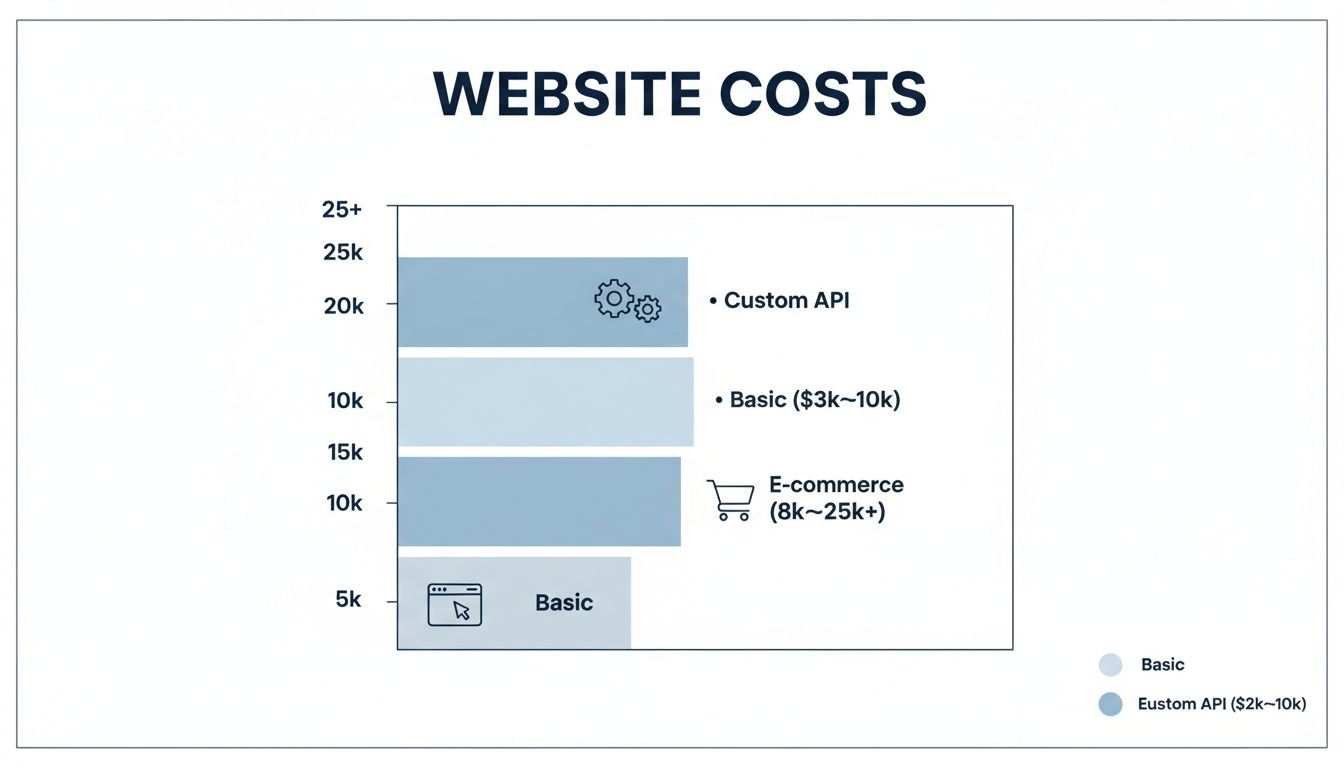
As you can see, adding e-commerce or custom integrations pushes the investment up significantly compared to a basic brochure-style site.
Retail and E-commerce Stores
For retail and fashion businesses, the website isn't just a marketing tool; it is the shop. E-commerce platforms are complex beasts, handling everything from product catalogues and inventory to secure payments and shipping. That complexity naturally comes with a higher price tag.
A simple online store with just a handful of products might start at around $8,000. But for most retailers needing features like customer accounts, advanced product filtering, and links to inventory systems, the investment is more likely to be in the $15,000 to $25,000+ range. This ensures the platform is robust, secure, and ready to scale as the business grows.
Manufacturing, Mining, and Industrial Sectors
Big players in manufacturing and mining have a completely different set of digital needs. Their websites often cater to multiple audiences at once—investors, job seekers, and B2B clients. These sites require a high degree of customisation to showcase complex projects, technical specs, and corporate governance info.
Functionality can include secure client portals, detailed project case studies, and integrations with internal management systems. Because of this complexity and the need for enterprise-level security, a custom website for a major mining operation or a national construction firm can easily range from $20,000 to $50,000+.
Right now, the market backs these numbers up. Professional website costs in Australia for 2025 are hovering around $5,000-$25,000+ for SMBs in retail and the trades. This is heavily influenced by a shortage of skilled developers, with IT hiring projected to jump by +27% in Q1 2025, pushing senior developer rates up to $120-$180+ per hour. Investing in a quality build from an experienced agency is critical—it helps you sidestep the long-term headaches and scaling issues that almost always come with cheaper freelancer or DIY options.
Choosing Your Path: Agency vs. Freelancer vs. DIY
So, you’ve got a handle on what your website needs to do. Now for the big question: who’s actually going to build it? How you bring your site to life is one of the biggest calls you’ll make, and it directly shapes your website design cost in Australia. You’ve got three main paths, each with its own balance of cost, quality, and support down the track.
Think of it like building a new kitchen. You could go the DIY route with flat-pack cabinets and a bunch of YouTube tutorials. You could hire a freelance carpenter—a specialist—to handle the custom joinery. Or, you could bring in a full-service renovation company to manage the whole thing, from design and plumbing to the final installation. Each path gets you a kitchen, but the experience, cost, and quality of the final result will be worlds apart.
Your website is no different. Let’s break down your options so you can pick the right one for your business.
The DIY Approach: The Starting Point
Website builders are a popular first step for many small businesses. They get you online with very low upfront costs—sometimes even for free or a small monthly fee.
But that affordability comes with some serious strings attached. You’re locked into the platform’s templates and features, which can make it tough to create a brand experience that’s truly yours. More importantly, DIY sites often lack the proper technical foundations for serious Search Engine Optimisation (SEO). This makes it much, much harder to rank in search results and attract customers without paying for ads.
A DIY site can get you online fast, but it’s usually a short-term fix. As your business grows, you’ll likely hit a wall with what you can customise and how well it performs, forcing you into a costly rebuild later.
The Freelancer Route: The Skilled Specialist
Hiring a freelance web designer is a solid middle-of-the-road choice. Freelancers are experts in their craft and can offer a more personalised service than a DIY platform, often for less than what a full agency would charge.
A good freelancer can deliver a high-quality, custom design that nails your initial brief. The catch? It’s rare for one person to have deep expertise across all the skills needed. You might find a brilliant designer who knows nothing about SEO, or a great developer who can’t write persuasive copy to save their life.
This often means you’ll end up hiring and managing multiple freelancers—one for design, another for development, a copywriter, and an SEO consultant. Suddenly, you’ve become the project manager, and juggling all those moving parts can get complicated, fast.
The Agency Model: The Comprehensive Partnership
Working with a digital agency is like hiring that full-service renovation team. You get an entire crew of specialists who all work together under one roof. This team usually includes:
- Strategists: To map out a plan that connects your website to your actual business goals.
- UI/UX Designers: To create a site that’s not just beautiful but also easy and intuitive to use.
- Developers: To build a secure, fast website that can grow with you.
- Copywriters: To write compelling content that turns visitors into customers.
- SEO Experts: To make sure your site is built to rank in Google from day one.
Because the whole team is integrated, every piece of the puzzle works together. The design supports the SEO, the copy fits the user journey, and the code is built for long-term growth. An agency manages the project from start to finish, giving you a single point of contact and ensuring everything comes together seamlessly.
While an agency is a bigger initial investment, the real value is in this holistic approach. You’re not just buying a website; you’re investing in a strategic digital asset built by a team of experts focused on your long-term success. If you're wondering what separates the great agencies from the rest, our guide on the best digital marketing agencies offers some helpful insights to make the right call.
How to Maximise Your Return on Investment
Talking about website design cost in Australia is only half the story. A smart investment isn’t about chasing the lowest price; it’s about squeezing the absolute most value from every dollar you spend.
The goal is to build a digital asset that actively brings in revenue and strengthens your brand—not just a pretty brochure that sits online collecting digital dust.
Shifting your mindset from cost to value is the first critical step. Let's be honest, the cheapest quote rarely leads to the best outcome. A poorly built site can end up costing you far more in lost leads, security holes, and future rebuilds than a quality build would have cost upfront.
Start with a Clear Project Brief
Before you even think about approaching a designer or agency, you need to create a detailed project brief. Think of this as the architectural blueprint for your website. A clear brief kills guesswork, cuts down on endless back-and-forth emails, and makes sure the quotes you get are actually accurate and comparable.
Your brief should clearly spell out:
- Your primary business goals: What do you actually want this website to do? Generate more leads? Drive direct sales? Build a stronger brand presence?
- Your target audience: Who are you trying to reach? What keeps them up at night, and what information do they need from you?
- Essential features and functionality: Make a list of your "must-haves," like an online booking system or an e-commerce store, and separate them from the "nice-to-haves."
- Competitor examples: Note what you like (and dislike) about your competitors' websites. This gives designers a clear direction to run in.
To make sure your investment really pays off, mastering audience research with AI can uncover crucial insights that lead to higher conversions and engagement. At the end of the day, understanding your audience is the foundation for building a site that connects and performs.
Prioritise Features That Drive Revenue
It’s easy to get carried away with flashy animations and wanting every feature under the sun. But to maximise your return on investment (ROI), you have to be ruthless about prioritising features that directly contribute to your bottom line. Focus your budget on the things that actually generate leads or sales.
These revenue-driving features usually include:
- Clear Calls-to-Action (CTAs): Strategically placed buttons and forms that tell users exactly what to do next.
- Optimised Service Pages: Content that clearly explains your value and persuades visitors to pick up the phone.
- Streamlined Checkout Process: For e-commerce sites, a simple, fast checkout is non-negotiable for cutting down abandoned carts.
- Lead Capture Forms: Simple, effective forms to gather contact details from potential customers.
Everything else is secondary. By focusing on a conversion-centric design, your website stops being a cost and starts becoming a growth engine. This is the core principle behind understanding what conversion rate optimisation is and why it’s so vital for your site’s success.
Consider a Phased Rollout
If your budget is tight, you don't have to build your dream website all at once. A phased rollout is a smart way to launch a strong, functional core website first, then add more advanced features over time as your business grows and starts generating revenue.
This approach, often called a Minimum Viable Product (MVP), gets you online faster while keeping upfront costs manageable. You can launch with your most critical pages and features, then use real user data and feedback to decide what to build next. This ensures you’re only investing in features your customers actually want and use.
Of course, partnering with an experienced agency that understands digital strategy is key to making this approach work effectively.
Your Website is Your Most Powerful Asset—Let's Build It Right
Figuring out the true website design cost in Australia is about more than just getting a quote. It's an investment. It’s about building a strategic digital asset that actually drives measurable growth for your business, not just sits there looking pretty.
Turning an idea into a high-performance website that brings in customers is a complex journey, but having the right partner simplifies everything.
For over 25 years, Titan Blue has been that partner for countless Australian businesses. We’re not your typical web designers. We're a dedicated digital strategy team right here on the Gold Coast, committed to building websites that deliver real, long-term success. Our approach is always strategy-first, making sure every dollar you spend has a purpose.
We focus on creating custom websites that are secure, scalable, and fully optimised for both today's SEO and the future of AI-driven search. This isn't just about launching a site; it's about making sure your investment continues to pay off for years to come.
Your website has the potential to be your most powerful tool for growth. It’s time to move from planning to action.
Ready to build a website that performs? Contact our expert team today for a personalised consultation and discover how we can help your business hit its digital goals. Let’s build something exceptional together.
Got a Few More Questions About Website Costs?
Even after breaking it all down, it’s completely normal to have a few questions rattling around. It’s a big investment, after all. This is the part where we tackle the most common queries we hear from business owners just like you, giving you the last few pieces of the puzzle so you can move forward with confidence.
How Long Does It Take To Build a Website in Australia?
The timeline for building a website really comes down to its complexity and scale. Think of it like building a house – a simple granny flat is much quicker to finish than a custom-designed mansion with all the bells and whistles.
-
A straightforward brochure-style website with about 5-10 pages can usually be designed and launched within 4 to 6 weeks. This assumes you’ve got all your content and branding assets ready to go from the start.
-
An e-commerce website or a site with custom features like a booking system needs more time in the workshop. There’s a lot more development and testing involved, so these projects typically take anywhere from 8 to 12 weeks, sometimes longer.
-
For large-scale custom projects built for corporate or industrial clients, you could be looking at a timeline of 3 to 6 months or more. This accounts for complex integrations and unique functionalities that need to be built from the ground up.
Are There Hidden Costs I Should Know About?
Yes, and it’s smart to budget for more than just the initial build. While we’ve covered the main ongoing costs, a few other expenses can catch people by surprise. These aren't "hidden" because an agency is trying to be sneaky; they're simply things that fall outside a standard website build.
It’s always a good idea to ask your potential web partner about:
- Professional Photography and Videography: Stock photos can get you started, but nothing builds trust and authenticity like custom images of your team, your products, or your work in action.
- Premium Plugins or Software Licences: While many tools have free versions, some of the more advanced features rely on paid plugins or third-party software that come with annual subscription fees.
- Content Migration: If you have an existing website with hundreds of blog posts or product pages, moving all that content over to the new site can be a serious task. This is often quoted as a separate line item.
Why Do Quotes Vary So Much Between Agencies?
Getting quotes that jump from $5,000 to $50,000 for what looks like the same project can be baffling. The difference almost always comes down to the depth of service and the process behind the build. A lower quote might just cover a basic design template, leaving the strategy, copywriting, and SEO completely up to you.
A higher quote from an experienced agency like ours typically includes a comprehensive, strategy-first process. We’re talking about market research, user experience (UX) design, professional copywriting, and foundational SEO. It’s a process designed to build a genuine business asset that delivers a real return, not just a digital placeholder that looks pretty.
At Titan Blue Australia, we’re all about total transparency. Our quotes reflect a strategic partnership aimed at building a high-performance website that actually drives business growth. Ready to get a clear, comprehensive quote for your project? Let's talk.
Make Titan Blue a preferred source in Google
One click tells Google to surface our articles more often in Top Stories, AI Overviews and AI Mode.

ChatGPT GPT-6 Search Upgrade: What It Means for Australia
OpenAI rolled out GPT-6 to ChatGPT on 7 October 2026 with faster search. Here is…

Best Dental Website Design Agencies in Australia: 7 Compared
Best dental website design agencies in Australia 2026: seven compared on dental proof, booking, AHPRA…

Childcare Centre Website Design Australia: The 2026 Guide
Childcare centre website design Australia: show hours, ages and enrolment as text so parents and…