Stay ahead with the latest tips, trends, and insights from the Titan Blue team , straight from the studio in Broadbeach.



Your law firm’s website is your single most important client acquisition tool. It's the digital front door where potential clients form their first, and often lasting, impression. A website is no longer an online brochure; it's a strategic partner working around the clock to generate leads and build your firm's credibility.
Why Your Website Is Your Most Important Partner
Forget the old days of relying solely on referrals. Today, your website is the central hub of your professional identity and your hardest-working asset.
It’s the first place a potential client, often in a stressful situation, turns for answers, reassurance, and expertise. They’re sizing you up long before they even think about picking up the phone. A clunky, outdated, or poorly designed site can immediately signal disorganisation or a lack of attention to detail—qualities no one wants in their legal counsel.
On the flip side, a strategic, high-performance website does the heavy lifting for you. It attracts, educates, and converts visitors into qualified leads, 24/7. This is your primary opportunity to articulate your firm's unique value, showcase your expertise, and build that initial trust needed for a client to finally reach out.
The Modern Client Journey Starts Online
The shift in client behaviour is undeniable. Australian-focused legal marketing analysis shows that 73% of legal consumers now begin their search for a lawyer online. What's more, a staggering 82% of clients look at three or more firm websites before ever making contact.
This means your website is constantly being compared to your direct competitors. It has to communicate professionalism, authority, and competence in a split second.
To truly capitalise on this, you have to think beyond just the website itself. It needs to be the anchor of broader, proven law firm marketing strategies that drive visibility and client acquisition.
Your website is the foundation. It supports every single one of your online marketing efforts, from social media profiles to email campaigns. By investing in a well-crafted site, you're investing directly in your firm's growth and future success. To see how all the pieces fit together, you can read our complete guide on developing a cohesive marketing strategy for your law firm.
Building Your Foundation with Strategic Planning
A great law firm website isn't just about sharp design and a fancy logo; it’s built on a rock-solid strategic foundation. Diving into design without a clear plan is like walking into court without a case strategy—you’re setting yourself up to fail. This is the crucial first step where your firm's real-world business goals are translated into a digital blueprint.
It all starts by getting laser-focused on your ideal client. Forget broad strokes like "we handle business law." Are you targeting a startup founder who needs advice on intellectual property, or a family navigating a messy estate dispute? Each one has completely different pain points, questions, and ways of searching for help.
Your corporate client is probably looking for detailed case studies and your team's credentials. The individual facing a personal crisis? They need immediate reassurance, a clear path to contact you, and a sense that you understand their urgency. The key is to map your core services directly to these specific client needs. So, instead of a generic "Family Law" page, your strategy might pinpoint the need for content on "uncontested divorce" or "child custody agreements" because that's exactly what your ideal clients are typing into Google.
Defining Your Firm's Digital Goals
Every single element on your website needs to have a job to do. Before a single pixel is designed, you have to define what success actually looks like for your firm. Are you aiming to boost qualified leads by 25% in the next year? Or is the main objective to cement your firm's reputation as the go-to authority in a niche practice area?
Your goals will shape the entire project. If lead generation is the priority, the site will be built around prominent contact forms, click-to-call buttons, and compelling calls-to-action. If you're building for brand authority, the focus will shift to in-depth articles, partner publications, and media features.
Most law firms we work with have one or more of these goals:
- Generate qualified leads through intake forms and phone calls.
- Build brand credibility and position partners as industry thought leaders.
- Educate potential clients to build trust long before the first meeting.
- Streamline the client intake process to improve internal efficiency.
This early planning makes sure your website isn't just a digital brochure, but a hard-working asset. To see how this fits into the bigger picture, have a look at our guide on what a digital marketing strategy really involves.
Articulating Your Unique Value Proposition
Let's be blunt: why should a potential client choose you over the firm down the street? The answer is your unique value proposition (UVP), and your website needs to communicate it loud and clear from the moment someone lands on your homepage.
Your UVP might be your firm's deep expertise in a highly complex area of law, a promise of a specific communication style, or even a different approach to billing. Whatever it is, it can't be buried. A firm might state, for example, "We exclusively handle high-asset divorces, ensuring discreet and expert financial navigation." That one sentence instantly qualifies their audience and sets them apart.
To get a sense of how a potential client finds and chooses a firm, the graphic below shows their typical journey.
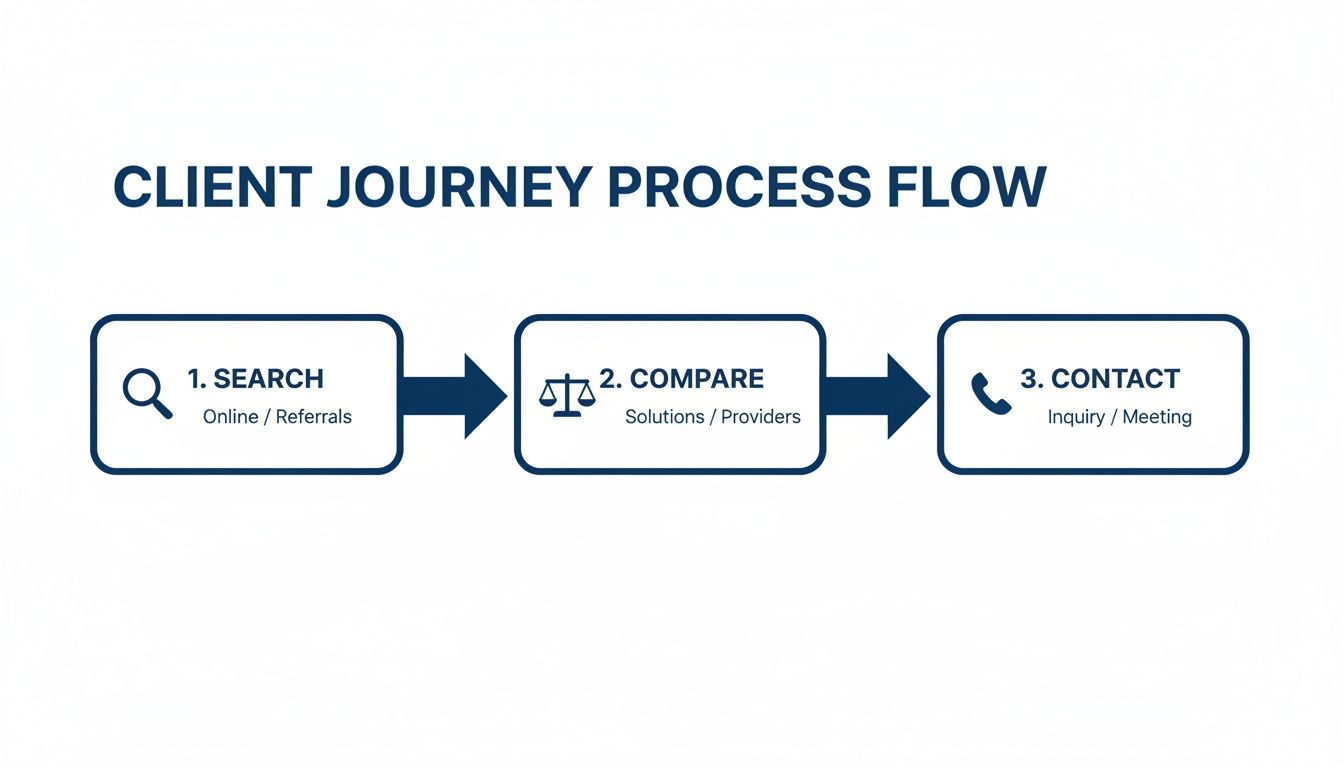
As you can see, after that initial search, clients actively compare their options. This is where a strong UVP becomes make-or-break. Without a clear strategy defining your goals and your unique value, you're just another name on a list, and you'll lose potential clients before they ever pick up the phone.
Designing a Website That Builds Client Trust
When someone is looking for a lawyer, they're often dealing with a stressful, high-stakes situation. Your website is frequently their very first point of contact, and it needs to project confidence and competence from the moment they land on it. It’s not about flashy graphics; it's about creating a digital space that feels professional, secure, and genuinely helpful.

This all begins with a well-thought-out site structure and a user experience (UX) designed specifically for legal clients. Every single element, from your navigation menu down to the colour palette, contributes to building that critical foundation of trust.
Structuring for Clarity and Confidence
A confusing website is the online equivalent of a messy, disorganised office. It kills confidence instantly. A potential client needs to find exactly what they’re looking for—whether that's information on a specific practice area or the profile of a solicitor—without having to think too hard.
Your navigation needs to be crystal clear. Forget generic labels like "Services." Instead, use direct, specific terms that your clients actually use, like "Family Law," "Commercial Litigation," or "Estate Planning."
Within those sections, organise the content to answer a visitor's most urgent questions first. A person searching for a family lawyer is probably going through a tough time. Your site can ease some of that anxiety with a calm, professional design and a reassuring tone. Keep the language straightforward and empathetic, and ditch the complicated legal jargon.
A well-structured website doesn't just present information; it anticipates the user's emotional state and provides a clear, reassuring path forward. This proactive approach to UX is fundamental to building trust.
This thinking also applies to how you showcase your team. Your solicitors' profiles should be easy to find and compelling, highlighting not just their qualifications but the real people behind the credentials.
Crafting Compelling Service and Profile Pages
Your service pages are where potential clients make the call: "Is this the right firm for me?" These pages have to do more than just list what you do. They need to prove you understand their problem and have the expertise to solve it.
Every strong service page should include:
- A Clear Problem-Solution Framework: Start by describing the client's problem in their own words. Then, pivot to explaining exactly how your firm delivers the solution.
- Answers to Key Questions: Get ahead of their concerns. What does the process look like? How long might it take? What can they expect from an initial consultation?
- Relevant Testimonials and Case Studies: Don't bury your social proof on a separate page. A powerful testimonial from a former family law client has the most impact right there on the Family Law service page.
Your solicitor profiles are just as important for building trust. Go beyond a dry CV. Include a professional headshot, a short statement about their personal approach to practising law, and link to articles they’ve written or notable cases. It makes your team feel far more credible and approachable. For more on this, it's worth reading up on high-trust web design for professional services.
Making Contact Effortless
When someone decides they're ready to reach out, you need to make it incredibly easy for them. Any friction at this stage can cost you a client.
Your contact details—phone number, email, and physical address—must be visible on every single page of the site. The header and footer are the standard, non-negotiable spots. Don't make people hunt for it.
Keep your contact forms short and simple. Ask only for what you absolutely need to start a conversation: name, email, phone number, and a brief message. A long, intimidating form is a massive turn-off. The entire journey, from their first click to hitting "submit," has to reinforce that your firm is professional, organised, and ready to help. Of course, a great design needs great content to back it up; our guide on expert website content writing can help you nail the messaging.
Mastering the Technical Side of Your Website
Behind every great law firm website is a powerful technical engine. While things like “server response time” and “accessibility compliance” might sound like they belong to your IT department, every partner needs to grasp why they matter. How your site performs technically has a direct impact on client trust, lead generation, and ultimately, your firm's reputation.
Let’s pull back the curtain on the technical must-haves that separate a high-performing legal website from one that actively turns clients away. These aren’t just nice-to-haves; they're the non-negotiable standards that ensure your digital front door is fast, secure, and open to everyone.
A clunky, slow, or insecure website sends a clear message to potential clients, and it's not a good one. It suggests a lack of attention to detail—a quality no one wants in their legal representation.
Prioritise Mobile Speed and Performance
Think about your potential clients. They're often looking for legal help under stress, on the go, using whatever device is in their pocket. That’s almost always their smartphone. This makes a mobile-first design and lightning-fast load speeds absolutely non-negotiable.
A slow-loading mobile site is a lead-generation killer. It’s that simple. According to Australian law firm marketing benchmarks, a staggering 69% of visitors will abandon a law firm’s website if it loads slowly, with mobile speed being the main culprit. Think about that—nearly seven out of every ten potential clients could be gone before they even see your practice areas.
The data gets even more brutal. Enquiry rates drop by about 12% for every extra second it takes for a page to load. This means a shift from a two-second to a four-second load time could slash your potential leads by roughly 24%.
Your website doesn't get a second chance to make a first impression. In the few seconds it takes to load, a potential client has already judged your firm's efficiency and professionalism.
To make sure your site is up to scratch, you need to focus on key performance indicators. For a deeper dive into what Google is looking for, our guide on catering for Google Core Web Vitals offers a clear breakdown of what you need to know.
Fortify Your Website with Ironclad Security
As a law firm, your duty to protect confidential information is paramount. This ethical obligation extends directly to your website, which is often the first point of contact for sensitive client enquiries and personal data. Ironclad security isn't just a best practice; it's a cornerstone of legal ethics in the digital age.
A security breach, no matter how small, can cause irreparable damage to your firm's reputation. Clients must feel completely confident that any information they share through your website is protected.
Here are the essential security measures your website must have:
- SSL Certificate: This is what gives you the padlock icon and "https://" in the address bar. It encrypts data sent through your contact forms, making it a fundamental requirement for building trust.
- Regular Software Updates: Your website's content management system (CMS), plugins, and themes need to be kept up-to-date. These updates often contain critical security patches that shield you from newly discovered vulnerabilities.
- Secure Web Hosting: Don't cheap out here. Choose a reputable hosting provider that offers robust security features like firewalls, malware scanning, and regular backups. This creates a secure environment for your site from the ground up.
Champion Inclusivity with Web Accessibility
A truly professional website is one that everyone can use, regardless of their abilities. Web accessibility ensures that people with disabilities—including visual, auditory, motor, or cognitive impairments—can navigate and interact with your site's content effectively.
Following the Web Content Accessibility Guidelines (WCAG) isn’t just about doing the right thing; it reflects your firm's commitment to inclusivity and professionalism. An accessible website also broadens your potential client base and helps mitigate legal risks tied to digital discrimination.
Implementing accessibility means getting a few key things right:
- Provide Text Alternatives: All images should have descriptive alt text so that screen readers can describe them to users with visual impairments.
- Ensure Keyboard Navigation: Your website must be fully usable with only a keyboard, as many users with motor disabilities can't use a mouse.
- Use Sufficient Colour Contrast: Text and background colours need enough contrast to be easily readable for users with low vision or colour blindness.
- Add Captions to Videos: Any video content should include accurate captions, making it accessible to users who are deaf or hard of hearing.
By mastering these technical elements, your firm’s website transforms from a simple online brochure into a secure, fast, and inclusive platform that builds trust and effectively converts visitors into clients.
Converting Website Visitors Into Qualified Leads
A visually impressive website is a great start, but let's be honest—if it isn't making your phone ring or filling your inbox with enquiries, it's not doing its most important job. Effective web design for a law firm is about more than just aesthetics; it's a strategic process of turning curious visitors into genuine, qualified leads for your practice.
This means we need to move beyond a simple "Contact Us" page and engineer a conversion-focused experience from the moment someone lands on your site.

The journey from a browser to a client is all about removing friction and building confidence. Every single element on your site should have a purpose, gently nudging the user to take that next logical step.
Let's break down the critical components that transform your website from a digital brochure into a powerful client acquisition tool.
Crafting Compelling Calls to Action
Your calls to action (CTAs) are the signposts on your website telling visitors exactly what to do next. Generic, lazy buttons like "Submit" or "Click Here" are massive missed opportunities. Your CTAs need to be specific, action-oriented, and connect directly with the user's immediate needs and emotional state.
Think about the mindset of someone searching for a lawyer. They're often stressed and looking for clarity and reassurance. A powerful CTA speaks directly to that need.
For instance, which of these sounds more compelling for a family law firm?
- Option A: "Submit Form"
- Option B: "Request a Confidential Consultation"
It's Option B, hands down. It uses empathetic language ("confidential") and clarifies the outcome ("consultation"), making the user feel understood and secure. The goal is to align your CTAs with the specific service they're looking at. A commercial litigation page might use "Schedule a Case Evaluation," while an estate planning section could feature "Start Planning Your Legacy."
Designing Streamlined Intake Forms
Once a visitor clicks your CTA, the intake form is often the final hurdle. A long, complicated form is one of the quickest ways to lose a potential lead, especially when over 60% of legal searches happen on a mobile device.
The key is to ask for only the absolute bare minimum needed to start a conversation.
A good intake form should be:
- Brief and Focused: Stick to the essentials. Name, phone number, email, and a small text box for their issue are usually enough for an initial contact. You can gather the rest of the details on the follow-up call.
- Mobile-Friendly: The form must be dead simple to use on a smartphone, with large input fields and clear labels. A frustrating mobile form experience will cause them to leave almost instantly.
- Secure and Reassuring: A short privacy statement right below the form goes a long way. Reassuring users that their sensitive information is safe with your firm is a small detail that massively boosts trust.
Leveraging Trust Signals to Motivate Action
Before a potential client will even think about sharing their personal details, they need to trust your firm. Strategically placed trust signals are absolutely crucial for overcoming that initial hesitation and encouraging them to make contact.
These are the visual cues that validate your firm's expertise and credibility. Don't just bury them on an "About Us" page—sprinkle them throughout your site, especially right next to your CTAs and contact forms.
Effective trust signals we always recommend include:
- Awards and Recognitions: Displaying logos of legal awards or badges from professional services provides instant third-party validation.
- Bar Association Memberships: Showcasing your affiliation with respected legal bodies reinforces your professional standing and credibility.
- Client Success Stories: A powerful, specific testimonial placed next to a contact form can be the final nudge a visitor needs. A quote like, "They guided me through a complex commercial dispute with exceptional clarity," is far more effective than a generic five-star rating.
By combining sharp CTAs, simple forms, and powerful trust signals, your website stops being a passive online presence. It becomes an active, lead-generating engine that works for your firm around the clock.
Getting Found with Modern Law Firm SEO
Let’s be honest, your firm's expertise doesn't mean much if potential clients can't find you. An incredible website is only half the battle; the other half is getting it in front of the right people at the right time. That’s where a smart, modern search engine optimisation (SEO) strategy comes into play.
SEO for lawyers isn't some dark art full of secret tricks or keyword stuffing. It’s all about proving your authority and making it dead simple for search engines like Google to understand and trust your firm’s expertise. When you get it right, it connects you with clients who are actively looking for the exact services you provide.
Dominate Your Local Market
For most law firms, clients aren't coming from across the country; they're coming from a specific geographic area. This makes local SEO your most powerful weapon for attracting relevant leads. You're not just a "commercial lawyer"; you're a "commercial lawyer in Parramatta," and that distinction is everything.
Optimising for local search means making sure your firm shows up prominently in Google’s map results and local listings when someone nearby needs a lawyer.
Your Google Business Profile is the absolute cornerstone of this strategy. Think of it as your digital storefront in the search results, and it needs to be perfect.
- Complete Every Single Section: Fill out your business name, address, phone number, and opening hours with 100% accuracy. Any inconsistency can hurt your ranking.
- Select the Right Categories: Get specific. Don't just pick "Lawyer." Choose categories like "Family Law Attorney" or "Criminal Justice Attorney" to tell Google exactly what you do.
- Encourage Client Reviews: Positive reviews are a massive trust signal for both potential clients and Google’s algorithm. They’re digital word-of-mouth.
By nailing these local signals, you ensure that when a potential client in your area needs help, your firm is the first one they see.
Create Content That Builds Authority
High-quality content is no longer a "nice-to-have"—it's a fundamental part of a successful web design for a law firm. Your website's blog and service pages are your chance to answer the real questions your ideal clients are asking, establishing your firm as a credible, authoritative voice.
Australian-centred legal marketing research shows a massive opportunity here. While 87% of firms have a website, only about one-third bother to maintain a blog. This is a huge mistake. Firms with active blogs benefit from 434% more indexed pages in search results and receive 97% more inbound links.
If you're wondering about the financial return, our data shows that over three years, a solid law firm SEO strategy can deliver an average ROI of 526%.
Your content strategy should be built around solving problems, not just selling services. Think less about self-promotion and more about providing genuine, helpful answers to common legal questions.
This approach builds trust long before a potential client ever decides to pick up the phone. For a deeper dive into crafting a winning strategy, check out our comprehensive guide on SEO for law firms.
Prepare for the Future of Search
The way people find information is changing. Fast. AI-powered search engines and large language models (LLMs) are now answering complex questions directly in the search results. To stay visible, your site needs to be structured so these new technologies can easily understand it.
This is where structured data (also known as schema markup) comes in. It’s a layer of code you add to your site that explicitly tells search engines what your content is about. You can use it to mark up your firm’s address, your lawyers' credentials, and your specific areas of legal practice.
This helps AI tools confidently recommend your firm as the solution to a user's problem, making sure you get found not just today, but in the search landscape of tomorrow.
Common Questions About Law Firm Web Design
Investing in a professional website for your firm is a big decision, and it’s natural to have questions. We get it. To help clear things up, here are answers to some of the most common queries we hear from legal professionals just like you.
How Much Should a Law Firm Website Cost?
There’s no single price tag. A law firm website can range from a few thousand dollars for a basic template site to well over $50,000 for a completely custom build with advanced features. The final figure really comes down to the complexity, size, and specific tools you need.
Think of it this way: a simple "digital business card" site will be at the lower end. But if you're after a site with a secure client portal, a deep content strategy, and sophisticated SEO to bring in new matters, you’re looking at a more significant investment. It's the difference between a standard sedan and a high-performance vehicle—both get you from A to B, but the experience, features, and results are worlds apart.
How Long Does the Design Process Take?
From our first strategy session to launch day, a typical law firm website project takes between 8 to 16 weeks. This isn't just about coding; it's a comprehensive process that allows for proper discovery, strategic planning, design mock-ups, content creation, development, and rigorous testing.
What can stretch this timeline out? A few things usually come into play:
- The complexity of the design and the features required.
- The sheer number of pages and the volume of content that needs to be written.
- The speed of feedback and approvals from your firm’s key decision-makers.
Can We Update the Website Ourselves?
Absolutely. Any modern website worth its salt should be built on a user-friendly Content Management System (CMS) like WordPress. The whole point is to empower you and your team to handle routine updates without having to call a developer every time.
You should be able to add new blog posts, update solicitor profiles, or post firm news with ease. Of course, for bigger structural changes or design modifications, it’s always best to loop in your web design partner to make sure you don't accidentally break something.
What is the Most Important Element of a Law Firm Website?
If we had to pick just one thing, it’s this: building trust, and fast.
When a potential client lands on your site, they're often in a vulnerable or stressful situation. They need to see, almost instantly, that you are credible, professional, and the right expert to help them. This isn't achieved by one single element, but by a powerful combination of professional design, crystal-clear navigation, compelling solicitor profiles, and undeniable social proof like client testimonials and successful case results.
At Titan Blue Australia, we’ve spent over 25 years building high-performance websites that generate leads and build trust for law firms across Australia. If you’re ready to turn your website into your most valuable asset, see what we can do for you at https://titanblue.com.au.

AI Search Consultant Australia: What They Do, What to Look For, and How to Choose
An AI search consultant helps Australian businesses earn citations in ChatGPT, Perplexity, and Google AI…

AI Search Strategy Australia: A 7-Step Framework for Getting Found in ChatGPT, Perplexity, and Google AI
A practical 7-step AI search strategy framework for Australian businesses wanting to get cited in…

AI Search Marketing Australia: The Complete Strategy Guide for 2026
AI search marketing means getting your Australian business cited by ChatGPT, Perplexity, and Google AI…