

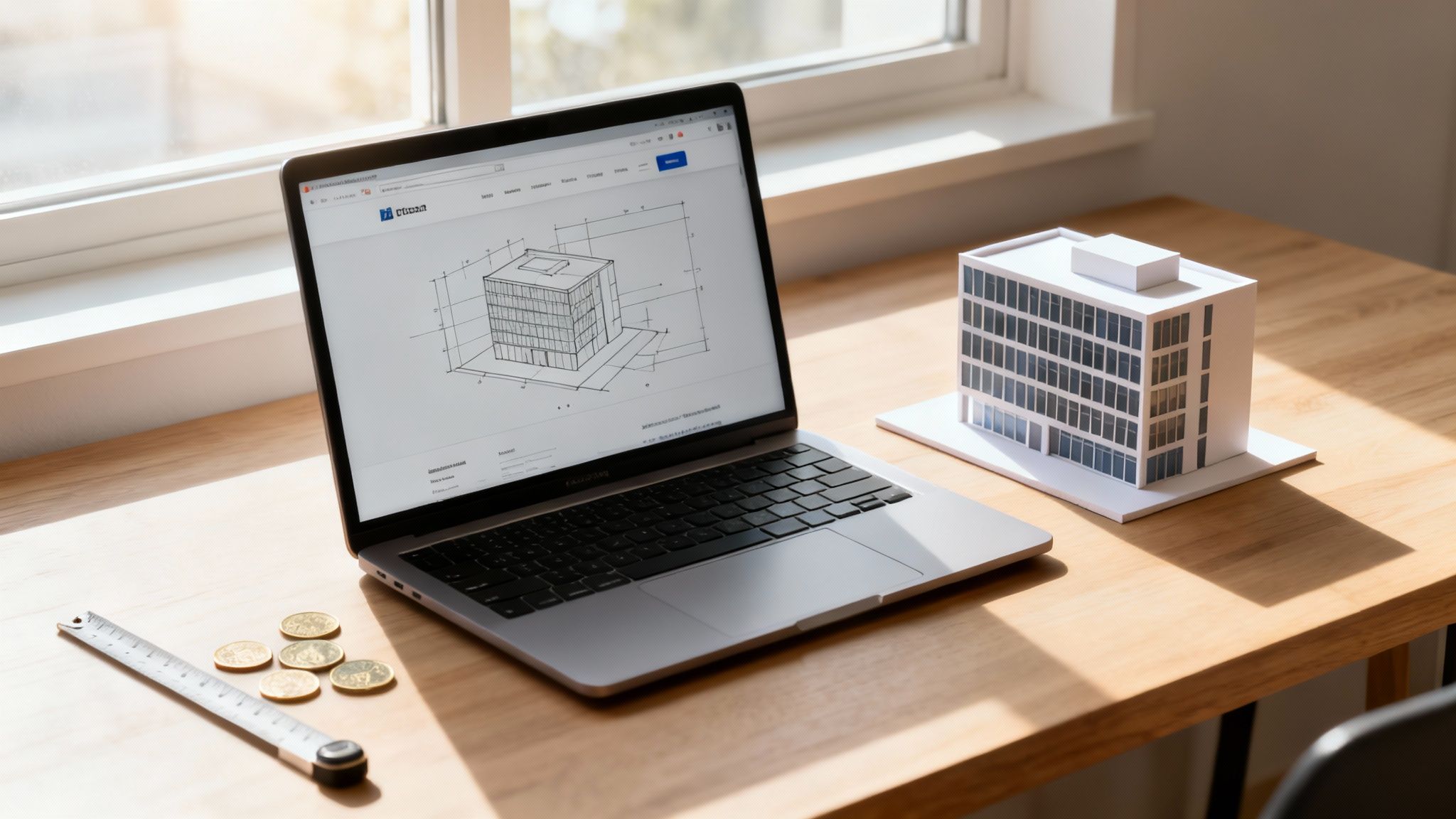
Trying to pin down a single web page design price is a bit like asking for the price of a car. Are you after a small runabout, or a Kenworth prime mover? They’ll both get you from A to B, but their purpose, features, and cost are worlds apart. For any Australian business, a website is a serious investment, not an off-the-shelf product with a one-size-fits-all price tag.
The final cost comes down to your specific goals, the features you need, and just how complex the whole build is.
Decoding the True Cost of Website Design
Think about it like building a commercial property. A small pop-up shop has a completely different budget, timeline, and set of goals compared to a multi-level office complex designed for hundreds of staff. Both are technically "buildings," but their purpose dictates the investment. The same logic applies directly to web design.
Your website is your digital shopfront, and its blueprint has to match what you’re trying to achieve commercially. A local tradie, for instance, just needs a clean, professional site to show off their work and get the phone ringing. But a national fashion brand? They need a powerful e-commerce platform with secure payment gateways, inventory management, and a slick customer experience.
Your Business Goals Define the Blueprint
So, the real question isn't "how much for a website?" It should be, "what does this website need to do for my business?" That simple shift changes the conversation from an expense to a genuine investment.
The objectives that really shape the design—and therefore the price—are things like:
- Generating Qualified Leads: A law firm’s site needs clear calls-to-action, trust-building content, and a simple way for potential clients to book a chat.
- Driving Online Sales: An e-commerce site has to handle transactions securely, manage a product catalogue, and offer a frictionless checkout process.
- Building Brand Authority: A manufacturing company might need a site that showcases technical specs, case studies, and industry know-how to pull in B2B clients.
- Improving Operational Efficiency: A mining company might need a secure client portal to access documents or even a custom web app to streamline internal workflows.
Each of these goals demands a different set of features, a unique design strategy, and a completely different level of technical complexity.
With over 25 years of experience in the Australian market, we’ve seen firsthand that a clear strategy is the bedrock of any successful project. To get a better feel for this, you can learn more about our approach to professional web design and development. This guide will break down what really drives the final price, helping you budget for a website that delivers a real return on your investment.
Typical Website Price Ranges in Australia
Trying to pin down a specific price for a website in Australia is a bit like asking "how much does a building cost?" You wouldn't expect a local café to have the same price tag as a multi-storey office block. Websites are the same—they're categorised by their function and complexity, and the investment reflects what they need to do for your business.
To give you a realistic starting point for budgeting and talking with any digital agency, we can break websites down into a few common tiers.
Foundational Brochure Websites
The simplest form of a professional online presence is what we call a brochure or informational website. Think of it as your digital business card. Its main job is to build credibility, show off your services, and give people a way to contact you.
These sites are a perfect fit for trades, consultants, or local service providers who just need a clean, professional hub to send potential customers. They usually have a handful of core pages: a homepage, an 'About Us' section, a services page, and a contact form.
- Typical Price Range: $3,500 – $7,000 AUD
- Best For: Small businesses that need a credible and professional online footprint.
- Key Features: Custom design, mobile responsiveness, basic on-page SEO, and a straightforward contact form.
Strategic Lead-Generation Websites
A step up from the basic brochure site is the lead-generation website. This kind of site is built with a clear purpose: to actively turn visitors into qualified leads, not just inform them. It's a must-have for service-based businesses like law firms, financial planners, and high-value construction companies.
These websites are more than just an online pamphlet. They often feature strong calls-to-action, dedicated landing pages for marketing campaigns, and trust-building elements like case studies. Sometimes, they'll have simple integrations with a Customer Relationship Management (CRM) system. The investment is higher because the whole point is to build a machine that directly feeds your sales pipeline.
Here in Australia, we're seeing a clear split in website pricing. While DIY builders offer a cheap entry point, professionally built websites typically range from $3,500 to over $10,000 for a standard business site. The sweet spot for many small to medium businesses often lands between $5,000 and $8,000, which gets you a great balance of quality design and strategic features that deliver a real return.
E-commerce and Custom Platforms
For any business selling products directly online, an e-commerce website is essential. This is where the price takes a significant jump because of all the extra complexity involved. You aren't just building a website; you're building a secure, efficient, and user-friendly online store.
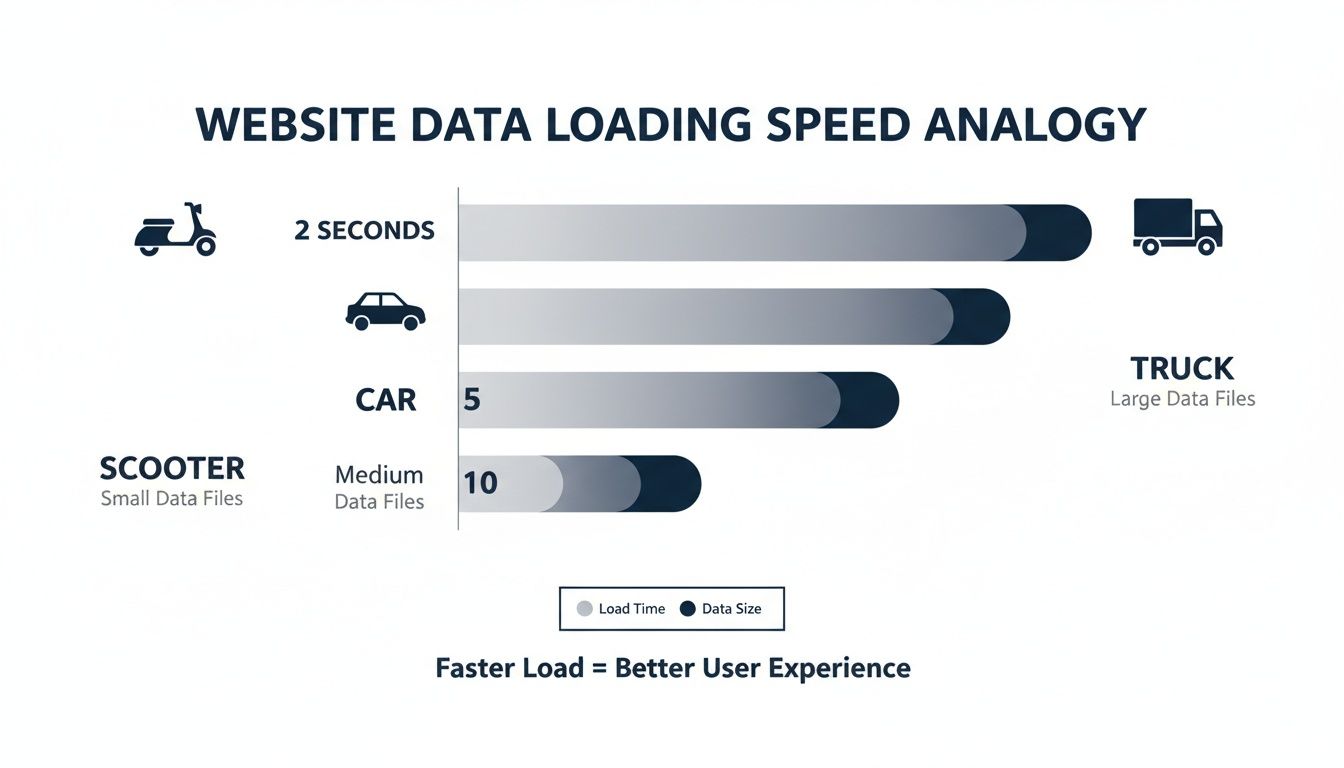
This visual helps put the investment into perspective. A simple site is like a scooter—quick and easy for small jobs. A complex e-commerce platform is more like a heavy-duty truck, built for specific, demanding tasks.
Key functionality for an e-commerce site includes:
- Secure Payment Gateways: Integrating systems to safely handle credit card payments.
- Product Catalogue Management: The ability to easily add, update, and sort hundreds or even thousands of products.
- Inventory and Shipping Logic: Systems that track stock levels and calculate shipping costs automatically.
Going even further, some businesses in sectors like mining or manufacturing need custom web applications. These are highly specialised platforms built from the ground up to solve unique business problems, like a secure client portal for sharing sensitive documents or a system that connects with proprietary industrial software. Because these projects are completely bespoke, the costs are substantially higher and require deep, detailed scoping.
Our own Titan Launch Business Website Design package is a great example of a strong foundation designed for businesses ready to establish a professional and effective online presence from the get-go.
How Web Design Agencies Structure Their Prices
Figuring out how agencies arrive at their web page design price is key to setting a realistic budget. It’s rarely as simple as picking a service off a menu. Instead, agencies use different pricing models that fit the project's size and complexity. Think of it like hiring a builder—the way you pay differs depending on whether it’s a brand-new build, a small renovation, or just ongoing maintenance.
Each approach has its own perks and potential pitfalls. Getting your head around these structures means you can have a far more productive chat with a potential agency, helping you land on an arrangement that suits your project, budget, and business goals.
Let's pull back the curtain on the three most common ways agencies price their work.
Fixed Project Price
The fixed project price is easily the most common and straightforward model you'll come across for a website build. It’s like getting a quote for a full house construction—you agree on a detailed scope of work upfront, and the agency gives you a single, all-in price to get that exact job done.
This model gives you maximum budget certainty. You know exactly what you’re in for financially before a single line of code is written, which is a massive plus for planning. The flip side is its rigidity. If you get halfway through and decide you want to add a new feature or another page, that usually means hitting pause, getting a new quote, and making a formal change to the scope.
It's the perfect fit for projects with crystal-clear requirements, like a standard business website or a specific campaign landing page where the goals are locked in from day one.
Hourly Rate Model
An hourly rate model is all about flexibility. This is your "pay-as-you-go" renovation. The agency tracks the time spent on design, development, meetings, and any changes you request, then bills you for those hours, usually on a weekly or fortnightly cycle.
The big win here is adaptability. It’s ideal for projects where the scope isn't set in stone or for ongoing tasks like fixing bugs on an existing site. You only pay for the work that’s actually done, which can be really cost-effective for smaller, less-defined jobs.
The obvious downside, though, is the lack of cost certainty. Without a hard cap, the final web page design price can creep up if the project scope expands or takes longer than expected. This model really relies on a high level of trust and transparent communication to keep the budget on track.
Retainer Agreements
Finally, we have retainer agreements, which are built for long-term partnerships, not one-off projects. This is like having a property manager on call to handle all the continuous maintenance, security, and upgrades for your building. You pay a set monthly fee, and the agency dedicates a certain amount of time or resources to your website every month.
Retainers are perfect for businesses that need more than just a website launch. They cover all the crucial ongoing work that keeps a site running smoothly, like:
- Regular security updates and performance checks.
- Rolling out new features or design updates as your business evolves.
- Ongoing Search Engine Optimisation (SEO) and content refreshes.
- General tech support and strategic advice.
This model gives you the peace of mind that a professional team is actively looking after your most important digital asset. The predictable monthly cost makes budgeting a breeze and ensures your site stays secure, relevant, and effective long after it goes live. For businesses on the Gold Coast wanting a long-term partner, exploring a comprehensive business website design service that includes ongoing support is often the smartest move.
What Really Goes Into Your Final Website Cost?

Trying to understand what drives your final web page design price is a bit like customising a new car. You have the base model at a set price, but every extra you add—leather seats, a bigger engine, a top-tier sound system—adds to the final bill. Websites work exactly the same way. Each feature serves a purpose and adds a different kind of value.
A professional quote isn't just a single number; it's a breakdown of all those "optional extras." It shows you what’s needed to build a digital asset that actually hits your business goals. When you understand these key cost drivers, you can see precisely where your money is going and which features will deliver the best return.
This transparency helps you make smarter decisions. You won't overpay for things you don't need, and more importantly, you won't underinvest in the elements that will genuinely grow your business.
Design and Development Complexity
The biggest factor in your website's cost is the level of customisation. Are you happy with a pre-built template, or do you need a completely bespoke design built from the ground up?
- Template-Based Websites: These use a pre-designed layout as a foundation. They're more affordable but offer limited flexibility for unique branding or specific user experiences.
- Custom-Designed Websites: A custom build means creating a unique design tailored specifically to your brand and goals. It costs more, but you get a one-of-a-kind digital presence that's perfectly aligned with your vision.
Beyond the look, development complexity plays a massive role. A simple five-page brochure site with static information is far less complex to build than a site with interactive animations or a members-only login area. Every unique function requires specialised coding and rigorous testing, which directly impacts the hours needed and, ultimately, the price.
Scope and Scale of the Project
The sheer size of your website is another major cost driver. A bigger site with more pages and deeper navigation simply takes more time to design, develop, and fill with content.
Think about these variables:
- Number of Pages: A 5-page site will naturally cost less than a 50-page one. Each page needs to be designed, populated with content, and optimised.
- Content Creation: Are you supplying all the text and images, or do you need professional copywriting and photography? High-quality content is non-negotiable for engagement and SEO, but it's a specialised skill that adds to the budget.
- E-commerce Functionality: If you plan on selling products online, the project scope expands dramatically. Adding a shopping cart, secure payment gateways, product pages, and inventory management is a complex job that significantly increases the cost.
The scope also covers the level of polish. Things like custom-designed icons, detailed animations, or interactive infographics all add to the development time and overall investment.
Integrations and Special Features
Modern websites rarely stand alone. They often need to "talk" to other software to streamline business operations, and that’s where integrations come in.
Each integration adds another layer of technical complexity. For example, connecting your website to a CRM system like Salesforce allows you to automatically capture leads. Similarly, integrating a booking system for a restaurant or a scheduling tool for a law firm adds huge value but requires development expertise.
Web design pricing in Australia reflects this. A basic website for a small business might start around AUD $4,000, while e-commerce sites often fall between AUD $5,000 and AUD $15,000. For businesses in competitive markets like Sydney, a sophisticated online store could range from AUD $10,000 to AUD $30,000. Custom, feature-heavy websites with backend systems and APIs will easily exceed AUD $15,000, reflecting the specialised work involved.
Ongoing Investments
The initial build is just the start. To keep your website running securely and effectively, you need to budget for ongoing costs.
- Hosting: This is the 'rent' you pay for your website's spot on the internet. Quality hosting ensures your site is fast, reliable, and secure. To manage this effectively, it pays to understand how to choose a web hosting provider.
- Maintenance: Websites need regular updates to protect against security threats and ensure everything keeps working correctly. A professional maintenance plan is a must-have for any serious business website.
- SEO and Digital Marketing: A beautiful website is useless if no one can find it. Search Engine Optimisation (SEO) is a crucial ongoing investment to attract free traffic from search engines like Google. This involves creating content, technical tune-ups, and building your site's authority over time. You can learn more about the top 7 elements for high-performing website design that help boost your search visibility.
Understanding the Hidden Costs and Long-Term Value
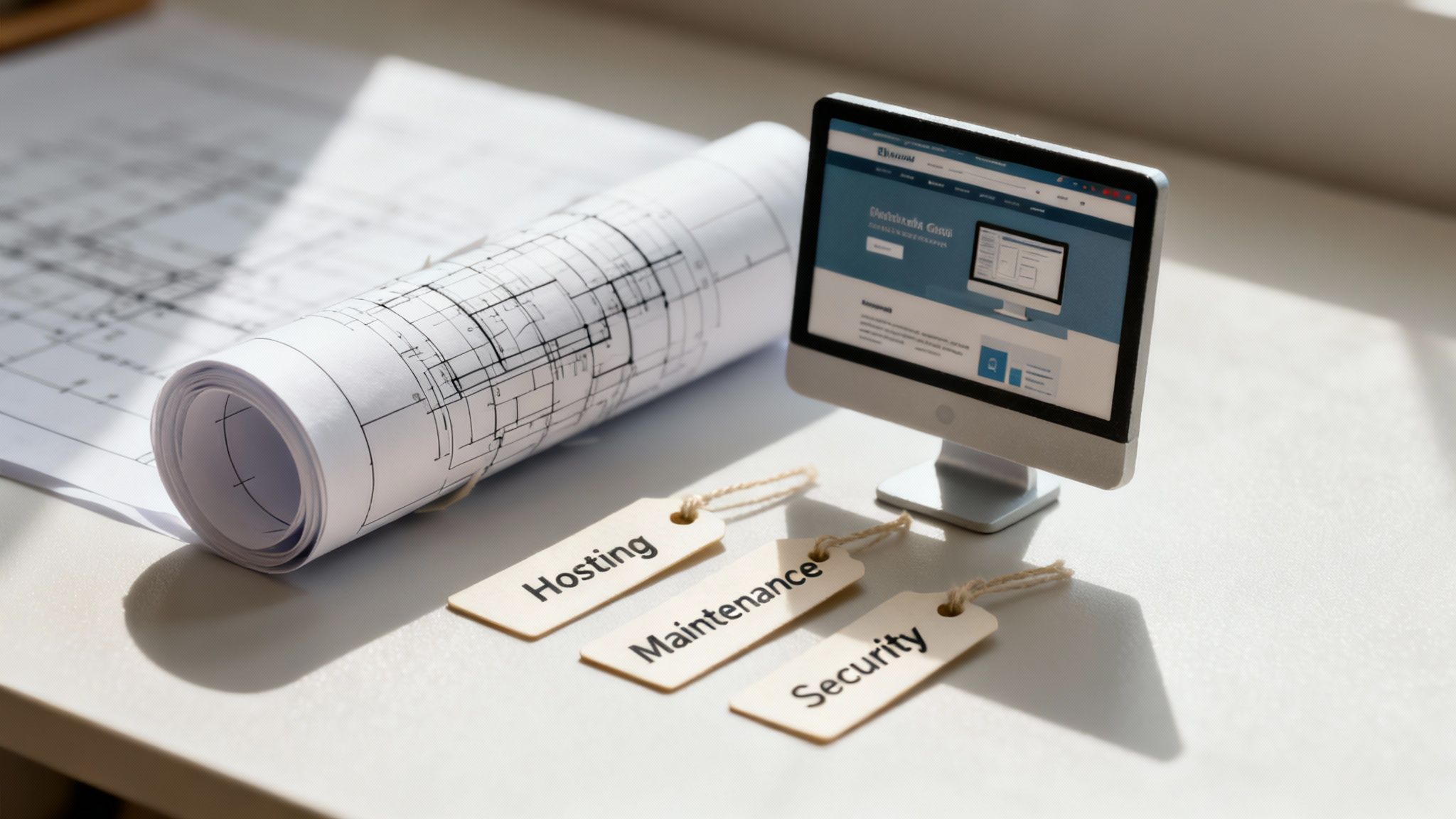
The initial quote for a new website is just the beginning of the story. Focusing only on the upfront web page design price is like buying a house based on the deposit alone; it completely ignores the total cost of ownership that really determines its long-term value. A cheap build can quickly turn into a costly headache down the track.
This is where the idea of ‘time debt’ really hits home. If you opt for a cut-price solution, you often end up paying for it later with your own time and money—fixing bugs, patching security holes, and trying to speed up a sluggish site. A professionally built website is a bigger investment upfront, but it’s an asset engineered for growth, not just for launch day.
Uncovering the Ongoing Expenses
Beyond the initial design and development fees, there are several recurring costs that are essential for keeping your website live, secure, and actually doing its job. These aren't optional extras; they're the fundamental running costs for any serious business website.
These ongoing investments include:
- Domain Name Registration: This is your website's address on the internet, which needs to be renewed every year. It’s a core digital asset, and understanding how to value domain names can help you appreciate this crucial piece of digital real estate.
- Quality Web Hosting: Think of this as the rent you pay for your website's spot online. Premium hosting makes sure your site is fast, reliable, and secure, which directly impacts user experience and how you show up in search results.
- Security Certificates (SSL): An SSL certificate is non-negotiable today. It encrypts the connection between your site and its visitors, protecting their information and showing both users and Google that you can be trusted.
Forgetting to budget for these is a common mistake that can undermine your entire project. They are the foundational services that keep your site performing day in and day out.
The True Cost of Neglecting Maintenance
One of the most critical—and frequently overlooked—expenses is ongoing website maintenance. A website isn't a static brochure; it's a dynamic piece of software. The code, plugins, and frameworks it’s built on all need regular updates to stay secure and functional.
Ignoring maintenance is like never servicing your car. It might run okay for a while, but eventually, small issues will snowball into major, expensive problems. Our website maintenance package is designed to handle this proactively, making sure your site remains a secure, high-performing asset.
Investing in a professional maintenance plan isn't an expense; it's insurance against data breaches, crashes, and lost revenue. It protects the integrity of your initial investment and ensures your digital storefront is always open for business.
Why Local Australian Expertise Matters
Working with a local agency gives you more than just convenience; it provides a crucial layer of protection. An Australian agency understands the specific regulatory landscape your business operates in, which is a massive factor in its long-term value.
Recent analysis shows that Australian-specific compliance costs—like handling GST correctly and adhering to the Privacy Act—can add 10–15% to project costs compared to overseas alternatives. While DIY tools tempt businesses to cut corners, they often find themselves sinking 60+ hours into fixes and revisions, creating a ‘time debt’ that eats away any initial savings. For Australian businesses, an investment between AUD $5,000–$12,000 with a local agency provides vital compliance management and quality assurance.
This local knowledge is invaluable. It protects you from future headaches and ensures your site is built to meet Australian standards from day one, turning your website from a potential risk into a secure, growth-driving asset.
Common Questions About Website Design Prices
Figuring out web design costs can feel a bit like navigating a maze. When you're trying to pin down a realistic budget, plenty of questions pop up. Here, we'll give you straight answers to the most common queries we hear from Australian business owners, so you can feel confident about your investment.
Why Is There No Simple Price List for a Website?
A professional website isn’t an off-the-shelf product; it’s a custom-built tool designed to hit your specific business goals. That’s why the web page design price is entirely based on your unique needs.
Think of it like asking a builder for a price list for a "building." Is it a small retail kiosk or a multi-level commercial office? The costs are worlds apart. It's the same with websites—a simple five-page informational site for a local plumber will have a very different price tag than a 50-product e-commerce store for a fashion brand. An agency first needs to understand your objectives, audience, and the features you need to give you an accurate price for a solution that will actually deliver results.
How Much Should a Small Business in Australia Budget?
For most small to medium-sized businesses here in Australia, a realistic budget for a professional website built by an experienced agency usually lands in the AUD $5,000 to $12,000 range. This investment typically gets you a custom design, mobile responsiveness, foundational SEO, and proper project management.
Simpler "brochure" style websites might start around $3,500. On the other hand, if you need e-commerce functionality, custom software integrations, or a lot of content created for you, the budget will naturally be higher. It's so important to see this as an investment in a core business asset. A cheaper site often costs you far more in the long run through lost leads, poor performance, and security headaches.
What Are the Ongoing Costs After My Website Is Built?
The initial build price is just the beginning. To keep your website secure, fast, and working for you, there are a few essential ongoing costs you need to factor in.
These are the three main ones:
- Web Hosting: This is basically the 'rent' you pay for your site's home on the internet. Good quality hosting is vital for speed and security, typically costing between $30 and $100+ per month.
- Domain Name Registration: This is your website's address (like titanblue.com.au), which you renew every year for about $20 to $50.
- Website Maintenance: This is non-negotiable for security and performance. It involves regular software updates, security scans, and backups to prevent hacks and fix bugs before they become big problems. Professional maintenance plans from an agency ensure your site stays protected and performs well, often costing between $100 and $500 per month.
These aren't optional extras; they're necessary investments to protect your digital asset and make sure it keeps working for you.
Does the Price Include SEO and Content Writing?
This is a fantastic question to ask, and the answer really depends on the project scope. Most reputable agencies include foundational 'on-page' SEO in the initial build. This covers the essentials like a logical site structure, optimised page titles, and a mobile-friendly design that Google loves.
However, a full-blown SEO campaign—which involves ongoing content strategy, keyword research, and building your site's authority—is almost always a separate, ongoing service.
Similarly, content writing is often quoted as a separate line item. Some business owners prefer to provide their own text and images, while others invest in professional copywriting to make sure the messaging is sharp, persuasive, and optimised for search engines. Always clarify with a potential agency exactly what's included in their price to avoid any surprises. A clear understanding from the start ensures everyone is on the same page.
At Titan Blue Australia, we believe in total transparency and building genuine partnerships. With over 25 years of experience helping Australian businesses succeed online, we build websites that are not just beautiful, but are powerful assets designed for long-term growth. If you're ready to invest in a website that delivers real returns, let's talk about your project today.
Discover our custom web design solutions at titanblue.com.au
Make Titan Blue a preferred source in Google
One click tells Google to surface our articles more often in Top Stories, AI Overviews and AI Mode.
Solar Installer Website Design Australia: The 2026 Guide
How solar installer websites in Australia should show CEC accreditation, real install proof and AI-ready…

Hotel & Hospitality Website Design Australia: 2026 Guide
Hotel and hospitality website design in Australia explained: booking flow, schema, AEO and what actually…

Restaurant Website Design Australia: The 2026 Guide
What a restaurant website in Australia needs: HTML menus, bookings, GBP sync, schema, and AI-ready…