

Last updated:
Let's be blunt: being a fantastic dentist isn't enough anymore. In Australia's crowded dental market, your ability to consistently bring new patients through the door is what separates a thriving practice from one that's just getting by.
Without a predictable way to fill your chairs, even the most skilled clinician faces the stress of an unpredictable schedule. This is where a sharp dentist SEO marketing strategy comes in. It’s not just marketing fluff; it’s a powerful magnet for local patients who are actively looking for a dentist right now.
Think of it this way: SEO is the digital equivalent of setting up your practice on the busiest, most visible corner in town. It’s what makes your clinic pop up when someone frantically searches for an "emergency dentist near me" or looks up "cosmetic dentistry Gold Coast." You become the immediate, trusted solution.
Why Your Dental Practice Needs a New Patient Magnet
The simple truth is you’re operating in a saturated market. With around 16,500 dentists competing for patients across Australia, many practices are running below capacity. This makes a strong online presence completely non-negotiable if you want to stand out.

We've seen the results firsthand. A single-location dental practice in a major Australian city was struggling to compete. Over six years, a dedicated SEO campaign took them to number one for their most competitive search terms, making them the top practice in their area. It’s a powerful example of what’s possible—you can read the full story about this dental marketing success.
When done right, a solid SEO strategy delivers real, tangible benefits that directly boost your bottom line:
- You Get Seen: It puts your practice front and centre the exact moment a potential patient is searching for dental services. No wasted effort.
- You Build Trust: High search rankings create instant credibility. People naturally see the top results as more authoritative and reliable.
- You Grow Sustainably: Unlike paid ads that vanish the second you stop paying, a strong SEO foundation brings in a steady, reliable flow of organic traffic and new patient enquiries for the long haul.
At the end of the day, SEO isn't just about keywords and rankings. It's about making it ridiculously easy for people in your community to find you, trust you, and choose you for their dental care. This guide is your practical, step-by-step playbook to build that connection and turn your website into an engine that reliably acquires new patients.
Winning The 'Dentist Near Me' Search Every Time
When a potential patient gets a sudden toothache or finally decides it’s time for a check-up, they don't reach for the phone book. They pull out their phone and search for "dentist near me" or "emergency dentist Broadbeach."
That's it. The battle for that new patient is won or lost in that exact moment, right there in the Google 'map pack'.

Your Google Business Profile (GBP) is your digital storefront. It’s hands-down the most powerful tool in your local dentist seo marketing arsenal. It's the difference between being the top, trusted choice and being completely invisible when it matters most. A fully optimised profile doesn't just list your address; it actively works to attract and convert local patients for you.
You can't overstate the importance of this local focus. A massive 46% of all Google searches in Australia now have local intent. That's a clear signal that nearly half the population is using these listings to find services just like yours. And with 88% of these local searches happening on a mobile device, your visibility on-the-go is everything.
Nailing Your Google Business Profile Optimisation
Just claiming your profile is the bare minimum. To really dominate the map pack, you need to treat your GBP with the same care and attention you give your physical clinic. That means methodically filling out and enhancing every single section. This gives both Google and potential patients the signals they need to see you as a high-quality, active practice.
Start with your service categories—a critical area many practices get wrong. Your primary category should obviously be "Dentist," but don't stop there. Get specific with secondary categories that reflect your most valuable services.
- Cosmetic Dentist
- Dental Implants Provider
- Emergency Dental Service
- Orthodontist
This detail helps Google match your practice to more specific patient searches, like "dental implants near me," which dramatically increases your chances of showing up. A well-rounded profile provides a comprehensive picture, which is essential for effective local SEO for businesses.
Your business description is another piece of prime real estate. Forget the generic mission statement. Use this space to speak directly to your ideal patient's pain points. Highlight what makes your practice unique—mention your gentle approach, advanced technology, or specialisation in anxious patient care. A compelling business description is your one-minute elevator pitch. It should instantly communicate your value and build a connection, turning a searcher into a prospective patient before they even visit your website.
Engage Directly With Patients On Your Profile
A static, set-and-forget profile is an ineffective one. Google rewards businesses that actively use its features because it creates a better experience for searchers. By using these tools, you transform your listing from a simple directory entry into a dynamic marketing channel that works for you.
Showcase your practice with high-quality photos. Post pictures of your clean, modern clinic, your friendly team, and the technology you use. Real photos of smiling staff members are far more welcoming than generic stock images.
Use Google Posts to your advantage. Think of these as mini-adverts that appear directly in your search listing. Share practice updates, announce new patient offers, or promote a recent blog post about the benefits of Invisalign.
Answer questions promptly in the Q&A section. If a potential patient asks about parking or your health fund policies, answering quickly and publicly shows you're responsive. It builds trust not just with that person, but with everyone else who sees it.
Finally, the absolute bedrock of local SEO is consistency. Your practice's Name, Address, and Phone number (NAP) must be identical across your website, your GBP, and every other online directory. Any variation, no matter how small, can confuse search engines. This consistency is a massive trust signal that solidifies your digital footprint and ensures patients always find the right information.
Building a Website That Converts Visitors into Patients
Getting potential patients to your website is only half the job. Once they land on your page, your site has to do the heavy lifting: convincing them you’re the right choice and making it dead simple to book an appointment. Your website shouldn't just be a digital brochure; it needs to be a high-performance patient conversion engine.
This all starts with knowing what patients are actually searching for. Effective dentist seo marketing is built on a solid foundation of smart keyword research. You have to get inside the mind of someone with a toothache or considering a cosmetic treatment and figure out the exact phrases they’re typing into Google.
Speaking Your Patient's Language
Forget generic terms like "dentist." You need to focus on high-intent, location-specific keywords that signal someone is ready to act. Think like a local patient who’s in pain or someone seriously looking into a big procedure.
They aren't just looking for information; they're looking for a solution right near them.
- Instead of "dental implants," a potential patient on the Gold Coast will search for "dental implants Gold Coast."
- Someone with a sudden, painful toothache will be frantically looking for an "emergency dentist Broadbeach."
- A parent searching for specialised care for their child might type in "paediatric dentist near me."
These are the terms that actually drive bookings. Once you have a list of these core keywords, you must strategically weave them into the fabric of your website. This means your page titles, meta descriptions (that little summary under the title in search results), and page headings (H1s, H2s) all need to be on point. This is how you tell search engines exactly what your pages are about, helping you rank for the queries that truly matter.
A website without strategic keyword placement is like a clinic with no sign on the door. Patients might walk past, but they'll have no idea what you offer or why they should come inside. Every single page needs a clear purpose defined by the keywords it targets.
Creating Dedicated Service Pages That Rank
One of the biggest mistakes I see dental practices make is cramming all their services onto one generic "Our Services" page. This is a massive missed opportunity for both patient education and SEO. Each core service you offer—from Invisalign to root canals—deserves its own detailed, high-quality page.
Imagine a potential patient researching cosmetic dentistry. A dedicated page on "Porcelain Veneers" that answers their questions, shows off before-and-after photos, and walks them through the process is far more valuable than a single bullet point on a long list of services.
These dedicated pages allow you to:
- Target Specific Keywords: You can fully optimise a page for terms like "teeth whitening Brisbane" without diluting its focus.
- Educate Patients Thoroughly: By addressing costs, procedures, and benefits upfront, you build trust and position your clinic as the go-to expert.
- Improve Conversion Rates: A user who finds exactly what they're looking for is much more likely to pick up the phone and book a consultation.
After you've nailed your SEO and started attracting visitors, the next crucial step is turning those visitors into actual patients. Learning about optimizing landing pages for conversions is key to making sure your traffic doesn't go to waste.
Mastering the Technical Non-Negotiables
Beyond your content and keywords, the technical health of your website is a make-or-break factor. It affects everything from user experience to your search engine rankings. If your site is slow, clunky, or insecure, potential patients will leave, and Google will definitely notice.
Think of these technical elements as non-negotiable. They are the essential foundations of a website that actually converts.
Blazing-Fast Speed
A site that takes more than three seconds to load will lose a huge chunk of its visitors. Patients are impatient, especially on their phones, and a slow website just feels unprofessional.
Mobile-First Design
The vast majority of local searches happen on smartphones. Your website absolutely must look and function perfectly on a small screen, with easy-to-tap buttons and text that you don't need to zoom in on to read.
Rock-Solid Security (HTTPS)
An SSL certificate (that's the "https" in your URL) is a must. It encrypts data, providing a critical trust signal for patients entering their personal info, and it's a confirmed Google ranking factor.
Simple Navigation
A confusing menu is a fast track to a lost patient. Your site structure should be intuitive, letting visitors find info about your services, team, and contact details in just a couple of clicks. A great user experience is at the heart of any successful dental website design.
Creating Content That Answers Patient Questions
Effective content marketing isn't about listing your services. It’s about building a bridge of trust with potential patients long before they even think about booking an appointment, positioning your practice as the go-to authority in your local community.
You do this by directly answering the real questions people have when they’re deep in the research phase. A sharp content strategy acts as a powerful part of your dentist seo marketing, pulling in high-quality traffic from people who aren't just browsing—they're actively looking for solutions.
And as search engines get smarter, especially with AI-driven answers becoming the norm, providing direct, expert information is no longer a "nice-to-have." It’s absolutely essential for visibility.
Adopting a Patient-First Content Mindset
It's time to stop thinking like a dentist and start thinking like a patient. What are their worries? What are they frantically Googling at 10 PM when a toothache suddenly hits? Your website’s content needs to be the answer they find.
This is the core of what Google calls Expertise, Authoritativeness, and Trustworthiness (E-A-T), a non-negotiable ranking factor in the healthcare space. You prove your E-A-T by creating content that’s genuinely helpful, factually accurate, and clearly written by a dental professional.
Think about the common questions your front office staff answers every single day. Those are content goldmines. Turning those everyday conversations into blog posts or detailed FAQ pages is a simple but incredibly effective way to start.
Brainstorming High-Impact Content Topics
Coming up with ideas doesn't have to be a grind. Start with the most common queries you hear in the clinic. These topics aren’t just what patients want to know; they also align perfectly with high-value search keywords.
Here are a few high-impact content ideas to get you started:
- Answering Common Concerns: Create blog posts that tackle specific patient worries head-on. Think "Are Dental Implants Painful?" or "5 Signs You Might Need a Root Canal." This kind of content builds immediate trust and authority.
- Detailed Service Guides: Go deep on your high-value treatments. A comprehensive page like "The Complete Guide to Invisalign in Your City" can attract highly motivated patients ready to take the next step.
- Cost and Insurance Breakdowns: Transparency is a massive trust-builder. Articles like "Understanding the Cost of Cosmetic Dentistry" will attract patients who are much further along in their decision-making process. For expert advice on building out your website's content, consider these insights on professional content writing on your website.
Building a library of helpful, patient-focused content transforms your website from a simple online brochure into a dynamic resource. It consistently draws in your ideal patients by answering their questions before they even think to ask them.
By focusing on these practical topics, you'll build a content calendar that works for both your patients and your search rankings. It's this consistent effort that drives long-term success.
The competition for attention online is fierce. With over 92% of Australian searchers never clicking past Google's first page, getting to the top is non-negotiable for a steady stream of new patients. To compete, a dental website often needs at least 30 pages of high-quality, optimised content that blends local SEO with a solid content structure. This is how you turn search queries into loyal patients.
Building a Five-Star Reputation with Patient Reviews
In healthcare, trust is everything. For a modern dental practice, that trust is increasingly built online before a patient even picks up the phone. Your digital reputation is the new word-of-mouth, and it’s all shaped by what other patients are saying about you. This makes managing patient reviews a core pillar of any serious dentist SEO marketing strategy.
A steady stream of recent, positive reviews sends powerful signals to everyone who matters. For potential patients, it’s the social proof they need to feel confident in your care. For Google, it’s a massive indicator of your authority and relevance, directly influencing how high you appear in local search—especially in that all-important map pack.
Encouraging Reviews Without Being Pushy
So, how do you get more reviews? The secret is to make it a completely natural and simple part of the patient experience. The absolute best time to ask is right after a positive appointment when the quality of your care is fresh in their mind. Nobody likes an aggressive or desperate request; it just feels awkward. Your approach has to be subtle but effective.
This is where automated follow-ups are a game-changer. A simple, friendly SMS or email sent a few hours after an appointment can work wonders. The message can thank the patient for coming in and gently nudge them to share their feedback on your Google Business Profile.
Here are a couple of simple, proven approaches:
- Post-Appointment SMS: "Hi [Patient Name], thanks for visiting us at [Practice Name] today! We'd love to hear about your experience. You can leave us a quick review here: [Link]."
- Email Follow-Up: A slightly more detailed email is a great touch. You can express your gratitude and briefly explain how their feedback helps not just your practice, but other locals looking for a great dentist.
The goal is to weave this into your standard patient communication. It should feel like a normal, gentle part of your process, not a clunky, one-off marketing task.
Responding to Every Single Review
Getting reviews is only half the job. How you respond is where you really show that your practice is committed to patient care. Responding to every single review—the good and the bad—is non-negotiable. It shows you’re engaged, you value feedback, and you care about the patient experience long after they’ve left the chair.
For positive reviews, a personalised thank you is huge. Ditch the generic, copy-paste responses. If you can, mention a specific detail from their review, like, "We're so glad you felt comfortable during your procedure!" It proves a real person is reading and appreciating their kind words.
Negative reviews can feel like a punch to the gut, but they’re actually a golden opportunity. A professional, empathetic, and quick response can turn a public complaint into a showcase of your incredible customer service. The trick is to take the conversation offline fast, while publicly acknowledging their concern. A great response follows a simple formula: acknowledge, apologise, and act.
For example: "Thank you for your feedback. We're sorry to hear your experience didn't meet your expectations. Please contact our practice manager at [Phone Number] so we can address this directly."
Your public responses to reviews are not just for the person who wrote them; they are for every potential patient who reads them. A thoughtful reply to a negative comment can often be more powerful than a dozen five-star reviews.
This proactive approach is a vital part of your digital presence. Effectively managing your online reputation and Google Business Profile is a specialised skill that directly impacts patient acquisition. For a deeper dive, you can learn more about how online reputation and Google My Business management can transform your practice's visibility. Ultimately, treating your reviews as a continuous conversation with your community builds a resilient, trustworthy brand that attracts new patients for years to come.
Your Dentist SEO Marketing Implementation Plan
Alright, let's tie all these strategies together into a real, actionable plan. This is the point where all the talk stops and the hard work of growing your patient list actually begins.
It's crucial to understand that a successful dentist SEO marketing campaign is a marathon, not a sprint. We see so many practices get frustrated because they expect to see results overnight. That's just not how it works. You have to be in it for the long haul.
The first few months are all about getting your house in order. We start by building a rock-solid technical foundation—fixing website speed, nailing mobile usability, and sorting out critical local SEO elements like your Google Business Profile. Think of this as laying the concrete slab for a new house; it has to be perfect before you can start building up.
A Realistic Timeline For Results
Building real authority and trust with Google takes patience and consistent, daily effort. It's not a 'set and forget' task. After the foundational work is done, the focus shifts to creating genuinely helpful content and building a stellar online reputation through patient reviews. It’s a slow burn that gradually picks up steam over several months.
If you’re wondering what that journey looks like, getting a handle on how long SEO takes to work is essential for setting expectations that match reality.
This timeline below breaks down the typical journey, showing you the foundational, content, and optimisation stages we follow.
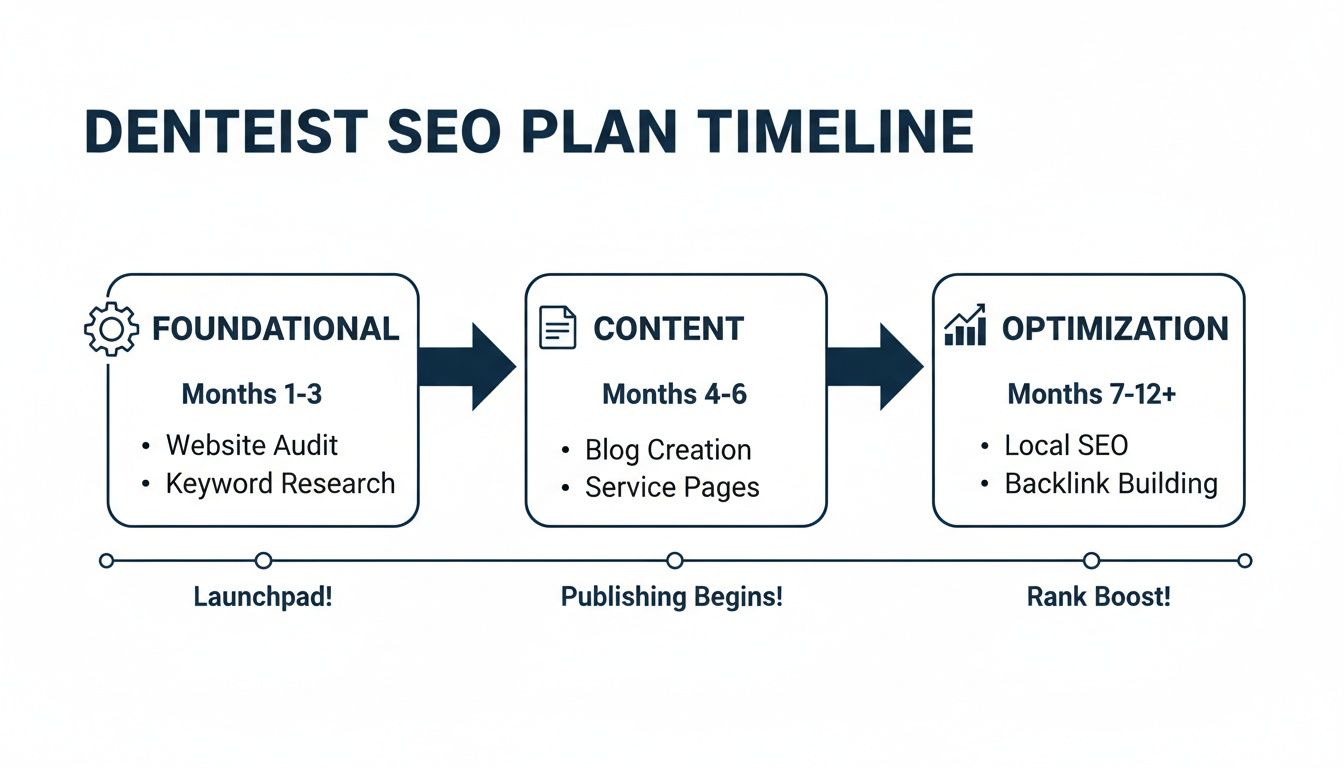
As you can see, SEO is an investment. The results compound over time, leading to a steady stream of new patients long after the initial heavy lifting is complete. You'll know it's working when you start tracking the key metrics that matter: more organic traffic, higher keyword rankings, and most importantly, more appointment requests coming through your website.
Your Top Dentist SEO Questions Answered
Jumping into digital marketing can feel like a minefield of questions. Let's cut through the noise and tackle some of the most common queries we hear from dental practice owners about using SEO to grow their patient list.
How Long Does It Take to See Results from Dentist SEO Marketing?
This is the big one, and the honest answer is: it’s a long game. While you might see some initial movement in local rankings within 3-4 months, the real, lasting results from a solid dentist SEO campaign typically start to show up between 6 to 12 months.
Think of it like building a reputation in your community—it doesn't happen overnight. SEO builds your digital authority over time. The first few months are all about laying the groundwork: fixing technical issues, optimising your website pages, and cleaning up your online listings. After that, it's about consistently creating helpful content and building your presence, which delivers compounding returns down the track.
Can I Do SEO for My Dental Practice Myself?
You can definitely handle some of the basics yourself, and you should! Things like updating your Google Business Profile with new photos, asking for reviews, and responding to them are fantastic ways to stay active and engaged online.
But for the deeper, more technical side of things? That’s a different story. Effective dentist SEO is a specialised skill. It demands a deep understanding of local search algorithms, technical website analysis, and strategic content creation. Given how competitive the dental industry is, partnering with a specialist agency means you have experts keeping up with Google’s constant changes, letting you focus on what you do best—caring for your patients.
Is SEO Better Than Google Ads for a Dental Practice?
Great question. It’s not about which one is "better" but how they work together. Think of them as two different tools in your marketing toolkit, each with a specific job.
-
SEO is your long-term investment. It builds your organic traffic and online authority, which means your cost to acquire a new patient gets lower over time. It’s an asset that grows in value and delivers sustainable, predictable growth.
-
Google Ads are for immediate impact. Need to promote high-value services like dental implants or fill a few last-minute appointment slots? Ads get you to the top of the search results right away. The catch? The traffic stops the second you turn off the spend.
The smartest strategy uses both. Use Google Ads for that instant lead generation while your SEO strategy builds a powerful, long-term foundation for patient acquisition.
How Much Should a Dental Practice Budget for SEO in Australia?
Your investment in SEO will depend on a few things, like your practice's goals, how fierce the competition is in your local area, and how comprehensive the campaign needs to be.
Here in Australia, a solid local SEO campaign for a dental practice typically falls in the range of $2,000 to $5,000+ per month.
That budget usually covers all the essentials: deep technical analysis, ongoing content creation, building local citations, and detailed reporting so you can see exactly what you're getting. It’s far better to view this as an investment in a predictable patient acquisition channel, not just another marketing cost. It’s about building an asset that delivers a significant return for years to come.
Ready to turn your online presence into a reliable patient magnet? At Titan Blue Australia, we have over 25 years of experience helping businesses grow with proven digital strategies. Let us build a custom SEO plan that fills your chairs. https://titanblue.com.au
Make Titan Blue a preferred source in Google
One click tells Google to surface our articles more often in Top Stories, AI Overviews and AI Mode.

ChatGPT GPT-6 Search Upgrade: What It Means for Australia
OpenAI rolled out GPT-6 to ChatGPT on 7 October 2026 with faster search. Here is…

Best Dental Website Design Agencies in Australia: 7 Compared
Best dental website design agencies in Australia 2026: seven compared on dental proof, booking, AHPRA…

Childcare Centre Website Design Australia: The 2026 Guide
Childcare centre website design Australia: show hours, ages and enrolment as text so parents and…