


Last updated:
Writing website content is all about planning, creating, and optimising the words on your web pages to connect with an audience and hit specific business goals. It's a real mix of strategic thinking, sharp copywriting, and search engine optimisation—all designed to pull in the right visitors and nudge them toward taking action.
Laying the Groundwork for High-Impact Content
Before you even think about writing a headline, remember this: the best website content is always built on a rock-solid strategic foundation. This is where we stop guessing and start making data-backed decisions that will literally make or break every single page. It all comes down to deeply understanding who you're talking to and what they're actually looking for online.
A non-negotiable first step is a thorough what is audience analysis to figure out who you're writing for. And I don't just mean basic demographics like age or location. We need to dig deeper to uncover what your customers really want, the specific problems they're trying to solve, and the exact language they use to talk about it. You’re hunting for their pain points, their motivations, and the questions they’re typing into Google at 11 PM.
To get this right, you can:
- Survey your existing customers and ask them about their biggest challenges in your industry.
- Dive into online reviews and forums where your target audience hangs out. What are their common gripes or praises about similar products or services?
- Analyse your own website's search data to see the raw, unfiltered queries people are using to find you.
Uncovering Keywords with Real Intent
Once you have a clear picture of your audience, it's time for some practical keyword research. This isn't about stuffing your pages with random terms to try and trick search engines. It's about finding the phrases that not only drive traffic but also signal genuine intent to buy.
Think about it. Someone searching for "best running shoes for flat feet" is much closer to making a purchase than someone looking up the "history of running shoes." Your job is to pinpoint these high-intent keywords that line up perfectly with what your business offers. This targeted approach ensures the traffic you attract is far more likely to turn into actual leads or sales.
This simple flowchart shows how these foundational pieces fit together.
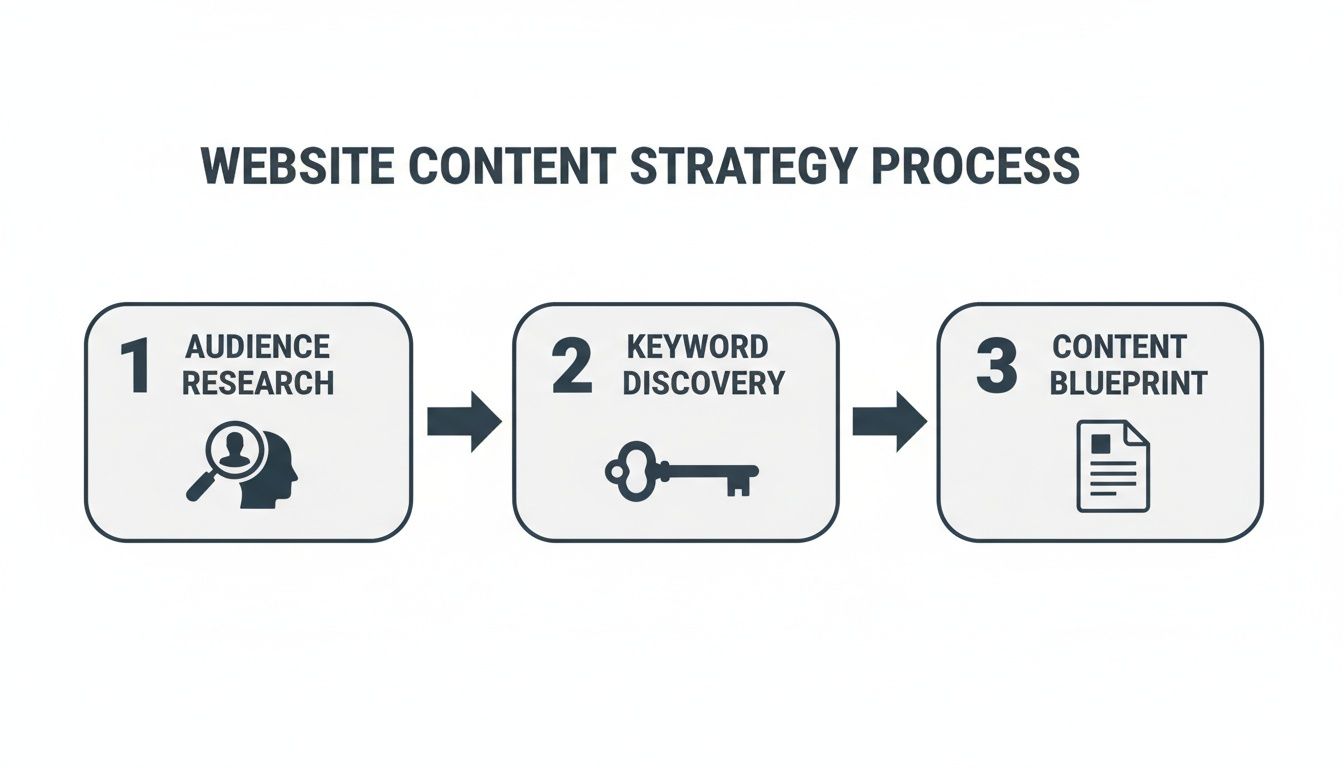
As you can see, a solid content blueprint is the natural outcome of combining deep audience insights with smart keyword discovery.
Building Your Content Blueprint
When you merge what you know about your audience with the keywords they use, you can start building your content blueprint. This is your master plan, ensuring every single page on your site has a clear purpose, speaks directly to the right person, and actively helps you reach your business goals. It’s the strategic document that turns random acts of content creation into a cohesive, results-driven machine.
For a deeper dive into organising this preliminary stage, check out our comprehensive https://titanblue.com.au/website-planning-checklist/ to guide your process. Honestly, this groundwork is non-negotiable for anyone serious about writing website content that delivers a real return. It’s the difference between just publishing content, and publishing content that actually works.
Designing a User-Friendly Website Structure

You can have the most fantastic, well-written content in the world, but if it's on a confusing website, it's a massive wasted opportunity. Before you even think about writing, you need to lock down an intuitive information architecture—that’s just a fancy way of saying a logical website map. It’s what guides your visitors effortlessly from one page to the next and helps search engines figure out what you do.
Think of this structure as the skeleton that holds your entire content strategy together.
A well-organised site doesn’t make people think. It anticipates what they’re looking for and serves it up on a silver platter. It's just like a physical store; you wouldn't bury the milk in the electronics section. The same logic applies online. Core service or product pages should be dead easy to find from your main navigation, with insightful blog posts playing a supporting role to create a seamless journey.
Mapping Your Website Blueprint
The first practical step is to get visual and map out your site's structure. You don't need fancy software; a whiteboard or even a piece of paper works perfectly fine. Start with your homepage at the very top, then branch out to your main navigation categories.
For a local construction company, this map might look something like this:
- Homepage (The front door)
- About Us (Your story, your team, your values)
- Services (The parent page for everything you do)
- New Home Builds
- Renovations & Extensions
- Commercial Projects
- Our Projects (Proof of your great work)
- Blog (A home for helpful articles)
- Contact Us (Clear instructions on how to get in touch)
This clear hierarchy stops people from getting lost and makes sure every page has a logical home. It also does wonders for your SEO by helping distribute authority (or "link equity") from your homepage down to your most important pages. A logical structure is the absolute foundation of good user experience design, making visitors feel comfortable and in control.
A website's structure should be so intuitive that a first-time visitor can navigate to any key page without having to think twice. If they have to search for your services page, your structure has already failed them.
Don't rush this planning phase. Research has found that 38% of people will stop engaging with a website if the layout is unattractive or confusing. And a clear structure is the very foundation of an engaging layout.
Crafting Detailed Content Briefs
Once your sitemap is locked in, the next move is to create a detailed content brief for every single page. This document is your non-negotiable roadmap for the writer, whether that’s you or someone on your team. It completely removes the guesswork and aligns the final copy with your strategic goals right from the get-go.
A strong content brief acts as the single source of truth, guaranteeing consistency and purpose for every piece of content you produce. It’s where you translate all that audience and keyword research into clear, actionable instructions.
A comprehensive brief should always include the following elements:
- Primary Keyword: The main search term the page is targeting, such as "custom home builders Gold Coast."
- Target Persona: A quick snapshot of the ideal reader. For instance, "A couple aged 35-50, planning their forever home, concerned about budget and quality craftsmanship."
- Key Messages: The three to five most important points the content must communicate. This could be your unique building process, a commitment to sustainability, or your award-winning designs.
- Desired Action (CTA): The single most important thing you want the reader to do next. Is it to "Request a Consultation," "View Our Gallery," or "Download a Brochure"? Get specific.
This structured approach transforms writing website content from a purely creative task into a strategic one. It ensures every single word serves a business objective and is set up to deliver measurable results.
Writing Persuasive Copy for Core Website Pages

Alright, you’ve got a solid structure and detailed briefs ready to go. Now for the fun part: turning all that planning into words that actually connect with people and get them to act. This is where the craft of persuasive web copywriting really shines, transforming your core pages from digital brochures into genuine trust-building, sales-driving machines.
The first thing to nail down is your brand voice. This isn’t just about what you say, but how you say it. It needs to feel authentic to your business while speaking directly to that ideal customer you identified earlier. Are you a buttoned-up law firm that needs a formal, authoritative tone, or a local cafe that should sound like a friendly neighbour?
Getting this voice right ensures every page, from your homepage to your contact form, feels like it’s coming from the same place. That consistency is what builds familiarity and trust—two absolute essentials for guiding a casual visitor toward becoming a loyal customer.
Crafting Scannable Copy People Actually Read
Let's be real for a second: people don’t read websites anymore, they scan them. A massive wall of text is the fastest way to send someone scrambling for the back button. Your main job when writing website content is to make it ridiculously easy for visitors to find what they’re looking for.
You’ve got a tiny window to make an impression. Research shows that most users bounce off a webpage in just 10–20 seconds. The only way to hold their attention longer is to show them you have something valuable to offer, and fast.
Here are a few practical ways to make your copy more scannable:
- Use Strong, Benefit-Driven Headings: Don't just label a section "Our Services." Sell the outcome. Try something like, "How We Solve Your Biggest Challenges."
- Keep Paragraphs Short: Stick to one to three sentences, max. This creates white space, which makes the page feel less intimidating and easier to digest.
- Lean on Bullet Points: Got a list of features, benefits, or steps? Bullet points are your best friend. They break up the text and pull the reader's eye to the most important info.
- Bold Important Phrases: Use bolding strategically to highlight your key takeaways. This helps scanners grab the main points without reading every single word.
Adopting these habits means you’re working with modern reading behaviours, not against them. It ensures your most critical messages are seen, even by the most impatient visitors. For a deeper dive, our guide on website copywriting services unpacks more advanced techniques.
Dissecting the Perfect Call-to-Action
Every single page on your website needs a clear purpose, and that purpose should lead to a compelling Call-to-Action (CTA). This is the specific instruction you give your reader, telling them exactly what to do next. Vague, passive CTAs like "Learn More" or "Click Here" just don't cut it anymore; they rarely inspire anyone to do anything.
A truly effective CTA is clear, has a sense of urgency, and focuses on the benefit to the user. It removes friction and makes the next step feel like a natural, easy decision. The goal of a CTA isn't just to get a click; it's to clearly communicate the value the user will receive after they click. It's the bridge between their problem and your solution.
Let’s look at a few page-specific examples. For a Homepage CTA, a weak option like "Submit" can be strengthened to "Get Your Free Quote Today." On a Service Page, a generic "Contact Us" becomes much more compelling as "Schedule a No-Obligation Consultation." Finally, on an About Page, instead of a vague "Our Work," guide users with a specific "See Our Award-Winning Projects."
See the difference? The stronger examples are specific, use action-focused language, and hint at a clear benefit. When you master the art of the CTA, you start turning passive browsers into active leads—and that's the whole point of writing great website content.
Integrating Modern SEO and AI Into Your Content
Look, having beautifully written copy is one thing, but getting people to actually find it is a completely different ball game. This is where modern on-page SEO and the rise of Answer Engine Optimisation (AEO) completely change the way we need to think. It's time to ditch outdated tactics like keyword stuffing and instead focus on weaving your target phrases naturally into your copy, meta descriptions, and headers.
This isn't about jamming a single keyword in as many times as possible. It's about semantic SEO—using related concepts and topics to build authority and signal to search engines that you have a deep, genuine understanding of your subject. For instance, if you're writing a page about "custom home builds," you'd better be talking about "floor plans," "building permits," and "interior design choices" to paint the full picture.
This screenshot breaks down the core on-page SEO components you can't afford to ignore.
Notice how the URL, title tag, and the content itself all need to work together to signal relevance. A scattered approach just won't cut it anymore; you need a cohesive strategy across all these elements to have a fighting chance at ranking well.
Optimising for an AI-Driven World
The way we find information online is fundamentally changing. Instead of a simple list of blue links, users are now getting direct answers from AI-powered search results. This shift makes it absolutely critical to structure your content so it can be easily understood and served up by these new systems.
This dual focus—creating content that resonates with both humans and machines—is non-negotiable for anyone serious about writing website content that actually performs. And the investment reflects this. Australian businesses are on track to increase their SEO services spend to $1.5 billion in 2025, a hefty 12% jump from 2024. Small businesses are now spending an average of $1,200 a month on these services, highlighting just how crucial expertly written, optimised content has become. You can dig deeper into the findings on Australian SEO and content marketing statistics to get a better sense of the market.
So, how do you get your content ready for this new reality?
- Answer Questions Directly: Structure your content with clear questions as headings (think of an FAQ section) and provide concise, straight-to-the-point answers right underneath.
- Use Natural Language: Write like a human. AI models are trained on conversational language, so stiff, corporate-speak is far less likely to be featured.
- Leverage Structured Data: Use schema markup to explicitly tell search engines what your content is about. It's like giving them a cheat sheet, making it much easier for them to parse and feature your information.
This strategic shift has a name: Generative Engine Optimisation (GEO). We've put together a full breakdown on how to prepare your content for Generative Engine Optimisation in our detailed guide.
The goal is simple: make your content the most helpful, direct, and authoritative answer to a user's question. When you do that, both traditional search engines and the new AI answer engines will reward you.
Leveraging AI as a Content Assistant
AI isn't just changing how content is found; it's also changing how it's created. But let's be clear: AI should never replace your unique brand voice or human expertise. Instead, think of it as a powerful assistant in your writing process.
For businesses looking to scale their content efforts, exploring the various powerful and efficient AI content generation tools available can seriously boost productivity.
Use AI to break through writer's block, generate a quick outline, or even rephrase a clunky sentence. But the final polish, the personal stories, and the strategic insights? That has to come from you. This human-AI collaboration is the sweet spot, allowing you to produce content efficiently without sacrificing the authenticity needed to build real trust with your audience.
How to Measure and Refine Your Content Performance

Hitting ‘publish’ isn’t the finish line; it’s the starting gun. From this point on, the real work shifts from pure creation to a critical cycle of publishing, measuring, and improving your content. After all, the success of your writing website content isn't determined by how good you think it is, but by how it actually performs in the wild.
This is where you trade your writer's hat for an analyst's. You need to get comfortable with data, using it to see what’s working and where the opportunities are hiding. Without this feedback loop, you’re flying blind, creating content that might just be taking up server space. Great, results-driven content is built on continuous improvement.
Identifying Your Key Performance Indicators
Before you can start improving anything, you have to know what you're actually measuring. Not all metrics are created equal, and it's easy to get distracted by vanity numbers like raw page views that don't tell the whole story. Instead, you need to zero in on Key Performance Indicators (KPIs) tied directly to your business goals.
Your KPIs are the narrative of how people are interacting with your content. They show you if your message is landing, if you're attracting the right crowd, and most importantly, if you're guiding them to take the next step.
Here are the metrics that genuinely matter:
- Organic Traffic: This is your pulse check on SEO. A steady rise shows that search engines are finding your content and people are clicking through.
- Time on Page: Are people actually reading what you wrote? This metric reveals how long they're sticking around. Longer times are a great sign of high engagement and genuine value.
- Conversion Rate: This is the big one—the percentage of visitors who do what you want them to, like filling out a form or buying a product. It’s the ultimate test of your content’s power to persuade.
- Bounce Rate: This tracks how many people leave your site after viewing just one page. A high bounce rate could signal that your content missed the mark for their search, or that the page experience is poor.
Keeping an eye on these figures in a tool like Google Analytics is the first, crucial step. It gives you the hard data needed to make smart decisions about where to put your energy. These numbers are also the foundation of effective conversion rate optimisation, which is all about turning traffic into tangible business outcomes.
Adopting a Cycle of Continuous Improvement
Once you have your KPIs on lock, you can get into a rhythm of iterative refinement. This simply means you’re regularly reviewing how your content is doing and making strategic tweaks based on what the data is telling you. It's a proactive mindset that turns your website from a static brochure into a powerful, evolving asset.
Start by looking for the underperformers. Got a blog post with heaps of traffic but a sky-high bounce rate? Maybe the intro needs a stronger hook or the formatting is a wall of text that’s scaring people away. Is a service page getting low time-on-page scores? The copy might be confusing or failing to address what your visitors really care about.
This data-first approach is becoming non-negotiable in Australia. The web design revolution is putting a massive spotlight on content performance. The AI-powered tools market is forecast to reach $6.77 billion in 2025, a huge 22.2% jump from 2024. With 73.1% of the country's $19.9 billion digital ad spend now online, every piece of content has to work hard to grab attention and justify that investment.
A website should be treated as an ever-evolving content machine, not a one-and-done project. Regularly refreshing and optimising content based on performance data is what keeps it relevant and effective.
Think of your website as a living, breathing portfolio of your expertise. Make it a habit—maybe once a quarter—to review your key pages. Look for simple opportunities: can you update old statistics? Can you drop in a new customer testimonial? Could you expand on a topic to add more value? This doesn't just improve the experience for your users; it also sends strong signals to search engines that your content is fresh and authoritative, helping you hold onto and even improve your rankings over time.
Still Got Questions About Writing Website Content?
Even with the best strategy laid out, a few common questions always seem to pop up when it comes to the nitty-gritty of writing for a website. Let's tackle some of the most frequent ones I hear from clients, so you can move forward with total confidence.
How Often Should I Update My Website Content?
Think of your website as a living, breathing part of your business, not a static brochure you print once and then forget about. It needs regular attention to stay relevant.
For your core pages—like your homepage, about us, and service pages—it’s a good idea to give them a thorough review at least every 6 to 12 months. This is your chance to make sure all the information is still accurate, the messaging aligns with your current goals, and everything still sounds fresh and compelling.
When it comes to your blog, an annual content audit is a game-changer. I always recommend identifying your top-performing articles and giving them a refresh. You can add new insights, update statistics with the latest numbers, or swap in more current examples. This doesn't just keep the content valuable for your readers; it also sends a signal to search engines that your site is active and up-to-date, which helps maintain its SEO value. In a fast-moving industry? You might even want to do this quarterly. The goal is simple: stay relevant.
What’s the Difference Between SEO and AEO Content?
This is a great question, and it's becoming more important every day. While SEO and AEO are definitely related, they focus on slightly different outcomes.
Traditional Search Engine Optimisation (SEO) is all about getting your web page to rank as high as possible in that classic list of search results. It's about beating the competition for visibility on the page.
Answer Engine Optimisation (AEO), on the other hand, is about having your content chosen as the direct, definitive answer to someone's question. Think about the featured snippets at the top of Google, the answer a smart speaker gives you, or the information an AI chatbot pulls to respond to a query.
To do AEO well, you need to focus on natural language, structured data, and providing incredibly clear, concise answers to very specific questions. A modern content strategy really needs both: you use SEO to get your page seen in the first place, and AEO to position your brand as the ultimate, go-to authority. It's no longer enough to just be on the list of results; the goal is to be the result.
How Long Should a Blog Post or Web Page Be?
Honestly? As long as it needs to be to do the job properly. There’s no magic word count. Quality and how thoroughly you cover a topic will always beat an arbitrary number.
A short, sharp blog post of 800 words that perfectly answers a specific question can be way more effective than a rambling 3,000-word article that never quite gets to the point. But if you’re creating an "ultimate guide" on a complex topic, you'll naturally need a longer format to provide real, in-depth value.
Instead of obsessing over word count, focus on these principles:
- Answer the Question Completely: Does your reader have everything they need, or will they have to click back to Google to find more information? If they have to leave, your content probably isn't deep enough.
- Make it Readable: No one wants to face a wall of text. Use short paragraphs, clear subheadings, and bullet points to break things up. This makes your content easy to scan and digest, no matter how long it is.
- Match the User's Intent: Someone searching for "emergency plumber near me" wants a quick, scannable page with a phone number right at the top—not a 2,000-word history of plumbing.
Can I Use AI to Write All My Website Content?
AI is an incredible assistant, but it's a terrible replacement for a genuine human expert. It's a tool that can seriously speed up the content creation process, but it absolutely should not be the sole creator. Think of it as a collaboration.
Here’s how I recommend my clients approach it:
- Use AI for: Brainstorming topics, generating outlines, getting a rough first draft on paper, and helping with keyword optimisation.
- Rely on a Human for: Fact-checking for accuracy, adding personal stories and unique insights, refining the brand voice, and crafting a narrative that actually connects with your audience on an emotional level.
To build real trust and create content that showcases your unique expertise, human oversight is non-negotiable. An AI simply can't replicate the nuanced understanding, authentic perspective, and real-world wisdom that comes from years of experience in your field.
Ready to transform your website into a powerful, results-driven asset? At Titan Blue Australia, we combine over 25 years of industry experience with modern SEO and AI strategies to create website content that connects and converts. Let's build something that lasts. https://titanblue.com.au
Make Titan Blue a preferred source in Google
One click tells Google to surface our articles more often in Top Stories, AI Overviews and AI Mode.

Law Firm Website Design Australia: The 2026 Guide
Real, practical guidance on law firm website design in Australia for 2026, built for trust,…

Real Estate Website Design Australia: The 2026 Guide
What a real estate website design in Australia needs in 2026: listings, suburb pages, sold…

Dental Website Design Australia: The 2026 Guide
Dental website design Australia in 2026: what to include, AHPRA compliance, booking flow and how…