


Last updated:
Marketing for law firms isn't just about placing an ad here and there. It's a calculated blend of digital and traditional methods designed to attract, engage, and ultimately win over your ideal clients. It’s all about building a rock-solid brand reputation, pulling in qualified leads, and driving real, measurable growth for your practice.
Truthfully, any successful strategy is always built on a solid foundation—one where you deeply understand your target audience and have crystal-clear, actionable goals.
Building Your Law Firm's Strategic Marketing Foundation

Effective marketing isn't about jumping on every new trend you see online. It’s about crafting a deliberate plan that’s perfectly aligned with your firm’s specific goals. Without that clear strategy, your efforts will feel disconnected and fall flat, wasting both your time and your money. This is the crucial stage where you decide exactly who you want to serve and what success actually looks like for your practice.
To get this right, you need a framework to keep your thoughts and actions organised. Think of a digital marketing strategy template as your blueprint. It's the guide that informs every single decision you make, from your website's design to how you spend your advertising budget.
Define Your Ideal Client Avatar
Before you can attract the right clients, you have to know exactly who they are. It’s time to move beyond broad practice areas like "family law" or "commercial litigation." The real magic happens when you create a detailed ideal client avatar.
Get specific about their circumstances. For example, a family lawyer might target:
- High-net-worth individuals navigating a complex division of assets.
- Young families looking to set up wills and guardianship plans.
- Business owners who need prenuptial agreements to protect company assets.
See the difference? This level of detail helps you tailor your messaging so it speaks directly to the precise challenges and motivations of the people you want to work with. A construction company needing contract reviews has completely different concerns than a family planning their estate.
Establish Meaningful Goals and KPIs
Your marketing objectives must be tied to tangible business outcomes. Vague goals like "get more leads" are impossible to measure and won't get you very far. Instead, you need to set SMART (Specific, Measurable, Achievable, Relevant, Time-bound) goals.
Here are a few practical examples of what this looks like in the real world:
- Increase qualified leads from our website by 20% within the next six months.
- Achieve a top-three ranking on Google for "commercial property lawyer Sydney" in one year.
- Generate 10 new client consultations per month from our paid advertising campaigns.
These specific targets give you clear benchmarks. You’ll know what’s working and what isn’t. To get a better handle on this, you can learn more about what a digital marketing strategy is and how to put it into action.
Allocate Your Budget Effectively
A classic mistake I see law firms make is throwing money at marketing without a clear reason why. Your budget should be a direct reflection of your goals and the channels you've chosen to reach them.
A firm that needs immediate leads from people actively searching for a lawyer might invest heavily in Google Ads. On the other hand, a firm wanting to build long-term authority in a niche practice area might dedicate more of its budget to creating expert content and focusing on SEO.
The key is to treat your marketing budget as an investment designed to produce a measurable return—not just another expense on the P&L. This strategic thinking ensures every dollar you spend is working as hard as possible to grow your practice.
Your Website and SEO as a Client Generation Engine

Think of your firm's website as more than just a digital brochure. It’s the engine room of your marketing strategy and, for most people, the very first point of contact they'll have with your firm.
These days, people don’t thumb through the Yellow Pages; they go straight to Google. Projections show that by 2026, a staggering 73% of legal consumers in Australia will kick off their search for a lawyer online. You can get a deeper look at this trend in this detailed report on legal marketing statistics.
This online-first behaviour is a massive shift. It means your website has to be your hardest-working employee, ready to attract and convert potential clients 24/7. Turning it into a genuine client-generation machine isn't just about a slick design; it demands a relentless focus on user experience, crystal-clear calls-to-action, and a rock-solid technical foundation built for search engines.
Creating a Client-Centred User Experience
When someone lands on your website, they're often stressed, confused, and desperate for clear answers. A slow, clunky, or confusing site is the last thing they need—and it's a surefire way to send them straight to your competitor.
Your design needs to prioritise clarity and simplicity, guiding visitors exactly where they need to go without any friction. This means making your contact details impossible to miss, organising your practice area pages logically, and ensuring the site loads in a flash, especially on a mobile phone. You've only got seconds to make a good impression.
A strong user experience hinges on a few key elements:
- Mobile-First Design: Your website absolutely must work flawlessly on a smartphone. Most people searching for local services, lawyers included, are doing it from their phones.
- Clear Calls-to-Action (CTAs): Don’t leave people wondering what to do next. Use prominent, action-oriented buttons like "Book a Confidential Consultation" or "Call Us Now" on every single page.
- Simple Navigation: Keep your site structure logical. A potential client should be able to find information about their specific legal issue within just two clicks from your homepage.
Your website isn't just a place to list your services; it's a tool designed to build trust and make it as easy as possible for a person in need to take the first step and contact you.
For firms planning a new site or a much-needed overhaul, it pays to understand the nuts and bolts of website development for law firms. Getting these fundamentals right from the start is non-negotiable.
The Mechanics of SEO for Lawyers
Search Engine Optimisation (SEO) is the art and science of getting your website to show up when people search for your services on Google. For law firms, it’s not optional; it’s essential.
Good SEO is what makes your firm appear at the top when someone types in "family lawyer in Gold Coast" or "construction contract review." It all starts with keyword research—figuring out the exact phrases your ideal clients are using. You'll want a healthy mix of practice area terms ("personal injury claim") and location-specific queries ("Brisbane property conveyancing").
Once you know what people are searching for, you need to weave those keywords into your website. This is what we call on-page SEO.
Mastering On-Page SEO Essentials
On-page SEO is all about optimising individual pages on your site to rank higher in search results. It’s how you signal to Google and other search engines what your content is about, making it clear that you're the right answer to a searcher's query.
Here are the crucial on-page elements you need to nail:
- Title Tags: This is the clickable headline that appears in search results and the browser tab. It needs to include your main keyword and location, like: "Expert Criminal Defence Lawyer in Sydney".
- Meta Descriptions: This is the short summary that appears under your title in Google. While it's not a direct ranking factor, a well-written meta description acts like a mini-advertisement, convincing people to click on your link instead of someone else's.
- Headings and Content: Structure your content with clear headings (H1, H2, H3). Your primary keyword should appear naturally in your main H1 heading and be sprinkled throughout the body of the text.
- Authoritative Backlinks: A backlink is simply a link from another website to yours. Search engines see these as votes of confidence. When a reputable site links to you, it signals that you're a trusted authority, which gives your rankings a significant boost.
And don't forget, search is evolving. More people are using voice search and asking conversational questions like, "What are the steps in a divorce proceeding?" Creating content that directly answers these questions will put your firm ahead of the curve in an AI-driven search world.
Winning Clients with Local Search and Online Reviews

While building a national reputation sounds great, the truth is most of your best clients are right in your own backyard. These are the people searching for a local expert they can trust, and they’re using Google Maps and local search to find you. Dominating this space isn’t just an option anymore; it’s non-negotiable.
Your Google Business Profile (GBP) is the absolute cornerstone of your local presence. It’s that info box that pops up in search results, showing your firm's name, location, hours, reviews, and photos. You need to stop thinking of it as a static listing. It's a dynamic profile that needs consistent attention if you want to stay competitive and visible.
An optimised profile is more than just claiming your business. It means actively using all its features to signal your relevance and activity to potential clients and, just as importantly, to Google's ranking algorithm. This active management is what separates the firms that show up at the top from those buried on the second page of local results.
Optimise Your Google Business Profile
Your GBP is often a potential client’s very first interaction with your firm, so every single detail counts. Nail the basics first: make sure your firm’s name, address, and phone number are perfectly accurate. Then, it's time to dig deeper and unlock its full potential.
Select the most specific primary category for your practice. Don't just pick "Lawyer." Choose "Family Law Attorney" or "Criminal Justice Attorney," then add secondary categories for your other practice areas. This helps Google understand exactly what you do and show your firm for the right searches.
You should also meticulously list every service you offer. Instead of one vague entry for "litigation," break it down into "commercial litigation," "civil litigation," and "contract disputes." Every one of those entries is another chance to appear in search results when a client is looking for specific help.
Cultivate a Five-Star Reputation
Online reviews are a massive ranking factor and an incredibly powerful form of social proof. A steady stream of positive reviews tells search engines that your firm is trusted and valued by the community. More importantly, it tells potential clients that you get excellent results.
Building a strong review portfolio doesn't just happen by accident. It requires a simple, ethical, and consistent system for asking for feedback from satisfied clients when their matter concludes.
Make the process completely effortless for them. Send a direct link to your Google review page via email or text. Personalise the request, thanking them for their trust. The real key here is to ask consistently and make it incredibly easy for them to share their positive experience. And remember to respond to every single review—good or bad—to show you're engaged and that you value client feedback.
Ensure NAP Consistency Across Directories
Your firm's Name, Address, and Phone number (NAP) must be identical across every single online directory, website, and social media profile. Inconsistencies, even something as small as using "St." on one site and "Street" on another, can confuse search engines and erode their trust in your business.
This consistency acts as a verification signal for search algorithms. When Google finds the exact same NAP details on your website, your GBP, and other legal directories, it becomes more confident that your business information is accurate and reliable.
Here are the key places you need to check for consistency:
- Your own website's contact page and footer.
- Your Google Business Profile.
- Major legal directories relevant to Australian lawyers.
- Social media profiles like LinkedIn and Facebook.
Taking the time to standardise this information is a fundamental step. To get a better handle on the broader strategy, you can find more insights on local SEO for businesses and how these pieces all fit together. This foundational work ensures that when clients search locally, your firm is the one they find, trust, and ultimately, hire.
Demonstrating Expertise Through Content and Thought Leadership
Before a potential client ever thinks about calling your firm, they’re searching for one thing above all else: trust. Content is how you build that trust at scale. It’s your chance to answer their most urgent questions, calm their anxieties, and prove you’re the authority in your field long before they even consider picking up the phone.
Marketing a law firm effectively isn't about just listing your services. It’s about showing your expertise in a way that’s genuinely helpful. This means you need to shift your mindset from selling to educating.
When you consistently provide real value, your firm becomes the first one people think of when they—or someone they know—finally need legal advice. It’s not about random blog posts; it's a strategic approach to understanding your ideal client's worries and creating resources that directly address them.
Identifying High-Impact Content Ideas
The best content ideas come straight from your clients' real-world problems. You don't need a complicated system to find them. Just start listening. What are the questions you get asked over and over again during those first consultations?
Every single one of those recurring questions is a perfect topic for a blog post, a short video, or a downloadable checklist. This approach guarantees your content is always relevant and meeting a genuine need.
Here are a few practical examples from different practice areas:
- For a family lawyer: A blog post titled, "What Are the First Steps in a Property Settlement in Australia?" This hits a high-stress question many people have right at the start of a tough time.
- For a commercial lawyer: A quick, two-minute video explaining, "Key Clauses to Watch for in a Commercial Lease." This delivers immediate, tangible value to business owners.
- For a personal injury firm: A simple infographic that visually breaks down the timeline of a typical public liability claim. It helps manage expectations and demystifies a complex process.
You’ll notice none of these are sales pitches. They’re educational tools that build your firm's credibility and position you as a trusted advisor. By tackling these foundational topics, you’ll also build a strong library of resources. You can dive deeper into a full content marketing for law firms strategy to really refine your approach.
Developing a Sustainable Content Calendar
Consistency is everything in content marketing. A simple content calendar is what turns good intentions into a reliable habit. This doesn't need to be a complex spreadsheet; it's just a tool to keep you organised and ensure a steady flow of valuable content.
Start by mapping out your main practice areas. From there, brainstorm four or five key topics for each area that you can turn into content over the next quarter.
A simple calendar might look something like this.
For Month 1, you could focus on Property Law. During Week 1, you can create a blog post on "Navigating Conveyancing in Queensland." For Week 2, produce a short video on "Common Mistakes First Home Buyers Make." In Week 3, share a LinkedIn post with a quick tip on stamp duty concessions. Finally, in Week 4, send a client email newsletter featuring the month's content.
Following that, you can focus on Estate Planning in Month 2. During Week 1, write a blog post explaining "Why You Need an Enduring Power of Attorney." For Week 2, film a Q&A video answering common questions about wills. In Week 3, create a LinkedIn post about updating your will after major life events. And again, in Week 4, distribute a client email newsletter.
This structured approach stops the last-minute scramble for ideas and makes sure you're consistently showcasing the full breadth of your firm's expertise.
The goal of a content calendar isn't to create more work. It’s to make your marketing more efficient and effective by planning ahead. It turns content from a reactive chore into a proactive strategy.
Distributing Your Content for Maximum Impact
Creating great content is only half the job. If no one sees it, it can't work for you. A smart distribution strategy makes sure your expertise reaches your target audience where they’re already spending their time.
Your firm's website and blog are the home base for all your content, but you need to actively push it out through other channels.
An email newsletter is a powerful way to stay in touch with past clients and nurture potential leads who aren't quite ready to hire a lawyer. For firms with a B2B focus, LinkedIn is absolutely essential. Sharing your articles and videos there positions you as a thought leader among your professional network and potential business clients. This constant visibility keeps you top of mind, so when a need does arise, your firm is the one they remember.
Using Paid Ads to Amplify Your Firm's Reach
While your SEO and content strategies are busy building long-term authority, paid advertising delivers something just as valuable: immediate visibility. It’s your chance to jump the queue and put your firm directly in front of potential clients the very moment they start searching for legal help.
Paid ads, particularly pay-per-click (PPC) campaigns, are incredibly effective for law firms because they target intent. You aren't just hoping someone stumbles across your website; you're paying to show up when a person types "divorce lawyer near me" or "commercial litigation solicitor" into Google. This speed to market can bring in high-quality leads almost instantly, filling your pipeline while your organic efforts gain traction.
Mastering Google Ads for Client Acquisition
When it comes to capturing high-intent leads, Google Ads is the undisputed king. For generating clients now, getting a handle on Google Ads lead generation is non-negotiable. The secret is to pour your budget into keywords that scream "I need a lawyer right now."
Think about the exact phrases someone would use in a moment of legal crisis. They usually fall into a few categories:
- Practice Area + Location: "Family lawyer Gold Coast" or "contract review solicitor Sydney."
- Action-Oriented Queries: "Hire a personal injury lawyer" or "speak to a criminal defence lawyer."
- Urgent Needs: "Emergency legal advice" or "after-hours solicitor."
Bidding on these types of terms ensures your ad spend is laser-focused on attracting qualified prospects, not just window shoppers. But getting the keywords right is only half the story.
Crafting Compelling Ad Copy That Converts
Your ad has one job: to make a potential client click your link instead of the five others surrounding it. The copy needs to be punchy, persuasive, and speak directly to their problem while showing them why you're the right choice.
Every effective legal ad needs a crystal-clear call-to-action (CTA). Forget generic phrases like "Click Here." Instead, use action-driven language that sets expectations, like "Book Your Free Consultation" or "Call for a Confidential Review." This tells the user precisely what to do next.
The best ad copy connects with the user's emotional state—whether it's stress, uncertainty, or urgency—and offers a clear, reassuring path forward. It’s not just about what you do; it’s about how you can solve their problem right now.
Designing High-Converting Landing Pages
Getting the click is the first hurdle. The landing page—where a user ends up after clicking your ad—is where the real magic happens. A rookie mistake is sending all your paid traffic to your generic homepage. This just creates friction, forcing a stressed-out visitor to hunt for the information they need. Most will just give up and leave.
Instead, you need dedicated landing pages for each ad campaign. If your ad is for "commercial lease reviews," the landing page should be about nothing else.
A killer landing page must have:
- A Clear, Matching Headline: The headline has to echo the promise you made in the ad.
- Concise, Scannable Content: Use bullet points and short paragraphs to highlight the benefits.
- A Simple Contact Form: Only ask for what's essential. Name, email, and phone number are usually enough.
- Prominent Contact Details: Your phone number and address should be impossible to miss.
- Social Proof: A powerful client testimonial or a positive review builds instant trust.
If you’re thinking about bringing in an expert, it’s worth understanding how to choose a pay-per-click agency that gets the unique compliance and strategic needs of a law firm.
Leveraging Retargeting to Re-Engage Prospects
Let's be realistic: not every person who clicks your ad is ready to pick up the phone right away. That’s where retargeting comes in. It’s a smart strategy that lets you show follow-up ads to people who visited your website but didn’t get in touch.
It works by keeping your firm top-of-mind as they continue their research. This is a highly cost-effective way to nurture warm leads. After all, someone who has already checked out your services is far more likely to convert than a cold prospect. By serving them subtle reminder ads on social media or other websites they visit, you gently nudge them back toward your firm when they’re finally ready to make a decision.
Measuring What Matters and Putting Your Plan into Action
A brilliant marketing strategy is just a document until you execute it. To turn your plan into a client-generation engine, you need to get your hands dirty with execution and measurement, making sure every dollar and hour spent contributes directly to your firm's growth.
This means moving past superficial numbers like website visitors or social media likes. Those are vanity metrics. Instead, let's focus on the data that actually reveals the health of your marketing and impacts your bottom line.
Key Performance Indicators That Drive Growth
To truly understand if your marketing is working, you need to measure the entire client journey—from the very first click to a signed agreement. This is where you find out how efficient your spending is and spot the biggest opportunities for improvement.
Focus on these critical data points:
- Cost Per Lead (CPL): This is the average amount you spend to generate one new enquiry, whether it's a phone call or a form submission. It tells you exactly how efficient each marketing channel is.
- Lead Conversion Rate: This is the percentage of leads that result in a booked consultation. A low rate here might signal a problem with your intake process or that you're attracting the wrong kind of enquiries.
- Client Acquisition Cost (CAC): This metric calculates the total cost to sign a new client. It pulls everything together—marketing spend and conversion data—to give you a crystal-clear picture of what it costs to win business.
Tracking these numbers gives you the power to make smart decisions. For instance, if you discover your SEO efforts are bringing in leads for $50 each while your paid ads cost $250 per lead, you know exactly where to double down on your investment for a better return.
This simple timeline shows just how quickly you can get things moving with paid ads, going from targeting potential clients to launching a campaign and actually converting them.
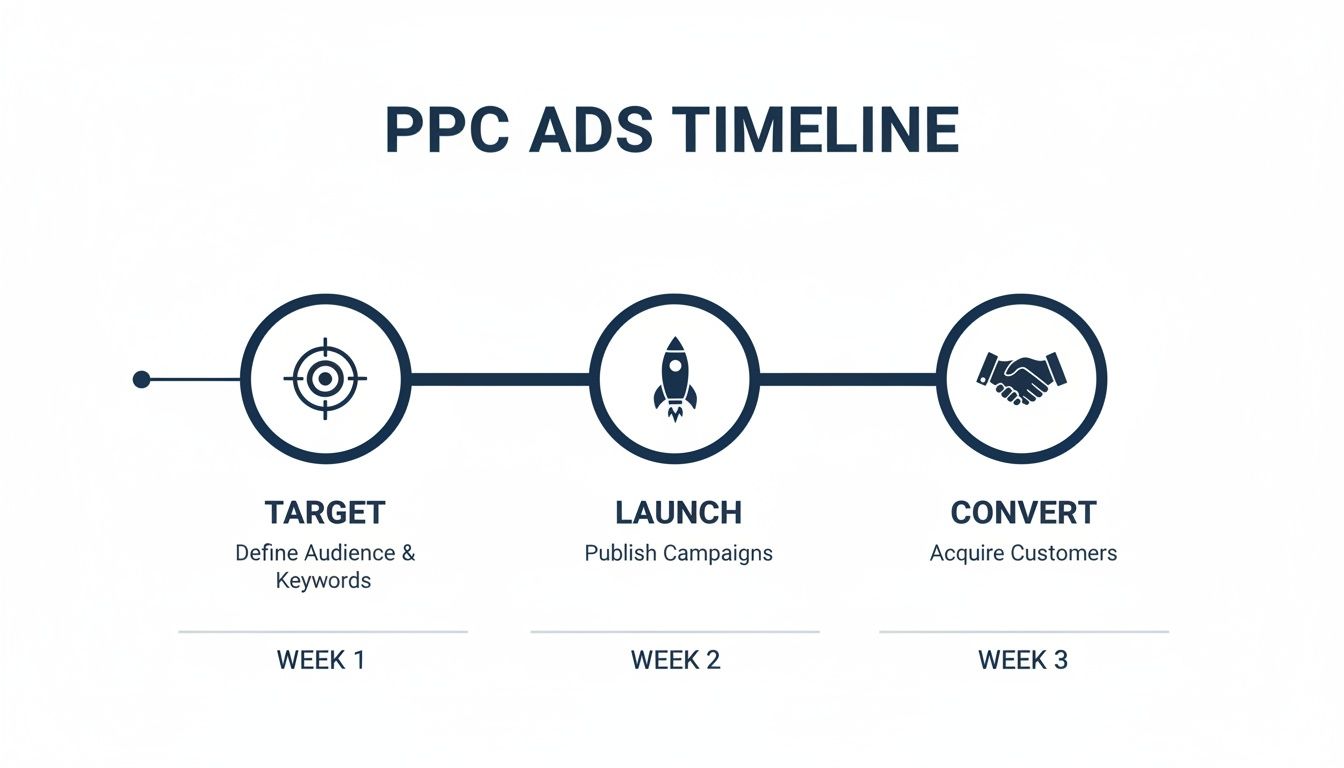
As you can see, a well-structured paid advertising campaign doesn't take forever to get going. It can start producing tangible results, like new client consultations, in just a few short weeks.
Your 90-Day Implementation Plan
Momentum is everything when you're putting a new plan into action. This 90-day timeline breaks down the strategies from this guide into manageable, weekly tasks. It’s all about building a solid foundation without feeling completely overwhelmed.
Months 1-2: The Foundation
- Weeks 1-2: Nail down your ideal client avatars and set your SMART goals. Jump straight into claiming and fully optimising your Google Business Profile—add all services, categories, and plenty of high-quality photos.
- Weeks 3-4: Complete a full audit of your website's on-page SEO. Check that every single page has a unique title tag, meta description, and a clear call-to-action.
- Weeks 5-6: Develop a simple, repeatable system for asking clients for reviews. Then, create a basic content calendar with 12 topic ideas—one for each week of the quarter.
- Weeks 7-8: Time to write and publish your first two blog posts. Base them on the most common questions you hear from clients. You can also start setting up a simple Google Ads campaign focused on just one of your core practice areas.
A great plan executed consistently will always outperform a perfect plan that never gets started. The goal of this timeline is to build habits and create forward motion, one small step at a time.
Month 3: Amplification and Refinement
- Weeks 9-10: Launch your Google Ads campaign and keep a close eye on its initial performance. Share your new blog content via an email newsletter and on your LinkedIn profile to get more eyeballs on it.
- Weeks 11-12: It's time to review your initial marketing data. Analyse your Cost Per Lead and see which channels are pulling their weight. Use these early insights to adjust your budget and fine-tune your strategy for the next quarter.
This structured approach is how you turn theory into practice. Of course, if you want personalised advice on building and measuring a strategy tailored to your firm, expert guidance can make all the difference. You can learn more by scheduling one of our digital marketing consultations.
By consistently taking these small, deliberate steps, you will build a powerful and predictable marketing system that drives sustainable growth for your firm.
Make Titan Blue a preferred source in Google
One click tells Google to surface our articles more often in Top Stories, AI Overviews and AI Mode.

ChatGPT GPT-6 Search Upgrade: What It Means for Australia
OpenAI rolled out GPT-6 to ChatGPT on 7 October 2026 with faster search. Here is…

Best Dental Website Design Agencies in Australia: 7 Compared
Best dental website design agencies in Australia 2026: seven compared on dental proof, booking, AHPRA…

Childcare Centre Website Design Australia: The 2026 Guide
Childcare centre website design Australia: show hours, ages and enrolment as text so parents and…