


Last updated:
When you're running an NDIS provider service, you need a direct line to participants, families, and support coordinators right when they're looking for help. That’s exactly what a well-managed Google Ads campaign delivers. It cuts through the noise of slower marketing methods, placing your organisation squarely at the top of the search results for an audience that’s ready to act.
Why Google Ads Are Essential for NDIS Providers
In a sector as crowded as the NDIS, just having a website isn't enough to drive growth. You can't afford to sit back and wait for participants to stumble across your services. A proactive approach using Google Ads isn't just a good idea—it's essential for any provider serious about connecting with more people.
The real challenge is twofold: you have to stand out, but you also need to navigate the strict ethical guidelines of the NDIS Code of Conduct. A properly managed Google Ads campaign achieves both, acting as a compliant and powerful way to reach your ideal audience.
The Power of Immediate Connection
Unlike organic SEO, which can take months to show any real traction, Google Ads gives you immediate visibility. The moment a support coordinator searches for "specialist disability accommodation Melbourne" or a parent is looking for "paediatric speech therapy near me," your ad can be right there at the top of the page.
This instant connection is everything. The person searching isn't just browsing; they have a real, often urgent, need. They are actively looking for a solution right now. Your ad meets them in that critical moment, making it far more impactful than almost any other form of marketing.
- High Intent: You’re reaching people who already know they have a need and are actively seeking a specific NDIS service.
- Targeted Reach: You can zero in on the exact suburbs, cities, or regions you serve, so you’re not wasting a single dollar of your ad budget.
- Measurable Results: Every click, call, and form submission can be tracked, giving you a crystal-clear picture of your return on investment.
Dominating the Search Landscape
Let's be honest, Google's dominance in Australia is undeniable. It's not just a search engine; it's the go-to tool for finding essential services. With Google commanding 94.28% of the Australian search market, it's where your audience is looking. In fact, there are nearly 50,000 searches for NDIS providers every single month.
Here's why that matters. A staggering 94% of searchers never click past the first page, and 63% only look at the top three results.
If you’re not on the first page of Google, you’re basically invisible to the vast majority of potential participants and their support networks.
A powerful website is your foundation, but ads are what drive that immediate, high-intent traffic to your door. To learn more about building that foundation, check out our guide on professional NDIS website development.
Building a High-Performance, Compliant Campaign
A winning NDIS Google Ads campaign isn't something you just switch on and hope for the best. It's built on a rock-solid foundation of strategic planning, which starts with getting inside the heads of the people you want to reach and understanding what they're actually searching for. This is where the theory ends and practical NDIS digital marketing agency expertise starts delivering real results.
Forget about casting a wide, generic net. The real secret is uncovering those high-intent keywords that participants, their families, and support coordinators are typing into Google every single day. We're not talking about broad terms like "disability services"; we mean the specific, needs-based questions that show someone is ready to make a decision.
Uncovering High-Intent Keywords
Your keyword strategy is what powers the entire campaign. The goal here is to perfectly match the language of your ideal client, focusing on the specific problems they're trying to solve right now.
Think about what a genuine search looks like. It’s usually quite specific.
Here are a few real-world examples of high-intent keywords we see working for providers:
- 'NDIS occupational therapy for children Sydney'
- 'Supported Independent Living vacancies near me'
- 'Behaviour support practitioner Gold Coast NDIS'
- 'How to get NDIS funding for assistive technology'
These longer, more detailed phrases (often called "long-tail keywords") are absolute gold. They face less competition and signal a much clearer, more urgent need. Someone searching for "SIL vacancies" isn't just browsing—they're actively looking for accommodation, making them a top-quality lead. Targeting these phrases means you connect with people at the most critical moment in their search.
This simple visual breaks down how a participant goes from a Google search to finding your service.
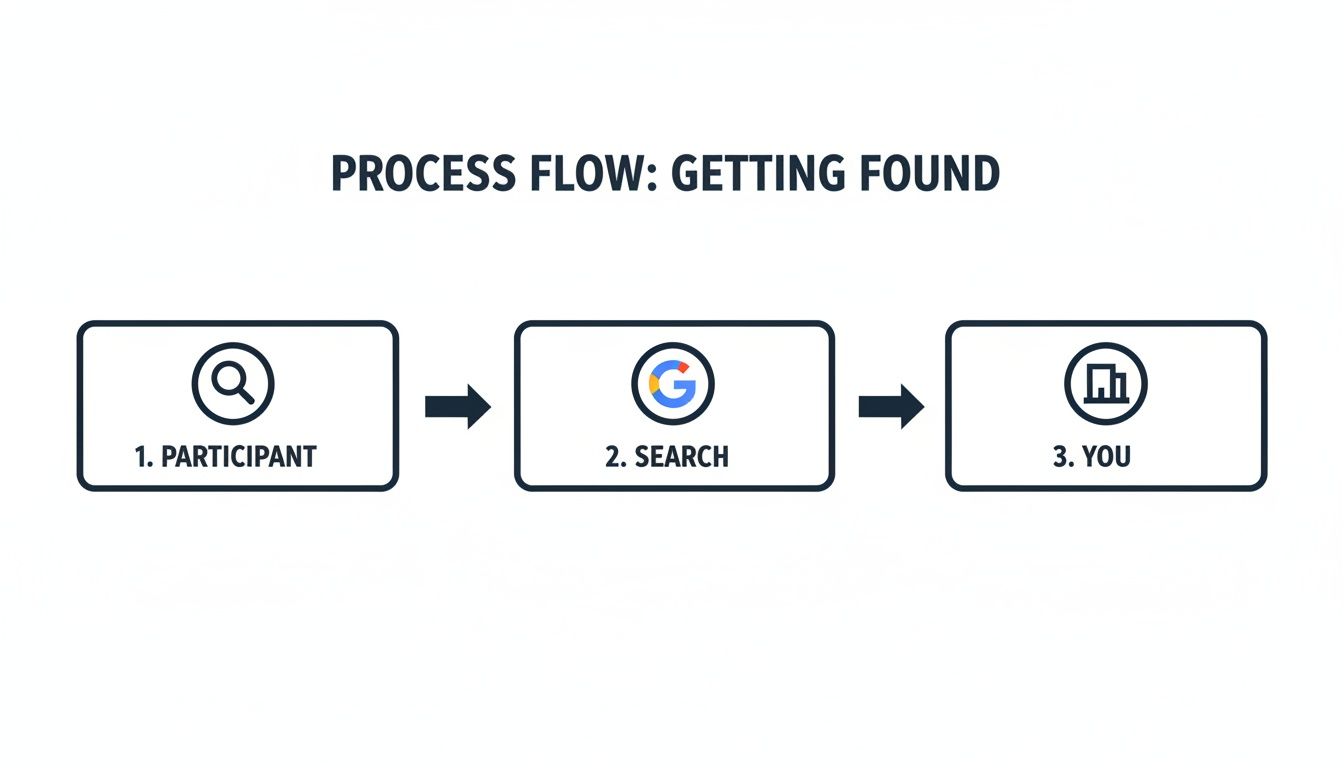
As you can see, your visibility hinges entirely on aligning your campaign with the exact search terms your audience is using.
Structuring Ad Groups for Maximum Relevance
Once you've got your list of keywords, how you organise them is the next crucial piece of the puzzle. A common mistake is to just dump all your keywords into one big ad group. This inevitably leads to vague, generic ads that don't really speak to anyone's specific problem, which means low click-through rates and a lot of wasted money.
The right way to do it is to create tightly themed ad groups that mirror the different services you offer.
For example, a provider might structure their campaign with distinct ad groups like these:
- Core Supports: This group would target keywords like 'NDIS daily personal activities' or 'assistance with social participation'. The ads you write for this group would then speak directly to these essential, everyday support services.
- Capacity Building: Here, you’d focus on keywords such as 'NDIS therapeutic supports' or 'improved living skills'. The ad copy would be all about development, independence, and empowerment.
- Supported Accommodation: This group needs to be highly specific, using keywords like 'SDA housing vacancies Brisbane' or 'short term accommodation NDIS'.
This organised structure ensures that when someone searches for a particular service, they see an ad that feels like it was written just for them. This relevance doesn't just boost your ad performance; it builds trust with the user from the very first click.
Precision Location Targeting to Maximise Your Budget
As an NDIS provider, you almost certainly serve a specific geographical area. Advertising to people outside of your service region is one of the fastest ways to burn through your ad budget with absolutely nothing to show for it. Luckily, Google Ads gives you powerful location-targeting tools to stop this from happening.
You can get much more specific than just targeting a city. It's best to get granular and focus on:
- The specific postcodes you serve.
- A radius (e.g., 20km) around your office or service hub.
- Individual suburbs or local government areas (LGAs).
For instance, a provider based in Western Sydney could choose to show their ads only to users in suburbs like Parramatta, Blacktown, and Penrith, while completely excluding the rest of the Sydney metro area. This kind of precision ensures every single dollar is spent reaching people you can actually help, making your NDIS Google Ads management far more cost-effective from day one. To make sure you’re truly building a high-performance campaign, it's vital to understand the most important Google Adwords metrics to track and see how they paint a picture of your overall success.
Crafting Ad Copy That Connects and Complies
Writing compelling ads for the NDIS sector is a fine art. It’s not just about getting clicks; it’s about building immediate trust and showing genuine empathy, all while staying strictly within the NDIS Code of Conduct. Think of your ad copy as the very first handshake a potential participant or their family has with your organisation. Every single word counts.

The ads that truly work are the ones that move beyond just listing services. They tap into the outcomes and feelings people are searching for: independence, empowerment, community connection, and a better quality of life. This person-centred approach is exactly what you need to create copy that resonates on a human level.
Writing with Empathy and Focusing on Outcomes
Your headlines and descriptions need to speak directly to the core needs and goals of your audience. Instead of just stating "We offer occupational therapy," dig deeper into the why behind that service. A much more powerful approach connects what you do with a meaningful, life-changing outcome.
Let's look at the difference:
A service-focused headline might be "NDIS Support Coordination Services," whereas an outcome-focused headline is "Achieve Your NDIS Goals with Expert Support Coordination."
The same goes for the description.
A service-focused description could say "We provide in-home care and daily assistance." An outcome-focused description is much stronger: "Live more independently in your own home. Compassionate daily support tailored to you."
That subtle shift in language makes a world of difference. It shows you understand the person, not just their plan. Your copy should always be respectful, empowering, and completely free of jargon. And remember, that great first impression needs to continue when they click—the design of your landing page is just as crucial. For more on that, you can check out our detailed guide on effective web design for NDIS providers.
Staying Compliant with the NDIS Code of Conduct
While connecting emotionally is vital, compliance is absolutely non-negotiable. The NDIS Quality and Safeguards Commission has clear guidelines in place to protect participants. This means your ads must be honest, accurate, and avoid making misleading claims or creating unrealistic expectations.
Here are the key compliance points to always keep in mind:
- Avoid Guaranteed Outcomes: Never, ever promise specific results. Every participant's journey is unique.
- Use Respectful Language: Always use person-first language (e.g., "person with a disability," not "disabled person").
- Be Factual and Transparent: Don't exaggerate your services or expertise. Be crystal clear about what you offer.
- No Unsolicited Selling: Your ads should be a helpful answer to someone's search, not an aggressive sales pitch for services they haven't asked for.
Adherence to the Code of Conduct isn't just about avoiding penalties; it's fundamental to building a reputable brand that participants and their families can trust. Your NDIS Google Ads management strategy must have compliance at its core.
Supercharge Your Ads with Extensions
Ad extensions are a fantastic—and free—way to make your ads more helpful and take up more real estate on the search results page. They provide extra snippets of information and give people more reasons to click your ad instead of a competitor's. Honestly, they're a critical part of professional NDIS Google Ads management.
For NDIS providers, a few extensions are particularly effective.
-
Sitelink Extensions: These are extra links that pop up below your main ad, pointing users to specific pages on your website. You can use them to highlight key services like 'Supported Independent Living', 'Therapeutic Supports', or 'About Our Team'. It helps people find exactly what they need, faster.
-
Call Extensions: This one’s a no-brainer. It adds your phone number directly to the ad. On mobile, users can simply tap to call, which is incredibly useful for support coordinators or family members who need to make an immediate enquiry.
-
Location Extensions: If you have a physical office or centre, this extension is perfect. It displays your address, a map, and the user's distance from you. It’s ideal for attracting local participants searching for services "near me."
By combining empathetic, outcome-focused copy with smart ad extensions, you create ads that not only perform exceptionally well but also reflect the caring and professional values of your organisation.
Smart Budgeting and Bidding Strategies
This is where the rubber meets the road. Managing the financial side of your NDIS Google Ads is where a campaign either takes off or fizzles out. It’s a common myth that you need a huge budget to compete. The real secret is making every single dollar work as hard as possible to connect you with participants who genuinely need your support.
That means picking the right bidding strategy and, most importantly, knowing exactly what’s working and what isn’t.
Without clear data, your ad spend is just a hopeful guess. But with proper tracking, it transforms into a predictable engine for growth, turning your budget into a reliable stream of new participant enquiries. A core metric here is understanding What Is Cost Per Acquisition and how to tweak it for your specific NDIS services.
Choosing the Right Bidding Strategy
Google Ads gives you a whole menu of automated bidding strategies, each built for a different goal. The right choice depends entirely on where your campaign is at and what you want to achieve right now. Getting this right is a massive part of effective NDIS Google Ads management.
When you're just starting out, your goal is to gather data and learn.
- Maximise Clicks: This is the perfect starting line for a brand new campaign. Your mission is simple: drive as much traffic as you can to your website within your daily budget. This feeds Google's algorithm the data it needs to start learning who’s interested in your services.
Once your campaign has been running for a bit and you have some conversion data under your belt, it’s time to shift gears to a more results-driven strategy.
-
Maximise Conversions: After setting up conversion tracking (more on that in a moment), this strategy tells Google, "Get me the most form submissions or phone calls you can for my budget." It then works its magic, automatically adjusting bids to find users who are most likely to take that valuable action.
-
Target CPA (Cost Per Acquisition): This one is for when you really know your numbers. If you’ve worked out that you’re happy to pay up to $50 for a new lead, you can set that as your Target CPA. Google will then hunt for conversions at or below that average cost.
The key is to let your strategy evolve with your campaign. Start broad to learn, then get laser-focused to optimise for the actions that actually grow your organisation.
The Game Changer: Conversion Tracking
You can't manage what you don't measure. This old saying is gospel in the world of Google Ads. Conversion tracking is simply the process of knowing when a user who clicked your ad completes an action you care about, like filling out an enquiry form or calling your office.
Honestly, it's the only way to know if your ad spend is actually generating leads or just clicks.
For NDIS providers, two types of conversions are absolutely non-negotiable.
-
Form Submissions: This tracks when someone fills out a contact form, a service request, or an SIL vacancy enquiry on your website. Every single submission is a direct hand-raise from a potential participant, family member, or support coordinator.
-
Phone Calls from Ads: Let's face it, many people would rather just call. Google’s call tracking technology can cleverly show a unique phone number on your website only to users who clicked an ad. This lets you track exactly which campaigns and keywords are making your phone ring.
Setting this up properly is the difference between guessing and knowing. It gives you your precise cost-per-lead, empowering you to make smart, data-backed decisions about where to put your budget. For a more detailed look, you can explore our breakdown of how much Google Ads should cost and the factors that drive the price.
Making a Small Budget Work Wonders
So many providers think you need a massive budget to get results with Google Ads, but that’s just not true. Smart targeting and efficient management can deliver incredible outcomes, even with a modest spend.
Take this real-world example: one Australian NDIS provider saw fantastic success with a tiny daily budget of just A$24 to A$48.
Their tightly focused campaign generated 36,623 impressions and a brilliant 6.06% click-through rate. This led to 2,221 clicks at an average cost of only A$0.95 each. The total spend? Just A$133.69. And the result? They secured 8 valuable conversions (a mix of form fills and calls) at an incredible cost per conversion of just A$16.71.
This isn't a fluke. It's proof that a strategic approach crushes a big budget any day of the week. By focusing on high-intent keywords, tight location targeting, and dead-accurate conversion tracking, any provider can turn a small investment into a powerful source of new participants.
Advanced Tactics for Scaling Your Impact
Once your core campaigns are humming along and bringing in a steady stream of enquiries, it's time to shift gears. The goal is no longer just about building a foundation; it’s about scaling your impact and pulling ahead of the competition.
Top-performing NDIS providers don't just "set and forget" their ads. They're constantly refining their approach with advanced strategies to boost efficiency and extend their reach. It's about making your budget work smarter, not just harder. By reconnecting with interested families, sharpening your audience targeting, and plugging budget leaks, you can turn a good campaign into a truly great one.
The Power of Remarketing
Think about the typical journey of a support coordinator or family member looking for services. They might land on your website, read about what you offer, and then get pulled away by a phone call before they can make an enquiry. It happens all the time.
Remarketing is your chance to bring them back. It lets you show targeted ads specifically to people who have already visited your site. This is incredibly powerful because you're no longer advertising to a cold audience. You’re reconnecting with people who have already shown genuine interest in your NDIS services.
Here’s a simple but effective remarketing strategy:
- Create a specific audience list of everyone who visited your Supported Independent Living (SIL) vacancies page but didn't fill out the enquiry form.
- Run a gentle, separate campaign on the Google Display Network, showing them an ad that reminds them of the quality support you offer.
This simple tactic keeps your organisation top-of-mind and gives them an easy way back to you when they're ready to take the next step.
Leveraging Audience Signals for Sharper Targeting
Google's algorithm is incredibly sophisticated, gathering countless anonymous signals about user behaviour, interests, and what they’re planning to do next. By layering these "audience signals" onto your search campaigns, you can give Google a much clearer picture of your ideal participant.
You can guide the algorithm by adding specific audiences to your campaigns for "Observation." This doesn't restrict who sees your ads, but it allows you to see how different groups perform. More importantly, you can then increase bids for the audiences that prove to be more valuable.
Key audiences we often see work well for NDIS providers include:
- In-Market Audiences: People actively researching services like "Residential Care Facilities" or "Health Insurance."
- Affinity Audiences: Users with long-term interests in topics like "Family-Focused" or "Health & Wellness."
- Custom Audiences: You can even build your own audiences based on the specific websites people visit or the search terms they've used.
Using these signals helps Google's machine learning find more people who look just like your existing clients, which dramatically improves the quality of your leads over time.
Optimising Your Landing Pages for Conversion
You can have the best ad in the world, but if it sends people to a confusing or slow-loading landing page, you’re just throwing money away. Every single click needs to lead to a seamless experience that makes it incredibly easy for a visitor to do what you want them to do: contact you.
Your landing page must be a direct continuation of the promise made in your ad. If your ad talks about "compassionate in-home care," the landing page needs to echo that message loud and clear, right from the start.
Your landing page has one job to do: convert a visitor into a lead. Make sure your phone number is prominent, your contact form is short, and the page clearly and quickly states the value you provide.
Don't underestimate this. Even small tweaks to a landing page can have a massive impact on your conversion rates. It’s often the quickest way to get more leads without spending an extra dollar on clicks.
Saving Money with Negative Keywords
Digging into your "Search Terms Report" is one of the most valuable things you can do in Google Ads management. This report shows you the exact search queries people typed into Google that triggered your ads. It's an absolute goldmine for finding irrelevant searches that are quietly eating up your budget.
For instance, a provider offering SIL might discover their ads are showing up for searches like "SIL provider jobs" or "free disability housing." These searchers aren't potential participants or their families. By adding "jobs" and "free" to your negative keyword list, you instantly stop your ads from showing for those queries ever again.
Regularly reviewing this report and adding negative keywords is like plugging leaks in a bucket. It ensures your precious budget is spent only on reaching genuinely interested participants and their support networks.
When you combine these advanced methods with a strong organic presence through services like NDIS SEO services, you create a powerful engine for long-term growth.
In the competitive Australian NDIS market, Google Ads is a powerhouse for providers who need immediate, measurable results. It’s not unusual for well-run campaigns to achieve a click-through rate (CTR) of 6-10%, with a cost per click (CPC) between A$3.50-A$8.00. This can translate to a cost per lead (CPL) from A$35-A$90.
To put that into perspective, an NDIS provider in Brisbane with a modest A$3,000 monthly budget could realistically expect to generate around 500 clicks. This could lead to 50 valuable enquiries and potentially secure up to 20 new participant sign-ups each month.
Got Questions About NDIS Google Ads? We’ve Got Answers
Stepping into the world of Google Ads can feel a bit daunting, even with a solid plan. It's completely normal to have questions swirling around about budgets, how to stand out from bigger providers, and what success actually looks like.
We hear the same concerns from NDIS providers all the time. Think of this as your go-to guide for those common hurdles. We’ll break down the practicalities so you can fine-tune your campaigns, spend your budget wisely, and stay focused on what really matters—connecting with participants who need you.
How Much Should We Realistically Spend on Google Ads?
This is the million-dollar question, isn't it? The honest answer is: it depends. But you definitely don't need a massive budget to make an impact. How effectively you spend your money is far more important than how much you spend.
A smaller, laser-focused budget will always outperform a large, scattered one.
For most local NDIS providers just starting out, a budget of around $50 to $100 per day is a great place to begin. It's enough to gather meaningful data, test which ads and keywords are hitting the mark, and start generating a steady stream of enquiries without a huge financial leap of faith.
The key metric to obsess over is your cost per acquisition (CPA). Once you know exactly how much it costs to get a qualified lead through the door, you can make smart, data-driven decisions about scaling your budget up or down based on the return you're seeing.
Can We Really Compete with the Big NDIS Providers?
Absolutely. This is probably the biggest myth about Google Ads. While the national providers might have deeper pockets, you have a powerful advantage they can't easily replicate: your local expertise. Your strength is your deep, authentic connection to your community.
Here’s how you can not only compete but win in your local area:
- Go Hyper-Local: Target specific suburbs, postcodes, and even local council areas that the big players often overlook. Your ads can speak directly to the community, mentioning local landmarks or neighbourhood names that build instant trust.
- Own Your Niche: Instead of trying to be everything to everyone, double down on what you do best. Focus your campaigns on your specialist services, like SIL vacancies, paediatric therapy, or complex behaviour support. This lets you completely dominate those specific, high-intent searches.
- Be Quick and Agile: As a smaller organisation, you can pivot in a heartbeat. If you spot a new local need or a gap in the market, you can have a targeted campaign live in a day. Your larger competitors are likely still stuck in planning meetings.
Remember, Google Ads isn't just about who has the biggest budget. It's about who is the most relevant. Your local knowledge is your secret weapon—use it.
How Do I Know If My Ads Are Actually Working?
Clicks and impressions look nice on a report, but they don't pay the bills or help more participants. The only real measure of success for your Google Ads is whether they are driving tangible, valuable actions for your organisation. This is why conversion tracking is completely non-negotiable.
You'll know your ads are truly working when you can confidently say yes to these things:
- Leads are Coming In: You're getting a consistent flow of phone calls and form submissions that you can trace directly back to your Google Ads campaigns.
- The Cost Per Lead Makes Sense: What you're spending to get each new lead is sustainable. If a qualified lead costs you $60 but a new participant brings in thousands in funding, your ads are delivering a fantastic return.
- The Enquiries are High-Quality: The people getting in touch are the right fit. They are enquiring about the specific services you advertised and are located right in your service area.
If you can't tick all three of those boxes, it's a clear signal that your campaign needs an urgent tune-up. Success isn't about getting traffic; it's about getting qualified enquiries that help you grow and support more people.
Focusing on these practical measures takes the guesswork out of the equation. You’ll be managing your ads based on real, measurable results that directly fuel your organisation's mission.
Ready to connect with more participants and maximise your impact? The team at Titan Blue Australia has over 25 years of experience helping Australian organisations grow with proven digital strategies. Let us handle your NDIS Google Ads management so you can focus on providing exceptional care.
Find out how we can help you at https://titanblue.com.au.
Make Titan Blue a preferred source in Google
One click tells Google to surface our articles more often in Top Stories, AI Overviews and AI Mode.

ChatGPT GPT-6 Search Upgrade: What It Means for Australia
OpenAI rolled out GPT-6 to ChatGPT on 7 October 2026 with faster search. Here is…

Best Dental Website Design Agencies in Australia: 7 Compared
Best dental website design agencies in Australia 2026: seven compared on dental proof, booking, AHPRA…

Childcare Centre Website Design Australia: The 2026 Guide
Childcare centre website design Australia: show hours, ages and enrolment as text so parents and…