

Google Ads management is the hands-on process of steering, tweaking, and constantly improving your ad campaigns to hit specific business goals. It’s what turns your ad spend from a hopeful guess into a predictable, high-return investment, making sure you capture customers who are actively searching on Google for what you offer.
What Is Google Ads Management

Imagine standing on a busy street corner, handing out flyers to every single person who walks by. You’re hoping a few of them might need what you’re selling, but you know most will just toss the paper. That’s pretty much what running Google Ads without a proper plan feels like—a lot of activity, but very little targeted impact.
Now, picture this instead: you get to walk right up to someone who is looking for your exact service, at the very moment they need it, and hand them a compelling offer. That’s the real power of effective Google Ads management. It’s not about just switching on a campaign and crossing your fingers; it’s a non-stop cycle of strategic moves designed to get you the best possible results.
This process is so much more than just bidding on a few keywords. It's a full-on effort to make sure every single dollar you spend is working its hardest to grow your business. For small and medium Aussie businesses in competitive fields like trades, construction, or hospitality, this strategic oversight is the difference between a wasted budget and a pipeline full of leads.
The Goal of Strategic Management
The main goal is straightforward: connect your business with high-intent customers at the precise moment they’re searching for a solution you provide. It’s about transforming your advertising from a simple cost into a reliable lead generation machine. Instead of just chasing clicks, you start getting actual phone calls, quote requests, and sales.
Good management zeroes in on a few key areas:
- Targeting the Right Audience: Making sure your ads are shown to people most likely to become customers, based on what they search for, where they are, and how they behave online.
- Optimising Ad Spend: Constantly digging into the performance data to shift your budget towards the campaigns and keywords that deliver the best return.
- Improving Campaign Performance: Running continuous tests on ad copy, landing pages, and bidding strategies to improve your key metrics over time.
- Driving Measurable Business Growth: Ultimately, it's all about generating tangible results that directly impact your bottom line—whether that’s more jobs for a plumber or more bookings for a restaurant.
Why Proactive Oversight Matters
Without someone actively managing it, even a well-built campaign can quickly start losing money. Your competitors will change their tactics, search trends will shift, and costs can easily spiral. Proactive management is your safeguard, making all the small, consistent adjustments needed to keep your campaigns on track and profitable.
A deep dive into effective PPC management for small business highlights just how important these fundamentals are. It’s a key part of the wider world of paid advertising. To see how this fits into your overall online strategy, you can learn more about what search engine marketing is in our detailed guide. This hands-on approach is what separates a successful campaign from a costly experiment, turning clicks into real customers for Australian businesses.
The Core Components of a Winning Ad Campaign
A great Google Ads campaign is like a well-oiled machine. It has several key parts that need to work together perfectly to get results. If you ignore just one of these components, the whole system can grind to a halt. For any business owner, understanding these building blocks is the first real step to turning ad spend into actual growth.
Think of it like building a house. You wouldn’t just start throwing up walls without a solid foundation and a clear blueprint. In the same way, effective Google Ads management needs a strong structure built on proven components, each playing a critical role in getting customers through your door.
The Blueprint: Keyword Research
Everything starts with keyword research. This is the absolute foundation of your campaign. It’s where you dig in and find the exact search terms your potential customers are typing into Google when they’re looking for what you offer. The goal isn't just to find any terms, but to pinpoint high-intent phrases that signal someone is ready to buy.
For a local business, this means getting specific. Instead of just targeting a broad term like "plumber," a smarter strategy would focus on phrases like "emergency plumber Broadbeach" or "Gold Coast solar installers." These longer, more specific keywords are less competitive and are used by people who are much closer to making a decision, which means higher quality leads for you.
The data backs this up. With 80% of local searches converting into a visit or purchase and 77% of consumers using Google weekly to find businesses nearby, this is a channel you can't afford to ignore. For small and medium businesses, tapping into this audience is the key to generating immediate work.
Crafting Compelling Ad Copy
Once you’ve got your keywords sorted, it's time to write ad copy that grabs attention and speaks directly to your ideal customer. Your ad is often the very first impression someone has of your brand, so it needs to be crystal clear, compelling, and a perfect match for what they searched for.
Good ad copy should always:
- Solve a Problem: Get straight to the point. If someone’s searching for an emergency plumber, an ad starting with "Blocked Drain? Fast, Reliable Service" will get their attention.
- Show Off Your Unique Edge: What makes you the better choice? Mention things like "24/7 Service," "Free Quotes," or "Family-Owned for 20 Years." This builds trust instantly.
- Have a Strong Call-to-Action (CTA): Tell people exactly what to do next. Use active, direct language like "Call Now for a Free Quote" or "Book Your Table Online."
This is where the art of persuasion really comes into play. You have a tiny amount of space to convince someone to click your ad over a competitor’s. When your message lines up perfectly with what the user wants, you dramatically increase your chances of earning that click. For a deeper dive, check out our guide on how to create high-converting Google Ads campaigns.
Smart Structuring and Landing Pages
Finally, how you organise your campaigns and where you send people after they click are just as important as the ads themselves. A smart campaign structure involves grouping your keywords into tightly themed ad groups. For instance, a construction company might have separate ad groups for "new home builds," "kitchen renovations," and "bathroom remodelling."
This level of organisation allows you to show incredibly relevant ads for each specific search, which boosts your Quality Score and can actually lower what you pay per click.
But the customer's journey doesn't end with a click. The landing page—the specific page they arrive on after clicking your ad—is where the magic happens. This page has to be a seamless continuation of your ad's promise. It needs a clean design, the right information, and a clear, unmissable call-to-action. A fantastic landing page is non-negotiable if you want to turn clicks into actual business.
Setting a Realistic Budget and Expected Returns
Alright, let's talk money. It’s the question every business owner asks: "How much should I actually spend on Google Ads, and what can I realistically get back?" This is where we cut through the noise and give you a straight answer.
Setting your ad budget isn't about pulling a number out of thin air. It’s a science. Think of it like a clinical trial—if your sample size is too small, the results are meaningless. The same goes for your ad spend.
If you don't invest enough to get a decent number of clicks, Google's algorithm never gets enough data to learn what works and what doesn't. Your campaign is left flying blind, and you end up throwing money away instead of making a calculated investment.
How to Determine Your Starting Budget
So, what's a good starting point? In Australia's competitive market, where the average cost per click (CPC) has hit $5.26, underfunding your campaign is a recipe for failure. This is especially true for businesses in trades and hospitality.
Any campaign spending less than $20-$50 a day is going to struggle to get off the ground. That’s why we recommend a starting budget of between $1,000 and $2,500 per month for most small businesses. For a more detailed breakdown, our guide on how much Google Ads cost dives deeper into the factors at play.
This initial investment isn't about making a huge profit overnight. It's about buying data. You're letting the campaign run long enough to see what clicks, what converts, and what your audience truly responds to.
Understanding Industry Costs and ROAS
The cost of a click can change dramatically depending on what you do. A keyword like "best Gold Coast restaurant" is going to be a lot cheaper than something like "commercial construction quote." It’s simple supply and demand—competitive industries with high-value customers will always have higher CPCs.
It’s smart to get a feel for what others in your space are paying. For example, understanding specific PPC advertising costs in the legal field helps you set a realistic budget from the get-go.
But the real measure of success isn't what you spend; it's what you get back. We call this Return On Ad Spend (ROAS). It’s a simple formula: for every dollar you put in, how many dollars in revenue come out?
This is the number that truly matters. A solid ROAS is the ultimate sign of a healthy campaign. And the good news? Despite the costs, the average ROAS is a strong 200%. That means for every $1 you invest, you can expect to see $2 back in revenue. Most small to medium businesses start seeing a positive return after about six months of consistent work and optimisation.
Aligning Your Budget with Business Goals
Ultimately, your budget needs to be tied directly to what you're trying to achieve. Are you a plumber looking for a steady flow of leads? Or a restaurant owner trying to pack the house on a Friday night? Each goal demands a different financial game plan.
Think about how these common goals shape your budget:
- Lead Generation: If a single lead is worth $500 to your business, you know you can afford to spend a certain amount to get that lead and still make a healthy profit. Your budget becomes a simple calculation based on how many leads you need each month.
- Driving Sales: For an e-commerce store, it’s even more direct. If your average order is $100 and your profit margin is 40%, you have a clear ceiling on what you can spend to acquire each customer.
- Building Brand Awareness: If your goal is more about getting your name out there, your budget might be based on hitting a certain number of impressions or reaching a specific slice of the local market.
Setting realistic financial expectations is the foundation of good Google Ads management. By starting with a sensible budget, understanding your industry's landscape, and keeping a close eye on ROAS, you can transform your ad spend from an expense into a powerful, predictable engine for growth.
Key Metrics for Measuring Campaign Success
How do you know if your ads are actually working? It’s easy to get caught up in the excitement of a high click count, but numbers like clicks and impressions can often be vanity metrics. Proper Google Ads management means digging deeper to focus on the numbers that directly fuel business growth and tell the real story of your campaign’s performance.
Think of it like running a physical shop. Impressions are the people who walk past your window display. Clicks are those who decide to step inside. But what truly matters is how many of those visitors actually buy something and how much profit you made.
Let's break down the key performance indicators (KPIs) that really define success.
From Clicks to Customers
First things first, we need to know if your ads are catching the right people's attention. That's where your Click-Through Rate (CTR) comes in. It’s a simple but powerful metric showing the percentage of people who saw your ad and were interested enough to click it.
A healthy CTR is a great sign that your ad copy and keywords are lining up perfectly with what your audience is searching for. It means your message is hitting the mark. If you want to play around with the numbers, our Click-Through Rate Calculator can give you some more perspective. But remember, a click is just the start of the conversation.
Turning Interest into Action
The next crucial KPI is your Conversion Rate. This tells you what percentage of people who clicked your ad went on to take the action you wanted—like filling out a form, calling your business, or buying a product. This is the moment a casual browser becomes a genuine lead or customer.
Sticking with our shop analogy, your conversion rate is the percentage of people who walked in and actually made a purchase. It’s the ultimate test of your landing page’s effectiveness. A low conversion rate often signals a mismatch between what your ad promises and what the landing page delivers.
Looking at Australian industry benchmarks, there are some clear opportunities. The home improvement sector, which covers many of our trades and construction clients, sees an impressive 8.62% conversion rate. Restaurants enjoy an 8.72% rate with a low average cost-per-acquisition of just $29.67, while personal services like plumbing hit 8.83%. This shows just how well the platform works for local Gold Coast businesses.
Measuring Financial Efficiency
Knowing your conversion rate is great, but you also need to know how much each of those conversions is costing you. This brings us to the two most important financial metrics in Google Ads: Cost Per Acquisition (CPA) and Return On Ad Spend (ROAS).
-
Cost Per Acquisition (CPA): This is your total ad spend divided by the number of conversions. It tells you exactly how much it costs, on average, to get one new lead or sale. A low CPA means your campaign is running efficiently.
-
Return On Ad Spend (ROAS): This is the ultimate measure of profitability. It calculates how much revenue you earn for every dollar you put into ads. For example, if you spend $500 and generate $2,000 in sales, your ROAS is 400%.
The infographic below neatly shows how budget, spend, and returns are all connected.
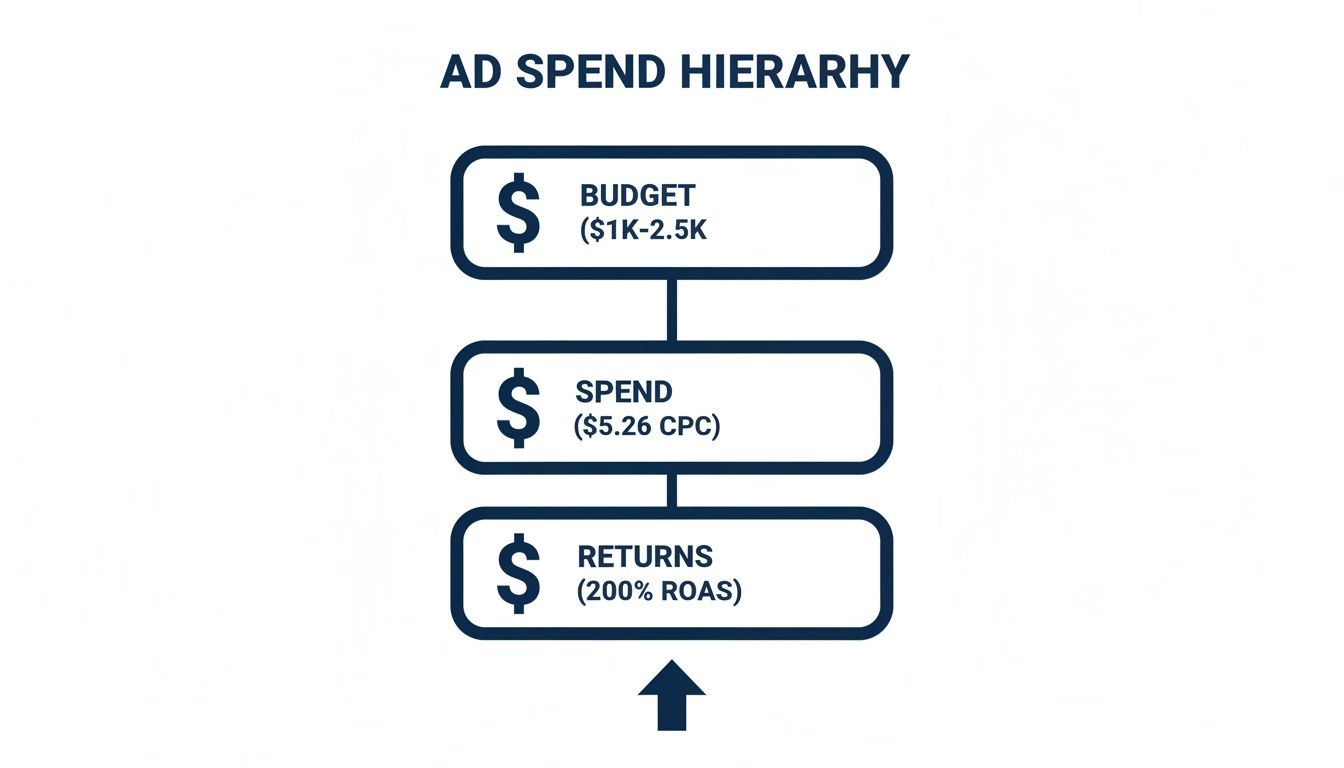
This visual makes it clear that even with a modest budget, achieving a 200% ROAS is a realistic and powerful goal for small businesses.
By focusing on Conversion Rate, CPA, and ROAS, you move beyond surface-level data and start making strategic decisions. These are the numbers that directly impact your bottom line, helping you understand not just if your ads are being seen, but if they are truly growing your business.
DIY Management Versus Hiring a Professional Agency
One of the first big questions you’ll face is whether to manage Google Ads yourself or bring in a professional agency. It’s the classic tug-of-war: time versus money, total control versus deep expertise. There’s no single right answer, as both paths have their moments to shine. The best choice for you really boils down to your specific situation, your skills, and what you’re trying to achieve.
Going the DIY route is often tempting, especially if you’re keen on keeping costs down and having your hands on the controls. This can be a smart move, particularly for businesses with smaller budgets and a willingness to get into the weeds and learn the platform. After all, nobody knows your business, your customers, and your industry better than you do. That’s a huge advantage when it comes to writing ad copy and picking keywords.
But let's be honest—the DIY path has a seriously steep learning curve. Google Ads looks simple on the surface, but it's incredibly complex underneath. One small mistake, like targeting the wrong audience or messing up your conversion tracking, can burn through your budget in a heartbeat. It’s also not a "set and forget" deal. Proper management demands daily check-ins, weekly analysis, and ongoing tweaks to stay effective.
The Value of Professional Expertise
On the other side, you have the option of hiring a professional agency. Think of it like hiring a specialist accountant or a lawyer. Sure, you could probably figure out your taxes or a legal contract on your own, but an expert brings years of focused experience, strategic know-how, and access to powerful tools that get you a much better result.
A good agency lives and breathes Google Ads every single day. They’ve run campaigns for all sorts of industries, seen what clicks and what flops, and they're always on top of the platform’s relentless updates. This kind of expertise means more efficient campaigns, a higher return on your ad spend, and far fewer expensive mistakes. They know how to squeeze every last drop of value out of your budget and turn it into a reliable growth engine for your business.
The real benefit of an agency isn’t just about saving you time; it’s about using their experience to get you a better outcome, and faster. They can often achieve in a few months what might take a business owner years of trial and error to learn.
Making the Right Choice for Your Business
So, how do you decide which way to go? It starts with an honest look at your resources, your skills, and your priorities. Hiring a professional agency is usually the smarter bet if any of these sound familiar:
- You Lack the Time: If you're already juggling a dozen other tasks to run your business, finding the hours needed to manage a Google Ads campaign properly is just not realistic.
- You Need Results Quickly: An experienced agency can get a campaign optimised and bringing in leads much faster than someone starting from square one.
- You're in a Competitive Market: Industries like trades and construction are battlegrounds with high competition and expensive clicks. You need expert management to avoid being outspent and outmanoeuvred.
- You Want a Strategic Partner: The best agencies do more than just manage ads. They provide valuable insights on your landing pages, what’s happening in your market, and your overall digital strategy.
To help you navigate this decision, we’ve put together a detailed checklist in our guide on how to choose a pay-per-click agency.
Ultimately, effective Google Ads management is a crucial investment in the growth of your business. Whether you decide to build the skills yourself or partner with an expert, the most important thing is to ensure your campaigns are actively and strategically guided towards your goals. For many Australian businesses, working with a professional team is the most direct and reliable path to a strong return on their advertising investment.
The Future of Advertising with AI and Automation
The way people find information is changing, and it’s happening faster than ever. Artificial intelligence is at the centre of this shift, and it’s completely reshaping what effective Google Ads management looks like today—and what it will demand tomorrow.
This isn’t some far-off concept. Automation is now a core part of modern advertising, not just a flashy add-on. Think of it as having a tireless digital strategist working around the clock to fine-tune your campaigns, making decisions at a scale no human ever could. This intelligence is already built into powerful tools you can start using right now.
The Rise of AI-Driven Campaigns
Campaigns like Performance Max are the perfect example of this evolution in action. Instead of you needing to manually tweak every single bid and targeting setting, these campaigns use machine learning to do all the heavy lifting. Your job is to provide the right inputs: your business goals, your budget, and your creative assets like headlines, images, and videos. From there, Google's AI takes the reins.
The system then automates several critical processes:
- Smart Bidding: It analyses thousands of signals in real-time to set the perfect bid for each auction, all geared towards maximising your conversions or the value of those conversions.
- Audience Targeting: It uncovers new customer segments you might never have thought of, reaching people across Google's entire network—from Search and YouTube to the Display Network and Gmail.
- Creative Optimisation: It automatically tests and combines your headlines, descriptions, and images to create the most effective ad for different audiences and platforms.
This approach allows your campaigns to learn and adapt at a speed that’s simply impossible to match manually. It’s all about letting the technology handle the complex data crunching so you can focus on the big-picture strategy.
Preparing for a Conversational Search World
This shift towards automation is tied to a much bigger trend: the rise of conversational search and AI-powered answer engines. People are no longer just punching keywords into a search bar. They’re asking questions to voice assistants and getting instant, summarised answers from large language models (LLMs).
This changes the game entirely. Your business needs to be visible not just in a list of blue links, but as the definitive answer to a user's question. This is where a modern, cohesive digital strategy becomes absolutely vital. Your Google Ads, your website's content, and your SEO efforts must all work together seamlessly.
The goal is to ensure that when an AI model is looking for the best local plumber or the top-rated restaurant in Broadbeach, it finds your business and presents it as the most credible solution.
This is the essence of future-proofing your online presence. Effective Google Ads management in the years ahead won't just be about winning the next click. It will be about securing your place in this new ecosystem, making sure you are found wherever—and however—your customers are searching.
Got Questions About Google Ads Management? We've Got Answers
We hear a lot of the same questions from Australian business owners trying to get their heads around Google Ads. Here are some straight answers to the most common ones.
How Long Until I Actually See Results?
You'll start seeing data like clicks and impressions almost immediately, but don't confuse that with actual results. Getting a stable, positive return on your ad spend is a marathon, not a sprint—it typically takes three to six months.
That initial period is crucial. It’s when we’re gathering data, testing what resonates with your audience, and refining your campaigns so they’re not just spending money, but making it. Patience is everything; a strategic, consistent effort is what leads to long-term success.
Can I Get Away with a Really Small Budget?
Technically, yes, but trying to run a campaign on less than $30 a day in competitive Aussie markets like the Gold Coast is incredibly tough.
With such a small budget, you’re starving your campaign of the data it needs to learn and improve. Google's algorithm can't get enough information to figure out what works, and your campaign will likely struggle to gain any real momentum. We generally find a starting point of at least $1,000 a month is needed to make a real impact.
Isn't Google Ads Management Just Bidding on Keywords?
Not even close—that’s one of the biggest misconceptions out there.
Thinking that Google Ads is just about keywords is like thinking a chef's job is just about turning on the stove. Proper management is a much bigger picture. It involves digging deep into audience research, analysing what your competitors are doing, writing ad copy that actually connects with people, and making sure your landing pages are built to convert. On top of that, there's setting up pinpoint-accurate conversion tracking, constantly analysing performance, and making ongoing tweaks to optimise the entire customer journey.
Ready to turn your ad spend into predictable growth? The team at Titan Blue Australia has over 25 years of experience helping businesses across the Gold Coast and Australia succeed online. Get in touch with us today to discuss your digital strategy.
Make Titan Blue a preferred source in Google
One click tells Google to surface our articles more often in Top Stories, AI Overviews and AI Mode.

AEO and GEO for Australian Businesses: How to Get Recommended by ChatGPT and Google AI Mode
A field guide to getting recommended by AI answer engines in Australia, built on our…

Web Design Mistakes Killing Your AI Visibility (2026)
The web design mistakes killing your AI visibility in 2026, and how to fix each…

AEO Website Design Checklist 2026: The Complete Build Guide
A practical AEO website design checklist for 2026 covering crawlability, schema markup, content structure, Core…