

Last updated:
Every Gold Coast shop owner knows the frustration when potential customers leave a website without making a purchase. In a competitive market where first impressions count, website design is more than looks—it connects your business goals to what your customers truly need. Mastering the core principles of site layout and user experience transforms casual browsers into loyal buyers and sets your business apart from competitors.
Table of Contents
- Website Design Fundamentals Explained Clearly
- Key Elements of Effective Site Layouts
- Types of Website Designs for Businesses
- SEO Essentials and Legal Compliance
- Common Mistakes and How to Avoid Them
Key Takeaways
| Point | Details |
|---|---|
| Effective Design Matters | A well-designed website is crucial for converting visitors into customers by combining visual appeal with functionality. |
| Prioritise Mobile Optimisation | Ensure your site performs flawlessly on mobile devices, as a significant portion of users browse on their phones. |
| Simplify Navigation | Create clear and logical navigation to prevent user frustration and ensure visitors can find what they need easily. |
| Focus on SEO and Compliance | Prioritising SEO and adhering to legal requirements is essential for visibility and avoiding penalties that could harm your business. |
Website Design Fundamentals Explained Clearly
Website design is far more than aesthetics. It’s about connecting your business goals with what your customers actually need when they land on your site. A well-designed website converts visitors into paying customers. Poor design sends them to your competitors instead.
Think of your website as your shop front. If someone walks past and the window display is confusing or unwelcoming, they won’t enter. The same applies online. Your website must communicate clearly, guide visitors logically, and make it easy for them to take action.
What Makes Effective Website Design
Website design combines multiple disciplines working together. Understanding user experience and interaction psychology is fundamental to creating sites that actually perform. You need to balance visual appeal with functional clarity.
Here’s what separates good websites from great ones:
- User behaviour matters: Visitors scan pages in patterns. Your design must guide their eyes to what matters most.
- Speed impacts everything: Slow websites lose customers within seconds. Performance is non-negotiable.
- Mobile comes first: More Gold Coast shoppers browse on phones than desktops. Your site must work flawlessly on mobile.
- Clear navigation saves time: Visitors shouldn’t hunt for what they need. Structure your menu logically.
- Calls-to-action drive results: Buttons, forms, and contact links must be obvious and compelling.
Your website must work harder than traditional marketing. It’s available 24/7, building trust and generating leads while you sleep.
Core Design Principles for Gold Coast Retailers
Retail businesses need websites that sell. Whether you’re selling physical products or services, certain principles apply universally.
Simplicity beats complexity every single time. Too many colours, fonts, or competing elements confuse visitors. They leave. Your site should look intentional and organised.
Consistency builds confidence. Use the same colours, fonts, and layout patterns throughout. Visitors develop a rhythm and trust your professionalism.

White space is your friend. Empty space around content makes everything easier to read and digest. It’s not wasted space; it’s breathing room.
Your website should also reflect your brand identity. Colours, imagery, and tone all communicate what you’re about before anyone reads a single word. For Gold Coast businesses, many use ocean blues, warm tones, or modern minimalism. Choose what represents you authentically.
Why This Matters for Your Business
Your website is your hardest-working employee. It doesn’t take holidays. It answers questions at 3 AM. It showcases your products without you standing there explaining them.
A poorly designed website costs you sales. It damages your reputation. It makes you look outdated compared to competitors. Conversely, a thoughtfully designed website builds trust, establishes authority, and converts browsers into buyers.
Gold Coast customers expect professionalism online. They compare you instantly to similar businesses. If your site feels unfinished or confusing, they assume your business is too.
Pro tip: Start by analysing your three main competitors’ websites. Note what works, what confuses you, and what makes you trust or distrust them. Your design should clear those same hurdles better than they do.
Key Elements of Effective Site Layouts
Your website’s layout is the blueprint for visitor success. It’s not just about looking nice; it’s about guiding people through your content in a logical, intuitive way. A poor layout confuses visitors and kills conversions. A solid layout makes everything feel effortless.
Think of your layout like a supermarket. Products in logical sections, clear signage, and easy checkout. Customers find what they need quickly. Your website should work the same way.
The Core Components
Every effective site layout includes several essential elements working in harmony. Understanding usability and visual hierarchy principles is crucial for creating layouts that keep visitors engaged.
Here are the non-negotiables:
- Header section: Your logo, main navigation, and search bar live here. It’s usually the first thing visitors see.
- Hero area: A bold visual or statement that immediately communicates what you do. Make it count.
- Content zones: Information organised into clear, scannable sections. Avoid walls of text.
- Sidebar or secondary navigation: Additional options or related content that doesn’t clutter the main flow.
- Footer: Contact details, links, social media, and legal information. Many visitors scroll here.
- Call-to-action buttons: Contact forms, “Buy Now”, “Get Started”. Make them visible and compelling.
Your layout must guide visitors to what matters most, not hide it behind confusing menus or excessive scrolling.
Visual Hierarchy Matters
Visual hierarchy tells visitors what to focus on first. Size, colour, and positioning create this hierarchy naturally.
Larger elements grab attention. Important information should be larger. Bright colours stand out from neutral backgrounds. Strategic placement—above the fold, at eye level—increases impact.
Gold Coast retailers often struggle with cramming too much onto one page. Resist this urge. Prioritise ruthlessly. What’s the one thing you want visitors to do?
Navigation: The Silent Guide
Navigation should be so obvious visitors don’t think about it. They just follow it. Menus work best when they’re simple, consistent, and predictable.
Most visitors expect navigation at the top or top-left. Don’t be clever and hide it. Stick to conventions. If your menu confuses people, they’ll leave.
Mobile navigation requires special attention. Hamburger menus work, but test that they’re easy to use.
Responsive Design is Non-Negotiable
Your layout must adapt beautifully to phones, tablets, and desktops. Responsive design principles ensure your site works everywhere. A layout that looks great on desktop but breaks on mobile costs you sales.
Test on real devices. Don’t assume your design works—verify it.
Pro tip: Design your mobile layout first, then expand upwards. Mobile constraints force prioritisation. Once you know what truly matters, desktop designs become easier to plan.
Types of Website Designs for Businesses
Not all websites are created equal. Your business needs a specific type of website matched to your goals. A retail shop needs something completely different from a law firm. Understanding which type suits you is the first step toward success.
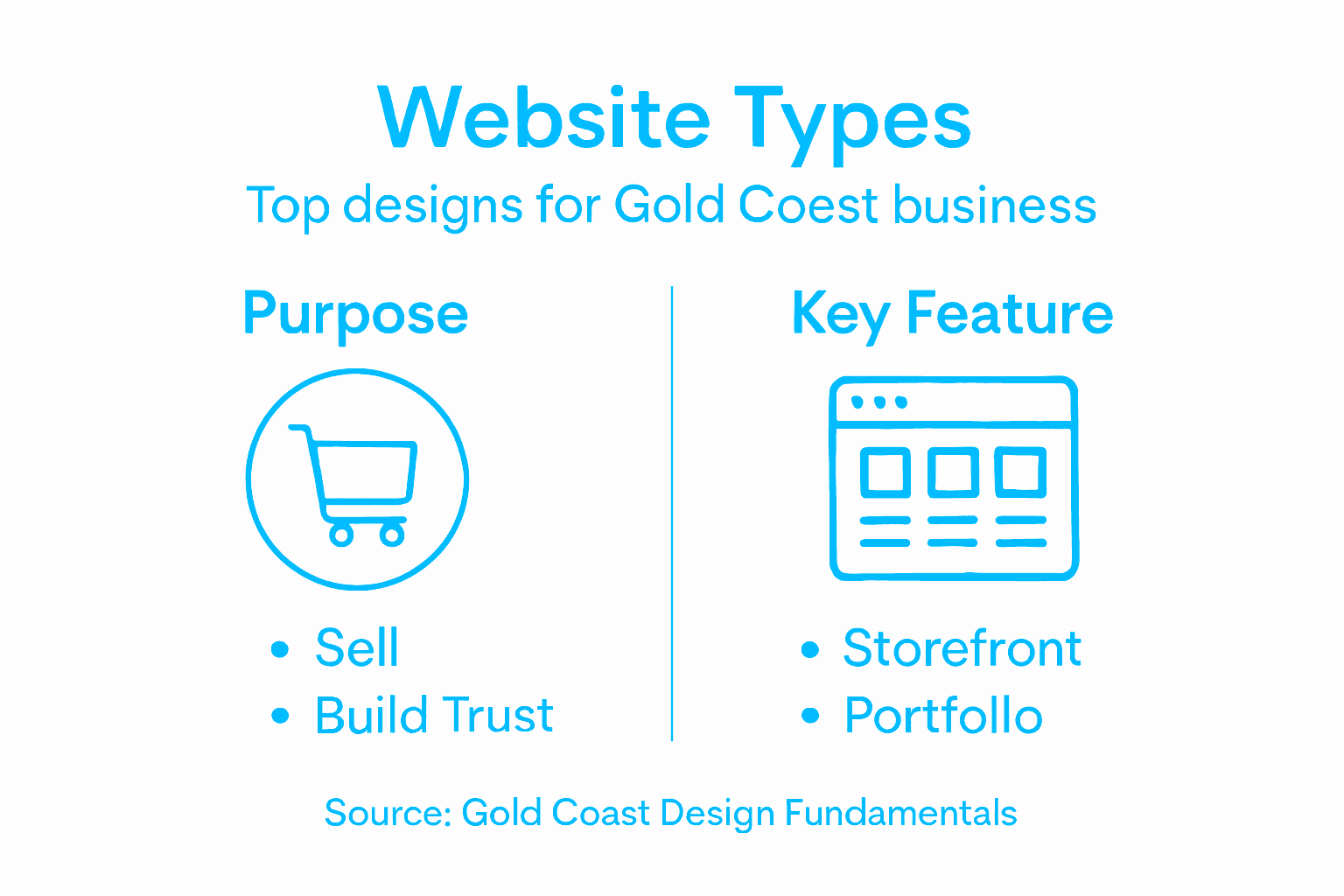
Choosing the wrong design type wastes money and delivers poor results. The right type attracts customers, builds trust, and generates revenue.
E-Commerce Websites
E-commerce sites are built to sell products online. They need shopping carts, payment systems, and product catalogues. Different design approaches for online retail help businesses showcase inventory and streamline purchases.
Gold Coast retailers often underestimate what a proper e-commerce site requires. You need:
- High-quality product photography
- Clear pricing and shipping information
- Secure payment processing
- Easy checkout (fewer steps = more sales)
- Customer reviews and ratings
- Mobile-optimised shopping experience
E-commerce sites typically cost more upfront but generate ongoing revenue. The investment pays dividends quickly when designed properly.
E-commerce websites must prioritise trust signals. Security badges, customer testimonials, and return policies reassure buyers before they hand over money.
Corporate and Branding Websites
Corporate websites establish credibility and communicate your company’s story. They’re not primarily about selling products; they’re about building authority and trust.
These sites typically feature company information, service descriptions, team bios, and case studies. They serve as your digital headquarters.
A corporate site needs to look professional and polished. Poor design damages your reputation instantly.
Portfolio and Showcase Sites
Creatives, agencies, and service providers use portfolio sites to display their work. Photographers, designers, and consultants rely heavily on these.
Portfolio sites showcase your best work visually. Images matter more than words here. The design itself demonstrates your capabilities.
Blog and Content Websites
Blogs drive traffic through consistent, valuable content. They’re perfect for establishing expertise and improving search visibility.
Content websites prioritise readability over flashy design. Clear typography, logical structure, and easy navigation matter most.
Membership and Community Sites
Some businesses operate membership or community platforms. These require login systems, user profiles, and member-only content areas.
These are more complex and expensive to build but create loyal audiences and recurring revenue.
Choosing Your Type
Your business model determines your website type. Ask yourself: Am I selling products, building authority, showcasing work, or creating community?
Most successful Gold Coast businesses combine elements. A retail site might include a blog. A corporate site might have a shop.
To help you decide which website style best matches your business, see this comparison of common site types:
| Website Type | Main Purpose | Key Features | Ideal For |
|---|---|---|---|
| E-Commerce | Online sales | Shopping cart, secure payments | Retailers, product sellers |
| Corporate/Branding | Credibility and authority | Company info, case studies | Professional services |
| Portfolio/Showcase | Displaying previous work | Project galleries, large images | Creatives, agencies |
| Blog/Content | Demonstrating expertise | Frequent posts, clear structure | Writers, educators |
| Membership/Community | Building loyal audiences | Member login, exclusive content | Clubs, subscription sites |
Pro tip: Start with your primary goal. Everything else should support that goal. Too many purposes create confusing websites that do nothing well.
SEO Essentials and Legal Compliance
SEO and legal compliance aren’t optional extras. They’re fundamental to running a successful website in Australia. Ignore either one, and you’ll face penalties, lost traffic, or worse.
A beautifully designed website means nothing if nobody can find it. And a website that breaks Australian law exposes you to serious liability. Both matter equally.
Why SEO Matters for Your Bottom Line
Search engine optimisation gets your website in front of people actively looking for what you sell. When someone searches “plumber Gold Coast” or “retail shop near me”, you want to appear first.
Without SEO, you’re invisible. Competitors who invest in SEO will capture the customers you’re losing.
SEO Fundamentals for Websites
Web content discoverability through search optimisation requires understanding how search engines work. They crawl your site, read your content, and rank pages based on relevance and quality.
Key SEO elements include:
- Keywords: Use words your customers search for naturally throughout your content
- Page titles and meta descriptions: These appear in search results; make them compelling
- Headings and structure: Organise content logically with clear headings
- Internal links: Connect related pages to guide visitors and search engines
- Mobile optimisation: Faster, mobile-friendly sites rank higher
- Quality content: Valuable, original content outranks thin or copied material
SEO is a marathon, not a sprint. Results take months, but the payoff is consistent, free traffic flowing to your site indefinitely.
Australian Legal Compliance Requirements
Australian law imposes specific requirements on websites. Ignoring these creates legal exposure and potential fines.
Privacy laws require you to protect customer data. If you collect emails, addresses, or payment information, you must safeguard it and be transparent about how you use it.
Copyright law means you can’t use others’ images, text, or designs without permission. This includes stock photos if you haven’t purchased the licence.
Accessibility standards require websites to be usable by people with disabilities. Text on images, keyboard navigation, and screen reader compatibility matter.
Data Protection and Customer Trust
Handling privacy regulations and data security compliance builds customer trust. Clearly state your privacy policy. Display security badges. Encrypt sensitive information.
Customers won’t buy from sites they don’t trust. Legal compliance isn’t just about avoiding penalties; it’s about protecting your reputation.
Getting It Right
SEO and compliance aren’t burdensome. They’re investments in your website’s success and legal safety. Small oversights create large problems.
Start with the basics: quality content, mobile optimisation, and a clear privacy policy. Build from there.
Pro tip: Audit your website today for basic compliance issues: Is your privacy policy visible? Do your images have proper permissions? Does your site work on mobile? Fix these first, then focus on SEO improvements.
Common Mistakes and How to Avoid Them
Most websites fail because of preventable mistakes. These aren’t technical failures; they’re oversights that damage user experience and kill conversions. Learning what to avoid saves you money and embarrassment.
Gold Coast businesses often repeat the same errors. Understanding these pitfalls gives you a competitive advantage.
Slow Loading Times
A slow website loses visitors within seconds. If your site takes more than three seconds to load, people leave. They don’t wait. They go to competitors instead.
Common design mistakes affecting site performance include large, unoptimised images and bloated code. Every element adds weight. Every millisecond matters.
How to avoid this:
- Compress images before uploading them
- Use a content delivery network (CDN) for faster global access
- Minimise unnecessary plugins and scripts
- Choose fast hosting specifically designed for websites
- Test your site speed regularly using free tools
Speed isn’t just user experience; it affects your search rankings. Google favours fast sites.
Poor Mobile Experience
More than half your visitors use phones. If your site doesn’t work smoothly on mobile, you’ve lost them.
Mobile mistakes include text too small to read, buttons hard to tap, and layouts that don’t resize properly. Test your site on actual phones, not just computer browsers.
Mobile isn’t an afterthought anymore. It’s your primary platform. Design for mobile first, then expand to desktop.
Unclear Navigation and Confusing Layout
Visitors should find what they need instantly. If they can’t, they leave. Confusing menus, buried contact information, and illogical page structure frustrate users.
Your navigation should be predictable. Visitors expect certain things in certain places. Don’t be creative with menu placement; be clear.
Ignoring Accessibility
Accessibility standards and inclusive design practices aren’t optional. They’re legal requirements in Australia. Beyond that, they expand your audience.
Accessibility includes:
- Text descriptions for all images
- Keyboard navigation throughout the site
- Sufficient colour contrast for readability
- Captions for videos
- Clear, simple language
Accessibility benefits everyone. It’s not just for people with disabilities.
Outdated or Poor Quality Content
Broken links, outdated information, and spelling errors damage trust. Visitors assume your business is unprofessional if your website looks neglected.
Update your content regularly. Fix broken links. Proofread everything.
Here is a summary of frequent website design mistakes and their direct impact on business success:
| Mistake | Effect on Visitors | Business Impact |
|---|---|---|
| Slow loading speeds | Frustration, early exits | Lost sales, lower rankings |
| Unclear navigation | Inability to find information | Fewer enquiries or purchases |
| Poor mobile optimisation | Awkward browsing experience | High bounce rates |
| Neglecting accessibility | Excludes disabled users | Legal risks, smaller reach |
| Outdated content | Loss of trust | Damaged reputation |
Missing or Weak Calls-to-Action
Visitors need to know what to do next. Without clear calls-to-action, they’ll leave without contacting you or buying anything.
Make buttons obvious. Use action-oriented language: “Get Started”, “Request a Quote”, “Shop Now”. Don’t be subtle.
Pro tip: Create a simple checklist of these mistakes and audit your website quarterly. One small oversight becomes a major problem quickly when left unaddressed.
Unlock Your Gold Coast Business Potential with Expert Website Design
Struggling to convert visitors or worried your website is driving customers away rather than attracting them? The article highlights critical challenges like unclear navigation, slow loading speeds, and poor mobile optimisation that directly undermine your success online. At Titan Blue, we understand these pain points well and specialise in creating visually appealing, fast, and mobile-first websites that guide your visitors seamlessly to take action. By applying proven website design fundamentals, we help Gold Coast businesses build trust and increase conversions through clear calls-to-action and intuitive layouts.
Now is the time to partner with a local digital marketing agency that knows how to combine innovative SEO strategies and custom website design to grow your brand. Explore our full range of services including e-commerce platforms, AI Search optimisation, and targeted advertising campaigns to attract more customers and boost sales. Visit Titan Blue to start transforming your online presence and see measurable results designed specifically for your business goals.
Frequently Asked Questions
What are the key elements of effective website design?
Effective website design includes user-friendly layouts, clear navigation, responsive design, fast loading times, and compelling calls-to-action. Each element plays a crucial role in guiding visitors and improving conversion rates.
How can I make my website mobile-friendly?
To ensure your website is mobile-friendly, use responsive design principles, optimise images for faster loading, and ensure navigation is simple and intuitive on smaller screens. Testing on actual mobile devices is essential to validate the user experience.
What are some common mistakes in website design?
Common mistakes include slow loading speeds, unclear navigation, poor mobile optimisation, neglecting accessibility standards, and outdated content. Addressing these issues can significantly enhance user experience and ultimately improve your business’s success.
Why is SEO important for my website?
SEO is crucial because it helps your website become discoverable through search engines. By properly optimising your site, you can attract more visitors actively looking for your products or services, leading to increased traffic and potential sales.
Recommended
- Role of Web Design – Driving Gold Coast E-Commerce
- Web Design Gold Coast That Drives Growth – Titan Blue Australia
- Winning Online with Gold Coast Web Design – Titan Blue Australia
- Boost Conversions with web page design gold coast
Make Titan Blue a preferred source in Google
One click tells Google to surface our articles more often in Top Stories, AI Overviews and AI Mode.

Best Dental Website Design Agencies in Australia: 7 Compared
Best dental website design agencies in Australia 2026: seven compared on dental proof, booking, AHPRA…

Childcare Centre Website Design Australia: The 2026 Guide
Childcare centre website design Australia: show hours, ages and enrolment as text so parents and…

Electrician Website Design Australia: The 2026 Guide
Electrician website design Australia: what to build, what we found on eight Gold Coast electrician…