


Last updated:
Imagine your business’s online presence shifting from a simple directory listing to having a dedicated expert personally recommend you to customers. That’s the real power of AI search. It’s a fundamental change in how people find and connect with local businesses like yours.
How AI Search Is Redefining Customer Discovery

The way customers find you is changing, and fast. For years, traditional search has worked like a digital phone book. A potential customer typed in what they wanted, got a list of blue links, and was left to figure out the best option on their own.
That familiar process is now being turned on its head. Modern AI search acts less like a phone book and more like a trusted local concierge. It doesn't just hand over a list; it tries to understand what the user really wants and gives them a direct, tailored recommendation.
From Listing to Recommendation
Think about the difference. A phone book simply lists every plumber in town. A good concierge, on the other hand, listens to your specific problem—like a burst pipe in the middle of the night—and recommends the one plumber who is best suited for that exact emergency. This is the new reality of search.
AI-driven features, like Google's AI Overviews, are becoming the new 'front door' for many customer journeys. They pull information from multiple websites, reviews, and articles to build a single, authoritative answer, effectively making the recommendation for the user.
For a local business, this means a few critical things:
- Expertise is rewarded: AI systems are built to find and feature the most knowledgeable and trustworthy sources.
- Direct answers matter: Content that directly answers a customer's question is far more likely to get picked.
- Visibility is changing: Showing up in an AI-generated answer is becoming just as important as being the number one organic result.
This directly impacts tradespeople, restaurants, and hospitality businesses. A customer searching for the "best kid-friendly restaurant near me with a playground" might now get a specific suggestion from an AI Overview, complete with details it pulled from the restaurant's website and recent reviews. The businesses that provide clear, helpful, and specific information are the ones that get recommended.
To see how this applies to your local area, check out our guide on AI-powered search on the Gold Coast.
Understanding this new dynamic isn’t just about keeping up with tech trends; it’s about making sure your business is positioned to attract high-intent customers who are ready to make a decision. Ignoring this shift means risking becoming invisible to a growing number of potential clients who now rely on AI to give them the answer.
Understanding the Mechanics of AI Search

To stay ahead, you need to get inside the head of an AI search engine. The way they work is a world away from the traditional search we’ve all been using for the last twenty years. The old game was all about matching keywords; the new one is about delivering answers.
This change is so fundamental it has created a whole new discipline: Answer Engine Optimisation (AEO). It's no longer good enough to simply rank for a term like "emergency plumber Gold Coast." The entire game has shifted towards understanding and solving the real-world problem behind the search.
Beyond Keywords to User Intent
The biggest difference is the jump from simply matching words to truly understanding a user's intent. An AI search engine doesn't just register the words someone types; it figures out the context, the urgency, and what they’re actually trying to accomplish.
Think about it. Someone frantically typing "water is leaking through my ceiling what do I do" isn't looking for a blog post on plumbing history. A traditional search engine might just hunt for pages with those keywords. An AI, however, picks up on the panic. It knows this is a cry for immediate help.
The AI then pulls together information from what it deems the most reliable and helpful sources online. Instead of just giving you a list of links to sort through, it builds a single, direct answer, often recommending specific steps to take or even local professionals who can solve the problem right now. To really get your head around the tech driving this, it’s worth learning more about what Large Language Models are and how they operate.
How AI Processes Your Website Content
An AI doesn't "read" your website like a person. It uses a process called parsing, where it breaks all your content down into small, individual chunks of information. It then looks at each piece—a sentence, a heading, a bullet point—and judges how well it answers a specific question.
This makes the structure of your website content more important than ever. If your site is just a huge wall of text, the AI will struggle to find and pull out the clear, concise facts it needs to build an answer. It’s like trying to find a single ingredient in a messy pantry.
Well-structured content, on the other hand, makes the AI's job easy. It can quickly pinpoint and lift the exact snippet of information it needs. This is precisely why old-school SEO tactics, which focused heavily on keyword stuffing and backlinks, are starting to fail. They just weren’t built for a world that demands direct answers.
Building Content for an Answer Engine
To win with AEO, you have to organise your website content to answer questions clearly and directly. Here are the key things an AI is looking for when it scans your site:
-
Clear Headings: Your H2 and H3 headings need to act like signposts. Instead of a vague heading like "Our Services," use something specific like "24/7 Emergency Burst Pipe Repairs."
-
Question-and-Answer Formats: This is the most direct way to get featured. A section titled "How quickly can you get to my home?" followed by a straight, simple answer is pure gold for an answer engine.
-
Actionable Lists: Bullet points and numbered lists are perfect for breaking down instructions or features. A plumber, for instance, could have a list of "Signs You Have a Hidden Water Leak."
If your content isn't structured for this kind of clarity, it's going to be left behind. The businesses that organise their expertise into helpful, easy-to-digest formats will be the ones whose information is used to build the AI-generated answers your future customers see first.
The Impact of AI Search on Small Businesses
The move towards AI search is more than just a tech update—it’s fundamentally changing how customers find your small business online. For years, the game was simple: get people to click on your website. Now, with AI serving up instant answers, that entire model is being flipped on its head.
This new reality presents a huge challenge for local businesses in trades, hospitality, and construction. It’s a trend called the 'zero-click search.' A potential customer asks a question, gets a complete answer from an AI Overview, and never bothers clicking through to your website.
The Rise of Zero-Click Searches
Picture a homeowner on the Gold Coast planning a renovation. They might search, "how to choose a plumber for Gold Coast renovations." In the past, they’d get a list of websites and blogs to sift through. Today, an AI search engine can pull the best advice from all over the web and present it as one tidy summary.
If your website has the best information, that’s fantastic—but if the AI gives the customer everything they need in its summary, you might never get that website visit. This isn't a future problem; it's happening now. For example, by 2026, Google AI Overviews are appearing in 21% of all Australian search results, but they're also tied to a 35% drop in click-through rates. This has driven zero-click searches to 27.2% of all queries in 2025, a massive jump.
This should be a wake-up call. If a customer can get your restaurant’s gluten-free options or a simple DIY fix directly from the search results, your website loses a crucial touchpoint and a potential lead. The data is especially clear for longer, more specific questions, with AI Overviews showing up in 46% of searches with seven or more words—exactly the kind of questions serious customers ask.
The Challenge Is Also the Opportunity
While a drop in website traffic sounds alarming, it’s not time to panic. It’s time to refocus. The game is no longer about getting the most clicks; it’s about attracting the right ones.
Think about it. The customer who gets an instant answer from an AI is often past the initial "just browsing" stage. They’re looking to make a decision. If your business is named as the source for that answer, you gain incredible credibility.
By becoming the go-to authority that an AI trusts and references, your business can capture highly qualified customers who are ready to act. You are no longer just another link on a page; you are the endorsed solution. This creates a powerful new opening for your business. Instead of fighting for broad, high-volume keywords, the goal is to become the definitive answer for specific, high-intent questions. To really nail this, it helps to understand the mechanics of how AI search engines work.
Becoming the Featured Authority
Being the source for an AI-generated answer is the new top ranking. It positions your business as an expert in your field and builds trust before a customer even lands on your site. For small businesses, this can completely level the playing field. You don't need a massive marketing budget; you just need to provide the clearest, most helpful answers.
- For a local builder: This means creating content that definitively answers, "What are the building regulations for a deck in Brisbane?"
- For a restaurant: This means having a webpage that clearly answers, "Do you have vegan options for a large group booking?"
- For a solar installer: This means publishing a guide that answers, "What is the average cost of solar panel installation in Sydney?"
By shifting your marketing efforts to become a trusted source, you can turn the challenge of AI search into your biggest advantage. For more practical ideas on how to adapt, you might find our guide on 7 actionable small business marketing tips useful. The businesses that embrace this change and focus on providing genuine value are the ones that will thrive.
Your Action Plan for AI Search Readiness
Knowing that AI search is changing the game is one thing, but actually getting your business ready for it is another. A proactive approach is absolutely essential. You need to be positioned to benefit from these changes, not just react to them after the fact.
This plan focuses on two key areas: the way you create your content and the technical signals your website sends to AI models. It’s a dual strategy that covers all your bases.
The journey most businesses will go through as AI search becomes the new normal is illustrated below. It highlights the initial shock and the eventual opportunity.
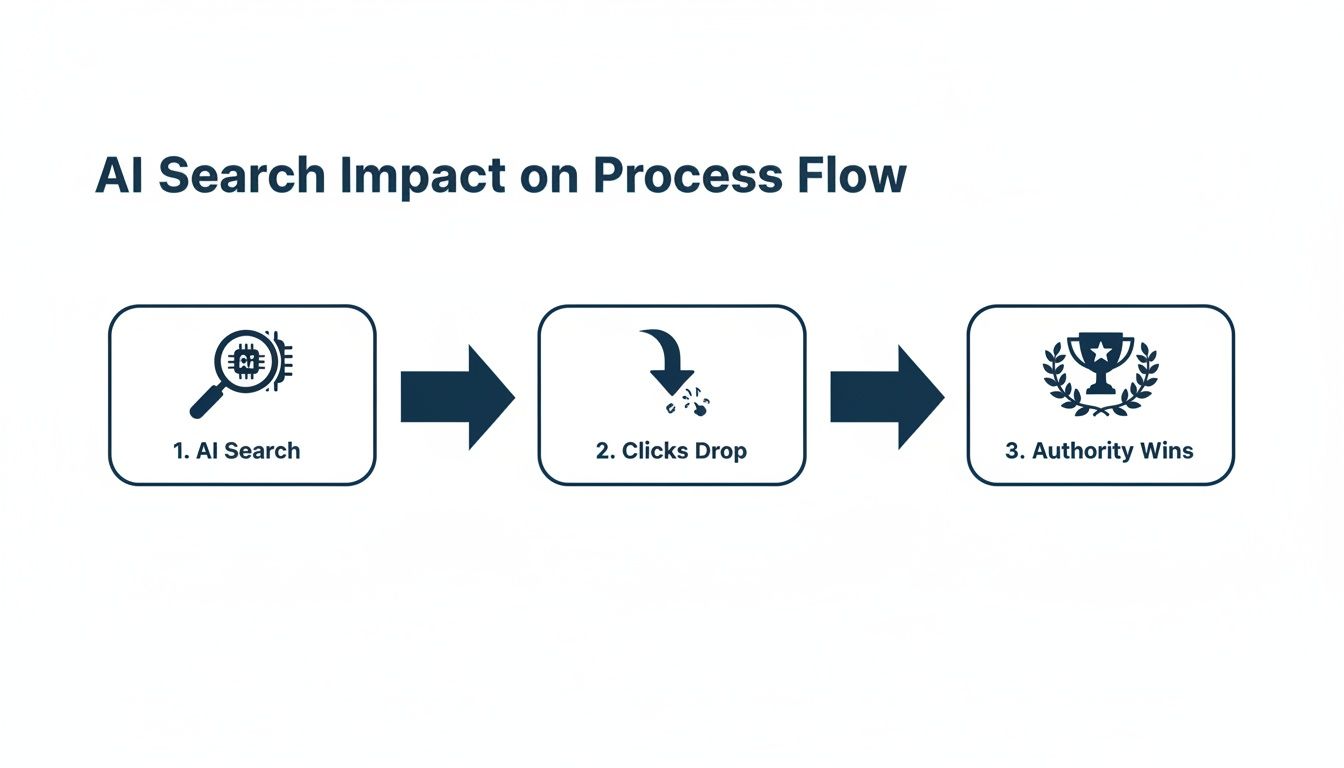
As you can see, an initial drop in clicks is common. But the businesses that adapt and build themselves up as a trusted authority will be the ones who ultimately win the most valuable, high-intent customers.
Create Content That Answers Questions
The single biggest change you need to make is to stop writing for search engines and start writing for your customers' real-world questions. AI systems are built to break down content into small pieces to find the most direct, helpful answer.
Your goal is to make your content the easiest and most authoritative source for the AI to pull from.
Think like your customers. What are the top ten questions a potential client asks you before they book your service or visit your restaurant? The answers need to be right there on your website, clear as day. This is the heart of what’s called Answer Engine Optimisation (AEO).
Here are a few practical ways to do this:
-
Build Question-and-Answer Sections: A dedicated FAQ page is a good start, but weaving Q&A formats directly into your service pages is even better. Use a clear heading for the question—like "How Long Does a Roof Replacement Take?"—followed by a short, direct answer.
-
Develop In-Depth Guides: For bigger topics, create comprehensive guides that cover a subject from A to Z. A solar installer could write the definitive guide on "Claiming Solar Rebates in Queensland," covering everything from eligibility to common mistakes. This move positions you as the go-to expert.
-
Use a Logical Structure: Clear headings and subheadings (H2s and H3s) act as signposts for both people and AI. Vague headings like "Our Products" are useless. Get specific with something like "Energy-Efficient Dishwashers for Open-Plan Kitchens."
This approach turns your website from a basic brochure into a genuinely useful resource. When an AI is looking for the best answer to a user’s problem, it will always favour content that is structured, clear, and packed with real expertise. For a deeper look at this, read our essential guide on making your website AI-ready.
Get Your Technical Foundations Right
While expert content is the most important piece of the puzzle, you also have to make sure AI can understand it on a technical level. This is where structured data, also known as Schema markup, comes into play.
Think of it as a set of digital labels you add to your website's code.
These labels don't change how your website looks to a person. Instead, they give search engines and AI systems critical context, telling them exactly what your content is about. This removes any guesswork and builds trust, making the AI more confident about using your information in its answers.
For a local business, this is incredibly powerful. You can explicitly label key information, such as:
- Your business name, address, and phone number (NAP): This confirms your location and service area.
- Your opening hours: Absolutely crucial for any restaurant, cafe, or retail shop.
- The specific services you offer: A plumber can label services like "Emergency Leak Repair" or "Hot Water System Installation."
- Customer reviews and ratings: This adds social proof and signals to the AI that you are a trusted business.
Implementing structured data might sound complicated, but many modern website platforms like WordPress have plugins that make it much simpler. The goal is to turn your plain text into organised data that a machine can interpret without any trouble.
Without these technical labels, an AI has to guess what your content means, making it far less likely to be chosen. By clearly marking up your information, you’re basically spoon-feeding the AI exactly what it needs to know, making you a more reliable and authoritative source.
How Local Businesses Win with AI Search
A great strategy is only worth something if it delivers real-world results. So, let’s move past the theory and look at how local businesses can actually use AI search to get more quotes, bookings, and sales. The goal is to stop being just another name on a long list and become the definitive answer for a customer's problem.
While many businesses are still on the fence, sitting back and doing nothing is becoming a bigger and bigger risk. We're already seeing Australian businesses start to lag behind. It’s not about getting bogged down in complicated tech; it's about making smart, practical changes. To see what’s possible, you need to understand how to boost local traffic with AI-powered SEO strategies.
This presents a huge opportunity for businesses that are willing to act. While others wait and see, you can get a massive head start by optimising for AI search right now.
From Builder to Local Authority
Let’s take a local builder in a packed suburban market. For years, they were stuck competing on generic keywords like "home renovations," constantly battling bigger companies with deeper pockets. But they completely changed the game by shifting their focus to what we call Answer Engine Optimisation (AEO).
Instead of just throwing up a gallery of project photos, they treated each one like a mini-case study, optimised not just for people but for AI.
For one project, they detailed its key features, titling it "Custom Alfresco Deck Extension in Robina." The description noted it was a 25-square-metre merbau timber deck for outdoor entertaining. They explained how they navigated council approvals and integrated a weatherproof outdoor kitchen, completing the build in three weeks. Using Schema markup, they clearly labeled the project’s location, materials used, and the "Deck Building" service provided.
So what happened? When a customer with high intent typed in a search like, "best builder for custom home extensions with an outdoor kitchen," the AI didn't just see a random photo. It saw a detailed, documented project that was a perfect match for the query. The builder's work was featured directly in the AI-generated summary, instantly positioning them as the go-to specialist and sending highly qualified leads their way.
The Solar Installer Who Owns the Answer
Now, picture a solar installer in New South Wales. They kept getting the same questions over and over about government rebates—a confusing but vital part of the decision-making process for customers. Instead of just answering them one by one, they decided to create the single best resource on the topic.
They published a deep-dive, easy-to-follow article titled "Your Complete Guide to Government Solar Rebates in NSW."
The guide was built from the ground up to be understood by AI. It used clear H2 and H3 headings to break down each stage of the rebate process, included a Q&A section answering common questions like "Am I eligible for the solar rebate?", and offered a simple bulleted list walking people through the step-by-step application.
Within weeks, their guide became the number one source for AI search answers about NSW solar rebates. Suddenly, they weren't just another company selling panels; they were the trusted expert helping people solve a complex problem. This built incredible trust and brought in a flood of quote requests from customers who already felt confident in their expertise.
These examples prove that winning with AI search isn’t about who has the biggest marketing budget. It’s about who is the most helpful. This approach connects your expertise directly with customers who are ready to buy, delivering a clear return on your investment.
It's a fact that many local businesses are dragging their feet. Research has shown that Australian leaders are slower to increase their AI investments compared to their global peers, creating a gap that proactive businesses can exploit.
Building a Future-Proof Digital Strategy
The way customers find you online is changing, and AI search is no longer a futuristic idea—it’s here, right now. For businesses in the trades, hospitality, and other local industries, this isn't just another trend. It’s a fundamental shift that requires a new game plan.
Sticking with old-school, reactive SEO tactics won’t cut it anymore. It’s time to get proactive and embrace what’s known as Answer Engine Optimisation (AEO).
This really boils down to two things: creating genuinely helpful content that solves your customers' problems and making sure your website's technical setup is crystal clear. The goal is no longer just to show up in a list of results, but to be the definitive answer that AI chooses to feature.
From Reactive SEO to Proactive AEO
The strategies we've covered are your roadmap to navigating this shift. To build a digital strategy that can stand the test of time, you first need a solid grasp of understanding AI SEO. It’s about changing your mindset to focus on clarity, real expertise, and what your customer actually wants, more than anything else.
Here are the key actions you need to take to secure your spot in this new environment:
- Create Authoritative Content: Answer your customers’ most common questions in detail. Position your business as the go-to expert they can trust.
- Implement Technical Precision: Use structured data (Schema) to label your business information so AI can easily read, understand, and trust it.
- Focus on User Intent: Move away from just stuffing keywords into your pages. Instead, focus on providing real solutions to the specific problems your customers have.
This is the moment to act with a clear plan. The "wait and see" approach is a recipe for being left behind, as the ground is already moving.
Sure, AI search brings challenges like zero-click searches and different user habits. But these are also huge opportunities for businesses that are ready to adapt. By becoming the trusted source an AI relies on, you get to connect with high-intent customers who are ready to make a decision.
Partnering with an expert who lives and breathes this new digital world is the fastest way to get ahead. Don't let your business get lost in the shuffle.
Schedule a consultation with Titan Blue today, and let us help you build a winning strategy for the new era of search.
Frequently Asked Questions About AI Search
Even with a clear game plan, it's natural to have a few questions about how AI search will actually affect your business. We get it. Here are some of the most common concerns we hear from local business owners across Australia, answered straight up.
Will SEO Still Matter with AI Search?
Yes, absolutely—but it’s changing. The fundamentals of good SEO, like having a fast, mobile-friendly website and using the right keywords, still form the bedrock of being found online. You can't skip the basics.
However, the game is shifting away from just stuffing keywords onto a page. The new focus is all about creating high-quality, genuinely expert content that gives a direct, satisfying answer to a person's question. This is what many are now calling Answer Engine Optimisation (AEO), and it’s the key to getting featured in an AI search result.
Can My Small Business Really Compete?
You bet. In fact, AI search is a massive opportunity for small businesses to level the playing field. AI models are designed to find the best, most helpful answer, not the one with the biggest marketing budget behind it.
This means a local tradie, cafe, or boutique hotel that provides a clear, specific answer to a local question has a real shot at appearing above a big national chain. Your unique local knowledge isn't just a bonus anymore; it's your competitive edge.
What Is the First Step I Should Take?
Start simple. Sit down and list the top ten questions you get from customers right before they decide to buy from you or book a service. Think about what they ask on the phone, in emails, or in person.
Once you have that list, create a dedicated page or a blog post answering each question, one by one. Your goal is to provide the most comprehensive, easy-to-understand answer available anywhere online. This one exercise is the most powerful first step you can take and the true foundation of a winning AEO strategy.
Ready to stop worrying about AI and start using it to win more customers? Titan Blue has over 25 years of experience guiding Australian businesses through every digital shift. We build future-proof strategies that ensure you're not just found, but featured. Contact us today to get started.
Make Titan Blue a preferred source in Google
One click tells Google to surface our articles more often in Top Stories, AI Overviews and AI Mode.

This Week in Australian AI Search: Google’s UGC Data Program
Google's UGC Fresh Data Program and Indexing API quota update, plus our Google AI Mode…

Google AI Mode Adds Official Links: What It Means for Australia
Google is adding more links to AI Mode and testing an official websites section. Here…

Best AEO and GEO Agencies in Australia (2026): 7 Compared
Best AEO agency and GEO agency in Australia, compared: seven agencies, what their own pages…