

So, how much does a professional website actually cost in Australia? The answer can be anything from a few thousand dollars for a simple site to well over $50,000 for a complex e-commerce platform. It all comes down to what your business needs, the features you want, and who you get to build it.
Your Quick Guide to Website Creation Costs

Trying to figure out the investment for a new website can feel like you're navigating a maze. The prices seem to jump all over the place, and it’s tough to know what you’re really paying for. This guide is here to cut through that noise and give you a clear financial snapshot for Australian businesses in 2026.
Think of this as the no-fluff summary for your website project. We’re breaking down complicated pricing into straightforward, easy-to-understand ranges. Our goal is to give you a solid idea of the budget you’ll need for different types of websites, helping you line up your financial planning with your business goals right from the start.
Typical Website Investment Ranges
Let’s get straight to the numbers. The Australian market for web development has some pretty wide price variations depending on the scale of the project. Data from 2026 shows a standard 6-10 page business website generally costs between AUD $5,000 and $10,000+.
For small businesses that just need a basic informational site, you might see costs as low as AUD $2,000. On the other end, fully custom-designed websites with advanced features can range from AUD $15,000 to $25,000+, while large-scale e-commerce stores often push past the AUD $50,000 mark.
This pricing tells us one thing: the sweet spot for most small to medium businesses is the $5,000-$15,000 investment range. This budget typically gets you all the essential tools you need to attract customers and build a solid online presence, especially for businesses in trades, construction, and hospitality.
Moving from Cost to Value
Seeing your website as just another expense on a spreadsheet is a common mistake. A well-built website isn't a cost—it's an investment engine for growth. It’s designed to generate leads, drive sales, and build your brand 24/7.
To really see how profitable this investment can be, you need to connect your website’s performance to actual business results. A great place to start is to learn how to calculate cost per lead, which helps you maximise your marketing return.
Before you get lost in the details of what drives your website creation cost, it’s crucial to have a clear plan. A detailed strategy ensures your budget goes toward features that deliver real value. To get started on the right foot, have a look at our guide on creating a comprehensive website planning checklist.
What Really Drives Your Website Cost
Ever wondered why one quote for a new website comes in at $5,000, while another lands at a staggering $25,000? It’s a common question for Australian business owners, and getting to the bottom of that price tag is key to making a smart investment. Let's peel back the layers on what actually shapes the final cost of a new site.
Think of it like building a house. You wouldn't expect a one-bedroom kit home to cost the same as a five-bedroom, custom-designed waterfront property. The same logic applies to your website.
Design and Customisation: The Blueprint of Your Site
The first major cost driver is how much design and customisation you need. This is the difference between picking a pre-made floor plan and hiring an architect to design a one-of-a-kind home from the ground up.
- Template-Based Design: This is your most budget-friendly route. We take a high-quality, pre-made design and customise it with your brand’s colours, logo, and content. It’s fast and effective for businesses that need a professional online presence without a huge upfront investment.
- Custom Design: This is the full architectural blueprint for your digital home. A designer creates a completely unique look and user experience tailored specifically to your brand and your customers. This involves a lot more strategy, creative thinking, and time, which is reflected in the higher cost.
A custom design gives you complete control over every single pixel, making sure your site stands out from the competition. For businesses serious about building a strong, memorable brand, that extra investment often pays for itself.
Functionality: Adding the Rooms and Features
Just like adding a gourmet kitchen or a home theatre drives up a house's price, adding advanced features will increase your website's cost. A simple five-page "brochure" website is worlds apart from a complex e-commerce platform with multiple integrations. The more your website needs to do, the more it will cost to build.
Common features that add complexity and cost include:
- E-commerce Functionality: Setting up an online store is a big job. It involves product catalogues, secure payment gateways, inventory management, and shipping integrations. A basic shop might cost a few thousand dollars, but a complex one with thousands of products could be tens of thousands.
- Booking and Scheduling Systems: If you’re a restaurant, consultant, or tradie, an integrated booking system is a game-changer. The work needed to build and integrate these systems seamlessly directly impacts the final price.
- Membership or Login Portals: Creating private areas for users requires secure databases, user authentication, and profile management. This is specialised work that adds significant development time.
The level of technical skill needed to build, secure, and integrate these features is a huge reason why the website creation cost can vary so dramatically. Diving into the differences between website design and website development helps show why this kind of specialised work carries a premium.
Content and SEO Foundation
Finally, don't forget about the content and the groundwork for Search Engine Optimisation (SEO). A house isn't ready without furniture and power, and a website is useless without well-written content and a solid SEO structure.
It's often said that a website without a strong SEO foundation is like building a beautiful retail store on a street with no name and no traffic. It might look great, but no one will ever find it.
Here’s what influences this part of the budget:
- Number of Pages: It’s simple—more pages mean more work. A 50-page website requires a lot more design, development, and content than a 5-page site.
- Copywriting and Content Creation: Do you already have professional, SEO-friendly text and high-quality images? If not, the cost of creating this content needs to be factored in. Good copywriting is what connects with your visitors and tells search engines what you're about.
- Technical SEO Setup: A properly built site includes foundational SEO from day one. This means creating a search-friendly site structure, optimising page speed, making sure it works perfectly on mobile, and setting up XML sitemaps. This technical groundwork is non-negotiable for long-term visibility on Google.
Choosing Your Build Path: DIY vs. Freelancer vs. Agency
The path you take to build your website is single-handedly the biggest factor driving the final cost, the project timeline, and the quality of the result. It really boils down to a choice between investing your own time, hiring a solo expert, or partnering with a dedicated team.
Each route comes with its own set of trade-offs, and as a business owner in Australia, it’s crucial to weigh them up carefully. Let's dig into the real-world differences between building it yourself (DIY), bringing a freelancer on board, or working with a digital agency so you can make a call that fits your budget and goals.
This flowchart shows how major decisions, like picking a template versus a custom build, have a direct knock-on effect on your budget.

As you can see, the journey from a simple template to a feature-packed custom e-commerce site involves progressively more work, which naturally bumps up the investment needed.
The DIY Route: The Time-for-Money Trade
Building your own website with platforms like Squarespace or Wix can seem like the ultimate money-saver. And it’s true, the upfront cost is minimal—often just a small monthly subscription. But this path demands a different kind of payment: your time.
While these platforms market themselves as user-friendly, there's still a real learning curve. You’re not just the designer; you instantly become the project manager, copywriter, SEO specialist, and tech support, all rolled into one. This "sweat equity" can quickly swallow dozens, if not hundreds, of hours.
The DIY approach is a great fit if you have more time than money and a genuine interest in learning. The catch is that the final product often lacks the professional polish, performance, and SEO foundation needed to actually compete for customers online.
Think about these trade-offs. The initial cost is low, with your main outgoings being the platform subscription and maybe a premium theme. However, you must be ready for a significant time commitment to learn the platform, design pages, and write content. You are also stuck within the confines of a template, which can hold back your brand's unique look and feel and create roadblocks for future growth.
Hiring a Freelancer: The Specialist Approach
Hiring a freelancer is a popular middle ground. You get direct access to a specialist—like a web designer, developer, or copywriter—without paying for the overheads of a full agency. This can be a smart way to get a professional website on a more moderate budget.
Freelancers are often masters of their specific craft, bringing deep expertise to one part of your project. The trick is finding the right person. A brilliant freelance web designer can build you a stunning site, but you might still need to find and hire a separate SEO expert or content writer to finish the job.
This means you step into the role of project manager, coordinating different experts and making sure all the pieces fit together. While you'll save money compared to an agency, you're the one responsible for steering the ship. If one part of the puzzle gets delayed, it can throw the whole timeline off course.
Partnering with an Agency: The Strategic Investment
Working with a digital agency is the most comprehensive option. It’s also the highest initial investment, but it’s important to see what you're actually paying for. An agency gives you an entire team of specialists—designers, developers, strategists, SEO experts, and copywriters—all working in sync.
This integrated approach takes the project management burden completely off your shoulders. The agency handles everything, from the initial strategy and design concepts right through to launch and ongoing support. This ensures every part of your site is cohesive and laser-focused on your business goals.
An agency partnership is about more than just building a website; it’s about creating a long-term business asset. They provide ongoing maintenance, security, and strategic advice to make sure your site keeps delivering results. For businesses that need a powerful, all-in-one solution that delivers a clear return on investment, an agency is often the smartest path forward. For more guidance, have a look at our guide on the 6 steps to finding a genuine marketing agency to ensure you find the right team to partner with.
Real-World Website Cost Examples in Australia
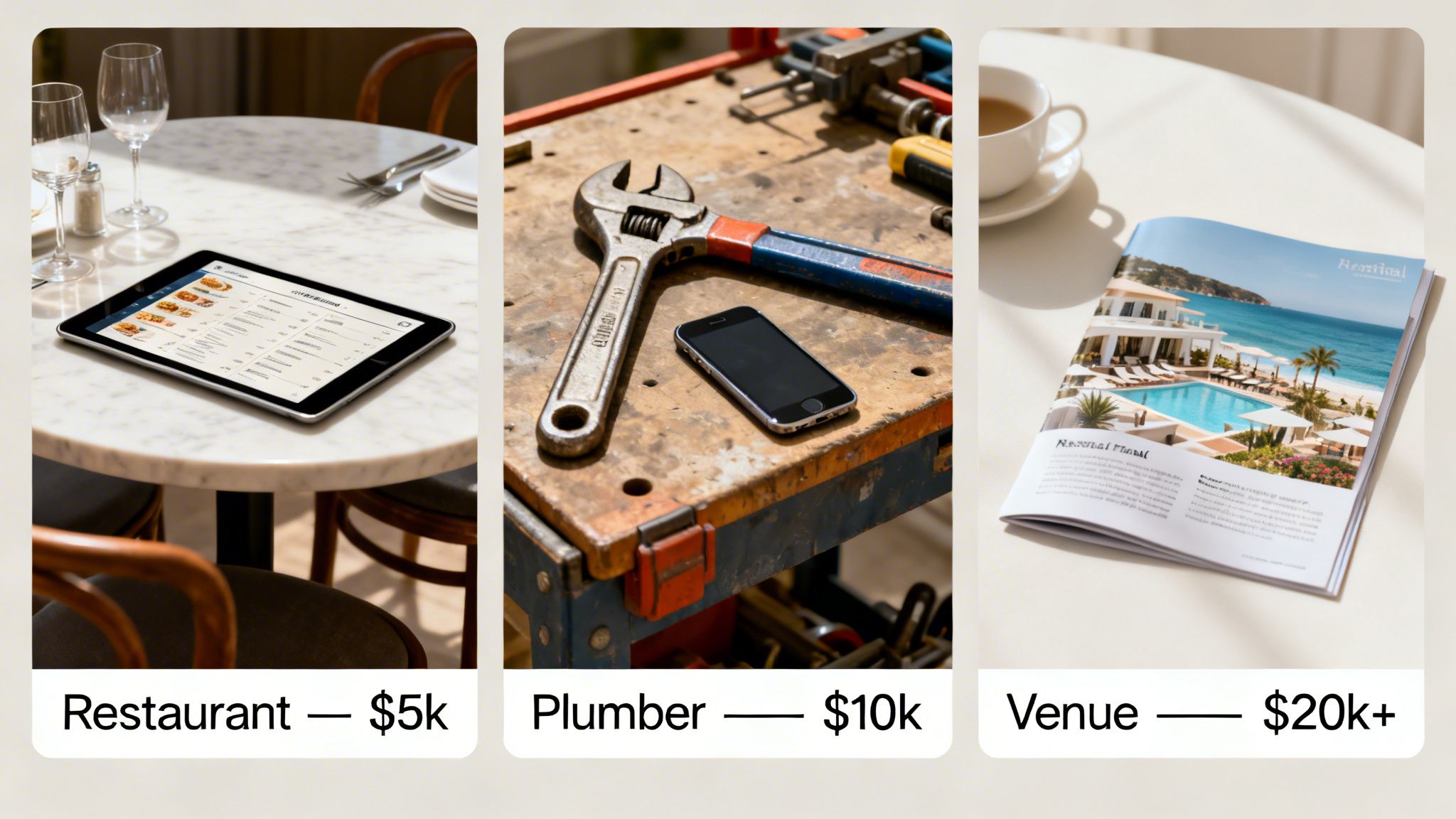
All this talk about cost drivers and price ranges is great, but what does it actually look like for a real Australian business? Theory is one thing; seeing the numbers in action is another.
Let's ground these concepts in reality. We'll walk through a few common scenarios to show you how a budget of $5,000, $10,000, or even $20,000+ gets put to work to solve specific business problems and deliver a return on investment.
Example 1: The Gold Coast Restaurant
Picture a popular restaurant on the Gold Coast. They have a steady stream of diners walking in, but their online presence feels like a relic from ten years ago. Customers can't find the menu easily and have to call to book, which ties up staff and leads to lost bookings during the hectic tourist season.
Their goals are straightforward: stop the phones from ringing off the hook for basic info, streamline the booking process, and show off what makes their dining experience special.
To get there, their new site needs to solve these exact pain points. The scope would look something like this:
- A Professional Multi-Page Website: A visually stunning homepage, an 'About Us' section to share their story, and a gallery filled with mouth-watering photos of their food and venue.
- Integrated Online Menu System: No more emailing clunky PDFs. This would be a dynamic, mobile-friendly menu that the team can update in minutes.
- Online Booking Integration: A seamless reservation system built right into the site, letting customers book a table 24/7 without ever picking up the phone.
- Mobile-First Design: With over 60% of restaurant searches now happening on mobile, the website experience has to be flawless on a smartphone.
This isn't just a facelift; it's an investment in operational efficiency. For a project like this, the website creation cost typically lands in the $7,000 to $12,000 range. That investment pays for itself quickly by freeing up staff and capturing reservations that were previously falling through the cracks.
Example 2: The Sydney Tradie
Now, let's think about a plumber in Sydney. They're fantastic at their job, but their business runs almost entirely on word-of-mouth. They're ready to grow and want a reliable way to get qualified leads coming in directly from their website.
The goal here is crystal clear: lead generation. The website needs to act like their top salesperson, working around the clock to convince potential customers that they're the best choice and making it incredibly simple to get in touch.
A website built for this job is a lean, mean, lead-generating machine. The key features are all about conversion:
- A Conversion-Focused Design: A clean, no-fuss layout with unmissable calls-to-action like "Call Now" and "Get a Free Quote" on every single page.
- Service Area Pages: Creating dedicated pages for key Sydney suburbs ("Plumber Bondi," "Blocked Drains Chatswood") is crucial for ranking in local Google searches.
- Click-to-Call Functionality: Making their phone number a clickable link on mobile is a must-have, especially for emergency jobs.
- Trust-Building Elements: Prominently displaying customer reviews, trade licences, and photos of their team on the job to build instant credibility.
For this plumber, the website isn't an online business card—it's a core piece of their sales infrastructure. The investment for a high-performance tradie website like this is usually between $5,000 and $9,000. Every element is designed with one outcome in mind: making the phone ring.
Example 3: The Sunshine Coast Hospitality Venue
Finally, imagine a boutique resort on the Sunshine Coast. They offer an exclusive experience with stunning ocean views, an on-site spa, and a fine-dining restaurant. Their objective is to attract high-value guests by selling the luxury and uniqueness of their property online.
This website needs to do more than just provide information; it has to sell a dream. The goal is to create an immersive digital experience that makes visitors feel like they're already on holiday, compelling them to book their stay directly. This demands a much higher level of investment in design and content.
A high-end hospitality site would feature:
- Custom Visual Design: A completely bespoke design that embodies the venue’s premium brand and atmosphere. No templates allowed.
- Professional Photography and Videography: Stunning, high-resolution visuals are non-negotiable here. This often includes drone footage of the property and video tours of the rooms and facilities.
- Advanced Booking Engine Integration: Connecting to a powerful booking system that can manage different room types, packages, add-ons, and dynamic seasonal pricing.
- Content-Rich 'Experiences' Section: Detailed pages that showcase the spa, restaurant, local attractions, and special events to upsell guests and enrich their stay.
This kind of project is a significant marketing investment. The website creation cost for a custom hospitality site often starts at $15,000 and can easily push past $25,000, especially when factoring in high-end videography and custom functionality. For a luxury brand, this investment is essential to attract the right clientele and command premium prices.
Looking Beyond the Launch: Uncovering Ongoing Costs
Getting your new website live is a huge milestone, but it’s the start of the race, not the finish line. A common—and very expensive—mistake we see Australian businesses make is fixating on the upfront build cost and completely forgetting about the recurring expenses needed to keep a site healthy, secure, and actually working for them.
Think of your website like a brand-new car. The initial purchase is just the first step. To keep it running smoothly, you need to budget for fuel, regular servicing, and insurance. Your website is no different; it’s a living business asset that needs ongoing investment to perform at its best and deliver a return.
Let's break down these non-negotiable costs.
The Foundational Recurring Costs
Some expenses are just part of the deal when you own a professional website. These are the absolute essentials that keep your site online, secure, and available to customers. Cutting corners here is a false economy that almost always ends in a bigger, more expensive problem down the track.
These foundational costs are your site's life support:
- Web Hosting: This is like the rent you pay for your website's spot on the internet. Good quality hosting means your site loads fast and stays online, which is vital for both your visitors and your Google rankings. A slow site can cause up to a 7% loss in conversions for every one-second delay.
- Domain Name Renewal: Your domain (e.g., yourbusiness.com.au) is your unique digital address. You pay a small annual fee to keep it registered to your business. It's your online identity.
- SSL Certificate: This is what puts the little padlock in the browser bar, securing the connection between your site and your visitors. It’s essential for building customer trust, protecting data, and is a confirmed factor in how Google ranks your site.
Ignoring these basics is like building a fantastic retail store but refusing to pay the power bill. Eventually, the lights will go out.
The High Cost of Neglecting Maintenance
Beyond the absolute basics, the single most critical ongoing investment is professional website maintenance. It’s so easy to think, "The site is built, my job is done," but that mindset leaves your business wide open to some serious risks.
Your website is built on complex software—a content management system like WordPress, plus a collection of themes and plugins. Developers are constantly releasing updates for these components to patch security vulnerabilities, fix bugs, and improve how they run.
Neglecting website maintenance is like leaving the front door of your shop unlocked overnight. You might get away with it for a while, but you are inviting theft, vandalism, and costly emergencies. This is where a professional maintenance plan is worth its weight in gold. It isn't just about "keeping the lights on"; it's about active protection and optimisation. A managed service ensures all your software is updated promptly, your site is backed up regularly, and security is monitored 24/7. Skimping on this often leads to a frantic, expensive emergency call-out to fix a hacked site or restore one that's completely crashed. You can learn more about what goes into professional website maintenance packages to see how they prevent these exact headaches.
Fuelling Growth with SEO and Content
Finally, for your website to be more than just a digital brochure, it needs fuel. That fuel comes in the form of ongoing Search Engine Optimisation (SEO) and fresh content. The online marketplace isn't a set-and-forget environment; your competitors are working every single day to outrank you on Google.
A one-off SEO setup when the site launches is a fantastic start, but it won’t keep you visible over the long term. Ongoing SEO is about adapting to Google's algorithm changes and consistently attracting your ideal customers, month after month.
This ongoing effort typically involves a few key activities. You need to create new content by regularly publishing genuinely helpful blog posts, guides, or case studies. This tells Google that your site is a relevant, active authority in your field. You should also focus on building quality backlinks by earning links from other respected websites, which acts as a huge vote of confidence in Google's eyes. Lastly, it is important to perform technical monitoring by continuously keeping an eye on site speed, mobile-friendliness, and other technical SEO factors to ensure you stay in Google's good books.
This is the work that transforms your website from a sunk cost into a powerful lead-generation machine that delivers a real, measurable return on your investment.
How to Calculate Your Website Return on Investment
It’s a common mistake to see your website as just another business expense on a spreadsheet. In reality, it’s an investment engine designed to power your growth. Shifting your mindset from cost to value is the only way to understand its real worth.
This means getting comfortable with measuring its return on investment (ROI) and proving how your site actively brings in revenue for your Australian business.
Think of your website less like an online brochure and more like a 24/7 sales and marketing machine. By setting clear, trackable goals, you can finally put a dollar figure on its impact and make that initial website creation cost feel like a smart investment.
Setting Your Goals and Metrics
Before you can measure ROI, you need to know what a win actually looks like for your business. Your goals will be unique, but they have to be specific and measurable. Vague targets like "get more customers" are impossible to track and even harder to achieve.
Instead, you need to focus on concrete outcomes. A few powerful goals could be:
- Lead Generation Targets: Aiming for a set number of new enquiries each month. For example, generating 20 qualified leads through your contact form.
- Online Sales Growth: For an e-commerce site, this could be a goal to lift online revenue by 15% in the next quarter.
- Improved Brand Reach: Tracking the growth of organic traffic from Google to see how many new people are discovering your business.
To connect these goals to real performance, you'll need to monitor the right metrics. To get a better handle on this, check out our guide on the top Google Analytics metrics that actually matter.
A Simple ROI Framework
Once your goals are locked in, you can use a straightforward framework to calculate the return. The basic formula is the perfect place to start: (Net Profit from Website – Website Investment) / Website Investment.
Let's put this into a real-world scenario. Remember our Sydney plumber from earlier? Let's say they invested $8,000 in a new lead generation website.
- Track the Leads: In the first six months, the new site brings in 60 qualified phone calls and form submissions.
- Calculate Lead Value: The plumber knows from experience they convert 1 in every 3 leads into a paying job, and their average job is worth $500. This makes each lead worth roughly $167 ($500 / 3).
- Determine Total Revenue: Those 60 leads generated $10,000 in new business (60 leads x $167).
- Calculate ROI: With a net profit of $2,000 ($10,000 Revenue – $8,000 Cost), the ROI is 25% in just the first six months.
This simple calculation transforms the website from an "expense" into a proven, revenue-generating asset. For a deeper dive into evaluating the success of your digital spend, discover how to measure marketing ROI effectively. It’s this kind of data that gives you the confidence to make smarter decisions and keep investing in your growth.
Make Titan Blue a preferred source in Google
One click tells Google to surface our articles more often in Top Stories, AI Overviews and AI Mode.

How to Make Your Website AI Friendly: The 2026 Step-by-Step Guide
How to make your website AI friendly: a step-by-step 2026 guide to getting crawled, structured…

Web Design for AI Search Optimisation: The 2026 Build Guide
Web design for AI search optimisation: crawlable HTML, clear architecture, accessible UX and trustworthy content…

AEO Web Design: How to Build Websites AI Can Cite
AEO web design creates websites that AI systems can find, understand and cite through clear…