Stay ahead with the latest tips, trends, and insights from the Titan Blue team , straight from the studio in Broadbeach.


A great Gold Coast web design project never starts with colours and fonts. It begins with strategy. For local businesses, this means figuring out exactly what you need your website to do to bring in real-world results. This planning phase is, without a doubt, the most important step toward getting a return on your investment.
Establishing Your Digital Foundation
Before you even think about picking up the phone to call a web design agency, you need to do a bit of homework. Putting in the effort to build a solid project foundation now will save you a tonne of time and money down the track. It prevents that dreaded "scope creep" and makes sure everyone is on the same page from day one.
It’s just like building a house. You wouldn't order bricks and pick out paint colours without a detailed blueprint. Your website is no different—it needs a solid plan outlining its purpose, audience, and essential functions.
Define Your Primary Business Goals
First things first: what is the number one thing you need this new website to do for your business? You have to be specific here. Vague goals like "get more business" are impossible to measure and mean nothing. Instead, focus on tangible outcomes that directly impact your bottom line.
Here are a few real-world examples for Gold Coast businesses:
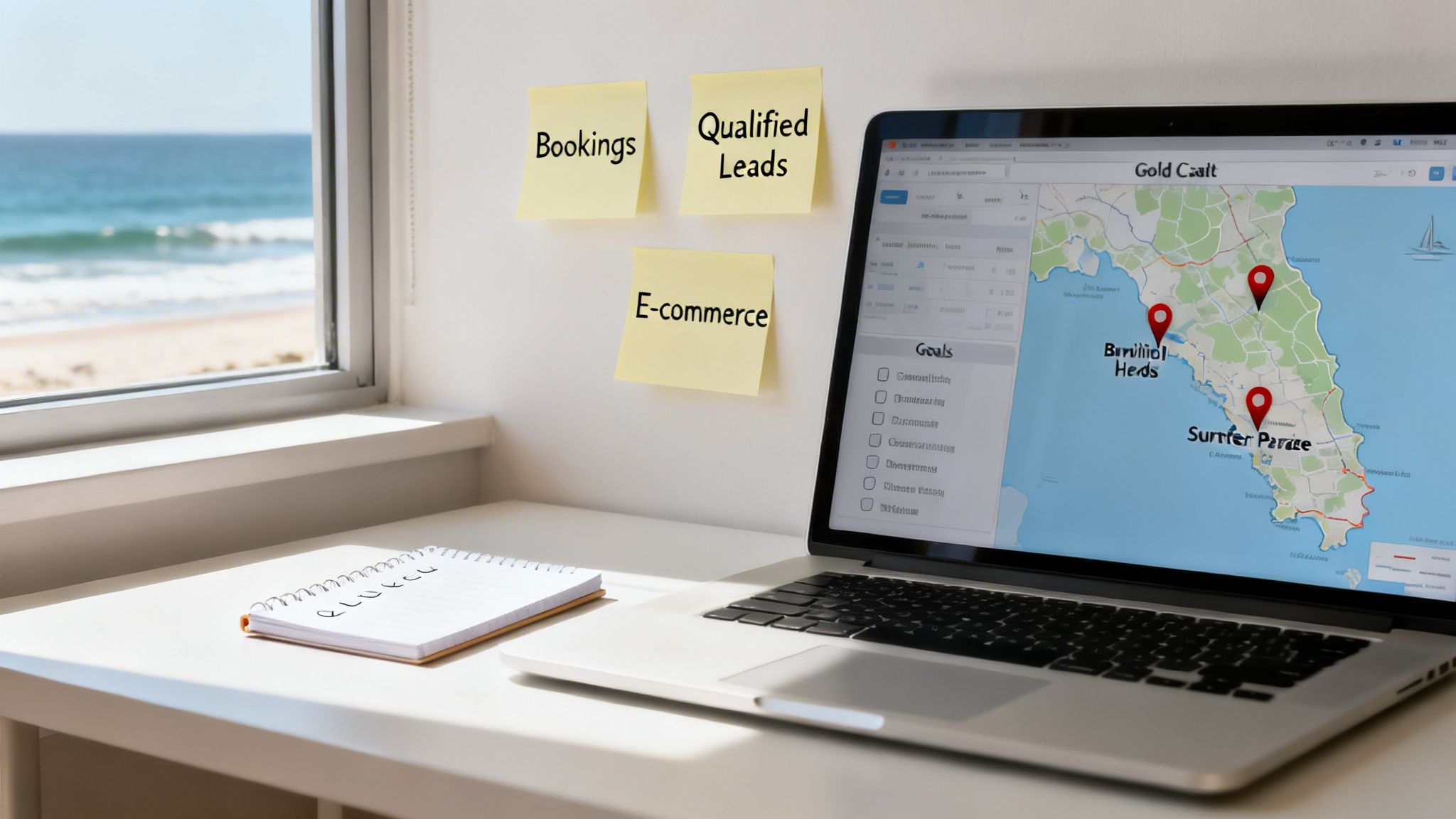
- A restaurant in Burleigh Heads might aim to increase online table bookings by 20% within six months.
- A plumber covering the coast from Coolangatta to Coomera might want to generate 15 new qualified quote requests per week through their contact form.
- A retail shop in Surfers Paradise could set a goal to achieve $10,000 in monthly e-commerce sales.
Setting clear Key Performance Indicators (KPIs) like these gives your project a north star. It helps your chosen web design partner understand what success actually looks like and allows them to build a site that’s laser-focused on hitting those targets.
Pinpoint Your Gold Coast Audience
Next, who are you actually trying to talk to? The entire design, the language you use, and the site's functionality must connect with your ideal customer. A website built to attract tourists looking for things to do in Surfers Paradise will look and feel completely different from one targeting local families in Robina.
Think about who they are, where they hang out online, and what problems they're trying to solve. Are they locals searching for a reliable tradie, or holidaymakers wanting to make a dinner reservation? Getting a handle on their intent is critical for effective Gold Coast web design. This insight informs everything from your site's navigation to the calls-to-action.
For a deeper dive, our complete website planning checklist offers a structured way to map out these crucial details.
Map Out Your Must-Have Features
Finally, it’s time to make a list of the functionalities your website absolutely needs to have. This isn’t a wish list of every cool feature you’ve ever seen on another site. It's a practical list of non-negotiable tools your website needs to achieve the goals you just defined.
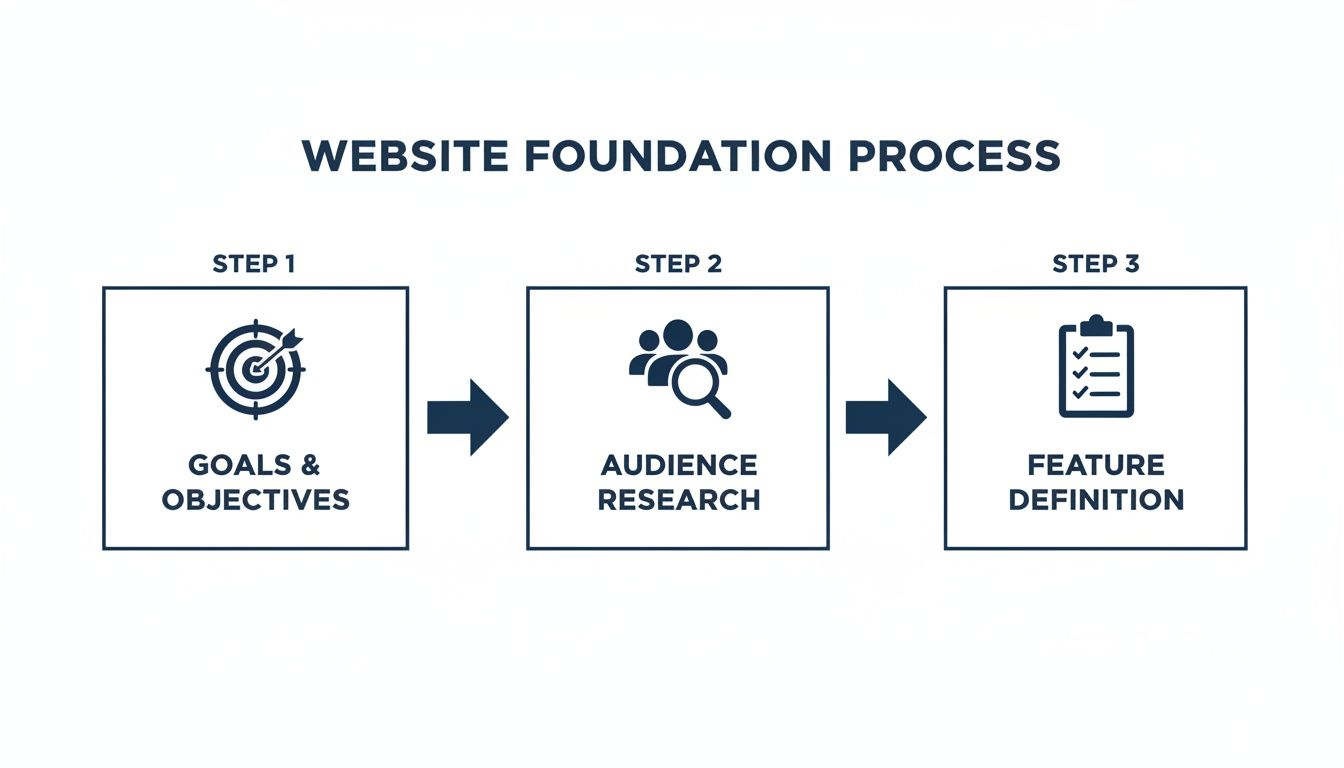
This simple process—goals, audience, then features—ensures every decision you make is strategic. It stops you from blowing your budget on flashy but unnecessary bells and whistles and keeps the focus firmly on what will actually deliver business value.
When you follow this path, you'll walk into your first meeting with an agency holding a clear vision, ready to build a site that truly works for you.
Choosing the Right Gold Coast Web Design Partner
Finding the right agency isn't just a transaction. It’s about building a genuine partnership with a team that’s invested in seeing your business grow. The right choice can be the difference between a website that just sits there and one that becomes your hardest-working employee, generating leads and sales 24/7.
But getting there means looking beyond glossy proposals and low-ball quotes. You need a partner who gets the unique rhythm of the Gold Coast market—from the tourist rush in Surfers Paradise to the needs of local families out in Robina.
Look for Relevant Local Experience
Start by diving into an agency’s portfolio, but don't just skim the surface. You need to see cold, hard proof that they've delivered real results for businesses like yours. If you're a tradie, have they built sites for other construction companies that actually bring in quote requests? If you own a restaurant, have they created booking-focused websites for other hospitality venues?
An agency's longevity is another massive clue. A firm with over 25 years of experience isn't just a flash in the pan. They’ve seen design trends come and go and know how to build a digital presence that stands the test of time.
A local base is a huge advantage, too. An agency with an office in Broadbeach has an intrinsic feel for the Gold Coast economy that an interstate or overseas firm simply can't replicate. They live and breathe the local market, and that’s invaluable when creating a site that clicks with your audience.
Questions to Ask Beyond the Price Tag
While budget is always a factor, the cheapest option is almost never the best. To find a true partner, you’ve got to dig deeper with the right questions. Moving the conversation past the dollars and cents is how you gauge their process, communication style, and strategic thinking.
Here are a few essential questions to ask any potential Gold Coast web design agency:
- How will you measure the success of this project? A good partner will immediately connect their work to your business goals. They’ll talk about KPIs like lead generation or sales conversions, not just how pretty the site looks.
- What is your communication process like during a project? You need to know exactly who your point of contact is, how often you’ll get updates, and what tools they use for feedback. Clear communication is what stops small misunderstandings from turning into big delays.
- Can you explain your approach to local Gold Coast SEO? Their answer should prove they understand how to get your business found by both locals and tourists through "near me" searches and location-specific content.
This line of questioning shifts the focus from cost to genuine value and ROI. For more details on budgeting, you can check out our guide that breaks down the costs involved in creating a website.
Understanding the Local Market Dynamics
The Gold Coast’s digital market is one of a kind. Its economy is a vibrant mix of a tight-knit local community and a massive wave of seasonal tourists. This means your website has to be expertly built to capture both of these very different audiences.
The local web design market has grown to reflect this reality. Since 2015, the Gold Coast web design industry has expanded at an impressive annual rate of about 8%. This growth is fuelled by small and medium businesses in retail, hospitality, and professional services all trying to carve out a professional online space.
In a tourism hotspot where most people are browsing on their phones, a fast, locally optimised site isn't just a bonus—it's essential for survival. Choosing an agency that gets these dynamics is crucial. They'll know how to build a site that not only looks great but is engineered to perform in this specific commercial environment, turning browsers into bookings and casual visitors into loyal customers.
Crafting a Project Brief That Delivers Results
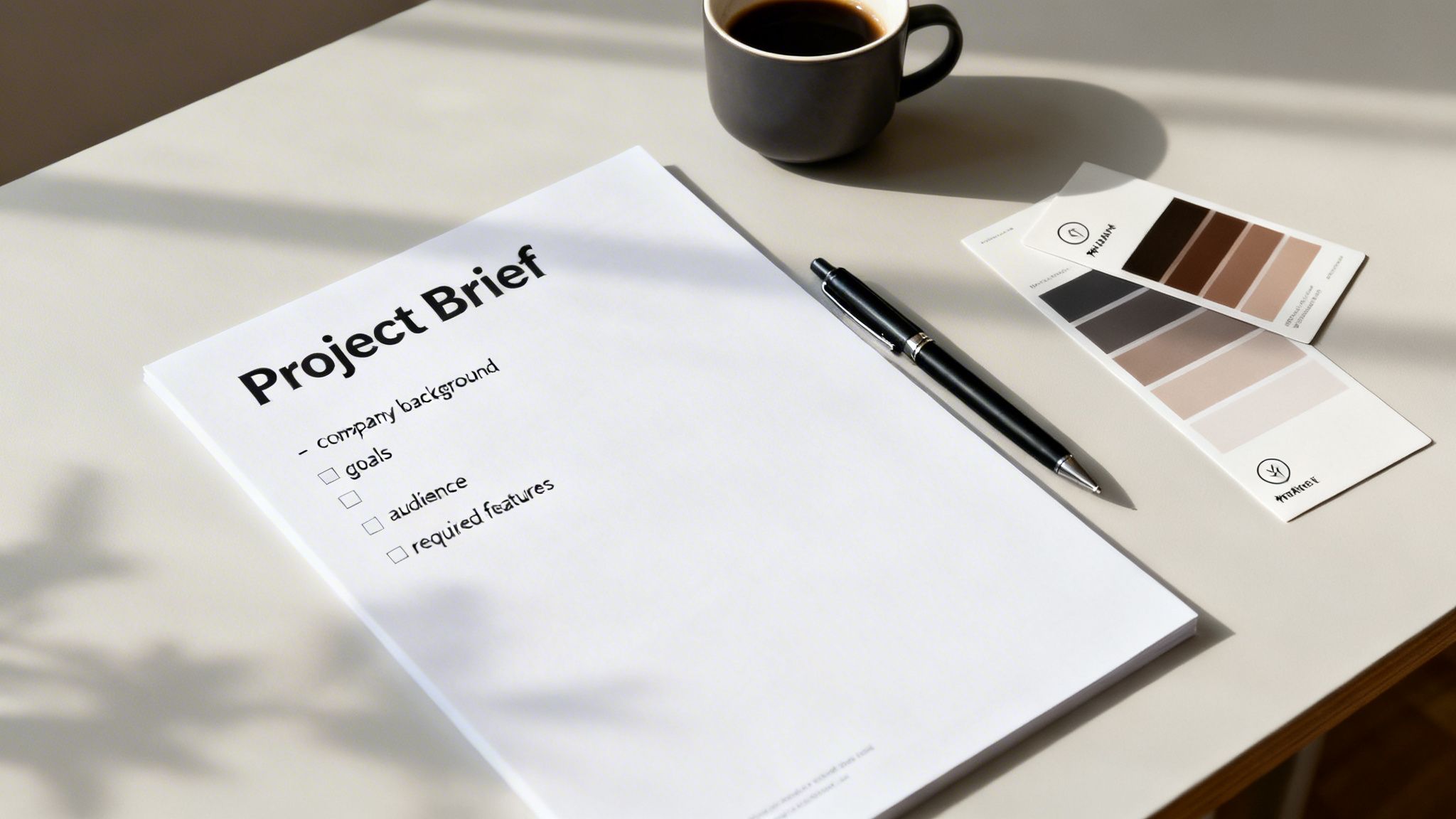
Think of your project brief as the single most important document you’ll create. It’s the roadmap for your entire web design project, turning a vague idea into a tangible, strategic business asset.
Without a solid brief, you’re basically flying blind. You open the door to miscommunication, endless back-and-forth, and a final website that just doesn't hit the mark for your business. A great brief gets everyone on the same page from day one, ensuring your vision is what actually gets built.
Detailing Your Company and Goals
The first thing any agency needs to know is who you are. Don't assume they understand the ins and outs of your industry on the Gold Coast. Lay it all out: what your business does, what makes you stand out from the local competition, and why customers choose you.
This is also where you bring in those specific, measurable goals we talked about earlier. Vague goals get vague results. Instead of just saying you want "more leads," get specific. "Our goal is to generate 15 qualified quote requests per week for our solar installation services." Now that’s a target a design team can work with.
You also need to paint a clear picture of your ideal customer. A brief for a buzzing Main Beach café targeting tourists is going to look completely different from one for a Coomera-based construction firm chasing commercial developers. The more detail you can provide about who you're trying to connect with, the better.
Outlining Functionality and Aesthetics
Now it’s time to get into the nuts and bolts. This is where you list out the essential features your website absolutely must have to achieve your goals. Don’t just throw out a list of words; explain the why behind each function.
A brief might include details like this:
- Online Booking System: To let customers reserve tables directly through the site, cutting down on phone calls and feeding straight into our existing reservation software.
- Dynamic Quote Form: A multi-step form for our plumbing services that asks for job details, location, and urgency. This sends qualified leads right to our team.
- Project Gallery: We need a filterable gallery to showcase our construction projects, allowing visitors to sort by residential and commercial work.
This is also your chance to talk about the look and feel. What’s your brand’s personality? Are you a polished, high-end professional service or a laid-back, friendly local spot? Share a few examples of websites you love (and maybe a few you can't stand) and explain your reasoning. This gives the designer invaluable insight into your taste. It's also worth knowing how site structure impacts your rankings.
Consider a Phased Launch for Faster ROI
For many Gold Coast businesses, especially in trades or services, waiting months for a massive, all-in-one website launch just isn't practical. You need to see a return on your investment sooner rather than later.
This is where a phased launch comes in.
Instead of building everything at once, you propose launching a powerful version 1.0 that focuses only on the most critical, money-making features. For a solar installer, this might be a clean site with clear service pages, a strong call-to-action, and a simple, high-converting contact form.
By getting a lean but effective site live quickly, you start generating leads and seeing a return almost immediately. You can then use real-world data and feedback to plan out Phase 2, adding more complex features like a client portal or in-depth case studies down the track. It's a smarter, more manageable, and financially sound way to approach your website project.
Navigating the Design and Development Process
Once the contracts are signed and the brief is locked in, the real work begins. This is where your vision moves from concept to code, and the collaboration with your agency kicks into high gear. It’s an exciting phase, but it’s also where projects can go off the rails without clear communication.
Keeping your Gold Coast web design project on time and budget isn't just up to the agency. It’s a two-way street. This isn’t a set-and-forget process; your timely input and feedback are the fuel that keeps the project moving forward.
The Lifecycle of a Website Build
Every website project follows a structured path, moving from broad strokes to fine details. It’s not just a whirlwind of creative chaos. It all starts with strategy and mapping out the site’s architecture—basically, creating a blueprint for where everything will go and how users will navigate it.
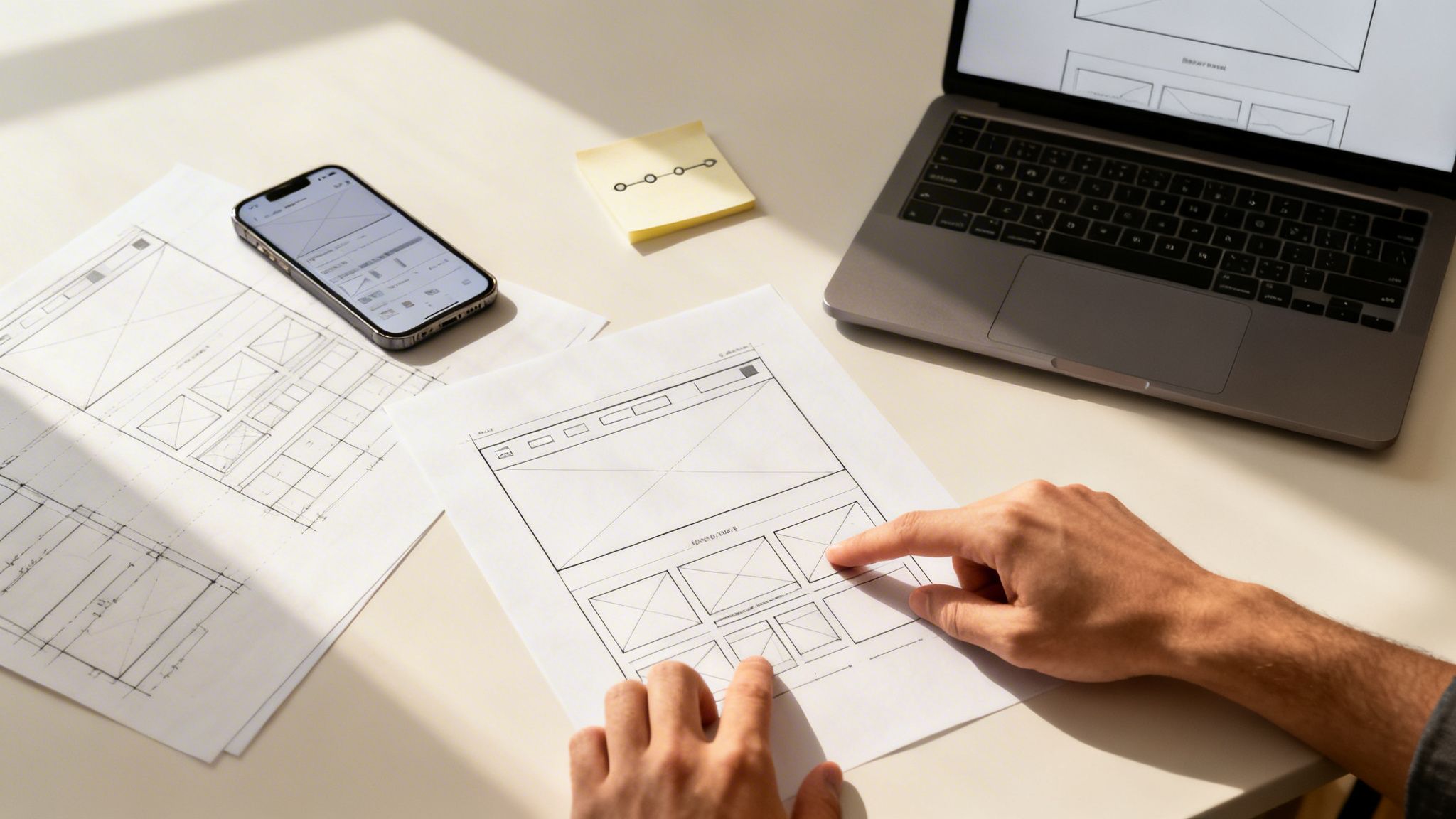
Next come the wireframes. These are simple, black-and-white layouts that focus purely on structure and functionality. There are no colours or fonts to distract you; it’s all about making sure the user journey makes sense before any design work begins.
Only after the blueprint is approved does the visual design start. This is the UI/UX stage, where your brand’s personality—colours, fonts, and imagery—is applied to the wireframes. Once you sign off on the look and feel, developers take over, writing the code that brings the designs to life. The final, critical stage is testing every link, button, and form before the big launch.
Providing Constructive and Actionable Feedback
Nothing stalls a project faster than vague feedback. We’ve all heard it: "I don't love it" or the classic "Can you make it pop?" These comments might feel right to you, but they give your design team absolutely nothing to work with.
Learning to articulate your feedback is one of the most valuable things you can do for your project. Instead of saying a design is "boring," try something more specific. For example: "This section is very text-heavy. Could we break it up with some icons or maybe a subtle background image to add visual interest?"
Here’s a simple framework for giving feedback that gets results:
- Be Specific: Pinpoint the exact element. "The call-to-action button in the hero section…"
- Explain the 'Why': Describe the problem it creates. "…feels a bit lost. It doesn't stand out enough to encourage clicks."
- Suggest a Direction: Offer a potential fix. "Could we try making it a brighter colour from our brand palette or slightly larger?"
This approach turns a subjective opinion into a clear, actionable task. It’s a game-changer for keeping momentum. For a deeper dive, check out our website design workflow guide for Gold Coast SMEs.
Trusting the Technical Experts
You know your business inside and out. That's your expertise. The agency, on the other hand, lives and breathes web standards, performance optimisation, and user behaviour. A great partnership relies on trusting their technical guidance, especially when it comes to things like mobile-first design and site speed.
These aren't just buzzwords; they're essential for success in 2026. Mobile web traffic in Australia has now hit over 69% of all internet use. Think about that. Whether you’re a local tradie getting calls from a job site or a restaurant taking bookings from tourists on the go, your website must work perfectly on a phone.
This mobile-first approach is non-negotiable. Google's Core Web Vitals now directly link your site’s performance—how fast it loads, how quickly it responds—to your search engine ranking. A slow, clunky site won’t just frustrate users; it will become invisible on Google.
Ultimately, building a great website is a partnership. Your agency provides the technical and design horsepower, while you bring the business goals and industry insight. When you work together and communicate clearly, the final product isn’t just a pretty design—it's a powerful business asset built to perform in the competitive Gold Coast market.
Planning for a Successful Launch and Future Growth
Pushing your new website live is a massive milestone, but it’s the starting line, not the finish. The real work begins now. Your focus needs to shift from design and development to a new phase centred on performance, marketing, and constant improvement.
A seamless launch sets the tone for everything that comes next. It demands a meticulous pre-launch checklist to make sure that first impression is a perfect one. This is your chance to catch any small glitches before your customers do.
The Essential Pre-Launch Checklist
Before you announce your new site to the world, a final, thorough audit is non-negotiable. This is your last shot at ironing out any wrinkles and guaranteeing a smooth user experience from the very first click. A rushed launch can undo months of hard work.
While your agency will be managing the technical backend, you should absolutely be involved in the final user-facing checks. This makes sure the site not only works perfectly but also actually aligns with your business goals.
Here are the critical areas we always review:
- Cross-Device and Browser Testing: Your website has to function flawlessly everywhere. Manually test it on an iPhone, an Android phone, a tablet, and different desktop browsers like Chrome, Safari, and Firefox. How does it look? Does everything work?
- Final Content Proofread: Read every single word on every page. Hunt for spelling errors, grammatical mistakes, or awkward phrasing. Most importantly, ensure all your contact details, like your address and phone number, are 100% accurate.
- Form and Link Testing: This one’s huge. Fill out every contact form, quote request, and booking form. Make sure they work and that you actually receive the submissions. Click every single link, from the main navigation right down to the footer, to find any broken pathways.
- Analytics and Tracking Setup: Confirm that your Google Analytics or another tracking tool is installed and firing correctly. You can't measure success or make informed decisions about future marketing without solid data from day one.
Nailing these checks transforms your launch day from a stressful gamble into a confident step forward.
Beyond the Launch: SEO and Ongoing Growth
Once your site is live, it becomes a living business asset that needs care and attention to deliver a return. The best Gold Coast web design is one that evolves with your business and the market. This is where a continued partnership with your agency becomes so important.
Your website is now a powerful marketing tool, but it won’t attract customers by itself. You need a proactive strategy for Search Engine Optimisation (SEO), content creation, and maybe even paid ads to drive traffic.
The digital world is always shifting. A site that ranked number one last year could be on page three today without ongoing work. Regular maintenance is also vital for security and performance. For a closer look at what this involves, it's worth checking the details of a professional website maintenance package to protect your investment.
Capitalising on Local Search and AI
For a Gold Coast business, success is often local. Whether you're a plumber in Burleigh, a restaurant in Broadbeach, or a builder in Coomera, your next customer is probably searching for services 'near me'. This is where a deep understanding of local SEO really pays off.
The landscape has changed dramatically. Local search has become a lead-generation powerhouse for Gold Coast businesses that historically relied on word-of-mouth. To tap into this, your site needs intent-matched pages, strong location signals, and simple ways for customers to get in touch. Insights from 2026 trends show that strategies like implementing FAQ schema and specific blog tagging can even double the enquiries a site gets from AI assistants.
A forward-thinking agency will also set up your site for new search experiences driven by AI. This means structuring your content so that AI language models can easily find and present information about your business. Key strategies to get this right include:
- Developing Targeted Blog Content: Create articles that answer the specific questions your Gold Coast customers are asking. A blog post titled "How to Choose a Solar Installer in Robina" is far more powerful than a generic services page.
- Implementing FAQ Schema: This structured data helps search engines understand the questions and answers on your site, boosting your chances of appearing in featured snippets and AI-powered answer boxes.
- Building Out Localised Service Pages: Don't just list your services. Create dedicated pages for each service and the specific suburbs you cover, like "Plumbing Services Broadbeach" or "Commercial Electrician Coomera."
By embracing these strategies, you turn your new website from a simple online brochure into a consistent lead-generation machine. It becomes a tireless digital salesperson, attracting and converting customers for your business around the clock.
Your Top Questions About Gold Coast Web Design Answered
Investing in your website is a big decision, and it’s natural to have questions. We get it. As a Gold Coast business owner, you want to know what you're getting into. Here are the honest answers to the questions we hear most often about planning, budgeting, and looking after a professional website.
How Much Does a Website Cost on the Gold Coast?
This is the big one, and the honest answer is: it depends. A website's cost is tied directly to what you need it to do for your business. Think of it like building a house—a one-bedroom granny flat isn't going to cost the same as a five-bedroom home with a pool.
For a local tradesperson or consultant who needs a sharp, professional brochure-style website to build trust and get enquiries, you might be looking at a starting point of a few thousand dollars.
If you need something more complex, the investment can range from $10,000 to $25,000 or more. This is typical for a retail store needing a full e-commerce setup, a local tour operator requiring an integrated booking system, or a firm needing custom-built client portals.
The real focus shouldn't be the upfront cost, but the return on your investment. A cheap website that brings zero business is an expensive mistake. A great website that becomes your number one source of leads is an asset that pays for itself.
Many agencies, including us, often suggest a phased approach. We start with a powerful version 1.0 to get you generating revenue and proving the ROI, then build out more advanced features from there.
How Long Does It Take to Build a Business Website?
Timeframes are a two-way street. The project's scope sets the foundation, but your feedback and collaboration are what keep the wheels turning. For a standard small business Gold Coast web design project, we usually see a timeline of 6 to 12 weeks from our first strategy session to launch day.
For larger, more customised builds, you're looking at a longer runway, often somewhere between 4 to 6 months. Several things can stretch this out:
- The sheer number of pages.
- The level of custom design and development needed.
- Complex integrations with third-party software like CRMs or payment gateways.
- How quickly you can supply content (text, images) and give feedback on designs.
Nothing keeps a project on track better than clear, prompt communication. A delay of a few days in getting feedback might not seem like much, but it can easily push a timeline out by weeks.
Why Is Local SEO So Important for a Gold Coast Website?
For most Gold Coast businesses, your customers are right here in your backyard. Whether you’re a plumber in Broadbeach, a café in Burleigh, or a lawyer in Southport, your clients are local. Local SEO is how you make sure they find you.
It's the art and science of getting your business to pop up when someone searches for a service 'near me' or in a specific suburb. With the Gold Coast's mix of locals and tourists constantly searching on their phones, showing up in Google Maps and local search results isn't just a nice-to-have; it's essential.
An agency that actually understands the Gold Coast will build your site with all the right signals—local keywords, location-specific content, and a technical structure that Google loves. This is what drives foot traffic, quote requests, and phone calls straight to you.
Do I Need Ongoing Maintenance After My Website Is Live?
Absolutely. Thinking of a website as a 'set and forget' task is one of the biggest mistakes we see. Your website is a living part of your business, not a static brochure. Ongoing care is crucial for three main reasons: security, performance, and relevance.
It’s about protecting your investment. This includes regular software updates to patch security holes, daily backups so you never lose your data, and performance checks to keep the site loading fast.
But it’s more than just technical upkeep. Google's algorithms are always changing, and new AI-driven search is on the horizon. An ongoing partnership for SEO and content means your site can adapt, stay visible, and keep attracting new customers long after launch day.
Ready to turn your website into a powerful growth engine for your Gold Coast business? Titan Blue Australia combines over 25 years of industry experience with local expertise to deliver digital solutions that get real results. Let's talk about your project today.

AI SEO for Australian Small Business: The Budget-Friendly Guide for 2026
AI SEO for small business means optimising your website and online presence so AI engines…

AI SEO for Healthcare: How Australian Medical Practices Can Win in AI Search
AI SEO for healthcare means optimising your medical practice so AI engines like Google AI…
How to Write Content AI Engines Actually Cite: A 10-Step Framework for 2026
A practical 10-step writing framework that helps Australian businesses create content AI search engines like…