

A good website design for plumbers isn’t just about looking professional; it’s a lead-generation machine that works for you 24/7. Your digital storefront has to build instant trust with a customer who's in a panic, make it dead simple for them to call you, and get you found first when they're frantically searching for help.
It’s the difference between a phone that rings off the hook and one that stays silent.
Your Digital Blueprint for More Plumbing Jobs
Think of your website as your most valuable employee. Research shows that around 70% of people will check out a company's website before they even think about picking up the phone. For a plumber, that first impression is everything.
When a pipe has burst or a drain is backing up, your potential customer isn't casually browsing. They need a fast, reliable solution, and they need it now. Your website has just a few seconds to convince them you're the right person for the job.
This guide is a practical roadmap built specifically for Australian plumbers. We're moving past simple looks to focus on building a digital asset that directly translates into more business—turning your online brochure into a powerful tool that brings in and converts customers.
The Core of Your Digital Strategy
A successful website for any plumbing business is built on a handful of core principles. Get these right, and you’re already ahead of the game. These are the non-negotiables.
- Build immediate trust: A homeowner in distress needs to feel they’ve found a credible, professional service. You achieve this with authentic photos of your team, a clear display of your licenses and insurance, and genuine customer reviews.
- Showcase your expertise: Clearly list out your services. From emergency call-outs and blocked drains to hot water system repairs, make it easy for visitors to see you can solve their exact problem.
- Make contact effortless: Your phone number should be impossible to miss. Your contact forms should be short and simple. The goal is to remove every ounce of friction between their problem and them calling you.
To get the full picture of how a site goes from an idea to a finished product, it's worth understanding the typical 8 website design process steps that agencies follow.
We've found the most successful plumber websites follow a simple, three-step flow.
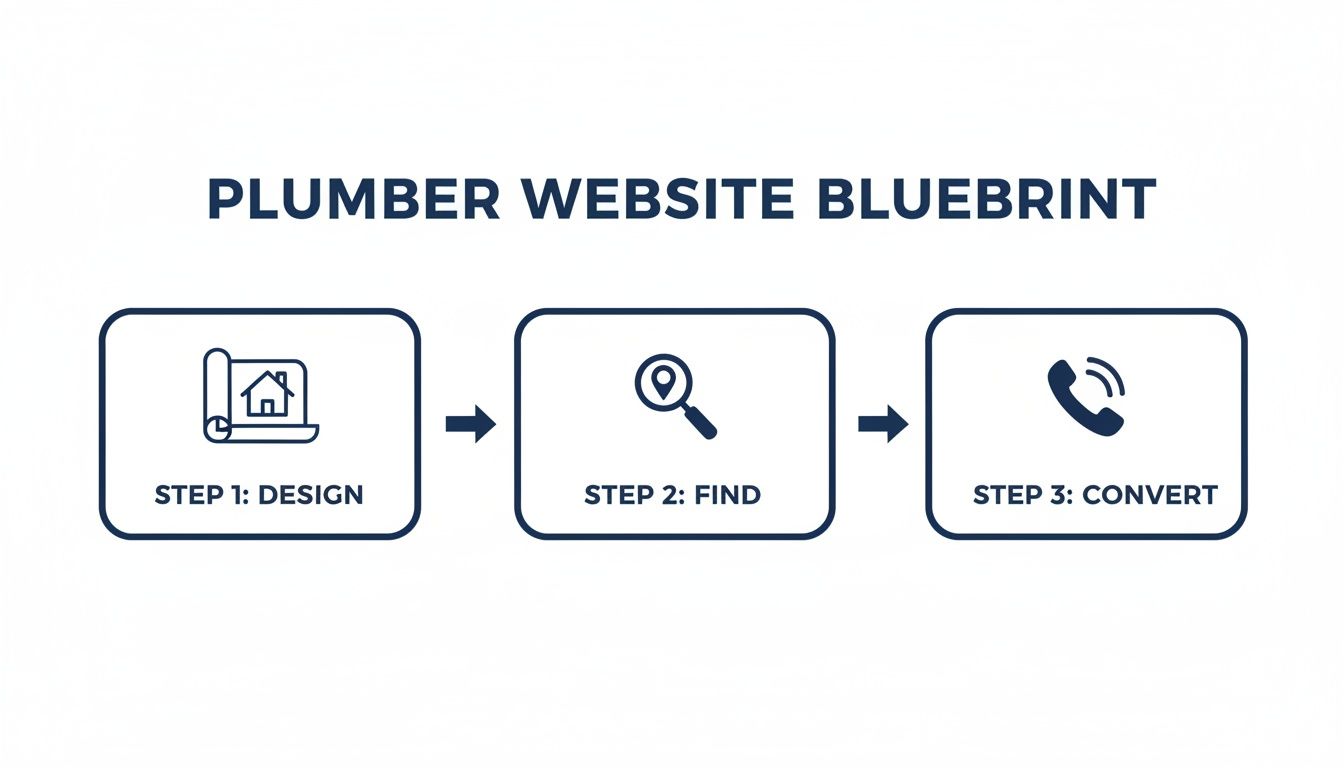
It all starts with a solid, trust-building design. From there, we make sure customers can find you through local SEO. The final step is converting that visitor into a phone call. This focused approach ensures every part of your website is working towards one primary goal: generating more jobs.
For a broader look at how this applies to other trades, you might find our guide on website design for tradies useful.
Build Instant Trust with Smart Website Design
When a pipe bursts at 2 AM, homeowners aren't casually browsing websites. They’re stressed, scrambling for a reliable professional who can fix the problem—fast. Your website has only seconds to prove you're the right plumber for the job.
This isn't about flashy animations or complicated graphics. Smart website design for plumbers is all about building instant credibility and making a visitor feel confident they've found a trustworthy expert. It’s where user experience (UX) and thoughtful visual design work together to guide a customer in a panic straight from their problem to your phone number.
Showcase Your Authenticity
The quickest way to build trust? Be real. Everyone can spot a generic stock photo of a smiling model holding a brand-new wrench from a mile away. It feels impersonal and can make your business seem like a faceless corporation.
You need to show the real people behind your business. Authentic photos are one of the most powerful tools you have.
- Your Team in Action: Get some high-quality shots of your actual plumbers on the job (with the client's permission, of course). It shows you have a real, professional crew.
- Your Branded Vehicles: A clean, branded van isn't just a vehicle; it's a mobile billboard and a mark of professionalism. Seeing it on your site reinforces that you’re an established, legitimate operation.
- Your Real Office or Workshop: Even a simple, clean photo of your home base adds a layer of authenticity that stock images just can't match.
These genuine images create an immediate human connection. They tell potential customers you’re a proud local business ready to serve the community, not just another name in a directory.
Display Your Credentials Prominently
Once a visitor feels that human connection, they need reassurance. They’re looking for proof that you’re qualified, insured, and reputable. Don’t make them dig for it.
In high-stress moments, like a major water leak, a customer’s decision-making process is on fast-forward. They aren't just looking for any plumber; they’re looking for the safest choice. Placing clear trust signals on your website is the fastest way to become that safe choice.
Your credentials should be impossible to miss. Put them near the top of your homepage and in your website footer.
This includes:
- Licence Numbers: Clearly display your plumbing licence number. In Australia, this is a non-negotiable sign that you're a qualified professional.
- Certifications and Memberships: Are you a member of the Master Plumbers Association? Do you have specialised gas-fitting certifications? Showcase those logos.
- Insurance Details: Simply mentioning you are fully insured gives customers immense peace of mind, knowing their property is protected.
- Customer Reviews: Integrate real-time reviews from Google. Star ratings and quotes from happy clients are incredibly persuasive social proof.
These elements work together to break down any doubt and build a solid foundation of trust. A great website showcases your expertise through clear branding; you can learn more about how strong branding in web design boosts recognition and helps you stand out.
Create an Intuitive Path to Your Services
A homeowner with a blocked drain doesn't have the patience to solve a puzzle. Your website's navigation needs to be dead simple.
Think about the main reasons someone lands on a plumber's website. They usually have a specific, urgent problem that needs fixing now. Your site structure should reflect that reality.
Organise your services so a visitor can find exactly what they need in one or two clicks. A logical structure might look something like this:
- Emergency Services: This needs to be a big, obvious button. A call-to-action like "24/7 Emergency Service" should be one of the most visible elements on your site.
- Core Service Categories: Group your offerings into clear categories like "Blocked Drains," "Hot Water Systems," "Gas Fitting," and "General Plumbing Maintenance."
- About Us: This is where you put your story, team photos, and credentials, building on that initial trust.
- Contact Us: Make this page easy to find, with a clear phone number, a simple contact form, and a map of your service area.
Ultimately, your website's job is to make a stressed person's life easier. By showing your real team, proving your qualifications, and making your services easy to find, you create a seamless and reassuring experience that turns a frantic visitor into your next loyal customer.
Dominate Local Search and Get Found by Customers
You can have the best-looking plumbing website in the country, but if a customer with a burst pipe can't find you, it’s all for nothing. When there's water pouring through a ceiling, nobody is admiring your graphic design—they're frantically Googling "emergency plumber near me."
For a local service business like yours, this is where the money is made. Your website needs to do more than just exist; it has to show up the second a potential customer in your service area needs help. This is where a rock-solid local search strategy comes in. Without it, you're essentially invisible to the very people who need you most.
Master Your Google Business Profile
Your Google Business Profile (GBP) is hands-down the most powerful tool in your local marketing kit. It’s that free listing that pops up in Google Maps and the "local pack" at the top of the search results. Given that a staggering 46% of all Google searches are for local information, getting this right is non-negotiable.
Think of your GBP as your digital shopfront right on Google’s homepage.
- Fill It Out Completely: Don't skip a single section. Your business name, address (or service area if you’re mobile), phone number, hours, and website must be filled in. Google sees an incomplete profile as a sign of a less credible business.
- Get Your Categories Right: Your primary category must be "Plumber." From there, add secondary categories for everything else you do, like "Gas Fitter," "Drain Cleaning Service," or "Hot Water System Supplier."
- Add Real Photos: Keep it fresh. Regularly upload high-quality photos of your team on the job, your branded vans, and examples of your work (always with the customer's permission, of course). This proves you're an active, legitimate business.
- Chase Those Reviews: Make it a habit to ask every happy customer for a Google review. Good reviews are a massive trust signal for new customers and a key factor in how Google ranks you.
An optimised GBP is the foundation of any effective local SEO campaign, turning searchers into callers without them even needing to click through to your website.
Create Hyper-Local Service Area Pages
Just listing the suburbs you work in on your contact page is a rookie mistake. To really own your local territory, you need to build out dedicated pages for each key suburb or region you want to get calls from.
Put yourself in the customer’s shoes. Someone in Parramatta isn’t searching for a generic plumber; they're searching for "blocked drains Parramatta." A dedicated page targeting that exact phrase tells Google you’re the most relevant expert for the job.
But don't just copy and paste. Each page needs to be unique and genuinely useful.
Here’s a quick-and-dirty structure that works:
- Specific Title and Heading: Go with something like "Your Go-To Plumbers in Bondi" or "Fast Blocked Drain Clearing in Parramatta."
- Localised Content: Show you know the area. Mention local landmarks, common problems (like old pipes in heritage suburbs), or anything that proves you're a true local, not just a city-wide franchise.
- Targeted Service List: Reiterate the specific services you offer in that suburb, whether it's 24/7 emergency work or gas fitting.
- Local Testimonials: Nothing builds trust like a good word from a neighbour. If you have a great review from a customer in that specific suburb, feature it on the page.
This strategy gets you seen in more location-specific searches and builds immediate trust with customers looking for a reliable local tradie. For more advanced search tactics, our full guide to SEO for plumbers goes into even greater detail.
Prepare for the Future of Search
The way people search is changing fast. Voice assistants like Siri and Google Assistant are no longer a novelty; they're how people find services. Soon, a customer won't type—they'll just say, "Hey Siri, find an emergency plumber who can fix a leaking tap."
To get your business recommended, your website needs to provide direct answers, not just lists of services.
A website optimised for voice search isn't just about keywords; it's about providing clear, concise answers to the questions your customers are actually asking. When someone uses voice search, they want a direct solution, not a list of websites to browse.
Instead of a page that just says "Leaking Tap Repairs," build content that answers the question head-on. A short FAQ section titled "What Causes a Leaking Tap?" or "How to Temporarily Stop a Leaking Tap" can be picked up by AI and served as a direct answer, positioning your business as the expert.
This conversational approach, backed by the right technical code (structured data), is what will separate the winners from the losers in the next wave of search.
Turn Your Website Visitors into Paying Customers
Getting traffic to your plumbing website is a huge win, but it's only half the job. The real goal is turning those clicks into phone calls and booked jobs. We call this process conversion rate optimisation (CRO), and it’s all about making it dead simple for a visitor to take that next step.
When a customer is staring at an overflowing toilet or has no hot water, their patience is wearing thin. Your website has to be the fastest path to a solution—which is calling you—with zero friction. Every single element, from where you put a button to the words you use, plays a part in whether you get the job or they click away to another site.
Make Your Phone Number Unmissable
In an emergency, the first thing a customer wants is to speak to a person. That makes your phone number the single most important tool on your entire website. It needs to be everywhere.
A non-negotiable feature, especially since over half of all web traffic comes from mobile, is a "sticky" call-to-action bar. This is a header or footer that stays locked to the screen as someone scrolls. It needs a big, tappable 'Click-to-Call' button alongside your phone number, making sure help is always just one tap away.
Here’s a quick checklist for where your phone number absolutely must be:
- In the top right corner of the header, on every single page. No exceptions.
- Inside that sticky header or footer, especially for anyone on a mobile.
- Front and centre on your contact page.
- At the very end of every service page, right after you’ve explained how you can fix their specific problem.
This constant visibility means a customer never has to hunt for your details. It dramatically increases the odds they’ll call you first.
Simplify Your Contact and Quote Forms
While phone calls are king for emergencies, you'll still get non-urgent queries through contact forms. The golden rule here? Keep it simple. Nobody wants to fill out a ten-field questionnaire just to ask about a tap replacement.
Every extra field you add is just another chance for a potential customer to give up and leave. Stick to the bare essentials.
For a basic enquiry, all you really need is:
- Name: So you know who you're talking to.
- Phone Number: So you can call them back. Fast.
- Email Address: A good secondary contact method.
- A Brief Message Box: For them to describe the issue in their own words.
That’s it. You have to resist the urge to ask for their full address, their budget, or a preferred time slot right now. Keep the form brutally simple and just get the conversation started.
Craft Offers That Compel Action
Sometimes, a well-placed offer is the final nudge a customer needs to pick up the phone. It's not about being the cheapest; it’s about reducing their risk and showing immediate value. The psychology is simple: give them a low-risk reason to call you now.
An offer like 'No Call-Out Fee' is incredibly powerful. It tells a customer they can get an expert to diagnose their problem without committing to a big, unknown cost. This simple gesture builds a massive amount of trust and removes the biggest barrier to making that first call.
Make sure these offers are featured prominently across your site, especially on the homepage banner and right next to your contact details.
A few effective offers for plumbers always include:
- $50 Off Your First Job: A direct, tangible saving that gets attention.
- Free, No-Obligation Quotes: This takes away the fear of being pressured into a service they're not sure about.
- No Call-Out Fee (With Completed Work): This is a classic for a reason—it works.
These aren't just discounts; they are strategic tools that build confidence and drive enquiries straight to your phone. By understanding the core principles of turning visitors into leads, you can get a lot more from your website. If you want to dive deeper, you can find out more about what conversion rate optimisation is and how it can supercharge your business. Your website can, and should, be a consistent source of high-quality plumbing jobs.
Choosing Your Digital Partner and Maintaining Your Site
Your website isn't a project you can just ‘set and forget’. Getting it live is really just the starting line. To keep it secure, running fast, and actually ranking on Google, it needs regular, ongoing attention. This makes picking the right digital partner just as critical as the initial design.
Think of it this way: the ongoing work, paired with a partner who gets your business, is what turns a one-off expense into a long-term asset that keeps the phone ringing.
Finding the Right Web Design Agency
Here’s the thing: not all web designers are the same. Heaps of them can build a good-looking site, but very few understand what a plumbing business actually needs to get more jobs. You need a partner who is obsessed with business growth and lead generation, not just colour palettes.
When you're looking at agencies, you're not just buying a website; you're starting a long-term relationship. The questions you ask upfront will make or break that partnership.
Before you sign anything, make sure you ask:
- Have you worked with tradies before? Ask to see websites they’ve built for other plumbers or similar Aussie service businesses.
- How do you handle local SEO? What’s your plan to get my business showing up for "emergency plumber" in the specific suburbs I service?
- How do you define success? Will you be tracking calls, quote requests, and keyword rankings? Can I see what a report looks like?
- What happens after launch? What are your options for ongoing maintenance and support?
A good partner will have solid, confident answers and a portfolio to back it up. They should be talking more about getting your phone to ring than about fonts and logos.
The Essentials of Website Maintenance
A website is a living piece of software. Just like your van needs a regular service to stay reliable on the road, your site needs consistent maintenance to perform. If you neglect it, you’re opening the door to hackers, slow load times, and a one-way ticket to the bottom of Google’s search results.
A poorly maintained website is a digital liability. Outdated software is the number one reason websites get hacked, and a slow site will make up to 30% of potential customers leave before the page even finishes loading. Ongoing maintenance isn’t an optional extra; it's essential insurance for your most important marketing asset.
There are a few core jobs that are non-negotiable for site performance and security. These should be done every month, either by you or, more realistically, by your agency. To see what’s involved, check out our guide to website maintenance packages for a full breakdown.
Your monthly maintenance checklist must include:
- Software and Plugin Updates: Your CMS (like WordPress) and its plugins constantly release updates to fix security holes. Running old software is a massive risk.
- Full Site Backups: Regular, off-site backups are your safety net. If your site gets hacked or breaks, a recent backup means you’re back online in minutes, not days.
- Performance and Speed Checks: You have to monitor your site's load speed. A slow site frustrates users—especially someone on their mobile in an emergency—and Google will penalise you for it.
- Security Scans: Regularly scanning for malware and other threats helps you catch problems before they do any real damage to your business or reputation.
This proactive approach makes sure your investment keeps paying off, keeping your digital shopfront open, secure, and ready for business 24/7. Your website should be a reliable tool that works for you, not another problem you have to deal with.
Your Questions on Plumber Website Design Answered
Getting a new website built or giving your current one a refresh can feel like a massive job, especially when you’re flat out with call-outs and trying to run your business. To cut through the noise, we’ve tackled some of the most common questions we hear from plumbers about getting their website right.
Here are the straightforward answers you need to make smart decisions for your business online.

How Much Does a Plumber Website Cost in Australia?
There’s no one-size-fits-all price for a plumber’s website in Australia. The cost varies massively depending on what you actually need.
A basic, template-based site from a freelancer might only set you back a few thousand dollars. This can be a decent starting point, but it often won’t have the customisation or local SEO grunt needed to compete in a crowded market.
At the other end, a fully custom website from a specialist digital agency can be upwards of $15,000. This isn't just a website; it’s a comprehensive lead-generation machine built for growth.
So, what pushes the price up?
- Custom Design & Features: A unique design built from the ground up costs more than a cookie-cutter template. Special features like an interactive quote calculator or integration with your job management software will also add to the investment.
- Number of Pages: A simple five-page site is naturally cheaper than a site with twenty-plus pages, especially if it includes dedicated service pages for every suburb you cover.
- Level of SEO Included: A site built with a deep understanding of plumber-specific SEO from day one will have a higher upfront cost but delivers a much stronger return over time.
Instead of seeing it as a "cost," think of your website as your hardest-working employee—one that generates leads for you 24/7.
How Long Does It Take to Build a New Website?
Building a new website for a plumbing business typically takes anywhere from 4 to 12 weeks. This timeframe allows for a proper, professional process to make sure the end result is polished and ready to perform.
A quicker turnaround of 4 to 6 weeks is often achievable for a more straightforward site. This usually means a clean design, a handful of service pages, and standard features—perfect for a new business that needs to get online fast.
A more complex project will naturally stretch towards the 8 to 12-week mark, or even longer. This gives us the time needed for in-depth planning, custom design work, writing all that hyper-local content, and developing any specialised functions.
A good agency will always give you a clear, detailed timeline from the get-go. This project plan should map out each phase so you know exactly what’s happening and when. It generally involves discovery and planning, design mockups, content creation, development, and finally, testing before the big launch.
What's More Important: SEO or a Nice Design?
This is a classic question, but honestly, it’s a false choice. You can’t have one without the other. An effective website for a plumber needs both a strong SEO foundation and a great design working in perfect harmony.
Think of it this way: SEO is the engine, and the design is the driver’s seat.
A powerful engine (your SEO) gets you to your destination—the top of Google where frantic customers are searching. But if the driver’s seat (your website’s design) is clunky, confusing, or looks untrustworthy, that potential customer will bail immediately.
On the other hand, a stunning website that nobody can find is just an expensive piece of digital art. It won’t make the phone ring or pay the bills.
A successful website is a perfect marriage of form and function. Great design builds the trust needed to convert a visitor, while strong SEO ensures there are visitors to convert in the first place. You must have both to succeed.
For a plumber, a visitor often lands on your site in a state of stress. A professional, reassuring design instantly calms their nerves and builds credibility. At the same time, it was the powerful SEO that made sure they found you—and not someone else—during that panicked search. They are two sides of the same coin.
Ready to invest in a website that becomes your most valuable employee? The team at Titan Blue Australia has over two decades of experience building high-performance digital solutions that deliver real results for businesses across Australia. Let's build a website that gets your phone ringing. https://titanblue.com.au
Make Titan Blue a preferred source in Google
One click tells Google to surface our articles more often in Top Stories, AI Overviews and AI Mode.

Ecommerce Website Design Australia: The 2026 Guide
How to design an ecommerce website in Australia that converts shoppers and can be read…

Construction Company Website Design Australia: 2026 Guide
How to build a construction company website in Australia that wins trust, converts enquiries, and…
Solar Installer Website Design Australia: The 2026 Guide
How solar installer websites in Australia should show CEC accreditation, real install proof and AI-ready…