

Last updated:
PPC advertising management is the hands-on, strategic work that turns your ad budget into a real engine for growth. It’s what separates just spending money on ads from making a predictable return on that investment.
Demystifying PPC Advertising Management
Think of your advertising budget as a high-performance race car. That powerful machine isn't much good without an expert driver—it might just spin its wheels or crash. PPC advertising management is the expert driver, navigating the complex track of digital advertising to make sure you cross the finish line and hit your business goals.
This isn't a "set and forget" task. It's a continuous cycle of planning, testing, analysing, and refining every single part of your campaigns. For an Australian small business, this oversight is absolutely critical. It’s what helps a local plumber in Brisbane get calls for emergency jobs or a cafe in Perth secure online orders for their weekend brunch special.
Why Is It So Important for Your Business?
Without active management, a PPC account is like a ship without a captain. It's just drifting, burning through fuel with no direction. Your budget can vanish in the blink of an eye on irrelevant clicks, the wrong keywords, or ads shown to an audience that will never buy from you. Proper management steers the ship towards profit by doubling down on what works and cutting what doesn't.
This strategic focus is more important now than ever. Australia's internet advertising market ballooned to $18.4 billion in 2026, and a huge chunk of that—$8.0 billion—was spent on search advertising, the heart of most PPC efforts. That's a lot of noise, and professional management is what helps you stand out and get heard.
Professional PPC advertising management transforms your ad spend from a hopeful expense into a measurable investment. It focuses on driving tangible business outcomes, such as qualified leads, online sales, and increased brand visibility, ensuring every dollar works towards your bottom line.
The Core Components of Management
Effective PPC management isn't a single action; it's a collection of ongoing tasks. Just like maintaining that race car, your campaigns need constant tuning to perform at their best. The key activities include:
- Strategic Planning: This is where it all begins. We define clear goals, pinpoint your target audience, and dive deep into keyword research before a single dollar is spent.
- Campaign Execution: We build out a logical account structure, write compelling ad copy that grabs attention, and design high-converting landing pages that guide visitors to take the next step.
- Continuous Optimisation: This is the day-to-day work. We're constantly analysing performance data, adjusting bids, A/B testing new ads, and refining targeting to improve results over time. You can also explore how this process relates to the broader field of search engine marketing in our detailed guide.
- Performance Reporting: We translate all the complex data into clear, actionable insights. This shows you exactly how the campaign is impacting your business goals, from your cost per lead to your return on ad spend.
Laying the Foundation for a Winning PPC Campaign
Building a PPC campaign that actually delivers results is a lot like planning a road trip. You wouldn’t just jump in the car and start driving without a map; you’d figure out your destination, plot the best route, and check your car's vitals first. This first stage of PPC management is where you draw that map, getting everything right before you spend your first dollar on ads.
Getting the foundation right means your campaigns are built for relevance, pointed directly at the right audience, and designed to hit your specific business goals. If you rush this part, you’re practically guaranteed to waste money and end up with disappointing results.
Choosing the Right Platform
Your first big decision is where to actually run your ads. Not all platforms are the same, and the best one for you comes down to your business and, more importantly, where your customers hang out online. For most Aussie small businesses, the choice boils down to Google Ads and social media platforms like Meta (Facebook and Instagram).
Here’s a simple way to think about it:
- Google Ads is for people who know what they want, right now. They're actively searching for a solution, making it perfect for capturing high-intent leads who are ready to buy.
- Meta Ads is for reaching people based on who they are. You can target users based on their interests, demographics, and behaviours, which is fantastic for building brand awareness and creating demand.
A Melbourne-based plumber, for instance, would lean heavily on Google Ads to catch all those "emergency plumber Richmond" searches. At the same time, they could use Meta Ads to target new homeowners in a specific suburb with an offer for a hot water system check-up, getting in front of them before an emergency happens.
This whole process breaks down into two core functions: the initial strategic planning and the ongoing optimisation once campaigns are live.
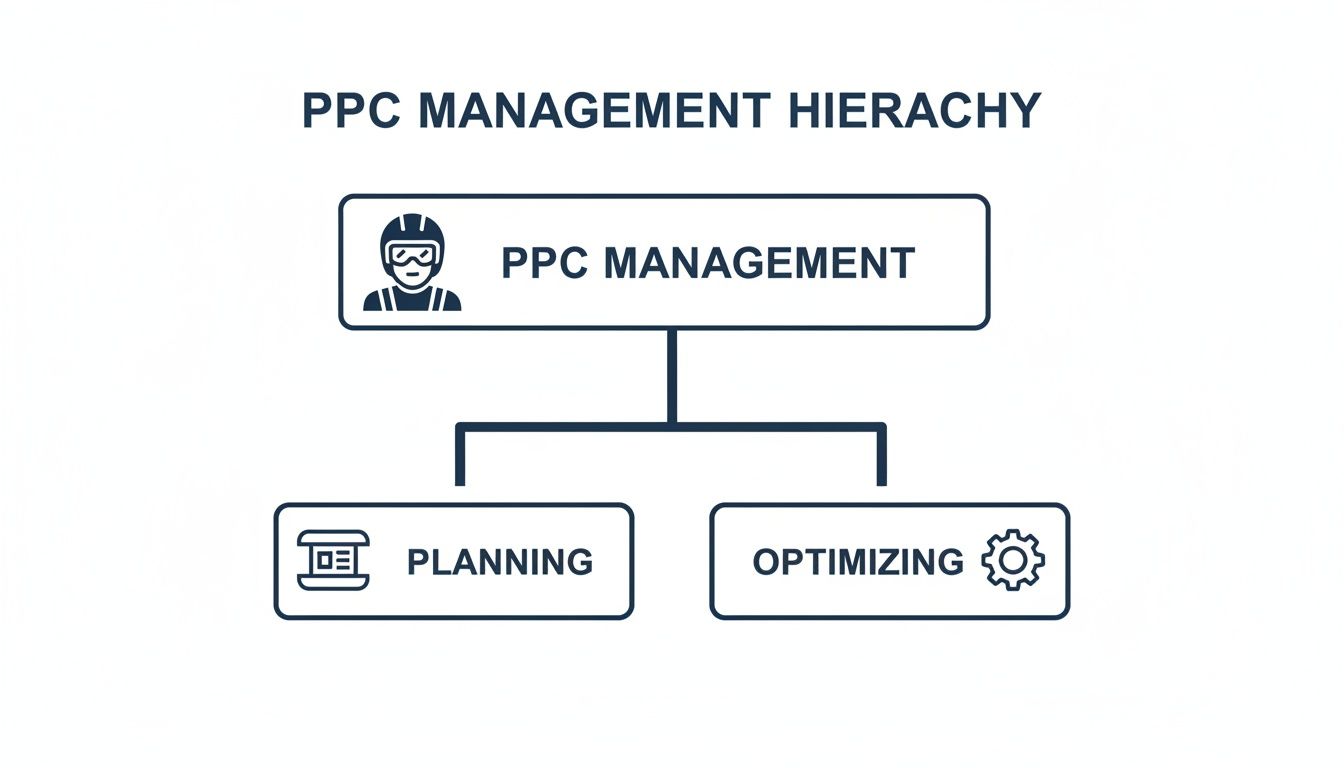
As you can see, a winning campaign depends just as much on the solid initial plan as it does on the constant tweaks you make along the way.
Structuring Your Account for Success
Once you’ve picked your platform, you need to build a logical account structure. A messy, disorganised account is a nightmare to manage and will burn through your budget. A clean structure, on the other hand, gives you better control, more relevant ads, and much clearer data on what’s actually working.
The best practice is to follow a simple hierarchy:
- Campaigns: This is the top level. Each campaign should focus on a single business goal or service category. For our plumber, this might be "Emergency Call-Outs" and "Renovation Projects."
- Ad Groups: Inside each campaign, you create tightly-themed ad groups. Under the "Emergency Call-Outs" campaign, you could have ad groups like "Blocked Drains" and "Hot Water Repairs."
- Keywords & Ads: Finally, each ad group contains a small, focused list of keywords and a couple of ads that are laser-specific to that theme.
This granular approach ensures that when someone searches for "24/7 plumber Fitzroy," they see an ad about emergency plumbing—not a generic one about bathroom renos. Platforms like Google reward this relevance with better ad positions and, crucially, lower costs.
Conducting Practical Keyword Research
For any search campaign, keyword research is the absolute core of your strategy. The goal is to get inside your customer’s head and uncover the exact phrases they’re typing into Google. This isn't about guesswork; it's about using data to understand their language and intent.
Start by brainstorming your main services, then use a tool like Google's Keyword Planner to find related terms. Pay close attention to long-tail keywords—these are longer, more specific phrases like "licensed plumber for gas cooktop installation Melbourne." They usually have less competition and signal that the searcher is much closer to making a decision.
A critical part of keyword research is also finding negative keywords. These are the terms you don't want your ads to show up for. For our plumber, adding words like "jobs," "course," and "free" as negative keywords would stop their budget from being wasted on clicks from job seekers or tyre-kickers.
Finally, you need to make sure your ads send people to a highly relevant landing page. Getting the click is only half the battle; the conversion happens on your website. For more on this, check out our guide on what conversion rate optimisation is and how it helps turn that valuable traffic into real business. Nailing these foundational steps gives your campaign the strongest possible chance of delivering a great return.
4. Bidding and Budgeting: Where the Rubber Meets the Road
Alright, with your campaign structure in place, we get to the pointy end of things: money. This is where you tell the ad platforms exactly how to spend your budget and what you expect in return. It’s the part of PPC management that feels most tangible because it directly connects your spending to your results.
Think of your bidding strategy as giving specific instructions to a personal shopper. You wouldn't just hand them your wallet and say "buy stuff." You'd give them clear goals. "Get me as many t-shirts as you can for $100" is a very different instruction from "Find me a pair of R.M. Williams boots, and don't spend more than $500." Both are valid, but they lead to completely different outcomes.
Choosing Your Automated Bidding Strategy
Gone are the days of manually tweaking bids for every single keyword. Today, we rely on the ad platform's machine learning to do the heavy lifting. You set the goal, and the system adjusts bids in real-time to make it happen. It's incredibly powerful, but you still need to give it the right instructions.
Here's a breakdown of common automated bidding strategies to help you align your approach with your campaign goals.
- Maximise Clicks focuses on the primary goal of driving website traffic. This is best for building awareness or gathering initial campaign data.
- Maximise Conversions is geared towards generating leads or sales. Its goal is to get the highest number of conversions (like calls or form fills) possible within your budget.
- Target CPA (Cost Per Acquisition) is designed for a controlled lead cost. This strategy is ideal for businesses that know exactly what a lead is worth and want to acquire them at a specific price.
- Target ROAS (Return On Ad Spend) prioritizes revenue and profitability. It's the go-to for e-commerce stores aiming for a specific return on every dollar spent on advertising.
Getting this right means you’re not just spending money; you’re investing it where it delivers the most value. It's how industries with high-value leads, like those using HVAC Paid Ads, can zero in on profitable jobs and avoid wasting money on tyre-kickers. The strategy you choose dictates how your budget is put to work.
How to Set a Realistic PPC Budget
Now for the million-dollar question: "How much should I spend?" The honest answer is always, "It depends." But that isn't very helpful, so let's work backwards from your goals instead of pulling a number from thin air.
Your budget needs to be grounded in the reality of your market. For example, 2026 data shows the average cost-per-click (CPC) in Australia sits around $5.26. But that average hides a huge range. The food and drinks industry might pay just $0.48 per click, while other hyper-competitive fields have seen costs jump by 40%. With 87% of industries seeing their CPCs rise, you can't afford to just guess.
To build a smart starting budget, you need to do some basic maths:
- Estimate Your Cost Per Click (CPC): Fire up Google’s Keyword Planner and get a feel for what a click will cost in your industry for your target terms.
- Define Your Target Cost Per Acquisition (CPA): This is the big one. How much are you willing to pay to get one new lead or customer? Be realistic.
- Work Backwards: Now, just connect the dots. If you know a new lead is worth $50 (your target CPA) and your website converts visitors into leads at a 5% rate, you can afford to pay up to $2.50 per click ($50 CPA x 5% conversion rate).
This simple calculation gives you a data-driven starting point. You can find a more detailed walkthrough in our guide on how much Google Ads cost. From there, you launch, gather real-world data, and adjust.
A well-managed PPC budget is not an expense; it’s a strategic investment. By aligning your spending with clear goals and leveraging automated bidding, you create a predictable and scalable system for generating new business.
Crafting Ads and Landing Pages That Convert
Getting your bidding and targeting right is a huge part of a strong PPC campaign, but it's only half the battle. The real magic happens when you pair that technical setup with a compelling message that grabs your audience at the exact moment they need you.
This is where the art of writing persuasive ad copy and building high-converting landing pages comes in. Nail this, and you turn a click that costs you money into a click that makes you money.
Your ad is your first handshake. It needs to be clear, direct, and solve a problem instantly.
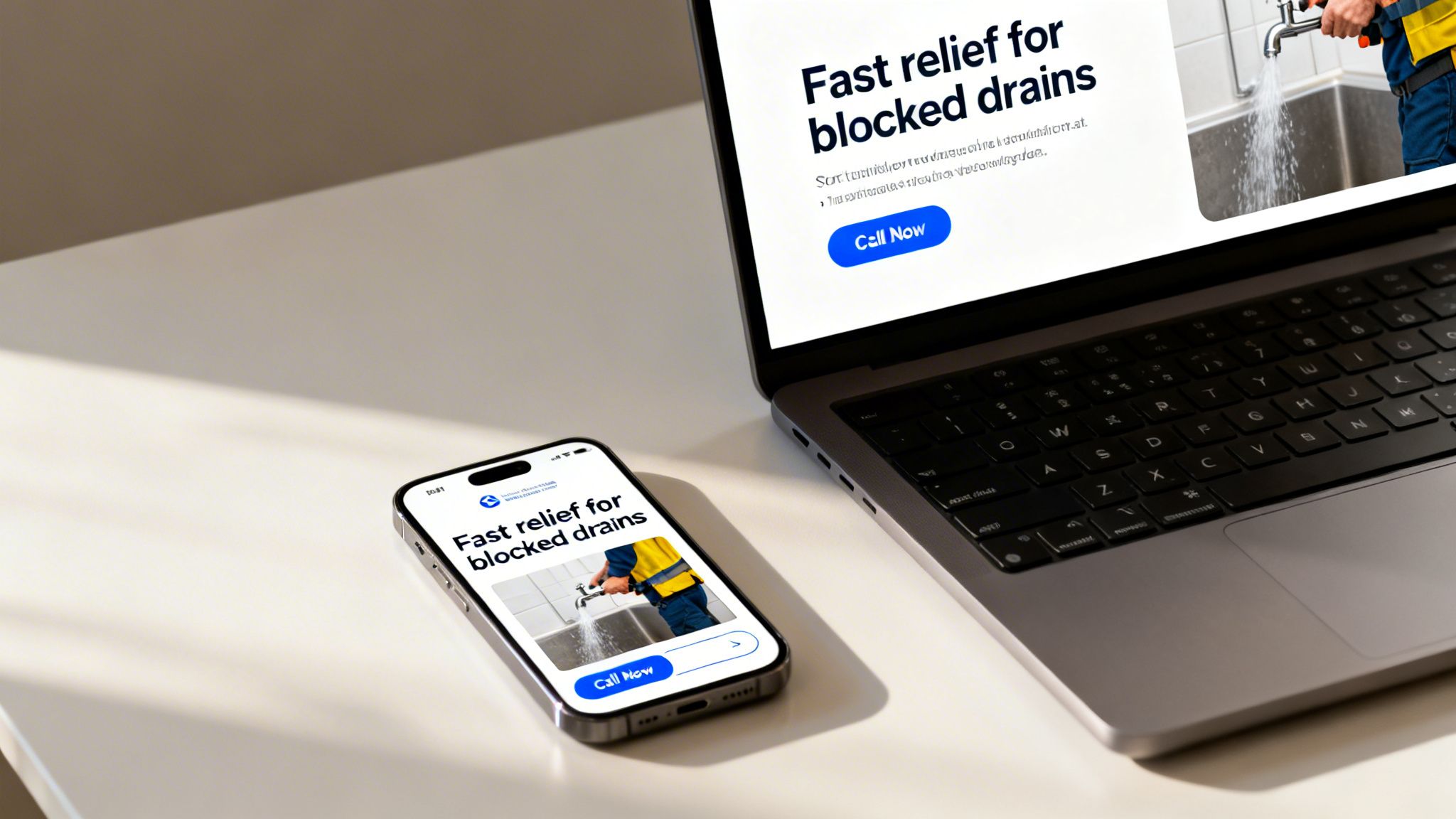
Imagine someone frantically searching "emergency plumber near me". An ad with the headline "Fast Relief for Blocked Drains" speaks directly to their crisis. It's far more effective than a generic business tagline because it matches their immediate need. We call this message matching, and it’s the foundation of good PPC management.
Building the Bridge from Ad to Landing Page
The ad's only job is to earn that click. The real work—the conversion—happens on your landing page. The journey between the two has to be seamless.
If someone clicks your ad for "blocked drain repair," they better land on a page that’s all about fixing blocked drains. Don't dump them on your homepage to fend for themselves amongst a dozen other services.
This continuity reassures the user they’ve come to the right place and makes it dead simple for them to take the next step. Any friction, any confusion, and they'll hit the back button in a heartbeat. And you've just paid for that click.
A high-converting landing page isn't just another page on your website; it's a purpose-built conversion machine. Every single element, from the headline down to the button colour, is strategically designed to guide one user towards one specific action.
The Anatomy of a High-Converting Landing Page
To turn those clicks into paying customers, your landing page needs to be built with intent. It has to answer questions, build trust, and do it all in a matter of seconds. While the exact formula varies by industry, every great landing page has these non-negotiables:
- A Crystal-Clear Value Proposition: A powerful headline and sub-headline that instantly confirms you have the solution to their problem. No fluff.
- An Unmissable Call-to-Action (CTA): A big, bold button or form with action-focused text like "Get a Free Quote Now" or "Call for Emergency Service." Don't make people hunt for it.
- Trust-Building Social Proof: This is your evidence. Customer testimonials, five-star reviews, industry awards, or "As Seen On" logos all show visitors that others have trusted you and had a great experience.
- A Flawless Mobile Design: A massive chunk of searches happen on phones. Your page must be easy to read and navigate on a small screen. For service businesses, a "tap-to-call" button is absolutely essential.
- Compelling Visuals: High-quality photos or short videos of your work can do wonders for building confidence and driving engagement. Show, don't just tell.
Effective ppc advertising management is all about making sure every piece of the puzzle—from the ad copy to the post-click experience—works in perfect harmony. This alignment is what will truly maximise your return on ad spend.
The skill involved in writing for these pages is a specialised field in itself. To get a better handle on creating compelling online text, you might find our overview of content writing for websites helpful. By mastering both the ad and the landing page, you build a complete system that consistently turns clicks into loyal customers.
Unifying PPC and SEO for a Stronger Digital Strategy
Running a great PPC campaign is a good start, but it’s a mistake to think it works in isolation. The sharpest Australian businesses know that paid search is just one part of a bigger picture. To get real, sustainable growth, you need to connect your PPC ads with your other digital channels, especially search engine optimisation (SEO).
Think of it like having two star players on the same team. PPC is your sprinter—it gets you immediate traffic, fast results, and crucial data from day one. SEO is your marathon runner—it patiently builds long-term authority, organic trust, and a steady stream of traffic that grows over time. When they work together, you cover all your bases, from short-term wins to long-term dominance.
How PPC and SEO Work Hand-in-Hand
The real magic happens when your paid and organic search efforts start feeding each other. This creates a powerful cycle where each channel makes the other one more effective. Your PPC campaigns essentially become a live testing ground, giving you instant feedback on which keywords and messages actually get your customers to click.
Here’s how they strengthen one another:
- PPC finds your best SEO keywords: Wondering what to write your next blog post about? Check your best-performing PPC keywords. If people are already clicking and converting on your ads for a certain search term, you can be confident that building organic rankings for it is a smart move.
- SEO makes your ads more trustworthy: A strong organic presence builds brand credibility. When someone sees your business show up in both the paid and organic results, it sends a powerful signal of authority, making them far more likely to trust and click your ad.
- Dominate the search results: By targeting important keywords with both PPC and SEO, you can take over the search engine results page (SERP). This "surround sound" approach pushes your competitors down the page and dramatically boosts your overall clicks.
When you integrate PPC and SEO, you’re not just running separate campaigns. You're building a complete digital presence that captures customers at every point in their journey, delivering quick wins and lasting growth at the same time.
Bringing Social Media into the Mix
This integrated mindset doesn’t stop at Google. Social media advertising, especially on platforms like Meta (Facebook and Instagram), is essential for building brand awareness and creating future demand for your services. You can use social ads to introduce your brand to potential customers who aren't even actively searching for you yet.
This initial brand exposure directly fuels later searches. For example, a Perth-based solar installer could run an engaging video ad on Facebook targeting local homeowners. A few days or weeks later, when those same homeowners start properly researching solar options, they’re far more likely to recognise and click on that company's Google Ad.
The results speak for themselves. Businesses that combine PPC and SEO see 25% more clicks and 27% higher profits than those that rely on just one channel. And with 31.3% of consumers now discovering brands through social media ads, a joined-up strategy is non-negotiable. You can dig deeper into these Australian digital marketing insights to see the full picture.
Measuring Success and Choosing Your Management Path
How do you know if your PPC efforts are genuinely paying off? Proper PPC advertising management isn't just about driving clicks; it’s about tracking the right data to prove you’re generating real value for your business.
It’s far too easy to get distracted by "vanity metrics" like impressions and clicks. While they have their place, they don't tell you if you're actually making a profit. To measure real impact, you need to focus on the metrics that connect directly to your bottom line.
Key Metrics That Truly Matter
To get a real sense of your campaign performance, you have to look past the surface-level numbers. The following KPIs reveal the true health and profitability of your advertising.
- Conversion Rate: This is the percentage of people who take a desired action (like a phone call or filling out a form) after clicking your ad. A high conversion rate is a great sign that your ads and landing pages are perfectly aligned with what your customers are looking for.
- Cost Per Acquisition (CPA): This metric tells you exactly what you’re spending to get one new lead or customer. It’s calculated by dividing your total ad spend by the number of conversions, giving you a crystal-clear measure of cost-effectiveness.
- Return On Ad Spend (ROAS): For businesses that can track revenue directly, ROAS is the ultimate measure of success. It calculates the total revenue generated for every dollar you put into ads, proving whether your campaigns are a profitable venture.
Tracking these figures helps you make informed decisions, ensuring every dollar is invested wisely. This focus on outcomes is what transforms PPC from a business expense into a powerful growth engine.
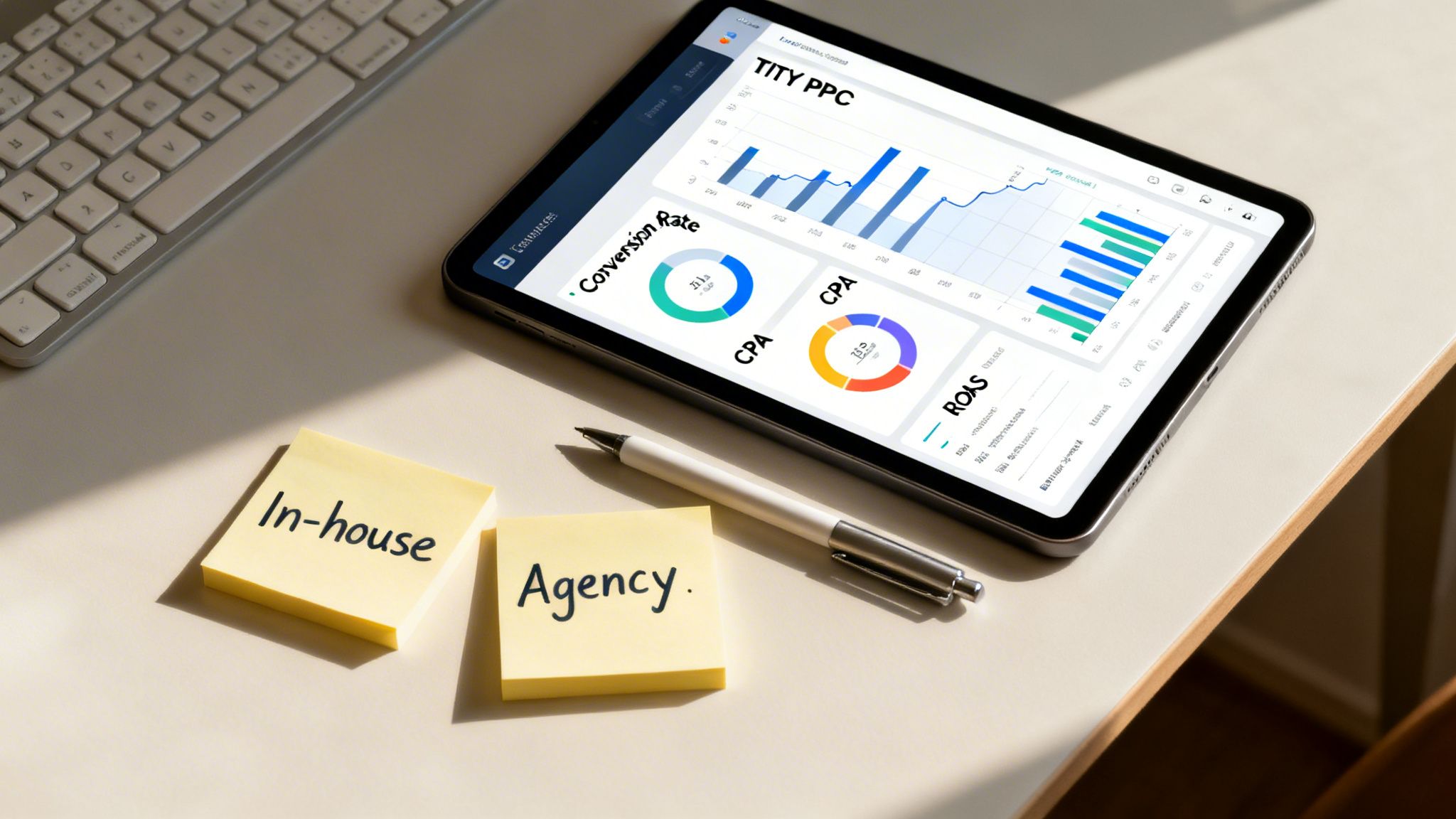
The Big Decision: In-House vs. Agency Management
Once you're committed to PPC, you face a critical choice: manage it yourself or bring in a professional agency? There's no single right answer here—the best path depends entirely on your business's resources, time, and in-house expertise.
Running campaigns in-house gives you maximum control and can be cost-effective if you already have a skilled team member with time to dedicate to it. The catch? The learning curve is steep, and keeping up with platform changes and daily optimisation can quickly become a full-time job.
On the other hand, partnering with a professional brings deep expertise, specialised tools, and saves you an enormous amount of time. If you are thinking about getting professional help, choosing the right PPC agency can make or break your campaign's success. An experienced agency lives and breathes this work, applying proven strategies to get you results much faster.
Understanding Agency Pricing Models
If you’re leaning towards hiring help, it’s useful to understand how agencies typically structure their fees. This knowledge will help you find a partner whose model aligns with your budget and goals.
Common pricing structures you’ll come across include:
- Percentage of Ad Spend: The agency charges a fee that’s a percentage of your monthly advertising budget.
- Flat Monthly Retainer: You pay a fixed fee each month for a clearly defined scope of management services.
- Performance-Based Pricing: Fees are tied directly to results, such as the number of leads generated or sales made.
Evaluating your own resources and goals is the first step toward making the right choice for your business. To help you navigate this decision, our team has put together a guide on finding the right pay-per-click agency for your needs.
Common Questions About PPC Advertising Management
If you're an Australian business owner looking at pay-per-click advertising, you’ve probably got a few questions. It's a complex area, so let's clear up some of the most common things we get asked about professional PPC management.
How Long Does It Take to See Results from PPC?
While your ads can start driving traffic almost instantly, real business results—like a steady flow of leads or sales—don't happen overnight. You should plan for an initial period of one to three months for data gathering, testing, and optimisation.
Think of this as the foundation-laying phase. Your management team is figuring out what messages resonate, which keywords convert, and where to best spend your budget. This initial work is what paves the way for long-term, profitable growth. Patience here pays off later.
Is PPC Management Only for Big Businesses?
Not at all. In fact, professional PPC advertising management is often even more crucial for small and medium-sized businesses operating on a tighter budget. For an SME, every single dollar has to pull its weight.
An expert manager makes sure your budget isn’t being burned on irrelevant clicks or poorly targeted ads. They focus your spending where it delivers the biggest impact, which is how smaller businesses can go toe-to-toe with the bigger players in their local market.
What Is Google Performance Max and Should I Use It?
Performance Max, or PMax, is Google's all-in-one campaign type. It uses AI to run your ads across all of Google's channels—Search, YouTube, Display, Shopping, you name it. The entire system is built to automatically find customers who are likely to convert.
For many businesses, PMax can be a fantastic tool for discovering new audiences. But it’s not a "set and forget" solution. It needs a careful setup and a human expert watching over it to make sure the AI is actually chasing your business goals, not just spending your budget on low-value channels.
Deciding on PMax really comes down to your specific goals. Its automation is undeniably powerful, but it can also hide important performance data. That's why you need an expert who knows how to interpret its results and steer the AI toward what matters most to your business.
Can I Just Set Up My Ads and Let Them Run?
This is easily one of the most common and costly mistakes businesses make with PPC. Setting up a campaign and just letting it run is like starting a car and then taking your hands off the steering wheel. The digital ad world is always in motion—competitors come and go, costs fluctuate, and customer behaviour changes.
Effective PPC advertising management is an ongoing process of monitoring, testing, and tweaking. This active, hands-on management is the only way to adapt to market shifts and consistently improve your return on ad spend over time.
Ready to turn your ad spend into a predictable growth engine? The expert team at Titan Blue Australia has over 25 years of experience helping businesses like yours succeed with strategic, data-driven digital marketing. Find out how we can help by visiting us at https://titanblue.com.au.
Make Titan Blue a preferred source in Google
One click tells Google to surface our articles more often in Top Stories, AI Overviews and AI Mode.

Best Dental Website Design Agencies in Australia: 7 Compared
Best dental website design agencies in Australia 2026: seven compared on dental proof, booking, AHPRA…

Childcare Centre Website Design Australia: The 2026 Guide
Childcare centre website design Australia: show hours, ages and enrolment as text so parents and…

Electrician Website Design Australia: The 2026 Guide
Electrician website design Australia: what to build, what we found on eight Gold Coast electrician…