


Trying to treat web design and SEO marketing as separate jobs is one of the biggest mistakes a business can make. It's like building a car with a powerful engine but no steering wheel. One part might be impressive, but without the other, you're not going anywhere.
Think of it this way: SEO is what gets potential customers to your front door. Web design is what welcomes them inside and convinces them to stay. If either part fails, the whole strategy falls apart, and you’re just wasting time and money.
Why Web Design and SEO Must Work Together
Imagine you've just launched a stunning, modern website for your restaurant. The food photography is mouth-watering, the menu is a breeze to navigate, and booking a table takes two clicks. The problem? Your site is buried on page ten of Google. This is like opening a five-star restaurant in an unmarked basement—it might be a masterpiece, but no one will ever find it.
Now, let's flip that. What if your SEO is flawless? You rank number one for “plumber Gold Coast,” but when someone clicks your link, they land on a clunky, confusing, and outdated website that takes forever to load. They're gone in seconds. This is like throwing a massive party but giving everyone the wrong address. You’ve attracted a crowd, but they can’t get in the door.
The Critical Connection Is User Experience
The truth is, web design and SEO marketing are two sides of the same coin. And that coin is user experience. Google doesn't just catalogue information anymore; it actively measures how people feel when they interact with a website. A positive, seamless experience is now a direct ranking signal.
This map shows exactly how web design and SEO should work together, with user experience as the foundation that turns clicks into customers.
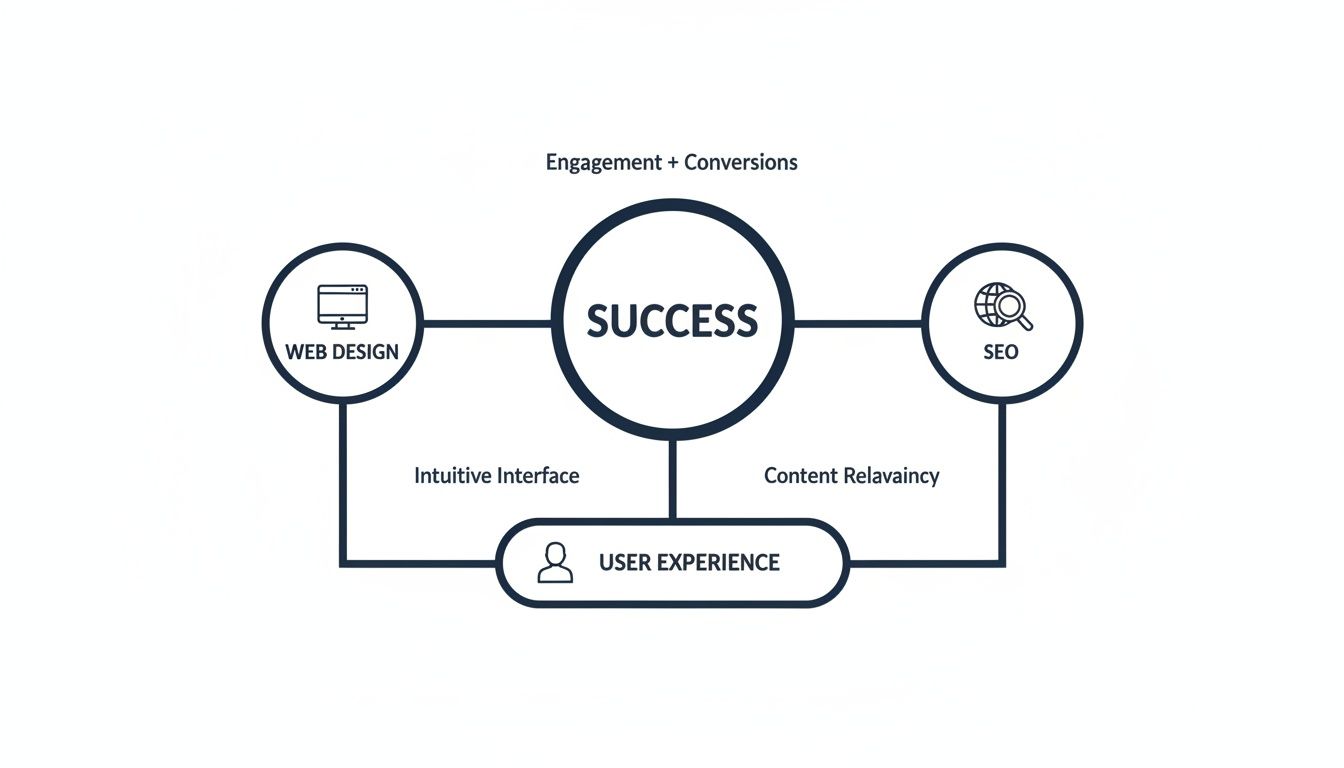
As you can see, a great user experience is the bridge connecting a beautifully designed site with top-ranking SEO. It's what leads to real business results. Without that connection, both efforts will fall flat. The synergy is undeniable; a great web design is crucial for local search dominance, acting as your most powerful, 24/7 sales tool.
First Impressions Dictate Your Success
The numbers back this up. A staggering 94% of first impressions are tied directly to your website's design. In Australia, the stakes are even higher for small and medium businesses; a bad online experience will cause 88% of consumers to never come back. This is especially true for local businesses like restaurants, cafes, and trades.
The bottom line is clear: separating design and SEO is a recipe for failure. An integrated approach is the only way to turn your online presence into a machine that generates leads and customers. You can explore our detailed guide on integrating SEO into web design to see how we put this into practice. This combined mindset transforms your website from a static online brochure into a sustainable source of business growth.
Building a Foundation with SEO-First Design
The best websites aren’t just beautiful; they’re built for performance from the very first sketch. Trying to add SEO after your site is live is like trying to add plumbing to a house after the walls are up—it’s messy, expensive, and never works as well as it should.
An SEO-first design ensures your website is a powerful asset from day one. This means every choice, from the site layout to the navigation, is made to please both human visitors and the search engines that bring them to you. It's about engineering a digital space that’s designed to rank, attract, and convert.
Embrace a Mobile-First Philosophy
In 2026, thinking "mobile-first" is no longer a choice; it's a requirement. This simply means designing your website for the smallest screen—a smartphone—and then expanding the layout for larger screens like tablets and desktops. Why? Because Google now primarily uses the mobile version of your site to decide how it ranks.
If your website is clunky and frustrating to use on a phone, your search rankings will take a direct hit. Frustrated users leave quickly, sending a clear signal to Google that your site isn't a good result. In Australia, where 75% of users judge a company’s credibility by its website design, a poor mobile experience is a business killer. This is made even worse by the fact that 53% of mobile users will leave a site if it takes more than three seconds to load. You can see how design impacts user trust and business credibility in more detail here.
Architect Your Site for Search Engines
A well-structured website is easy for search engine crawlers to navigate and understand. Think of it as handing Google a crystal-clear map of your business. This isn't about secret tricks; it's about a logical framework that's baked into the design process from the start.
Key parts of an SEO-friendly site architecture include:
- Clean and Logical URLs: Your page URLs should be simple for a human to read and include relevant keywords. A URL like
yourbusiness.com.au/services/emergency-plumbingis infinitely better than a messy one likeyourbusiness.com.au/p?id=123. - Strategic Heading Tags (H1, H2, H3): Headings create a clear hierarchy for your content, just like chapters in a book. Your main page title is your H1, with subheadings organised as H2s and H3s to break up text and show what’s important.
- Logical Internal Linking: Linking to other relevant pages on your own website helps search engines discover all your content and understand how different topics are related. It also has the added benefit of keeping users on your site longer.
- An Intuitive Navigation Menu: Your main menu should be dead simple. It needs to guide users effortlessly to your most important pages, like your services, about page, and how to get in touch.
Getting these foundational pieces right from the beginning is what separates successful websites from the ones that get lost on page five of Google. Our guide on the role of SEO in web design dives deeper into these technical details. By building with a solid structure, you create a website that’s primed for search engine visibility right out of the gate.
Optimising User Experience and Core Web Vitals
Think of your website as your digital storefront. Google’s Core Web Vitals aren't just technical jargon—they measure exactly how a customer feels when they walk through your virtual door.
Is it a welcoming experience? Can they find what they need without any fuss? Or is it slow, confusing, and frustrating, causing them to walk right back out? This is what Core Web Vitals tell us.
Essentially, these metrics ask three simple questions about your site:
- How fast does it load? (Largest Contentful Paint)
- How quickly can someone interact with it? (First Input Delay)
- Is the layout stable, or does it jump around unexpectedly? (Cumulative Layout Shift)
A poor score in any of these areas is a red flag for Google, signalling that your website is difficult to use. Search engines want to send their users to sites that provide a great experience, so a bad score will directly harm your rankings. This is where the fusion of web design and SEO marketing is most critical, ensuring your site is not just findable but also genuinely enjoyable.
Understanding the Core Web Vitals
To really get your head around these concepts, let's stick with the storefront analogy. Imagine a customer, Sarah, popping into a new cafe she’s heard about. Her experience perfectly mirrors how Google measures your site.
Largest Contentful Paint (LCP) is all about that first impression of speed. It measures how long it takes for the largest, most important element—like your main banner image or headline—to appear. For Sarah, this is the moment she walks in and sees the main menu board. If it takes ages to load, she’s going to get impatient and might just leave. A good LCP is under 2.5 seconds.
First Input Delay (FID) measures responsiveness. It’s how quickly your site reacts when someone tries to do something for the first time, like clicking a button or opening a dropdown menu. At the cafe, this is how long it takes for the barista to look up and acknowledge Sarah after she’s decided on her coffee. A long delay feels like being ignored. A good FID is under 100 milliseconds.
Cumulative Layout Shift (CLS) is all about visual stability. This tracks how much your page layout unexpectedly moves or reflows as it loads. For Sarah, it’s like trying to read the menu board while it suddenly jumps to a different wall. It’s disorienting, annoying, and makes for a terrible experience. A low CLS score means your page is steady and predictable.
Actionable Steps for Better Scores
Improving your Core Web Vitals isn't just a box-ticking exercise for developers. It connects technical fixes to real-world business outcomes, like lower bounce rates and more sales. When someone has a smooth, fast experience, they're far more likely to stick around, browse, and ultimately convert.
Here are some practical ways to get your scores up:
- Compress and Optimise Images: This is the low-hanging fruit. Huge, uncompressed images are the number one cause of slow websites. Before you upload any image, run it through a tool to shrink the file size without killing the quality. This directly boosts your LCP.
- Streamline Your Code: Bloated, unnecessary code (especially JavaScript) can stop a browser from loading your page quickly. This clogs up both LCP and FID. Chat with your developer about deferring non-critical scripts or cleaning up anything that isn’t essential.
- Specify Dimensions for Images and Ads: To stop your layout from jumping around (CLS), always set the width and height for your images, videos, and ad containers in the code. This tells the browser to save a spot for that element, preventing everything else from shifting when it finally loads.
Focusing on these areas ensures your website offers a welcoming experience that both users and Google will reward. For a deeper technical dive, you can explore more about catering for Google Core Web Vitals and see how these optimisations work in practice.
At the end of the day, a fast, stable, and responsive website is a non-negotiable cornerstone of modern SEO.
Creating Content That Fuels Design and SEO
If your website is the engine, then content is the fuel. It’s what powers both your design and your visibility in search engines. Without quality content, even a stunning website is just an empty shell, and your SEO efforts will have nothing to grip onto.
Great content does two jobs at once. For search engines like Google, it provides the context needed to understand what you do and why you deserve a top spot in the rankings. For your visitors, it offers the answers, value, and reassurance they need to trust you and make a purchase. It turns your website from a digital business card into a genuinely useful resource.
Uncovering What Your Audience Really Wants
Before you write a single word, you need to step into your customers' shoes and figure out what they’re actually searching for. This is where keyword research comes in. It’s not about guessing or stuffing your pages with repetitive phrases; it’s about discovering the real language your audience uses to find the solutions you offer.
Imagine you're a solar installer on the Gold Coast. Your potential customers aren't just typing in "solar panels." They're asking specific questions:
- "cost of solar panels Gold Coast" (ready to buy)
- "best solar installers near me" (comparing options)
- "how do solar panels work in cloudy weather" (doing their research)
Understanding these different search intents lets you create targeted content for each stage. You can build a detailed service page breaking down costs, a location page to attract local searches, and a blog post explaining the technology. It’s a strategic approach that attracts the right visitors at the right time.
The impact of this is huge. Recent data shows that 91% of marketers have seen positive results from their SEO efforts. When you consider that 68% of all online experiences begin with a search engine, having an optimised website is a lifeline for any business, from a local plumber to a boutique hotel. Better yet, SEO is incredibly cost-effective, driving 1,000% more organic traffic than social media. You can discover more SEO statistics and their impact to see the full picture.
Structuring Content for Modern Search
The days of simply writing long articles are long gone. To stand out in 2026, your content needs to be structured into different formats that serve different purposes. Your site should be a well-organised mix of pages designed to sell and articles designed to inform.
- Compelling Service Pages: These are your digital sales pitches. They need to be sharp, persuasive, and answer the most urgent questions a potential customer has about what you do.
- In-depth Blog Posts: This is where you build trust and authority. By answering the "why" and "how" questions your audience is asking, you position yourself as the expert, available 24/7.
This structure has become even more important with the rise of AI chatbots and conversational search. Your content now needs to provide direct, clear, and authoritative answers that can be easily understood and referenced by language models. This practice is often called Answer Engine Optimisation (AEO).
When creating content, it's also important to understand the nuances of humanizing AI text for SEO to maintain readability while satisfying search algorithms. If you want to dive deeper, our guide on effective content writing for websites will show you how to craft copy that truly connects and converts.
Winning Locally Where Design and Marketing Unite
For most small businesses, your best customers are the ones right around the corner. While ranking across the country sounds great, real success usually starts in your own backyard. This is where getting local SEO right becomes your unfair advantage, and it’s a game won by weaving web design and SEO marketing together.
Your website isn’t just there to look good. It needs to send strong local signals to search engines, turning it from a generic online pamphlet into a magnet for customers actively searching for services "near me."
The Power of NAP and On-Site Signals
The bedrock of local SEO is consistency. Search engines like Google want to see the exact same details about your business everywhere it shows up online. The most vital pieces of information are your Name, Address, and Phone number (NAP).
This is where your website design plays a critical role. Your NAP needs to be front and centre, not buried on a hard-to-find contact page. A smart move is to place your full NAP in your website's footer so it appears on every single page. This constant repetition tells Google, "Yes, this business is genuinely based here."
It’s a simple design choice, but it creates a powerful signal that anchors your business to a specific spot, making it much easier for local customers to find you right when they need you.
Integrating Local Trust Signals into Your Design
Beyond your NAP, your website’s design is your chance to build instant trust with local visitors. People want proof that you’re a real, active, and respected local business. You can use your site to show off your local credentials.
Your design should feature:
- Google Business Profile Showcase: Your website is the perfect spot to encourage reviews and show off your great rating. A well-designed section linking directly to your Google Business Profile not only helps happy customers leave feedback but also shows potential clients you're a trusted local name.
- Embedded Interactive Maps: Don’t just list your address—show it. Embedding a Google Map on your contact or homepage offers an interactive, easy-to-use feature that visually confirms your location. It’s practical for customers and another strong local signal for SEO.
- Prominently Featured Customer Reviews: Sprinkle glowing testimonials from local customers throughout your homepage and service pages. Seeing positive feedback from neighbours builds a level of trust that no marketing pitch can match.
These design elements all work together to tell a convincing story of local credibility, turning your website into a hub of community trust. For a deeper dive, you can learn more about what local SEO is and how these pieces fit into the bigger picture.
Dominating 'Near Me' Searches with Service Area Pages
If your business serves a specific region—like a plumber, electrician, or mobile dog groomer—creating dedicated service area pages is an incredibly powerful move. These are specific pages on your website built to rank for searches like "plumber Robina" or "electrician Broadbeach."
A common mistake is just listing all the suburbs you cover on one page. A much smarter approach is to create a unique, dedicated page for each key suburb you want to target.
Each page needs to be tailored with specific, locally-focused content. For instance, a page targeting "Emergency Plumber Robina" could mention local landmarks, discuss common plumbing issues found in Robina homes, and feature a testimonial from a client who lives there.
This proves to Google you have a real, meaningful presence in that exact location. So, when someone in that suburb searches for your services, you have a perfectly tuned page ready to meet their needs. It turns your website into a precision tool for attracting local customers, one suburb at a time.
Measuring Real Success and Preparing for the Future

A powerful strategy is only as good as the results it delivers. Combining web design and SEO marketing gives you a formidable business tool, but you need to know how to measure what truly matters. It’s time to move past surface-level numbers and focus on the metrics that directly affect your bottom line.
It's all about getting answers to the real questions. Are more qualified customers finding you through search? Are they actually engaging with your site? And most importantly, are they turning into leads and sales? This isn't just about tracking data; it's about making smart decisions to future-proof your investment and fuel real, sustainable growth.
Focusing on Metrics That Matter
To measure the real return on your investment (ROI), you have to look beyond vanity metrics like page views or social media likes. Instead, you need to concentrate on the data that shows how your website is performing as a genuine business asset. Two free tools are essential for this: Google Analytics 4 and Google Search Console.
These platforms give you a clear, business-friendly look at your performance. Here are the key numbers to watch:
- Organic Traffic Growth: This shows how many people are finding your site through search engines like Google. A steady increase means your SEO efforts are paying off.
- Keyword Rankings: Tracking your position for important search terms in Google Search Console shows whether you're gaining visibility for the services people are actually looking for.
- Conversion Rate: This is the percentage of visitors who complete a desired action, like filling out a contact form or calling your business. It's the ultimate measure of your website's effectiveness.
- Leads Generated: This is the hard number of enquiries or calls you receive directly from your website. This metric connects your digital efforts straight to your business growth.
By keeping a close eye on these specific figures, you can accurately gauge the success of your integrated strategy and understand exactly what's working and where you can improve.
Preparing for the Future of Search
The way people find information is changing, and it's changing fast. Search is no longer just about typing keywords into Google. People are using voice assistants, having conversations with AI chatbots like ChatGPT, and doing visual searches on platforms like YouTube and TikTok to get answers. Your content strategy has to adapt.
This means preparing your website to be a source of truth for both humans and AI. The key is to create content that is conversational, authoritative, and answers questions directly and clearly. AI-powered search engines love content that provides unique insights and isn't just a rehash of what everyone else is saying.
On top of that, diversifying your content formats is no longer optional. A single blog post can be cleverly repurposed to reach a much wider audience and satisfy different preferences:
- Video Summaries: Create short, engaging videos for platforms like YouTube to capture visual learners.
- Audio Guides or Podcasts: Convert your articles into an audio format for people who prefer to listen while they're on the go.
This multi-format approach demonstrates your expertise across different channels. As AI search tools pull information from a wider range of sources, having a presence on platforms like Bing, which powers many of ChatGPT's search capabilities, is becoming incredibly important. Making sure your site is registered with Bing Webmaster Tools is a smart, simple move to ensure your content is visible to these new answer engines.
Frequently Asked Questions
When you’re investing in your business’s online presence, you're bound to have questions. We get it. Here are some of the most common ones we hear about web design and SEO marketing, with straight-to-the-point answers.
How Long Does It Take to See Results From Web Design and SEO?
A brand-new, well-designed website will immediately improve how users see your business. But getting real traction from SEO is a different story—it’s a long game.
Think of it this way: your new site is the freshly planted garden, but SEO is the consistent watering, weeding, and care it needs to actually grow. You can generally expect to see the first signs of movement in rankings and organic traffic within 3 to 6 months. Search engines need that time to crawl, index, and make sense of your new site. It’s an investment in sustainable growth, not an overnight fix.
What Is More Important: A Beautiful Site or A High-Ranking Site?
This is a trick question we hear all the time. The answer is you absolutely need both. One without the other is just a waste of money, which is the whole reason integrated web design and SEO marketing exists.
A site that ranks #1 on Google but offers a terrible experience will send visitors running. They’ll hit the back button, signalling to Google that your site isn’t a good result, and your rankings will eventually drop. On the flip side, what good is a beautiful website if no one can find it? It’s just an expensive digital brochure.
Can I Do My Own SEO on a DIY Website Builder?
While DIY platforms have basic SEO tools, they often fall short when you need to get serious, especially in a competitive market. For a tiny local business with almost no online competition, it might be a decent starting point.
But for any business that’s serious about growth, you’ll hit a ceiling fast. The limitations become a real handicap:
- Slower Site Speed: These platforms are often bloated with unnecessary code, which kills your Core Web Vitals scores and frustrates users.
- Limited Customisation: Trying to implement advanced schema markup or have full control over your URL structures can be difficult, if not impossible.
To get a real competitive edge and a genuine return on your investment, you almost always need a custom website built by experts who understand performance, paired with a professional SEO strategy that goes beyond the basics.
Ready to stop guessing and start growing? At Titan Blue Australia, we build high-performance websites that look great and rank high. Get in touch with our team today to see how our integrated approach can work for your business.
Make Titan Blue a preferred source in Google
One click tells Google to surface our articles more often in Top Stories, AI Overviews and AI Mode.

Solar Installer Website Design Australia: The 2026 Guide
How solar installer websites in Australia should show CEC accreditation, real install proof and AI-ready…

Hotel & Hospitality Website Design Australia: 2026 Guide
Hotel and hospitality website design in Australia explained: booking flow, schema, AEO and what actually…

Restaurant Website Design Australia: The 2026 Guide
What a restaurant website in Australia needs: HTML menus, bookings, GBP sync, schema, and AI-ready…