


Your website looks fine. It has your services, your phone number, a few photos, maybe even some reviews. But the leads are patchy, Google sends very little traffic, and most new customers still come from word of mouth.
Many small businesses get stuck here.
A website on its own is a brochure. Content marketing for small business is what turns that brochure into a working sales tool. It gives people a reason to find you, trust you, and contact you before they ring the next plumber, book the next restaurant, or request the next solar quote.
For a busy owner, that matters because good content does one practical job. It answers the questions customers already ask, in the places they already search, so your business shows up when intent is high.
Why Your Small Business Needs More Than a Website
A static website rarely wins local business on its own. It tells people you exist. It does not do much to help them choose you.
Most customers do not start with your home page. They start with a problem. A burst pipe. A blocked drain. A last-minute dinner booking. A question about solar savings. If your business has no useful content around those problems, Google has very little to surface, and AI search tools have very little to cite.

Australian businesses that invest in blogging and SEO can see a 55% increase in website visitors, and for local businesses such as restaurants and plumbers on the Gold Coast, those efforts can translate to 3x more inquiries from Google. The same source notes that 75% of Australian consumers trust businesses with consistent, valuable content over traditional ads (small business marketing data cited here).
That trust is the key point. People hire the business that seems helpful before they hire the business that seems loud.
What a website does not do by itself
A normal small business website usually falls short in three areas:
- It does not answer enough questions. If you only have service pages, you miss the early searches people make before they are ready to call.
- It does not build enough trust. A service list says what you do. Helpful articles, FAQs, and videos show how you think.
- It does not create enough entry points. One home page gives Google one main page to rank. Ten useful pieces of content give it ten more chances.
What content changes
Content gives your website a job. It helps you appear for local searches, supports your Google Business Profile, gives you material for social posts, and helps AI systems understand what your business knows.
If you want the broader picture of how this fits into your overall online presence, this guide to digital marketing for small business connects the pieces.
Helpful content works like a staff member who answers the same customer questions every day, even when you are on the tools, in the kitchen, or out on site.
Understanding Content Marketing Fundamentals
Most owners hear “content marketing” and picture endless Instagram posts or blog articles nobody reads. That is not the useful version.
The useful version is simple. You publish material that helps a customer make a decision. That material can be a blog post, a service FAQ, a short video, a photo carousel, an email, or a how-to guide. The format matters less than the usefulness.
Think like the most helpful expert in town
The easiest way to understand content marketing is to compare it with local reputation.
If a plumber in your suburb is known for giving clear advice, people mention them. If a restaurant is known for explaining its menu well, showing what happens in the kitchen, and answering booking questions clearly, more people feel comfortable visiting.
Online content does the same thing at scale.
It lets a customer size you up before they call. It shows whether you understand their problem. It removes uncertainty.
How it differs from advertising
Paid ads interrupt. Content attracts.
Ads still matter. They can drive quick traffic, support promotions, and fill short-term gaps. But once you stop paying, that visibility stops with it.
Content behaves differently:
- It compounds over time. A well-written page can keep attracting search traffic and enquiries.
- It supports every channel. The same article can feed social media, email, sales conversations, and FAQs.
- It improves lead quality. People arrive better informed, which usually means better conversations.
That is why content should sit alongside ads, not underneath them.
What good content marketing looks like in practice
For a trade or hospitality business, it usually includes a mix of:
- Problem-solving content such as “What to do when your hot water system stops working”
- Decision-making content such as “Gas vs electric hot water for a family home”
- Trust-building content such as team profiles, process pages, behind-the-scenes videos, and real FAQs
- Conversion content such as booking pages, quote pages, menu pages, and local service pages
Many businesses get better results by tightening structure, intent, and consistency here. These content marketing best practices are useful if your content already exists but is not pulling its weight.
The best content does not try to sound clever. It tries to make the next step easy.
What does not work
A lot of small business content fails for predictable reasons:
- Random posting: One article in March, a few Instagram posts in June, then nothing
- Writing for yourself: Industry jargon, internal language, no customer framing
- Being too promotional: Every piece says “choose us” before proving why
- Ignoring search intent: Topics that sound good internally but do not match what locals ask
Good content marketing for small business starts when you stop asking, “What should we post?” and start asking, “What would help a customer contact us sooner?”
Crafting Your Simple Content Strategy
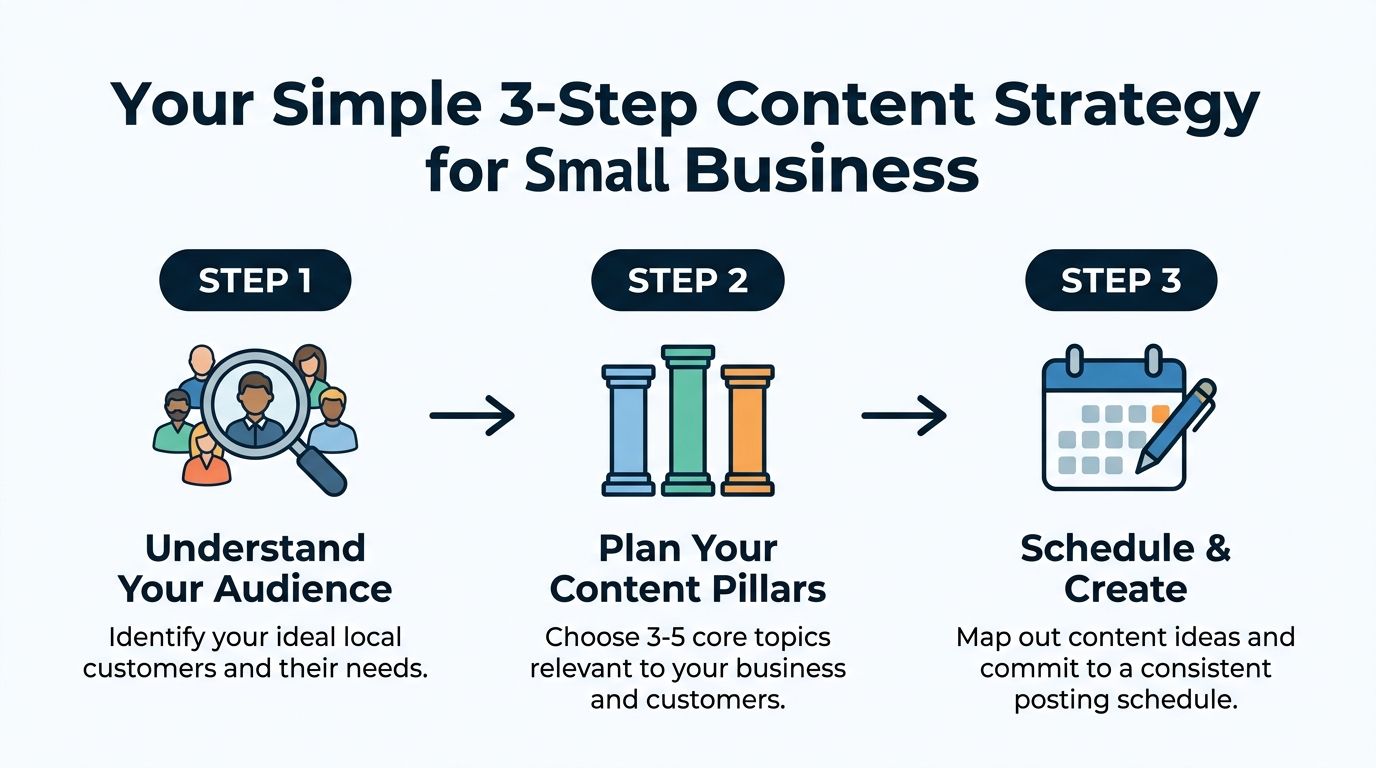
Strategy sounds bigger than it needs to be. For a small business, it can be kept very tight.
A workable content strategy answers three questions.
- Who are you trying to reach?
- What do you want them to do?
- What do they need to know before they do it?
That is enough to create months of useful content without overcomplicating the process.
Start with one customer, not everyone
The fastest way to make content vague is to aim it at “homeowners” or “local diners” or “business owners” as a broad group.
Narrow it down. A plumber might focus first on homeowners dealing with urgent problems. A restaurant might target local couples looking for a reliable Friday night booking. A solar installer might focus on Queensland homeowners comparing long-term value.
Write a quick profile with plain details:
- What problem are they trying to solve
- What makes them hesitate
- What words do they use
- What action do you want after they read
That last point matters. Content without a next step turns into dead weight.
Pick a business goal before a content topic
A topic is not a strategy. “We should write about plumbing tips” is too loose. “We want more emergency callouts from local homeowners” is usable.
Common small business goals include:
- More calls
- More quote requests
- More bookings
- Better-quality leads
- More repeat customers
Once the goal is clear, the topic selection gets easier. A restaurant chasing more bookings might create content around private dining, dietary options, chef features, and local events. A trade business chasing quote requests might build content around common faults, repair options, service areas, and response times.
If you need a practical way to map topics and publishing rhythm, this guide on creating an effective content plan is a solid reference.
Build three to five content pillars
You do not need dozens of categories. Most small businesses do well with a short set of repeatable themes.
A plumber could use:
- Common problems such as leaks, blockages, hot water issues
- Prevention advice such as maintenance checks and warning signs
- Service area content for suburbs or regions served
- Trust content like team qualifications, process, and callout expectations
A restaurant could use:
- Menu education including signature dishes and dietary guidance
- Behind the scenes such as sourcing, kitchen prep, and chef stories
- Occasion content for date nights, birthdays, and group bookings
- Local connection through events, community, and seasonal updates
A solar installer could use:
- Buyer questions around system choice and installation process
- Location-specific advice for Queensland conditions
- Myth-busting around bills, maintenance, and output expectations
- Project explanations that show how jobs are scoped and delivered
Keep the process simple enough to repeat
Most owners do not fail because content marketing is too hard. They fail because the system is too ambitious.
A practical routine looks more like this:
- Choose one core topic each month.
- Turn it into one main article or page.
- Pull two or three social posts from it.
- Add a matching FAQ to your service page.
- Use the same topic in email or Google Business Profile updates.
That is enough to create consistency without turning your week upside down.
Use customer questions as your content calendar
You do not need a brainstorm session with sticky notes on the wall. Start with what customers already ask by phone, email, in-store, on-site, or in DMs.
Write those questions down exactly as they are asked.
That gives you stronger content than generic topic lists because it is based on real sales friction. If five customers ask whether a blocked drain needs immediate attention, that is a content topic. If diners keep asking about parking, allergies, or booking times, that is content too.
A good strategy does not create more marketing work. It turns the questions you already answer into assets you can publish once and use repeatedly.
Content Ideas That Attract Local Customers
The easiest way to create content is to stop thinking like a marketer and start thinking like the person standing at your counter, calling your office, or searching from their phone.
Useful local content usually falls into one of three buckets. It solves a problem, answers a buying question, or removes a doubt.
For plumbers and trade businesses
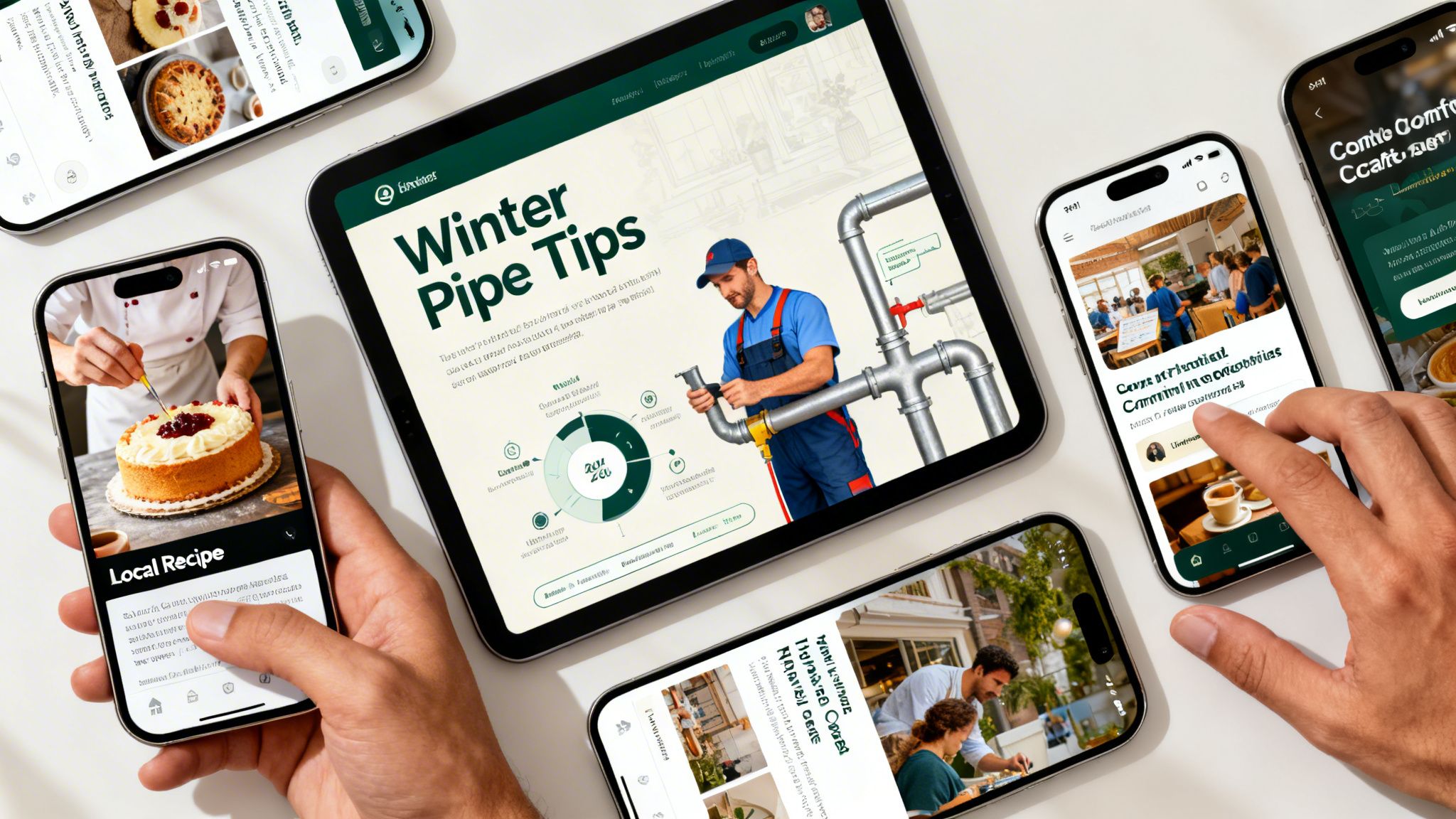
A plumber has more content ideas than most realise because the same jobs generate the same questions.
Some examples that work:
Emergency and problem content
- “What to do before the plumber arrives when a pipe bursts”
- “Why your toilet keeps running and when it becomes expensive”
- “Signs your hot water system is failing”
This type of content meets customers early. It captures the search before they choose a provider.
Decision content
- “Repair or replace your hot water system”
- “What an emergency plumbing callout usually involves”
- “How to choose a plumber for recurring drain issues”
By addressing these questions, you reduce hesitation. People do not just want a fix. They want to know what kind of fix they are agreeing to.
Local trust content
- “Areas we service on the Gold Coast”
- “What happens on a blocked drain job from inspection to fix”
- “Common plumbing issues in older coastal homes”
That last type helps local relevance. It also gives your business a more grounded, practical voice.
For restaurants and hospitality venues
Restaurants often underuse content because owners assume the food should sell itself. The food matters, but hesitation usually sits somewhere else. People want to know whether the venue suits the occasion, the budget, the diet, and the mood.
A few strong examples:
Booking confidence content
- “Where to book dinner for a quiet date night in Broadbeach”
- “What to expect when booking a group table”
- “Our approach to dietary requirements and kitchen prep”
Behind-the-scenes content
- “How our chef builds a seasonal menu”
- “A day in the kitchen before service”
- “Why we source certain local ingredients”
This content adds texture to the brand. It helps diners feel a connection before they visit.
Occasion-driven content
- “Best dishes to share on a long lunch”
- “Planning a birthday dinner without the stress”
- “How to choose a restaurant for a small celebration”
Video helps hospitality businesses especially well when it shows atmosphere, plating, staff personality, or preparation. This clip is a useful example of how simple video content can support your wider strategy.
For solar installers and home service specialists
Solar is a category where buyers usually research hard before they enquire. That makes educational content especially valuable.
Useful topics include:
- “A guide to solar panel ROI for Queensland homes”
- “Questions to ask before installing solar on an older roof”
- “How long a residential solar installation takes”
- “What affects system suitability at different property types”
The strongest content here explains, compares, and clarifies. It avoids hype.
One idea can become multiple pieces
This approach saves busy owners time.
Take one topic like “How to prepare for a plumbing emergency”. From that one idea, you can create:
- A blog article on your website
- A short checklist for Facebook or Instagram
- A Google Business Profile update
- A quick explainer video
- A service page FAQ entry
- An email to past customers
That approach keeps your message consistent and reduces creative drag. If you want your short-form posts to pull more weight, this guide on creating shareable social media content helps connect website content to social distribution.
What local customers respond to
In practice, customers usually respond to content that feels grounded in real life.
That includes:
- Specific scenarios instead of broad advice
- Local context instead of generic national copy
- Clear language instead of technical jargon
- Obvious next steps instead of soft, vague endings
If a customer can see their own problem in the headline, you are already closer to the call, quote request, or booking.
Distributing Your Content for Maximum Reach
Publishing content is only the first half of the job. If nobody sees it, it cannot generate bookings or enquiries.
Distribution for a small business should stay focused. You do not need every platform. You need the channels that match how local customers search, compare, and decide.
Start with the channels closest to purchase
For most trades, hospitality, and service businesses, the priority order is usually:
- Your website
- Google Business Profile
- Social media
Your website holds the full version of your content. Google Business Profile helps you show up in local discovery. Social media expands reach and keeps your business visible. Email supports repeat visits and repeat business.
That order matters because many owners do the reverse. They put effort into social posts that disappear quickly, while their website stays thin and underdeveloped.
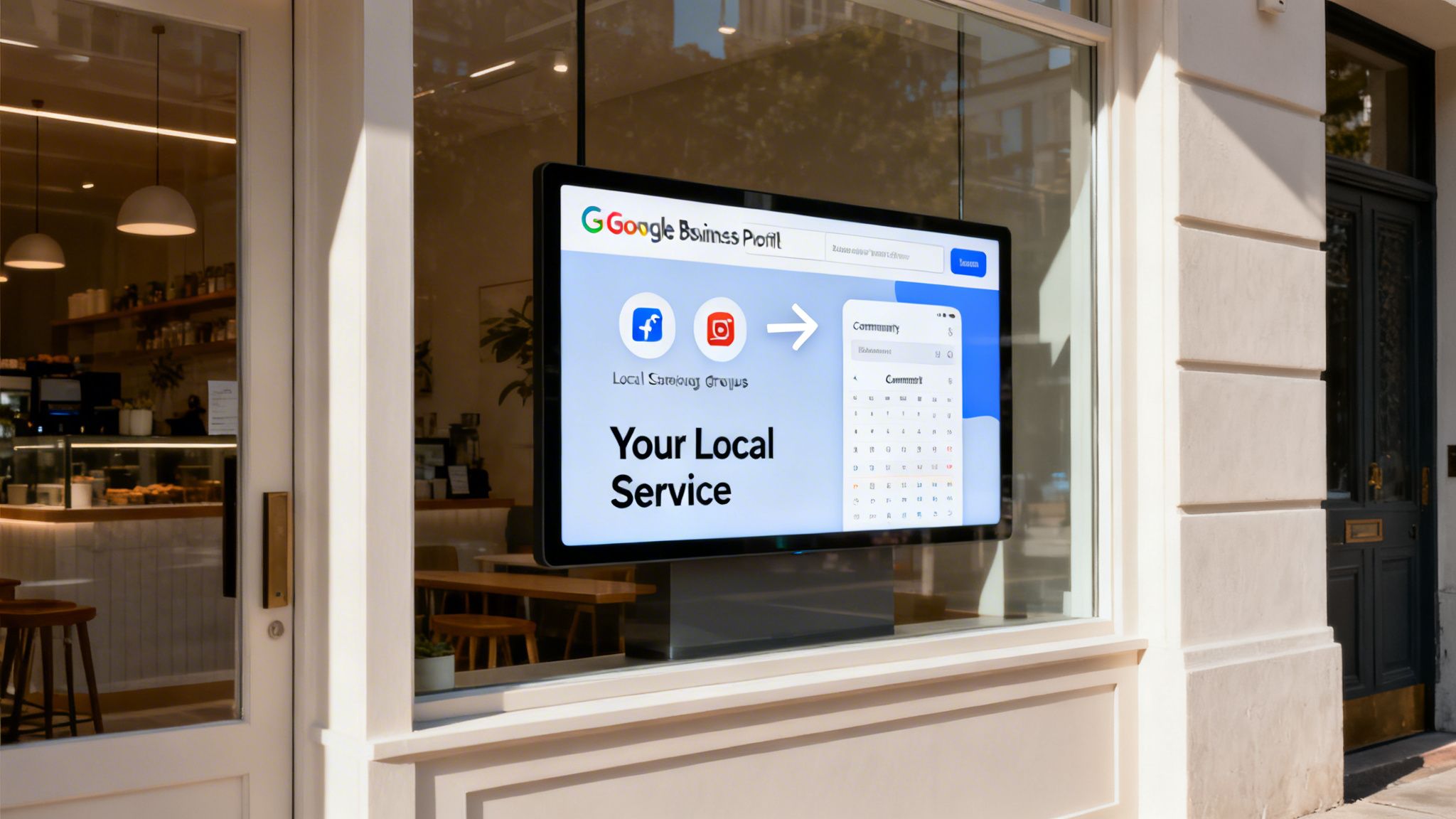
Use Google Business Profile as a distribution tool
A lot of small businesses treat Google Business Profile as a listing and nothing more. It is more useful than that.
You can use it to reinforce service relevance through updates, direct people to useful pages, surface reviews, and support local trust signals. If you publish a useful article on your site, point to it from your profile when relevant.
For example:
- A plumber publishes a blocked drain guide, then uses a profile update to promote it.
- A restaurant publishes a page about dietary options, then uses profile photos and updates to support it.
- A solar installer publishes a homeowner guide, then links to it through local updates and FAQs.
Social media works better when it supports owned content
Social should not carry the whole strategy. It should distribute and amplify content you already own.
A practical system looks like this:
- Publish the main article on your website
- Pull the sharpest tip into an Instagram caption or reel
- Use before-and-after visuals where relevant
- Answer a common objection in a short Facebook post
- Link back to the full page when the platform allows it
This reduces the pressure to invent new content every time you open your phone.
Where AEO now fits
This is the part many small business guides still miss.
Search is changing. AI-driven queries now account for 52% of searches in regions like the Gold Coast, while only 15% of small trades businesses invest in Answer Engine Optimisation, according to this write-up on effective content marketing for small business.
That creates a gap.
If your content is only written for old-style keyword rankings, you may miss visibility in AI Overviews, conversational search, and large language model responses. AEO is the practice of making your content easier for those systems to interpret, extract, and present.
How to make content easier for AI search to use
The good news is that writing for AI search usually means writing more clearly for humans.
A few practical rules help:
- Use direct question-based headings. “How do I know if my hot water system needs replacing?”
- Answer the question early. Do not bury the main point.
- Add concise FAQ sections. They are useful for readers and easy for AI systems to parse.
- Keep service pages specific. Mention locations, service types, and scenarios clearly.
- Avoid fluff. Long intros and vague marketing language weaken extraction.
This is also one area where specialist help can be useful. Alongside tools like Google Business Profile, GA4, Canva, and ChatGPT, Titan Blue Australia offers website content, SEO, and AEO services for businesses that want their content structured for both traditional search and AI search.
If a page answers a real question clearly, shows local relevance, and points to a next step, it is already doing the right work for both search engines and AI systems.
Measuring Real Results and Calculating ROI
Most small businesses do not stop content marketing because content cannot work. They stop because they cannot tell whether it is working.
That is a tracking problem, not a content problem.
A recent Sensis SMB finding states that 72% of Australian small businesses abandon content strategies due to unproven ROI, especially in hospitality and trades (summary here). That should not surprise anyone. If all you can see is pageviews and likes, it is hard to justify the effort.
Ignore vanity metrics first
Traffic matters, but traffic alone does not pay wages.
For a small business, the metrics that usually matter most are:
- Phone calls
- Quote form submissions
- Online bookings
- Direction requests
- Clicks from key content pages to service pages
A restaurant owner does not need a dashboard full of jargon. They need to know whether the content is producing more bookings. A plumber needs to know whether a blog post leads to calls or quote requests.
Use a simple tracking chain
The cleanest way to measure content is to follow this path:
- Someone lands on a content page.
- They take a meaningful next step.
- That action becomes a lead or booking.
For example:
- A user reads “What to do when your drain is blocked”
- They click to the emergency plumbing page
- They tap the phone number and call
Or:
- A diner lands on a “group booking” page
- They move to the reservation form
- They submit a booking enquiry
That is enough to start connecting content to outcomes.
Set up only what you will review
Google Analytics 4 is useful, but many small businesses overbuild it and then ignore it.
Start with a few tracked actions:
- Calls from mobile
- Form submissions
- Booking completions
- Clicks to location or contact pages
Then review them monthly.
This guide to top Google Analytics metrics is a practical place to focus if GA4 feels too broad.
How to judge whether a piece of content is worth keeping
A useful content page usually does at least one of these jobs:
- Brings in relevant traffic
- Sends visitors deeper into service pages
- Generates direct enquiries
- Helps close leads by answering objections
If it does none of those, it likely needs improvement or replacement.
Look at the page and ask:
- Does the headline match what customers search?
- Is the page too general?
- Is the call to action too weak?
- Does it answer the question quickly enough?
- Does it link to the right next page?
ROI is easier when content has a job
The businesses that struggle most with ROI tend to publish content with no clear role. General updates. Weak opinion posts. Seasonal filler. Surface-level social captions.
The businesses that get traction usually tie each piece to a commercial purpose. More local calls. More booking confidence. Better-quality enquiries. Faster trust.
Do not ask whether content marketing works in general. Ask whether this page helped a real person take the next step.
Your First Steps and Budget-Friendly Tools
Starting content marketing for small business does not require a huge plan or a full-time team. It requires a short list of actions you can keep doing.
The first three moves
If you are starting from scratch, do these first.
-
Write one helpful piece tied to a real customer question
Choose a question your staff hears often. A plumber might write about blocked drains. A restaurant might answer common booking or dietary questions. Keep it practical. -
Improve one money page on your website
Your most important service or booking page should be clear, local, and easy to act on. Add FAQs, stronger headings, and a clear next step. -
Set up one meaningful conversion in your analytics
Track something that reflects business intent. Calls, bookings, or form submissions are enough to start.
Low-cost tools that save time
You do not need a giant stack. A short, useful set of tools will do more for you than a dozen subscriptions.
For writing and planning
- Google Docs for drafting and collaboration
- Trello or Asana for a simple content calendar
- ChatGPT for brainstorming topics, outlining articles, or rewriting rough notes into a cleaner first draft
For design and publishing
- Canva for social graphics, menus, checklists, and simple promotional assets
- Your CMS such as WordPress or Shopify, depending on the site setup
- Meta Business Suite for basic post scheduling if Facebook or Instagram matter to your audience
For tracking and improvement
- Google Analytics 4 for traffic and conversion paths
- Google Search Console for search query visibility
- Google Business Profile for local visibility and customer actions
Where AI helps
AI is most useful when it reduces blank-page time.
It can help you:
- Turn a customer question into ten topic angles
- Build a first draft from your bullet points
- Rewrite technical explanations in plainer English
- Create variations of FAQs for service pages
- Repurpose one article into social captions or email copy
It should not replace your judgement. You still need to check accuracy, local relevance, tone, and whether the advice matches how your business operates.
There is also a strong commercial reason to personalise content where possible. For Australian small businesses, AI-driven personalisation can deliver a 20% uplift in sales opportunities, and customized content can increase time-on-page by up to 45%, according to this roundup of content marketing statistics. In practice, that means a page written for a specific audience, such as Queensland homeowners considering solar, can hold attention longer and lead to better enquiries.
Keep the system light
Do not try to publish everywhere. Do not try to sound like a national brand. Do not hand AI the keys and hope it figures out your business.
A better rhythm is:
- one useful article or page update
- a few supporting social posts
- one tracked conversion goal
- one review session each month
That is manageable. It is also enough to build momentum.
If your content starts doing three things consistently, you are on the right path. It gets found, it gets trusted, and it gets people to act.
If you want help turning scattered ideas into a content system that supports SEO, AEO, bookings, and local leads, Titan Blue Australia works with Australian small businesses to build practical digital strategies around content that customers can find and use.
Make Titan Blue a preferred source in Google
One click tells Google to surface our articles more often in Top Stories, AI Overviews and AI Mode.

Solar Installer Website Design Australia: The 2026 Guide
How solar installer websites in Australia should show CEC accreditation, real install proof and AI-ready…

Hotel & Hospitality Website Design Australia: 2026 Guide
Hotel and hospitality website design in Australia explained: booking flow, schema, AEO and what actually…

Restaurant Website Design Australia: The 2026 Guide
What a restaurant website in Australia needs: HTML menus, bookings, GBP sync, schema, and AI-ready…