


Last updated:
Friday arvo. A homeowner on the Gold Coast has a burst pipe, a restaurant in Broadbeach has a dishwasher down, and a property manager needs an electrician before tenants start ringing again. They do what everyone does now. They grab the phone, type the service and the suburb, and call one of the first businesses that looks trustworthy.
If your business is not showing in that moment, you are not losing to the biggest operator. You are losing to the business that is easier to find, easier to trust, and easier to contact.
That is what local seo services australia really come down to. Not abstract rankings. Not pretty reports. More calls, more bookings, more direction requests, and more jobs from people who are already looking.
From Queensland, this is easy to see in the day-to-day. Plumbers do not need traffic from Perth if they only service the Gold Coast. A restaurant does not need broad national visibility if the true win is getting found by people within driving distance. A solar installer may cover a wider region, but still needs suburb-level relevance, not generic visibility.
Good local SEO turns your business into the obvious option in your service area. Bad local SEO leaves you buried under competitors who may not even do better work than you.
Why Your Local Competitors Are Getting More Calls
The usual story is not complicated. A business owner has a decent website, a logo that looks fine, and years of good word-of-mouth. But on Google Maps and local search, they are almost invisible. Another operator with a more complete profile, better reviews, and cleaner suburb targeting gets the enquiry first.
That gap is where local revenue leaks out.
In Australia, local search is not a side issue anymore. The Australian SEO services market is projected to reach $1.5 billion in 2025, and 46% of all Google searches have local intent. Businesses that optimise for local search capture 24.4% of clicks from top results, which is why visibility at the top of local results drives more foot traffic and conversions, according to Red Search’s Australian local SEO statistics.
For a plumber, that means the difference between getting the emergency job and never knowing it existed. For a restaurant, it means one venue gets the booking when someone searches on the way home, and another sits empty with a better chef but weaker local presence.
What the customer sees
Customers are not auditing your marketing. They make a quick judgement based on a few signals:
- Can they find you fast: If your listing is missing, buried, or confusing, they move on.
- Do you look legitimate: Reviews, photos, opening hours, and clear service details matter.
- Can they contact you without friction: Tap to call, get directions, or book online.
Most small business owners do not have a visibility problem because they are bad at what they do. They have a visibility problem because Google does not have enough clear, consistent evidence to put them in front of local buyers.
Practical reality: The business that answers the local search demand first usually gets the shot at the quote first.
If your first thought is, “why is my business not showing up on Google?”, this breakdown from Titan Blue is worth a look: https://titanblue.com.au/why-is-my-business-not-showing-up-on-google/.
Why this matters more now
Search habits have shifted. People do not browse the way they used to. They search with urgency and intent. “Near me”, “open now”, “best”, “emergency”, “Broadbeach”, “Southport”, “Brisbane northside”. Those searches are commercial. The buyer is already in market.
Local SEO is how your business shows up when buying intent is highest. If your competitors are getting more calls, the answer is often not that they are cheaper. It is that they are more visible at the exact moment customers decide.
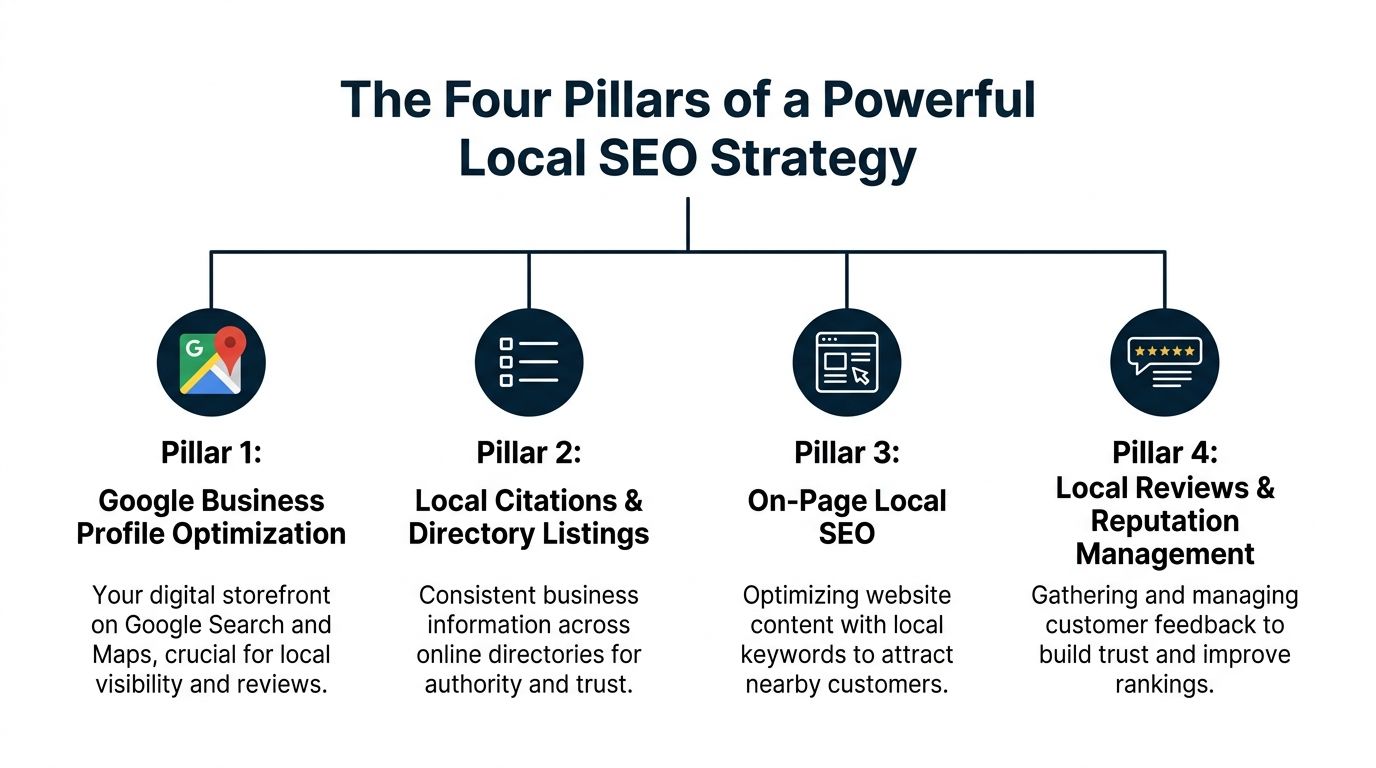
The Four Pillars of a Powerful Local SEO Strategy
Most local SEO campaigns work when four parts are handled properly. Leave one weak, and the whole thing wobbles.
It is like a shopfront. Your profile is the front window. Your citations are the street signs pointing people to you. Your website is the inside of the shop. Your reviews are the locals telling everyone whether you are worth a visit.
Google Business Profile
This is your digital storefront on Google Search and Maps. For many local businesses, it is the first thing a customer sees. Sometimes it is the only thing they see before calling.
A proper profile needs the basics right. Business category. Service areas. opening hours. Phone number. Website link. Photos. Services. Posts where relevant. A clear business description written for humans, not stuffed with keywords.
What does not work is setting it up once and forgetting it. Old hours, poor photos, missing services, and no updates send a bad signal.
Local citations and directory listings
Consistency earns trust here. Your NAP, which is your business name, address, and phone number, needs to match across directories and listings.
According to Eweb Marketing’s local SEO checklist, NAP citation consistency across 50+ Australian directories is a top-3 local ranking factor, can drive a 25-40% improvement in Google Local Pack visibility, and businesses with consistent NAP rank 3.7 positions higher on average.
On-page local SEO
Your website needs to confirm what your listing claims.
If you are a plumber serving Burleigh, Robina, and Southport, your site should say that clearly. If you are a restaurant in Broadbeach, your site should include your location, cuisine, booking details, parking information, and what makes the venue worth the trip.
Good on-page local SEO usually includes:
- Location pages: One strong page per service area or venue location.
- Service detail: Specific pages for blocked drains, hot water systems, switchboard upgrades, or lunch bookings.
- Clear contact paths: Click-to-call buttons, enquiry forms, booking links, and map embeds.
- Local language: Natural suburb and region references that match how customers search.
This explainer on what local SEO is gives a useful starting point if the term still feels too broad.
Reviews and reputation management
Reviews are your online word-of-mouth. They affect trust before a prospect even lands on your site.
A strong review profile usually includes recent feedback, authentic owner responses, and enough detail to show patterns. “Fast service”, “arrived on time”, “great with kids”, “clean install”, “helped us after hours”. Those details help customers decide.
What does not work is chasing fake reviews, copying the same canned response, or only asking happy customers once a year.
How the pillars work together
These four pieces reinforce each other:
- Profile drives discovery
- Citations validate your identity
- Website supports relevance
- Reviews build confidence
Key takeaway: Local SEO is rarely one magic fix. It is a stack of trust signals that point in the same direction.
When local seo services australia are done properly, they do not feel like a random bundle of tasks. They feel coordinated. Google gets a clean signal. Customers get a clear reason to call.
Local SEO Tactics for Your Specific Industry
A generic local SEO plan usually produces generic results. That is the problem.
A restaurant, a plumber, and a solar installer do not win local search the same way. They have different buying cycles, different urgency, and different trust triggers. The tactics need to match the job.

Hospitality businesses
Restaurants, cafés, bars, and venues live and die on convenience and confidence. People want to know what you serve, what it looks like, whether you are open, and how to book.
The practical local SEO work here is usually straightforward:
- Build pages around intent: Menus, functions, private dining, waterfront dining, breakfast, lunch, or gluten-free options.
- Keep booking friction low: If someone lands on the site from mobile, booking should be obvious.
- Use strong visual proof: Interior shots, dishes, ambience, frontage, and nearby landmarks.
- Match local search language: Broadbeach dinner, Surfers Paradise cocktails, Gold Coast brunch, and similar real-world phrases.
Reviews matter heavily in hospitality because people compare venues side by side. One stale listing can cost a weekend’s worth of bookings.
For a venue-specific example, this page on local SEO for restaurants shows the sort of work that helps hospitality businesses show up for nearby diners.
Trades and emergency services
Plumbers, electricians, builders, locksmiths, and other tradies need to rank where the job happens. That often means suburb-level service visibility rather than one broad city page.
If you serve multiple suburbs, build content and location signals around that reality. Do not hide all your services on one thin homepage and expect Google to connect the dots.
For trades, the best-performing local SEO often includes:
- Service area pages: Separate pages for suburbs or regions you service.
- Problem-based content: Blocked drains, burst pipes, switchboard faults, hot water repairs, leaking taps.
- Urgent call paths: Prominent phone buttons, after-hours contact details, and fast quote forms.
- Project proof: Photos of completed work, short job summaries, and review snippets tied to the type of service.
One technical tactic matters here too. According to First Page Australia’s local SEO guidance, implementing LocalBusiness Schema can lead to a 20-30% uplift in rich snippet appearances in local SERPs. For service-area businesses like plumbers, adding areaServed and aggregateRating creates hyper-local relevance and supports stronger click-through performance.
Solar installers and wider service-area businesses
Solar is different again. Customers often research for longer, compare providers, and want confidence in both the product and the installer. They may search by suburb, but they also want to see evidence of capability across a broader region.
That means your local SEO needs breadth and specificity at the same time.
A solar installer should usually focus on:
Suburb relevance without doorway pages
One page for “solar Australia” is too broad. Fifty near-identical suburb pages are also a mistake. The better approach is useful suburb or region pages with real differences. Roof types. local council conditions. common household setups. grid considerations. commercial versus residential demand.
Project galleries that prove local experience
Before-and-after photos, suburb names, install types, and system summaries help customers feel they are dealing with a business that has worked nearby.
Educational content tied to local intent
Questions like these often convert well because they meet buyers in research mode:
- How solar performs in coastal suburbs
- What homeowners ask before installation
- What to consider for larger family homes
- How battery storage fits different property types
Tip: If your service area is wide, your website should still feel local at every step. Broad reach only works when each page gives a local reason to trust you.
What works across all three
Different industries need different execution, but a few principles carry across the board:
- Write for customer decisions, not just keywords.
- Show where you work with precision.
- Make contact simple from mobile.
- Use proof that is local and specific.
Many local SEO services Australia campaigns fail here. They use a template. Search behaviour is local. Buying behaviour is local. Trust is local. The strategy has to be local too.
The Process from Local Invisibility to Local Leader
Most businesses do not need a miracle. They need a clean, disciplined process.
The first step is usually not “do more SEO”. It is finding out what is broken, what is missing, and what is holding the business back from appearing where customers are already searching.

Step one is the audit
A proper local audit looks at the full picture:
- Google Business Profile health: Categories, services, photos, hours, profile completeness.
- Citation consistency: Whether business details match across key directories.
- Website readiness: Location pages, service pages, mobile usability, contact flow.
- Reputation signals: Review quantity, freshness, quality, and responses.
- Local intent coverage: Whether the site targets the suburbs and services that matter.
This stage often finds simple problems that have been costing leads for months. Wrong phone number in one listing. Missing suburb pages. A profile category that does not match the service offered. Thin content written for search engines instead of customers.
Step two is implementation
Local SEO shifts from diagnosis to trade work at this stage.
A good provider will tidy citations, improve the profile, build or refine location content, add schema where useful, and tighten conversion paths. If the site is clunky on mobile or hard to contact from, that gets fixed too.
One option businesses in Queensland and across Australia use for this kind of work is Titan Blue Australia, which offers local SEO, website improvements, and AI search services as part of broader digital strategy.
Step three is patience with pressure
Unrealistic expectations often hurt business owners at this point. Local SEO is not paid ads. It does not switch on overnight.
According to Raven Labs’ guide to local SEO for Australian businesses, businesses starting a local SEO strategy typically see ranking improvements in 3-6 months. That sustained effort matters because 80% of local searches convert, and 28% of “near me” queries lead directly to a purchase.
That timeline is normal. Search visibility improves as Google gains confidence in your business signals over time.
A short explainer helps here if you want the visual version before going further.
What good ongoing management looks like
After the initial work, the campaign needs regular attention.
That usually includes:
- Updating profiles: New photos, service updates, seasonal changes, and corrected details.
- Review management: Asking consistently and responding properly.
- Content expansion: Adding useful local pages, FAQs, and service detail where needed.
- Performance checks: Watching calls, rankings, and lead quality, then adjusting.
Practical benchmark: If nobody is reviewing the local campaign month to month, the business usually slides back rather than moves forward.
The businesses that become local leaders are rarely the flashiest. They are the most organised. They give Google a reliable picture of who they are, where they work, and why customers trust them.
Measuring Real Business Growth and Understanding Costs
The easiest way to waste money on SEO is to focus on metrics that look impressive and mean little.
A local business owner does not pay wages with impressions. You pay wages with booked jobs, filled tables, qualified enquiries, and repeatable lead flow.
Measure what turns into revenue
For local SEO, the most useful indicators are usually the actions closest to a real sale:
- Phone calls from your Google Business Profile: Strong for trades, hospitality, and urgent services.
- Direction requests: Important for restaurants, clinics, showrooms, and retail.
- Contact form enquiries: Useful when people need quotes or consultation before buying.
- Booking completions: Essential for venues, beauty, hospitality, and appointment-based businesses.
- Suburb-level lead quality: Whether the right type of customer from the right area is finding you.
Good reporting should connect visibility to business outcomes. If rankings improve but junk leads increase, that is not a win. If traffic rises from outside your service area, that is not a win either.
What sensible reporting looks like
A practical monthly review should answer a few plain questions:
- Did calls, enquiries, or bookings increase from local search?
- Are we appearing in the suburbs and service categories that matter most?
- Which pages or listings are driving action, not just views?
- What needs fixing next month?
If you want a better handle on budgeting beyond marketing, broader financial planning matters too. This guide to business advisory services for SMEs is useful because it frames marketing spend inside wider business decision-making, not as an isolated expense.
How local SEO services are usually priced
In Australia, local SEO is commonly priced one of two ways.
Monthly retainer
This suits businesses that need ongoing work. Profile management, content updates, review support, citation checks, and monthly reporting fit naturally here.
Project-based work
This can work when the business mainly needs setup or cleanup. For example, fixing listings, building key location pages, and improving the Google Business Profile.
There is no honest flat answer to cost because scope changes everything. A single-location café is different from a plumbing business covering multiple suburbs. A solar installer targeting several regional pockets needs a broader build again.
The question is not “what is the cheapest package?” It is “what work is included, and will it move the right business metrics?”
This breakdown of SEO services cost is useful if you want to compare retainers, project work, and what you should ask before signing anything.
Rule of thumb: If the provider cannot explain what work they do each month in plain English, you are probably buying a report, not a growth service.
The strongest local SEO investment is one you can track back to enquiries, booked work, and customer value. Everything else is just decoration.
Future-Proofing Your Business for AI and Voice Search
Most local SEO advice in Australia still stops at Google rankings, Google Business Profile work, and citation cleanup. That work still matters. But it is no longer the whole job.
Customers are starting to ask AI tools direct questions. Not just search engines. They ask for recommendations, comparisons, and summaries. They want one useful answer, not ten blue links.

Why this shift matters
A potential customer might ask an AI tool for a reliable plumber in a specific suburb, a well-reviewed café nearby, or a solar installer servicing the Gold Coast. If your business data is thin, inconsistent, or hard to interpret, you are less likely to be surfaced in that recommendation layer.
According to Bring Digital Performance’s local SEO service page, current Australian local SEO guidance has a critical gap. It does not properly address optimisation for AI search engines and LLMs. As customers increasingly use AI tools for discovery, businesses need new strategies to ensure they are found and recommended in these channels.
That gap matters because recommendation-based discovery changes the game. In ordinary search, a customer may still scroll. In AI search, the customer may only see a short list or even a single answer.
What answer engine optimisation looks like
Answer Engine Optimisation, or AEO, begins to matter here.
For local businesses, practical AEO usually means:
- Clear business facts everywhere: Services, locations, hours, contact details, and category signals should be consistent.
- Strong entity signals: Your business name, website, profile, and directory data should all line up cleanly.
- Readable service content: Pages should answer real questions in natural language.
- Trust evidence: Reviews, awards, project examples, and local proof points help AI systems interpret credibility.
- Structured data: Schema helps machines understand what your business does and where.
Voice search follows the same logic
Voice queries are often conversational. People speak differently than they type. They ask longer questions and expect direct answers.
That means your content should not only target “plumber Gold Coast”. It should also help with natural-language questions such as which suburbs you service, whether you handle emergencies, what types of jobs you take on, and how fast customers can contact you.
What businesses should do now
The smart move is not to abandon traditional local SEO. It is to build on it.
Do these things now:
- Tighten your core business data across every platform.
- Create pages that answer customer questions directly.
- Use structured data so systems can parse your information cleanly.
- Collect and manage reviews consistently.
- Make your local expertise obvious through examples, not marketing fluff.
If AI search matters to your strategy, this page on AI search gives a practical view of how businesses can prepare content and visibility for LLM-based discovery.
Forward-looking advantage: Most competitors are still only optimising for where customers searched yesterday. The opportunity is to optimise for where customers will ask tomorrow.
Local seo services australia are changing. The businesses that adapt early will not just rank better. They will be easier to recommend across the next generation of search experiences.
Common Questions about Local SEO in Australia
Business owners usually ask the same sensible questions once they get past the jargon. The answers matter because local SEO can be simple at a single-site level and messy once you expand across suburbs, states, or franchise models.
Should I target one suburb or a whole city
Target the area you can service well and prove clearly online.
If you are a local café, one location page and a strong profile may be enough. If you are a plumber covering multiple suburbs, you usually need service area content that reflects where you work. Broad city targeting sounds attractive, but it often becomes vague. Vague pages tend to underperform.
The more specific your service footprint, the easier it is to build relevant content, reviews, and local trust signals around it.
Can I do local SEO myself
Yes, to a point.
A business owner can usually claim a Google Business Profile, update hours, upload photos, ask for reviews, and make sure the website shows the right contact information. That is a strong start.
Where DIY usually gets harder is in the consistency work. Citation cleanup, schema implementation, structured local content, duplicate listing problems, and multi-suburb strategy all take time and attention. Most owners can do parts of it. Fewer can keep it moving while running the business.
What changes for multi-location businesses
Local SEO becomes more operational at this stage.
According to Xugar’s guide to local SEO in Australia, Australian multi-location businesses and franchises face specific challenges, including managing NAP consistency across states, coordinating franchisee strategies, and adapting to different regional search behaviours.
That means the strategy for one location cannot be copied across every branch.
Common multi-location problems
These are the issues that show up most often:
- Inconsistent business details: One branch uses a different phone number format or trading name.
- Franchise autonomy clashes: Head office wants consistency, local operators want flexibility.
- Thin duplicated pages: Every location page says nearly the same thing.
- Review imbalance: One location has active review management and another has none.
How to manage local SEO across several locations
The best setup usually balances central control with local input.
A practical model looks like this:
-
Centralise brand basics
Keep naming, core service descriptions, and key business details standardised. -
Localise what customers care about
Each page or profile should reflect real local conditions, staff, photos, service nuances, and nearby suburbs. -
Give one team ownership
Whether internal or agency-side, someone has to own accuracy across profiles, pages, and reporting. -
Build a review process location by location
Reviews should not be treated as one national pool. Customers want to know about the branch they will use.
Is local SEO different from normal SEO
Yes. Traditional SEO often aims for broader visibility. Local SEO is tied to geography, service area, and immediate buyer intent.
The customer searching locally is often much closer to acting. That changes what matters. Contact paths matter more. Map visibility matters more. Reviews matter more. Local relevance matters more.
How long should I give it before judging results
Long enough to assess real movement, not just early noise.
Businesses often expect immediate dominance after a profile update or a few new pages. That is not how this works. A fair review looks at whether visibility, enquiries, and lead quality are moving in the right direction over a sustained period.
The best local campaigns are steady, not flashy. They build trust signals, improve discoverability, and make it easier for the right customer to choose you.
If your business should be getting more calls from local search but is not, Titan Blue Australia can help you assess the gaps, tighten your local presence, and build a strategy that covers both traditional Google visibility and the emerging AI search layer.
Make Titan Blue a preferred source in Google
One click tells Google to surface our articles more often in Top Stories, AI Overviews and AI Mode.

ChatGPT GPT-6 Search Upgrade: What It Means for Australia
OpenAI rolled out GPT-6 to ChatGPT on 7 October 2026 with faster search. Here is…

Best Dental Website Design Agencies in Australia: 7 Compared
Best dental website design agencies in Australia 2026: seven compared on dental proof, booking, AHPRA…

Childcare Centre Website Design Australia: The 2026 Guide
Childcare centre website design Australia: show hours, ages and enrolment as text so parents and…