

Last updated:
A lot of agencies end up in the same spot with PPC. You win a client who wants leads fast, launch a campaign quickly, report on clicks and conversions, then realise the account is chewing through team hours faster than it produces margin.
That usually happens when PPC is treated as a fulfilment task instead of a service line with rules, structure, and operating discipline. The campaigns may be live, but the service is still fragile. One bad month, one unclear expectation, or one sloppy handover and the client starts looking elsewhere.
That is a problem in Australia because paid search is too important to run casually. In the local market, search advertising accounted for AU$5.43 billion, or 38% of the total AU$14.3 billion digital ad spend in 2023, and Google held a 92% market share in Australian search according to this Australian PPC market summary. For agencies serving restaurants, tradies, builders, and hospitality operators, that makes PPC management for agencies a core capability, not a side offering.
Moving Beyond Ad-Hoc PPC Management
The weak version of agency PPC looks familiar. A new client signs. Someone opens Google Ads, imports a few broad keywords, writes generic ads, points traffic at an existing page, and starts “optimising” after a week.
That setup can produce activity. It rarely produces a reliable service.
What reactive PPC looks like
Reactive PPC management for agencies usually has a few symptoms:
- No commercial brief: The team knows the monthly budget but not the client’s real margin, sales cycle, booking process, or lead qualification rules.
- No service boundaries: The client assumes landing pages, call tracking, CRM fixes, creative refreshes, and reporting changes are all included.
- No account framework: Campaigns are grouped by whatever seemed convenient on launch day rather than by intent, geography, or funnel stage.
- No review rhythm: Changes happen because of panic, not because of a planned optimisation cycle.
The result is predictable. The agency gets blamed for problems that were never scoped, never tracked, or never owned.
What profitable agencies do differently
A strong PPC department behaves more like an operating system than a media buying seat. It uses a repeatable process across onboarding, build, optimisation, reporting, and retention.
That means:
- Qualifying the client properly
- Designing the account around business intent
- Reviewing performance on a fixed cadence
- Connecting ad data to sales reality
- Protecting margin with clear scope
For Australian SMBs, especially in trades and hospitality, this matters even more because local demand patterns are messy. Search volume can be suburb-specific. Mobile behaviour is dominant. Sales teams often answer leads by phone, not through polished CRM pipelines. A restaurant owner cares about bookings and functions. A plumber cares about urgent calls. A solar installer cares about qualified consultations, not form fills from the wrong postcode.
Strong PPC management for agencies is not about making more tweaks. It is about making fewer, better decisions inside a system that can scale.
The agencies that build PPC as a disciplined service line usually keep clients longer, report more clearly, and avoid the trap of becoming unpaid account babysitters.
Establish Your Foundation with Strategic Client Onboarding
The account often succeeds or fails before the first ad goes live. Most PPC issues that show up later are onboarding issues in disguise.

Start with the business, not the platform
When a client says, “We need Google Ads,” that is rarely the full brief. They may need booked jobs in certain suburbs, weekday lunch traffic, function enquiries, higher-value renovation leads, or better use of seasonal demand.
A proper onboarding process pulls apart the commercial engine behind the ad account.
Ask questions like:
- What is the highest-value job or booking type?
- What counts as a qualified lead and who decides that?
- Which suburbs or service areas matter most?
- Are there months where demand spikes or drops?
- How long does it take for a lead to turn into revenue?
- Which offers attract poor-fit enquiries?
For trades and hospitality businesses, the answers change campaign structure immediately. If a plumber wants emergency callouts, you build for urgency and location. If a venue wants event bookings, you build around a longer consideration path. If a builder has a slow quoting process, you do not judge campaign quality on short-term form fills alone.
Map the customer journey before touching targeting
A lot of agencies skip this because it feels non-technical. That is a mistake.
You need to know how the customer moves from search to action, where trust is built, and where leads drop off. A useful reference for this thinking is customer journey mapping for digital campaigns. The principle is simple. If you do not understand the path, you cannot assign the right campaign type, ad message, or landing page to each stage.
For local businesses, common friction points include:
- weak mobile landing pages
- no suburb relevance
- poor call handling
- slow response times
- booking forms that ask too much too early
- no proof of trust near the conversion point
Those are not “client-side issues” you can ignore. They shape PPC performance directly.
Build a commercial intake, not a marketing questionnaire
A proper intake document should cover more than branding and access permissions.
Include:
- Offer hierarchy: Which products or services deserve budget first
- Lead handling: Who answers calls, who follows up forms, and how quickly
- Sales lag: Whether deals close quickly or sit in quote stage
- Margin context: Which lead types are profitable and which are noise
- Geographic rules: Core suburbs, exclusions, and travel limits
- Existing assets: Landing pages, reviews, creative, CRM setup, call tracking
This intake prevents one of the biggest agency mistakes. Optimising toward easy conversions instead of profitable outcomes.
Set the SLA before scope starts drifting
Many PPC engagements become unprofitable because the agency never defined how the relationship would work.
Your service agreement should state:
- What is included: platform management, reporting, tracking checks, copy refreshes
- What is excluded: web development, CRM repairs, major landing page rebuilds, after-hours changes
- Communication rhythm: weekly check-ins, monthly review calls, escalation rules
- Approval process: who signs off budgets, offers, and creative changes
- Reporting standard: what metrics are reported and how success is judged
Keep it practical. Clients do not need legal theatre. They need clarity.
If the client thinks PPC management includes fixing every sales and website issue, the account will drift into resentment fast.
Onboarding should create decisions
By the end of onboarding, your team should be able to answer a few hard questions without guessing:
- Which leads are worth buying?
- Which geography matters first?
- Which campaign type supports the client’s actual sales process?
- What does success look like in the next review period?
- What should not be optimised for yet?
That is the difference between onboarding and admin. Admin gets the account connected. Strategic onboarding gives the agency control.
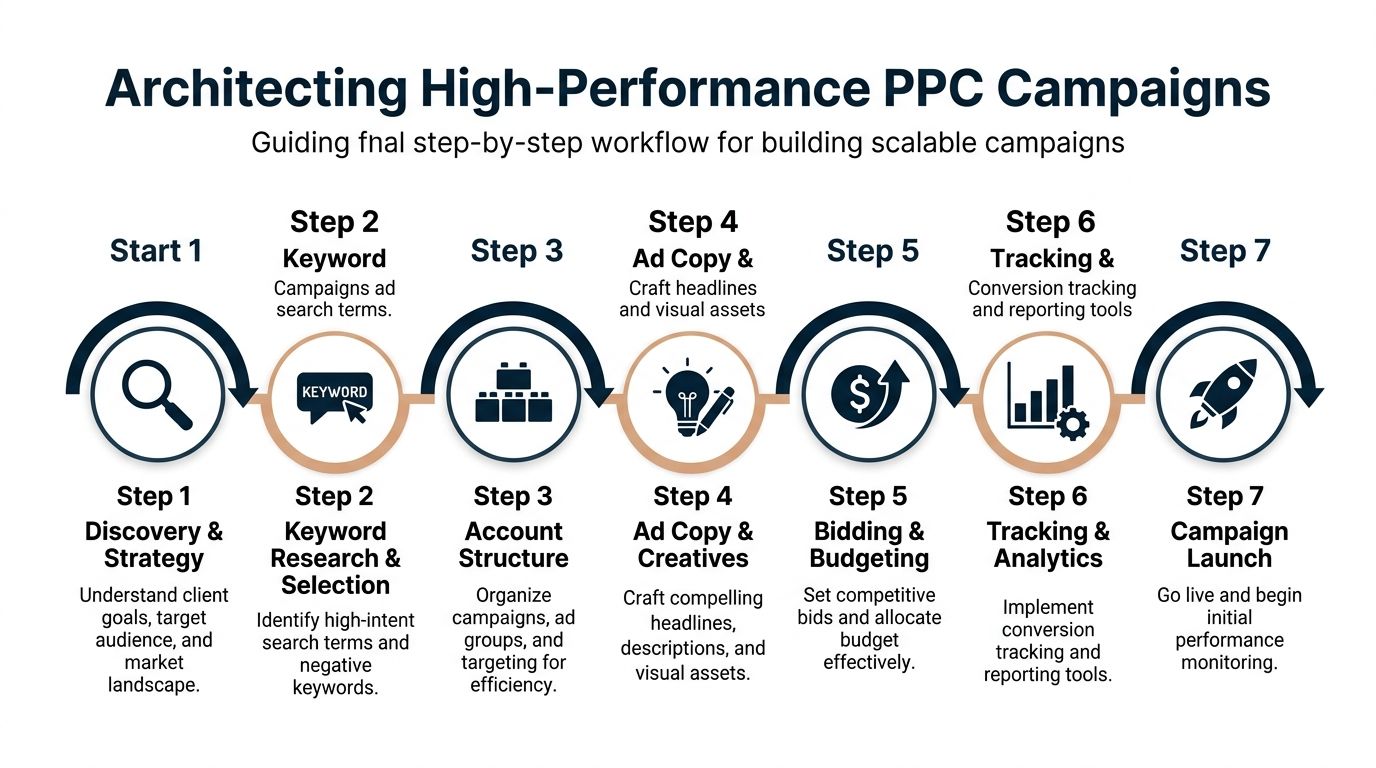
Architecting High-Performance PPC Campaigns
A good campaign build makes optimisation easier later. A bad build creates noise, hides waste, and forces your team to patch structural problems month after month.
Build around intent, not platform convenience
Too many accounts are organised by habit. One search campaign. One Performance Max campaign. Maybe a display campaign nobody really reviews.
A stronger structure starts with search intent.
For agency teams handling local service clients, the cleanest way to architect an account is usually to separate campaigns by a mix of:
- Service line: emergency plumbing, blocked drains, hot water, commercial plumbing
- Geography: Gold Coast core areas, surrounding suburbs, broader Queensland if relevant
- Funnel stage: bottom-funnel search, mid-funnel remarketing, broad discovery
- Commercial value: premium services, repeatable work, low-margin jobs
This keeps budget decisions tied to business priorities rather than campaign labels.
Match campaign type to the job it should do
Different campaign types should carry different responsibilities.
Search works best when intent is clear and the client needs direct response. That makes it ideal for high-intent service queries, branded protection, and urgent local demand.
Performance Max can work well when the account has enough conversion feedback, strong creative inputs, and solid landing pages. It is useful for filling coverage gaps and supporting local businesses with mixed search, maps, display, and video exposure. For agencies refining their service offer, this broader view of Google Ads management across campaign types matters because platform choice is never the strategy by itself.
Display and remarketing should support the main engine, not distract from it. For most SMB accounts, they work when tied to a defined audience and a clear message. They fail when added because someone wanted the account to look more “full funnel”.
Keyword selection for local service accounts
Keyword research for agencies is less about volume theatre and more about commercial fit.
For tradies and hospitality operators, focus first on high-intent terms that signal action. A plumber needs “emergency plumber”, “blocked drain repair”, and suburb variations. A restaurant needs booking, functions, events, or cuisine-specific local terms. A solar company needs service-led and consultation-led phrases, not broad educational traffic unless the landing experience supports a longer path.
A useful workflow looks like this:
-
Pull seed terms from real services
Use the client’s actual offer list, not industry jargon. -
Layer local modifiers
Suburbs, service regions, “near me” behaviour, and location-specific phrasing matter. -
Separate urgency from research
Emergency traffic should not sit in the same budget bucket as general discovery. -
Build a negative keyword habit early
Exclusions should be part of account architecture from day one, not a cleanup task later.
Ad copy should sound like the business can help
Generic ad copy is one of the clearest signs of weak agency work. If every ad says “quality service” and “contact us today”, nothing stands out and nothing pre-qualifies.
Write copy that reflects:
- the specific service
- the service area
- the trust signal
- the action the user should take now
For example, a trades client may need ad variants built around urgent response, licensed service, local coverage, or same-day availability. A hospitality client may need copy focused on bookings, private dining, functions, or local experience.
Good ad copy reduces wasted clicks because it tells the wrong prospect not to click.
Asset libraries matter more than agencies admit
Performance Max and responsive formats are only as good as the inputs. If your team throws in old logos, stock images, weak headlines, and recycled descriptions, the machine has very little to work with.
Create a reusable asset library for every client:
- Headlines by intent
- Descriptions by offer
- Image variants by service or venue
- Review snippets and trust messages
- Callout and structured snippet options
- Promo messaging by season or campaign theme
This is one of the biggest differences between one-off account builds and scalable PPC management for agencies. The service becomes easier to maintain when creative inputs are organised from the start.
A scalable account is not the one with the most campaigns. It is the one where another specialist can understand intent, budget logic, and testing history quickly.
Tracking is part of architecture
If conversion tracking is treated as a final checklist item, the account is already compromised.
Before launch, confirm:
- what counts as a primary conversion
- which softer actions should remain secondary
- whether calls are tracked separately from forms
- whether offline outcomes can be fed back into optimisation
- whether landing pages and thank-you paths are clean
A campaign cannot outperform the quality of its signals. Agencies that skip this step usually end up optimising for easy actions rather than meaningful outcomes.
Driving Growth with Advanced Optimisation Cycles
Once campaigns are live, most agencies either overreact or go quiet. Neither works. Sustainable PPC management for agencies comes from a review rhythm that is calm, documented, and commercially aware.

The weekly job is not reinvention
A weekly optimisation cycle should look for signal, not excitement.
That usually means checking:
- Search query quality: which queries are producing intent and which are burning spend
- Budget pressure: whether strong segments are limited and weak ones are coasting
- Ad freshness: whether key messages are still earning clicks without fading
- Lead quality notes: what the client’s sales team is seeing on calls and enquiries
- Device and location anomalies: where performance is drifting
The point is not to make a dozen changes. The point is to protect the account from obvious waste and keep clean notes on what deserves a deeper test later.
Quarterly segmentation audits separate operators from button-pushers
The most useful performance reviews are not daily micro-adjustments. They are structured segmentation audits where the agency deliberately reallocates budget based on stronger evidence.
According to this PPC analysis reference, agencies that run a quarterly segmentation audit and reallocate budget from segments with marginal ROAS can lift overall account ROAS by 25-40%. The same source notes that in Australian construction, ignoring the local conversion lag of 7-14 days leads to 40% of premature campaign pauses.
That matters a lot for tradies, builders, and solar accounts. If you judge a slow-moving lead too early, you can turn off the exact campaigns that were about to produce qualified revenue.
A practical quarterly audit usually reviews four layers:
Geography
Not every service area deserves equal spend. One suburb may convert well on urgent jobs while another produces lower-value tyre kickers. Split them before you can afford to “optimise” them.
Match type and query intent
Some ad groups look efficient until you inspect the actual search terms. Broad matching can help coverage, but only when negatives and conversion signals are strong.
Device behaviour
Mobile traffic often behaves differently for local service accounts. If calls matter, review call-led behaviour separately from form-led behaviour.
Funnel stage
Top-funnel clicks and bottom-funnel conversions should not be judged with the same lens. Agencies lose clarity when all campaign types are forced into one scoreboard.
Campaigns are often paused for being “inefficient” when the underlying problem is that the agency measured them too early or too broadly.
Automation helps, but oversight still wins
Google’s automation is useful. It is not a substitute for judgement.
Let the platform handle the auction-level adjustments it can see better than you can. Step in when business context matters more than the algorithm does. Seasonal surges, location exclusions, offer changes, stock issues, or poor lead quality all require agency intervention.
This is also where clients appreciate explanation, not just action. When you can tell them why spend moved, why an ad group was reduced, or why a campaign stayed live despite a soft week, confidence goes up.
Creative fatigue is a real operational issue
Many accounts plateau because the agency keeps changing bids while leaving stale creative untouched. Search ads, assets, offers, and landing page messaging all lose force over time.
A disciplined cadence includes creative review:
- refresh key headlines when performance softens
- rotate offer framing for seasonal periods
- compare trust-led messaging against price-led messaging
- test a different landing path when clicks remain strong but conversions drift
If you work with ecommerce-style funnels or promotional landing pages, broader conversion principles can help sharpen the post-click experience. A practical outside reference is this guide on improving ecommerce conversion rates, especially when urgency, offer framing, and page friction are affecting paid traffic efficiency.
Later in the review cycle, it helps to step back and watch account optimisation in context:
CTR is diagnostic, not vanity
Click-through rate only matters when used properly. A falling CTR can signal weak relevance, message fatigue, poor alignment between keyword and ad, or a stronger competitive page on the results screen.
If you are diagnosing ad weakness in mature accounts, this breakdown of fixing low click-through rates in Google Ads is the sort of operational lens agency teams should apply. CTR is not the final KPI, but it often tells you where the next profitable fix sits.
The strongest optimisation teams do not chase platform noise. They keep a clean cadence, separate short-term volatility from real trends, and make changes only when the account gives them a reason.
PPC Playbooks for Australian Trades and Hospitality
Generic PPC advice falls apart fast when you are dealing with a plumber needing urgent calls, a restaurant chasing bookings, or a solar installer working through a longer decision cycle. The structure may be similar, but the playbook is not.

For plumbers and other tradies
A Gold Coast plumbing account usually needs speed, precision, and ruthless filtering.
The best-performing setups tend to focus on:
- Urgent intent first: emergency and problem-based search terms usually deserve isolated budget and tighter ad copy
- Tight service areas: if the team cannot service the lead profitably, exclude it
- Call-first conversion paths: mobile searchers often want immediate action
- Trust signals at landing: licence details, reviews, suburb references, and response language help fast
Tradie accounts often underperform because agencies lump all services together. Emergency jobs, maintenance work, and commercial contracts are different buying situations. Treating them the same usually inflates noise.
For agencies working extensively in this category, broader strategic context around marketing for tradies is useful because PPC works best when the offer, reviews, service pages, and local presence support the ad click.
For restaurants and hospitality venues
Restaurant PPC should not read like a retail catalogue. It needs to reflect intent that leads to bookings, walk-ins, events, or functions.
A venue account might split traffic around:
- branded booking demand
- cuisine-specific local intent
- event and function enquiries
- seasonal or promotional searches
- remarketing for visitors who viewed menus or booking pages. In this context, Performance Max can work well if the inputs are strong. The campaign needs quality visuals, clear conversion actions, and landing pages that remove friction.
According to this Performance Max reference for hospitality and solar, expert agencies can achieve 8-10x ROAS in these niches with a systematic optimisation approach. The same source notes that landing pages should convert at more than 5%, and that 60% of campaigns fail at this step, which can double CPA.
That lines up with what many agency teams see in practice. The ad account is often not the first problem. The booking path is.
For solar and longer-consideration services
Solar accounts need patience and better qualification. High-intent queries matter, but the buyer rarely converts with the same urgency as someone needing a burst pipe fixed.
A stronger solar setup usually includes:
Search campaigns for bottom-funnel demand
Use commercial service terms, consultation terms, and location-led intent. Keep messaging practical and trust-heavy.
Supportive nurture paths
Remarketing and broader campaign types can support users who are comparing providers, reading reviews, or discussing the purchase internally.
Landing pages built for the sales cycle
The page has to help the prospect move to the next sensible step. That may be an enquiry, an assessment request, or a call with enough context to qualify the lead.
In hospitality and trades, the campaign usually fails where the user lands, not where the user clicks.
The local angle matters more than agencies think
Australian local businesses do not need bloated national playbooks. They need ad structures that reflect travel limits, suburb relevance, local trust, and the way customers buy.
For a restaurant, that might mean promoting the right occasion. For a tradie, it might mean filtering service areas hard. For solar, it often means giving the buyer more confidence before asking for commitment.
The agency that understands those differences will always build better campaigns than the one recycling a generic template.
Building the Engine to Scale Your PPC Services
A profitable PPC service is not built on one talented account manager carrying too much in their head. It is built on clear commercials, defined roles, and systems that make quality repeatable.
Pricing models should protect margin, not just win deals
Agencies often underprice PPC because they sell campaign setup and monthly tweaks instead of ongoing commercial management.
There are a few common models:
- Flat retainer: clean, predictable, and often best for local SMBs that want cost certainty
- Percentage of ad spend: simple in theory, but it can reward higher spend even when that is not the smartest move
- Hybrid model: a base retainer plus added fees for landing page work, tracking projects, or creative support
- Performance-linked arrangements: possible, but only when attribution, lead quality, and client follow-up are reliable
The right model depends on how much strategy, reporting, and operational support your agency is providing. If the account requires call tracking reviews, landing page input, sales feedback loops, and frequent creative refreshes, a bargain retainer will damage both quality and margin.
If clients need cost context before they commit, practical education helps. A guide like how much Google Ads cost is useful because better-informed clients are easier to scope and retain.
Scale with role clarity, not heroics
Most PPC teams break when everyone is doing a bit of everything.
A stronger agency structure usually separates these functions:
Strategist
Owns commercial direction, review calls, prioritisation, and account-level decisions.
Specialist
Handles platform execution, tests, search query reviews, campaign updates, and QA.
Creative or content support
Supplies ad variations, offer messaging, asset refreshes, and landing page input.
Operations or reporting support
Keeps dashboards, tracking checks, task flow, and meeting prep organised.
These do not all need to be full-time roles on day one. The point is to define responsibilities before delivery becomes chaotic.
SOPs are what make quality transferable
If your PPC department depends on memory, verbal handovers, or one senior operator fixing everything, it is not scalable.
Document the work that repeats:
- onboarding checklist
- account naming conventions
- launch QA
- negative keyword review process
- monthly reporting structure
- creative refresh cadence
- escalation triggers for budget or performance issues
Good SOPs should reduce thinking on routine tasks and preserve thinking for strategic work.
The agency that documents well usually delivers more consistently than the agency with the most raw talent.
Choose tools that reduce manual drag
A modern toolstack should support execution, not bury the team in dashboards.
Useful categories include:
- campaign platform management
- call tracking
- CRM integration
- dashboard reporting
- landing page testing
- task management
- creative asset storage
The exact stack varies by agency. What matters is that data moves cleanly enough for the strategist to make decisions without chasing screenshots and disconnected notes.
Consider flexible fulfilment when capacity shifts
Some agencies should build everything in-house. Others need support layers while they grow. The mistake is pretending one model fits every stage.
If you need overflow support, niche expertise, or delivery capacity without adding permanent overhead too early, it is worth reviewing options like whitelabel solutions for agencies. Used properly, that kind of support can protect service quality during growth periods. Used badly, it creates distance between strategy and execution.
The rule is simple. Do not outsource judgement. If external support is involved, keep strategy, client communication, and quality control inside your agency.
Service lines scale when decisions are standardised
A mature PPC operation has standard decision paths for common scenarios:
- lead quality drops
- spend is capped in a high-performing area
- creative fatigue appears
- the client wants a new offer launched quickly
- attribution becomes murky
- a sales team says leads are weak but data says conversions are fine
When those situations already have a playbook, the team spends less time improvising and more time improving.
That is how PPC management for agencies turns from a stressful custom service into a durable profit centre.
Answering Your Top Questions for 2026 and Beyond
The next stage of agency PPC will reward teams that can challenge platform defaults without fighting them blindly. The easy advice is still “automate more”. That is too simplistic.
Should agencies let Performance Max run with minimal intervention
Not always.
The common belief is that more automation always means better efficiency. In practice, some campaigns need agency control layered over machine learning. According to this PPC management analysis, manual overrides in Performance Max can yield 22% higher ROAS for seasonal Australian hospitality campaigns.
That makes sense for venues and restaurants with changing demand windows. Seasonality, booking periods, event calendars, and local conditions do not always fit neatly inside a hands-off setup. Automation can handle scale. Agencies still need to shape intent, exclusions, creative inputs, and timing.
Is Google enough for local service clients
No. Not for every account.
The same source notes that Bing Ads' share grew 18% in the Australian trades sector. Agencies that ignore hybrid Google and Bing setups can miss useful lower-competition opportunities, especially for plumbing, construction, and other local services where every qualified lead matters.
That does not mean every client needs a second platform immediately. It means agencies should stop assuming Google is the only serious channel for search intent.
How should agencies think about AI and regulation
Carefully, and with documentation.
As ad platforms push more AI-led features into campaign creation, agencies need stronger internal controls around ad approval, audience settings, location targeting, and claims made in copy. That is especially important in regulated categories and any campaign where auto-generated assets can drift from the client’s actual offer.
The practical response is not to reject AI. It is to use it with review layers.
What becomes more valuable as platforms automate more
Three things.
- First-party data discipline: clean CRM feedback, call outcome notes, and conversion quality signals
- Operational judgement: knowing when not to scale, when not to pause, and when not to trust surface metrics
- Client education: helping business owners understand what the platform can optimise and what it cannot fix
What should agencies prepare for now
Prepare for less visible tracking, more pressure on conversion quality, and greater importance placed on feed quality, landing page clarity, and business data integrity.
The agencies that win over the next few years will not be the ones making the most changes inside ad platforms. They will be the ones running tighter systems around strategy, data, and local commercial reality.
If your agency or business needs a more disciplined approach to paid search, Titan Blue Australia helps Australian brands build stronger digital performance across Google Ads, SEO, websites, AI Search, and broader digital strategy. From Broadbeach on the Gold Coast, the team works with businesses across Australia and brings the kind of long-term thinking that turns marketing channels into reliable growth assets.
Make Titan Blue a preferred source in Google
One click tells Google to surface our articles more often in Top Stories, AI Overviews and AI Mode.

Best Dental Website Design Agencies in Australia: 7 Compared
Best dental website design agencies in Australia 2026: seven compared on dental proof, booking, AHPRA…

Childcare Centre Website Design Australia: The 2026 Guide
Childcare centre website design Australia: show hours, ages and enrolment as text so parents and…

Electrician Website Design Australia: The 2026 Guide
Electrician website design Australia: what to build, what we found on eight Gold Coast electrician…