


Last updated:
Clicks are coming in. The budget is disappearing. The phone is quiet, the quote requests are patchy, and the monthly report says plenty without answering the only question that matters. Did the ads produce profitable work?
That is where many Brisbane businesses get stuck. A restaurant sees traffic but not bookings. A plumber gets form fills from the wrong side of town. A solar company pays for research clicks from people who are months away from a decision. The problem is rarely the platform itself. It is usually weak targeting, poor tracking, loose campaign structure, or a strategy built around activity instead of outcomes.
Good ppc management brisbane is not about turning ads on. It is about controlling waste, tightening intent, and tying spend back to business growth. That means knowing which suburb-level searches matter, which calls turned into jobs, which landing pages create friction, and when to scale or pull back.
It also means adapting to where search is heading. Many local campaigns still focus only on Google Ads and Meta Ads, while buyer behaviour is shifting into AI-driven answer environments as well. At the same time, many trades and hospitality businesses still cannot measure ROI properly because conversion happens over the phone, in-store, or weeks after the first click.
That gap is where smart operators win.
Stop Wasting Money on Ads That Don’t Work
A common Brisbane scenario looks like this. A business owner launches Google Ads, picks a few obvious keywords, sends traffic to the homepage, and waits. The account gets clicks. Staff get busy fielding mixed-quality enquiries. After a few weeks, nobody can say which searches drove sales and which ones burned budget.

That pattern hurts local operators more than large brands. A restaurant cannot afford to pay for clicks from people looking for jobs, recipes, or a venue in the wrong suburb. A tradie cannot waste spend on broad terms that attract DIY searchers. A construction or solar business cannot rely on a surface-level dashboard when the sale might happen long after the first enquiry.
What wasted spend usually looks like
The warning signs are easy to recognise:
- Broad search terms: Ads show for queries that sound related but have weak buying intent.
- Wrong geography: The account targets too wide an area, so spend leaks outside the service zone.
- No negative keywords: Irrelevant clicks keep slipping through.
- Weak landing pages: Prospects click, then bounce because the page does not match the ad.
- Poor conversion tracking: Calls, quote requests, and bookings are not measured properly.
Most underperforming accounts are not broken in one dramatic way. They leak from multiple places at once.
The shift from ad spend to investment
Professional management changes the job completely. The account stops behaving like a slot machine and starts behaving like an investment that needs active oversight. Keywords are tightened. Ad copy is rewritten around intent. Bids change based on performance. Tracking gets cleaned up. Budget moves toward the campaigns that produce work.
If your ads feel expensive but unclear, the issue is not always that search is too competitive. Often, the account needs stronger controls. A practical starting point is to review how campaigns are structured and where spend is being lost, which is exactly the kind of problem covered in this breakdown on improving Google Ads performance.
If you cannot point to the searches, suburbs, and conversion actions that create revenue, you are not managing PPC. You are funding guesswork.
What PPC Management Involves
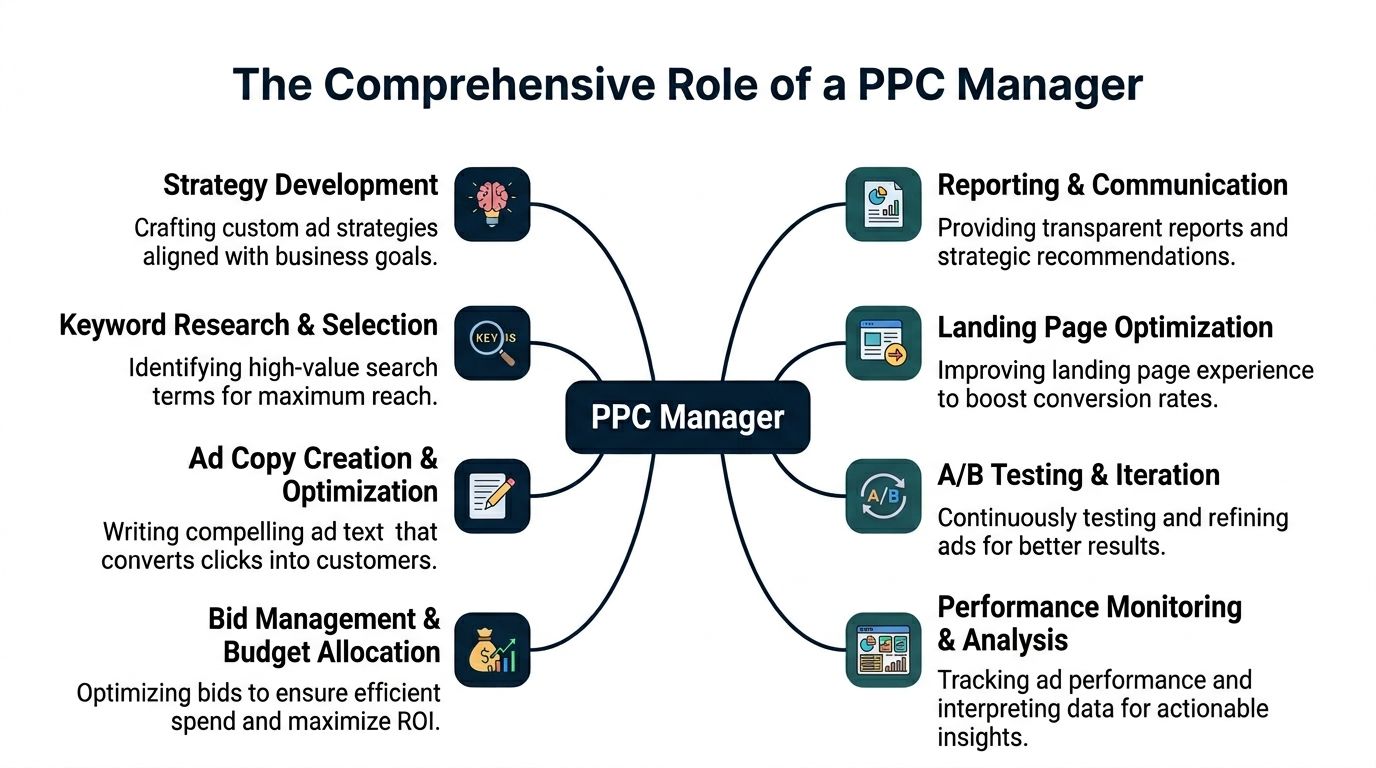
Most business owners think PPC management means writing ads and setting a budget. That is a small part of the job. A proper PPC manager acts more like a portfolio manager for your lead generation spend. The account needs constant decisions, not occasional attention.
The work that happens before a campaign launches
The foundation matters more than most advertisers realise. Before a campaign goes live, someone needs to define the business objective clearly. More calls is not specific enough. More profitable calls from the right service areas is.
A strong setup usually includes:
- Keyword planning: Separating urgent, high-intent searches from research terms.
- Campaign structure: Grouping services, locations, and intent types so performance can be measured cleanly.
- Ad copy direction: Matching the message to what the buyer wants right now.
- Landing page selection: Sending each click to the page most likely to convert.
- Tracking setup: Using tools such as GA4 and Google Tag Manager so calls, forms, and other actions flow into reporting.
Without that groundwork, optimisation later becomes messy because the data is muddy from day one.
The ongoing management that makes the difference
Once a campaign is live, work starts. Many DIY accounts and weak agency retainers fall apart here. Good management is repetitive, technical, and commercial at the same time.
On a practical level, that means:
-
Watching search terms closely
The keyword list is only the starting point. Search term data shows what people typed. That is where wasted spend often becomes obvious. -
Adjusting bids and budget allocation
Not every campaign deserves equal funding. High-intent searches usually need more protection than low-intent discovery traffic. -
Testing ad variations
Headlines, descriptions, calls to action, and extensions all affect performance. Small messaging changes can improve lead quality, not just click volume. -
Reviewing landing page fit
If one page creates calls and another creates drop-off, the page matters as much as the ad. -
Filtering weak traffic
Negative keywords and audience exclusions stop the account from buying junk clicks.
Expert agencies use a test-and-learn approach, hypothesising variables such as bid adjustments and creative changes, then refining based on performance. That method has been shown to reduce cost per acquisition by making better use of Google Ads Smart Bidding, according to Online Marketing Gurus on Brisbane PPC.
What good management looks like in business terms
For a restaurant, this might mean shifting spend toward booking-driven terms and away from generic menu browsing. For a plumber, it might mean isolating emergency intent from general plumbing queries. For a solar installer, it often means separating short-form lead capture from longer research journeys.
The important point is simple. PPC is not a set-and-forget channel. It is an active management discipline. Businesses comparing providers should look for that depth, not just someone who says they “do Google Ads”. A useful benchmark is whether the provider is delivering full PPC advertising management rather than basic campaign maintenance.
Why Professional PPC Drives Real Growth in Brisbane
The strongest argument for professional PPC is not convenience. It is economics.
In a competitive local market, poor campaign management wastes money in ways that are hard to spot if you only look at clicks and impressions. You can spend steadily, feel visible, and still underperform because the wrong people are clicking, the wrong suburbs are being targeted, or the account keeps buying low-intent traffic.
It saves money by cutting waste
A well-managed account filters harder. That means tighter keyword selection, better location settings, and a proper negative keyword list. The goal is not more traffic. The goal is fewer useless clicks.
For Brisbane businesses, that matters because lead quality affects everything downstream. Every irrelevant call distracts staff. Every bad enquiry slows response time for genuine buyers. Every poor-fit click makes the campaign look more expensive than it really should be.
According to iChoose Technology’s Brisbane PPC analysis, well-managed campaigns can deliver 20 to 50% higher conversion rates when agencies use precise keyword selection and real-time bid adjustments. The same analysis says case studies show average cost-per-click reductions of 15 to 30%.
Those gains do not come from tricks. They come from control.
It makes more money by improving lead quality
A cheaper click is only useful if the click leads somewhere valuable. Professional PPC management improves the quality of incoming demand.
That usually happens through a few direct mechanisms:
- Intent matching: Ads align with what the buyer needs now, not what the advertiser wants to push.
- Geographic accuracy: Service-area businesses show up where they can deliver.
- Message discipline: Ad copy pre-qualifies buyers instead of trying to attract everyone.
- Conversion path clarity: The landing page tells the visitor what to do next without friction.
For a local operator, this means more of the enquiries coming in are worth following up. Staff spend less time qualifying dead-end leads and more time closing work.
It saves time where it counts
Business owners often underestimate the management load behind a healthy PPC account. Someone needs to review search terms, test creative, adjust bids, audit tracking, and interpret what the data means commercially. That takes time, and it takes experience.
A campaign can look busy while still being commercially weak. Good PPC management turns platform data into business decisions.
The time saving is not just about outsourcing tasks. It is about removing decision fatigue. A business owner should not have to become a Google Ads technician just to stop budget leakage. They should be able to focus on quoting jobs, managing staff, serving customers, and protecting margins.
That is why professional PPC drives real growth. It improves efficiency, raises lead quality, and gives the business back the time needed to run operations properly.
Hyper-Local Targeting Strategies for Brisbane
Generic targeting wastes budget fast. Brisbane businesses win when they get much narrower than “Queensland” or even “Brisbane”. Real demand lives in specific suburbs, service corridors, and time windows.

A plumber covering Northside should not pay for Southside traffic if callout economics do not stack up. A restaurant in Fortitude Valley should not run the same local campaign logic as a destination venue that draws from across the city. A café near office clusters needs a different dayparting strategy from a suburban dinner venue.
Use location settings like an operator, not a tourist
The first mistake many advertisers make is choosing a target area that is far too broad. The second is trusting default location settings without checking how Google interprets “presence” and “interest”.
For local PPC, tighter is usually better.
A useful way to frame this is:
- Suburb targeting: Best for hospitality, retail, and service businesses with a clear local catchment.
- Radius targeting: Useful around a venue, showroom, or office where proximity matters.
- Service-area clustering: Better for trades and mobile services that can profitably cover grouped suburbs rather than a perfect circle.
Local keyword modifiers matter too. Terms such as “emergency plumber Brisbane Northside” or a venue search paired with a suburb often show stronger intent than generic city-wide phrases. Brisbane campaigns also benefit from matching the ad text to the place being targeted so the searcher feels immediate relevance.
For businesses already investing in organic visibility, combining PPC with local organic strategy can strengthen intent capture. That is why many operators pair paid campaigns with work such as local SEO for small businesses, rather than treating them as separate silos.
Match timing to how customers buy
Hyper-local strategy is not only about where ads appear. It is also about when.
Tradies often see better intent from early-morning searches, urgent same-day queries, or after-hours emergencies. Restaurants and cafés need a different rhythm, with stronger attention around lunch, dinner, and weekend planning windows.
The point is not to run ads all day just because the platform allows it. The point is to show up when the buyer is most likely to act.
A practical review should ask:
- When do calls convert best?
- When do staff answer enquiries well?
- When does demand spike for each service line?
- Which time blocks produce clicks but weak outcomes?
Those answers shape dayparting, ad scheduling, and budget pacing.
Layer intent with local context
Brisbane is not one uniform market. Search behaviour shifts by suburb type, travel patterns, and business density. Inner-city hospitality works differently from outer-suburban trades. A campaign should reflect those differences directly.
This video gives a useful visual explanation of local campaign thinking in practice:
One of the biggest account improvements often comes from breaking a single campaign into tighter local segments. Different suburbs can justify different messaging, offers, and landing pages. That gives you a clearer view of which areas produce profitable leads.
If every Brisbane suburb gets the same ad, the campaign is too blunt.
PPC Campaign Tips for Brisbane's Key Industries
A Camp Hill plumber gets a click at 7:10 am, misses the call, and pays for a lead that goes to the next advertiser five minutes later. A Fortitude Valley restaurant fills Saturday dinner but stays half-empty on Tuesday lunch. A solar installer brings in form leads for weeks, then complains that Google Ads is attracting "bad traffic" because none of those prospects signed in the first visit. Different industries fail in different ways. Their PPC setup should reflect that.
Trades need speed, tighter qualification, and call-first design
For plumbers, electricians, locksmiths, and other service trades, the campaign has to respect urgency. The searcher wants three things straight away: confirmation you service their area, proof you can help, and a fast path to call or book.
That changes the account structure. Emergency keywords should sit in their own campaigns with their own budgets, ad copy, and landing pages. A search for "emergency electrician Brisbane northside" should not send traffic to the same page used for a general rewiring quote. The intent is different, and the page needs to match it.
Good trade campaigns also filter out the wrong work. Broad traffic can look healthy in-platform while sales staff waste hours on low-value jobs, warranty questions, DIY research, and suburbs outside the service zone. Negative keywords, suburb-level exclusions, and service-specific forms protect margin.
AI search is starting to affect this category as well. Searchers increasingly ask broader questions before they click an ad, then rely on AI summaries to shortlist providers. If your service pages do not clearly state response times, suburbs covered, licence details, pricing approach, and review proof, you lose visibility before the click even happens. PPC still drives leads, but the landing page now has to work for both paid traffic and AI-assisted evaluation.
Hospitality campaigns live or die on offer clarity
Restaurants, cafés, bars, and venues usually get better results when PPC supports a defined commercial outcome. Bookings. Event reservations. Midweek foot traffic. Private dining enquiries. Voucher sales.
Generic awareness campaigns rarely hold up for long because the margin is too tight. The ad needs a reason to act now, and the landing page needs to remove friction fast. Menu access, booking buttons, opening hours, parking or location details, and mobile speed matter more than clever copy.
The metric set should match the service model. A quick-service venue may care about store visits and peak-period demand. A higher-end restaurant may care more about booking value, average party size, and whether paid traffic fills low-demand sessions without discounting away profit.
This is also where attribution gets messy. A diner might see a paid ad, read reviews, check Instagram, ask ChatGPT for "best date night restaurants in Brisbane," and book two days later through branded search. If you do not understand what is attribution in marketing, paid search often gets under-credited or over-credited depending on how the account is set up.
Solar, construction, and other high-value services need longer-cycle tracking
High-ticket services should not be judged on same-week conversions alone. Buyers compare providers, ask family or business partners, request multiple quotes, and come back later. In construction and solar, that delay is normal.
The campaign has to support that reality. Search captures active demand, but retargeting, CRM follow-up, and lead scoring do a lot of the heavy lifting after the first click. Landing pages should help a buyer move from curiosity to shortlist. Clear process explanations, finance information, project examples, FAQs, and strong trust signals usually outperform thin quote pages.
Offline conversion tracking is required here. If the account only records form submissions and phone calls, it cannot tell the difference between a tyre-kicker and a profitable project. Importing booked appointments, quoted jobs, and closed revenue back into Google Ads gives the bidding system something useful to optimise toward.
Budget pressure shows up quickly in these categories because cost per lead can look high before revenue catches up. Businesses comparing channels should look beyond platform metrics and use a practical breakdown of Google Ads costs for local businesses to judge whether the numbers fit their margins, close rates, and sales cycle.
Across all three categories, the same rule applies. Build the campaign around how the customer decides, then measure it at the point where money is won or lost. That is how PPC stops being a reporting exercise and starts becoming a growth channel.
Setting Your Budget and Measuring Success
Budget questions are fair. So are ROI questions. The problem is that many businesses ask the first one without getting clarity on the second.
A Brisbane business can spend too little, too much, or the right amount for the wrong objective. The number itself is not the strategy. The structure behind it is.
What Brisbane businesses usually budget
In Brisbane, small businesses typically allocate $1,500 to $3,000 per month for PPC management and ad spend, while growth-focused brands invest $3,000 to $6,000 monthly. Agencies often aim for 300 to 500% ROAS in competitive sectors, based on Conquerra Digital’s Brisbane PPC pricing analysis.
Those ranges are useful as market context, not a universal prescription.
A restaurant with a tight local catchment may need a different structure from a trade business covering multiple service zones. A solar company with longer sales cycles may need to absorb a slower feedback loop before performance becomes clear. Budget should follow commercial reality, not agency templates.
What to measure instead of staring at clicks
Clicks are not meaningless, but they are one of the weakest signals if you look at them in isolation. The stronger metrics depend on the business model.
For most local service businesses, the priority list looks more like this:
- Qualified leads: Not every enquiry deserves equal weight.
- Cost per lead: Useful only when lead quality is understood.
- Sales conversion rate from lead to customer: Many businesses lose visibility at this point.
- Revenue attributed back to campaigns: A true test of whether spend is justified.
- Return on ad spend: Strong as a commercial benchmark when attribution is clean.
That last point is where many SMBs struggle. Trades often close work over the phone. Hospitality businesses may take bookings across multiple systems. Construction and solar deals can take weeks or months. If those events are not connected properly, PPC looks less effective than it really is, or sometimes better than it really is. The issue is missing attribution.
Why attribution matters more in trades and hospitality
This is one of the most underserved parts of ppc management brisbane. Plenty of agencies talk about leads, but fewer explain how to connect ad interactions to revenue when the sale happens offline or later in the pipeline.
For businesses trying to understand the basics of that process, this plain-English guide on what is attribution in marketing is worth reading. It helps frame why a click, a call, a quote, and a completed sale are not the same event.
A practical measurement setup often includes GA4, Google Tag Manager, call tracking, form tracking, and disciplined CRM updates. The tools matter, but the operating habit matters more. Staff need to record lead outcomes consistently or the account never gets clean feedback.
A better way to judge campaign health
When I review local campaigns, I do not start by asking whether the account is busy. I ask whether the account is measurable.
A healthy decision process usually follows this sequence:
-
Confirm the conversion actions
Calls, bookings, quote requests, showroom visits, and qualified form fills all need definition. -
Check tracking quality
If the account cannot separate business actions from weak signals, reporting will mislead. -
Match spend to margin
Some services can support aggressive bidding. Others cannot. -
Review lead handling
PPC can generate demand, but slow follow-up can destroy ROI after the click. -
Scale only after evidence
More budget should follow proven performance, not frustration or hope.
If you are trying to map realistic costs before launching or restructuring an account, it helps to compare your likely spend against local conditions and service goals. This overview on how much Google Ads cost is a sensible starting point.
The question is not “How much should I spend?” It is “Can I trace that spend to profitable outcomes?”
Future-Proof Your Advertising with Titan Blue
Search behaviour is changing. Many businesses still run PPC as if Google’s standard results page is the whole playing field. It is not.
As of 2026, AI search platforms such as ChatGPT and Perplexity capture 15 to 20% of search queries in Australia, yet most local PPC agencies do not have a strategy for integrating paid campaigns with visibility in AI-generated answer environments, according to Gimaev’s PPC services analysis.

That matters because future-proofing no longer means only improving bids and writing stronger ads. It means thinking about how paid media, search content, landing pages, structured information, and brand visibility work together across traditional and AI-assisted discovery.
Why the old siloed approach is weakening
If a business treats PPC, SEO, and AI visibility as separate problems, gaps open up fast. The ad may generate interest, but the brand may still be absent when a buyer asks an AI tool for a recommendation or summary. The website may rank organically, but the message may not support paid conversion intent. The paid account may produce leads, but the content layer may not support the research phase.
That is why a more integrated model is becoming necessary.
Why Titan Blue is built for where search is heading
Titan Blue Australia brings more than campaign management. With over 25 years in digital, the agency combines long-running local market experience with a clear focus on AI Search, Answer Engine Optimisation, and visibility across LLM environments.
That matters for Brisbane and South East Queensland businesses because the market is crowded, buyer journeys are fragmented, and many service businesses need both immediate lead generation and longer-term discoverability. A provider that only manages ads solves part of the problem. A provider that understands how paid search and AI-era visibility intersect is better placed to protect future growth.
If you want a partner that takes that broader view seriously, this overview of Google Ads success with Titan Blue Australia shows how the agency approaches targeted traffic and business growth with a longer horizon in mind.
Frequently Asked Questions About PPC in Brisbane
How quickly can PPC start generating results
PPC can generate visibility and clicks quickly once campaigns are approved and live. Meaningful performance, though, depends on clean tracking, enough data to optimise, and whether the campaign is built around strong intent from the start. Fast launch does not guarantee profitable lead flow. Early weeks are often about refining.
Is PPC better than SEO for Brisbane businesses
They do different jobs. PPC gives you immediate presence for targeted searches. SEO builds long-term visibility and trust. Most local businesses do better when they use both properly. PPC is useful for immediate demand capture. SEO supports ongoing discoverability and lowers reliance on paid traffic over time.
What should I look for in a PPC management agency
Start with the basics. You want clear reporting, proper conversion tracking, and direct answers about how the account will be structured and improved. Ask how they handle search term reviews, negative keywords, landing page alignment, and offline conversion measurement. If they only talk about clicks, reach, or impressions, keep looking.
Can PPC work for trades and hospitality if sales happen offline
Yes, but only if the measurement setup reflects how the business closes work. Calls, bookings, quote requests, and follow-up outcomes need to be tracked properly. Otherwise, the campaign may look unprofitable when the issue is missing attribution.
Should my Brisbane campaign target only Google Ads
Not always. Google Ads often captures the strongest high-intent demand, but some businesses benefit from Meta Ads, retargeting, or a broader search-and-content strategy. The right mix depends on the buying journey, not on what is easiest to sell.
Titan Blue Australia helps businesses turn paid traffic into measurable growth with a sharper mix of strategy, tracking, local knowledge, and AI-ready visibility. If your current ads are producing noise instead of outcomes, explore how Titan Blue Australia can build a more accountable search strategy for your business.
Make Titan Blue a preferred source in Google
One click tells Google to surface our articles more often in Top Stories, AI Overviews and AI Mode.

Best Dental Website Design Agencies in Australia: 7 Compared
Best dental website design agencies in Australia 2026: seven compared on dental proof, booking, AHPRA…

Childcare Centre Website Design Australia: The 2026 Guide
Childcare centre website design Australia: show hours, ages and enrolment as text so parents and…

Electrician Website Design Australia: The 2026 Guide
Electrician website design Australia: what to build, what we found on eight Gold Coast electrician…