


A Brisbane café owner finishes the lunch rush, grabs a phone, and realises nothing has been posted all day. The dinner special is ready, staff are flat out, and comments from yesterday still need replies. Across town, a plumber wraps up a job, snaps a quick before-and-after photo, then forgets to upload it because the next call-out comes in. The social channels exist, but they’re running on spare moments.
That’s where many small businesses get stuck. Social media feels simple because posting is easy. Management is not. Planning content, choosing the right format, replying fast, spotting what’s working, and keeping the brand consistent takes time and judgement. When that work gets squeezed between invoices, bookings, quotes, and staff rosters, results usually become patchy.
For Brisbane SMBs, social media management is less about “being active online” and more about building a repeatable system that turns attention into enquiries, bookings, and trust. A capable manager doesn’t just make feeds look tidy. They help a business show up consistently, speak clearly to the right local audience, and measure whether that effort is doing anything useful.
If your business has been posting whenever someone remembers, this guide will help you see what a social media manager does, why local context matters, how AI now fits into the picture, and what to look for before you hire. If you want a local service overview first, this page on Brisbane social media marketing gives useful context.
Introduction to Social Media Management for Brisbane SMBs
A social media manager is the person who makes your online presence feel organised instead of accidental.
For a restaurant, that can mean scheduling weekday specials before service starts, filming short kitchen clips in one batch, and replying to reservation questions before they go cold. For a trade business, it can mean turning finished jobs into proof posts, keeping suburb tags consistent, and answering direct messages while the team is on-site.
Most owners don’t struggle because they lack effort. They struggle because social media asks for a different kind of work than running the business itself. It rewards timing, repetition, audience knowledge, and pattern recognition.
Why sporadic posting rarely works
A random post here and there is like opening your shop with no sign out front and hoping passers-by walk in. Some will. Most won’t notice you at all.
Social platforms also favour activity that looks steady and relevant. That means content needs a plan, not just a phone camera and good intentions.
Practical rule: If posting only happens when there’s spare time, it usually won’t happen often enough to build momentum.
What owners usually want, and what they actually need
Many Brisbane SMBs start by saying they need “someone to post on Instagram”. Usually, they need something broader:
- A content rhythm that matches how their customers browse and enquire
- Clear brand voice so every caption sounds like the same business
- Fast community handling so comments and messages don’t sit unanswered
- Basic reporting so they know whether effort is leading anywhere
That’s why the phrase social media managers brisbane shouldn’t be read as just a hiring search term. It’s really a search for structure. Once that structure is in place, social media stops being another unfinished task on the owner’s list and starts supporting sales, reputation, and retention.
Understanding Key Concepts of Social Media Management
Social media management looks broad from the outside because people mostly see the finished post. They don’t see the planning, testing, approvals, scheduling, reply handling, and reporting behind it.
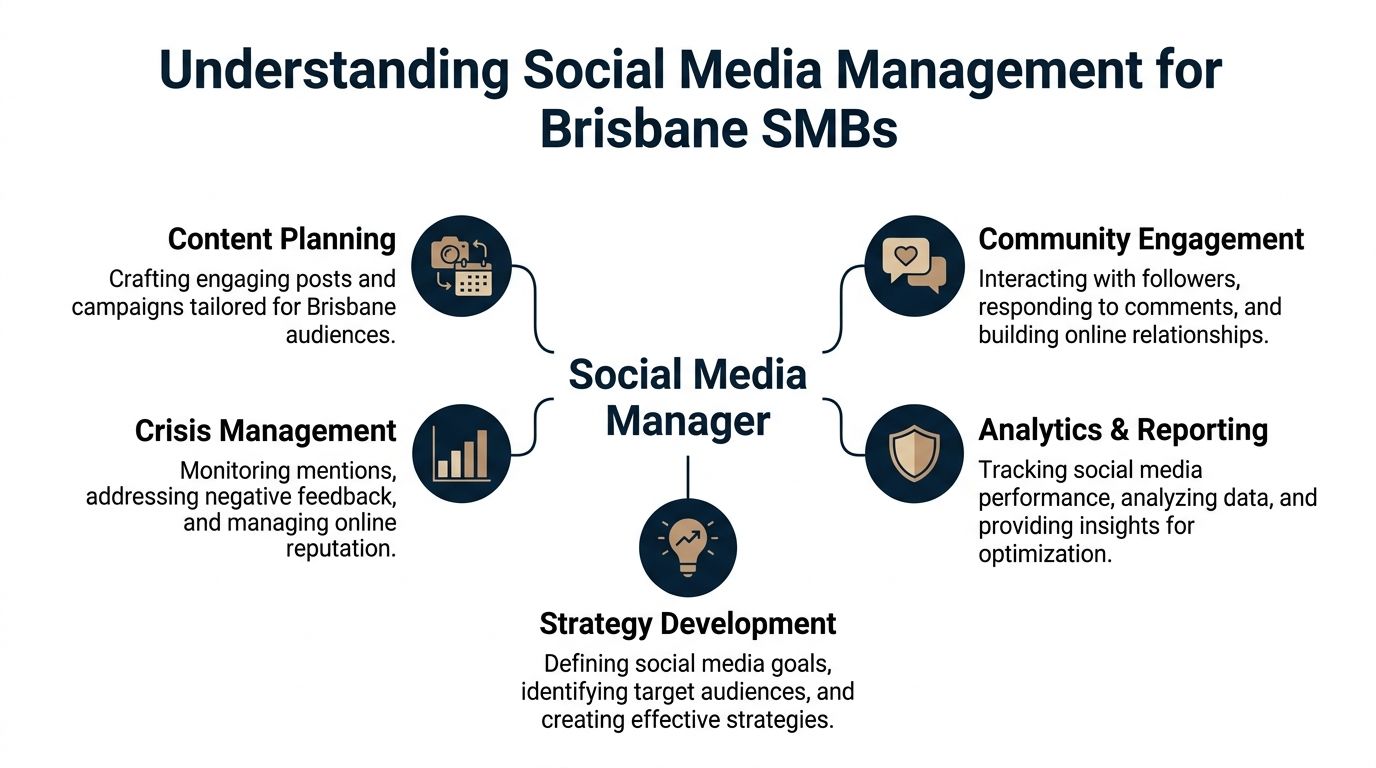
A useful way to think about it is this. A social media manager is part strategist, part organiser, part front desk, and part analyst.
Queensland data shows why that matters. In 2018, 53% of SMBs in Queensland had a social media presence, with 52% in metropolitan areas like Brisbane, and 72% of accounts were being handled by owners or managers themselves. The same report noted that only 21% of small businesses measured ROI, while 34% of small businesses and 49% of medium businesses were investing in advertising, with average annual spend of $4,879 and $14,387 respectively, according to the Yellow Social Media Report 2018. That’s a strong sign that many businesses were active, spending money, but still not running social in a tightly measured way.
If you want a broader definition of the discipline, this explanation of what social media management is gives a helpful overview.
Content planning is the booking system
A content calendar works much like a restaurant reservation book. It stops chaos.
Instead of waking up and wondering what to post, the manager maps content in advance. That usually includes offers, educational posts, behind-the-scenes footage, testimonials, seasonal topics, and local relevance. For a Brisbane builder, that might be project progress photos. For a café, it might be a weekday special, a barista clip, and a customer review.
Without a calendar, businesses often overpost one thing and ignore the rest. Feeds become repetitive or silent.
Community engagement is the front counter
Posting is only half the job. Replies matter.
When someone comments on a menu item, asks whether you service a suburb, or sends a direct message after work, that’s not background noise. It’s a customer interaction. Social media managers handle that interaction in the same way a good front-of-house team handles walk-ins. They answer clearly, keep the tone on-brand, and move the conversation forward.
This is one area where small businesses often get confused. They assume social media is a publishing task. It’s also a service task.
If your inbox is full of unanswered questions, your social media problem isn’t content alone. It’s response management.
Analytics tells you what deserves more effort
A manager also checks what content performs.
That doesn’t just mean likes. It means looking at which posts generate profile visits, website clicks, saved posts, direct messages, booking interest, or lead form visits. A trade business may learn that job-site videos pull stronger enquiries than static photos. A restaurant may find that short reels about specials create more direct messages than polished menu graphics.
Tools matter. Platforms such as Meta Business Suite, Later, Hootsuite, Canva Pro, Google Analytics, and CRM integrations help managers connect activity to outcomes. If you’re comparing platforms, this guide to social media management tools is worth reviewing because it shows how different tools support scheduling, monitoring, and workflow.
Strategy connects the work to the business
The final concept is the most important. A social media manager isn’t there to fill a feed. They’re there to support a business goal.
That goal may be:
- More bookings for a venue
- More quote requests for a trade
- Greater trust for a construction or service brand
- Better retention through regular customer contact
Once owners understand that, the role becomes much easier to evaluate. You’re not paying for posts. You’re paying for a system that makes online attention more useful.
Benefits for Restaurants Trades and Hospitality in Brisbane
For Brisbane businesses in hospitality and trades, good social media management changes two things at once. It improves visibility, and it reduces friction when someone is ready to act.
That matters because these sectors rely heavily on timing, trust, and local relevance. A diner might choose where to eat based on what looks lively tonight. A plumbing customer may check whether the business seems active and reliable before calling. A venue guest often wants quick reassurance through photos, reviews, and recent updates.
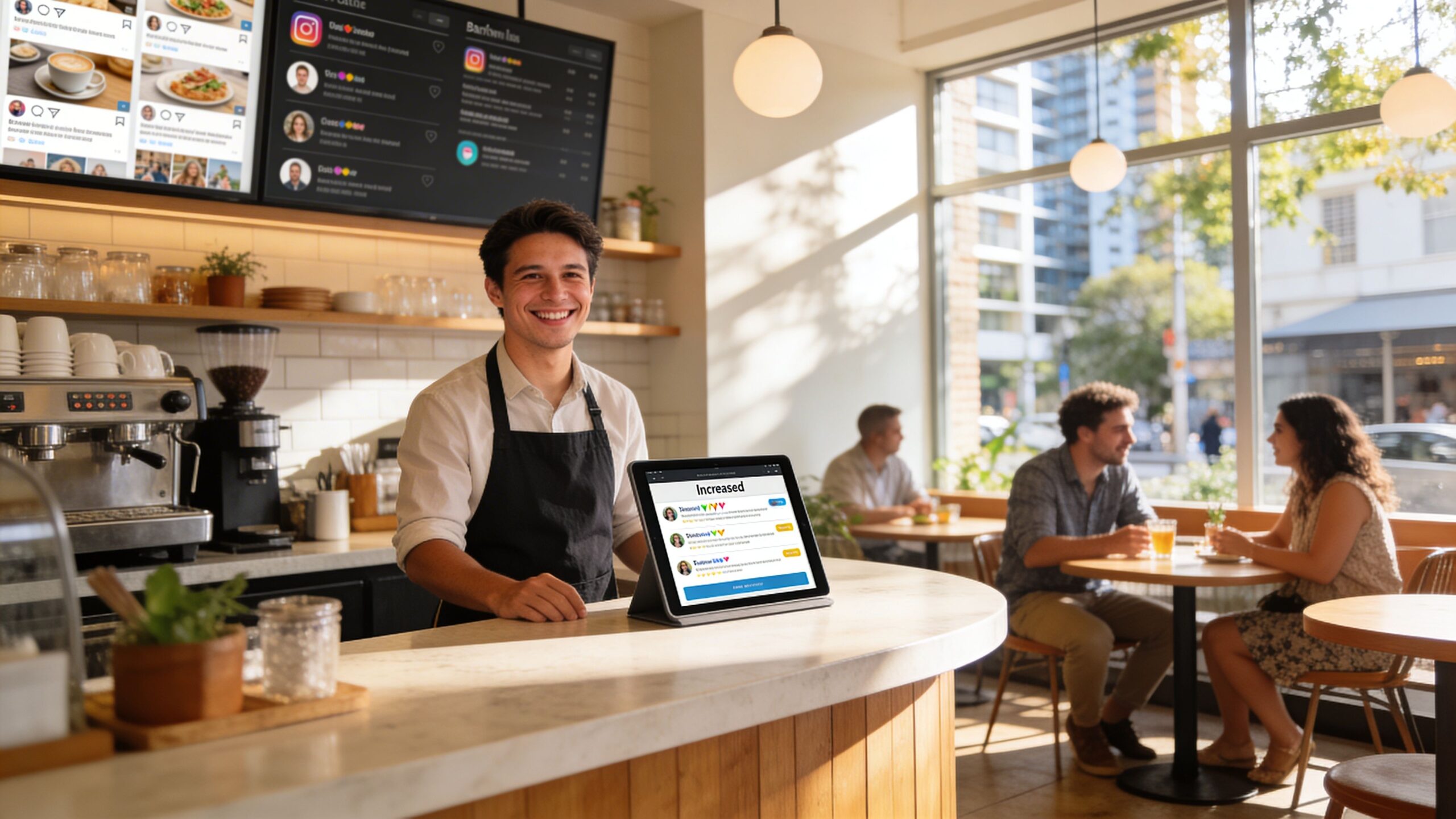
Restaurants need timing and appetite appeal
Restaurants don’t just compete on food. They compete on attention at the exact moment people are deciding where to go.
In Brisbane, audience-specific posting schedules matter because people don’t browse every platform the same way at the same time. For local SMBs such as restaurants and trades, expert managers use activity data from Facebook Insights and Instagram Analytics to improve engagement by up to 30% to 50%, and hospitality audiences in Queensland often show strong activity in the 6 pm to 9 pm weekday window, as described by Walker Hill’s social media management approach.
That means a manager won’t just post a dinner special at 10 am because it’s convenient. They’ll publish when the audience is active, then monitor comments and messages while intent is high.
A practical restaurant setup often includes:
- Recurring content pillars such as specials, staff moments, customer favourites, and venue atmosphere
- Fortnightly content planning so approvals happen before service gets busy
- Format testing to compare reels, carousels, and static images
- Tracking links so website visits from social can be measured properly
If your business is venue-based, this page on restaurant social media marketing gives a local lens on the category.
Trades need proof, not polish
Tradies often assume they need glossy branding to do well on social. Usually, they need clarity and consistency.
A finished install, a before-and-after, a short explanation from the owner, or a quick clip from the worksite can do more than a generic promotional post. It gives people evidence. That’s what service buyers look for.
Walker Hill’s cited methodology also notes that consistent fortnightly content plans can deliver 25% higher follower growth than ad-hoc posting for local clients, and that content pillars of 3 to 5 themed categories help businesses such as construction firms stay relevant across multiple post types. For a plumber or solar installer, those themes might include completed jobs, maintenance tips, customer testimonials, and team footage from the field.
Hospitality brands benefit from confidence cues
Hotels, event spaces, cafés, and bars all sell an experience before the customer arrives.
Social media lets them answer silent questions quickly:
- Does this place feel busy and current?
- What’s the atmosphere like at night?
- Are people engaging with the business?
- Does the venue reply when asked something simple?
When those answers look positive, hesitation drops. That’s one of the least discussed benefits of management. It doesn’t only generate new attention. It helps undecided people feel comfortable enough to book.
A short explainer can help if you want to see how modern workflows support that consistency:
The business effect is broader than engagement
Engagement matters, but owners should connect it to business actions.
Useful indicators include:
- Direct messages that ask about pricing, availability, or bookings
- Profile visits after locally relevant posts
- Website clicks from social content tied to offers or service pages
- Comments and saves on educational or proof-based posts
Brisbane agency benchmarks referenced by Walker Hill point to ROI benchmarks of 4:1 for SMBs when stronger engagement supports the conversion path and UTM tracking is in place. The lesson isn’t that every business will see the same result. It’s that social media works best when managed as part of a broader funnel rather than as a standalone branding exercise.
A good post gets attention. A good system turns that attention into the next step.
How to Choose the Right Social Media Manager for Your Brisbane Business
Hiring can feel messy because many providers sound similar on paper. They all mention content, strategy, reels, ads, and growth. The difference usually appears when you ask how they think about your sector, how they report, and whether they can explain their process without vague promises.
For Brisbane SMBs, choosing well comes down to fit, evidence, and operating style.
Start with sector experience, not just design taste
A manager who understands hospitality buying behaviour won’t plan the same content as someone handling a trade business. That matters more than whether their feed looks trendy.
Verified data tied to Brisbane-focused hiring and agency guidance says that strategies developed for the local market can achieve 40% higher conversion rates for hospitality and trades, that video content preferences among Brisbane’s 18 to 45 audience can bring a 65% engagement boost, and that Brisbane professionals can deliver 15% to 20% better performance because of local market understanding. The same source also notes 3.5x engagement from properly scheduled, fortnightly, optimised content and communication benchmarks such as monthly ROAS above 3:1, as outlined on this Brisbane social media manager hiring page.
That sounds impressive, but don’t stop at the numbers. Ask to see work that resembles your business model.
For example:
- A restaurant should ask how the manager would promote a quiet midweek service.
- A plumber should ask how they’d turn job photos into lead-generating content.
- A builder should ask how they would balance trust-building posts with project showcases.
Ask questions that reveal process
Good interviews aren’t about marketing jargon. They’re about how the person works.
Try questions like these:
-
How would you build content pillars for my business?
You want a clear answer, not “we’ll post a mix of things”. -
How do you decide what to post on Facebook versus Instagram?
Strong candidates will talk about audience behaviour, format fit, and goals. -
What do your monthly reports include?
They should mention outcomes, not vanity metrics alone. -
How do you use AI without making content sound generic?
This is increasingly important for speed, ideation, and optimisation. -
What happens if a post performs poorly?
Look for testing, review, and adjustment. Not excuses.
If you’re comparing agencies more broadly, this article on finding a marketing agency is useful because it frames the questions buyers should ask before signing anything.
For businesses needing strategic advice rather than full outsourcing, social media consultants can also be a practical model.
Red flags that deserve caution
Some warning signs are easy to miss because they sound confident.
Watch for:
-
Guaranteed results with no detail
If someone promises instant growth but can’t explain the method, be careful. -
No discussion of reporting
If they can’t show how they measure outcomes, you won’t know what you’re buying. -
Generic proposals
If the same plan could apply to a café, plumber, and builder without changes, it’s too broad. -
No local nuance
Brisbane businesses need messaging that fits local audiences, suburbs, and service patterns.
The right manager should make your business feel more specific online, not more generic.
Check how they think about workflow
This part often gets ignored. Ask how approvals happen, how often content is planned, how revisions are handled, and who responds to comments or urgent messages.
A smooth workflow usually includes a content plan, approval steps, asset requests, publishing schedule, and regular reporting cadence. If those basics are fuzzy, delivery often becomes reactive.
The best hire isn’t always the loudest or the cheapest. It’s the person or team that can show sector understanding, communicate clearly, and run a process you can live with month after month.
Pricing Models and Package Options in Brisbane
Pricing for social media management confuses many owners because proposals often bundle very different types of work under one monthly fee.
One package may cover scheduling and captions only. Another may include strategy, creative production, paid campaign support, reporting, inbox handling, and AI-assisted content workflows. If you compare prices without comparing scope, you can end up choosing a cheaper plan that leaves out the work that drives results.
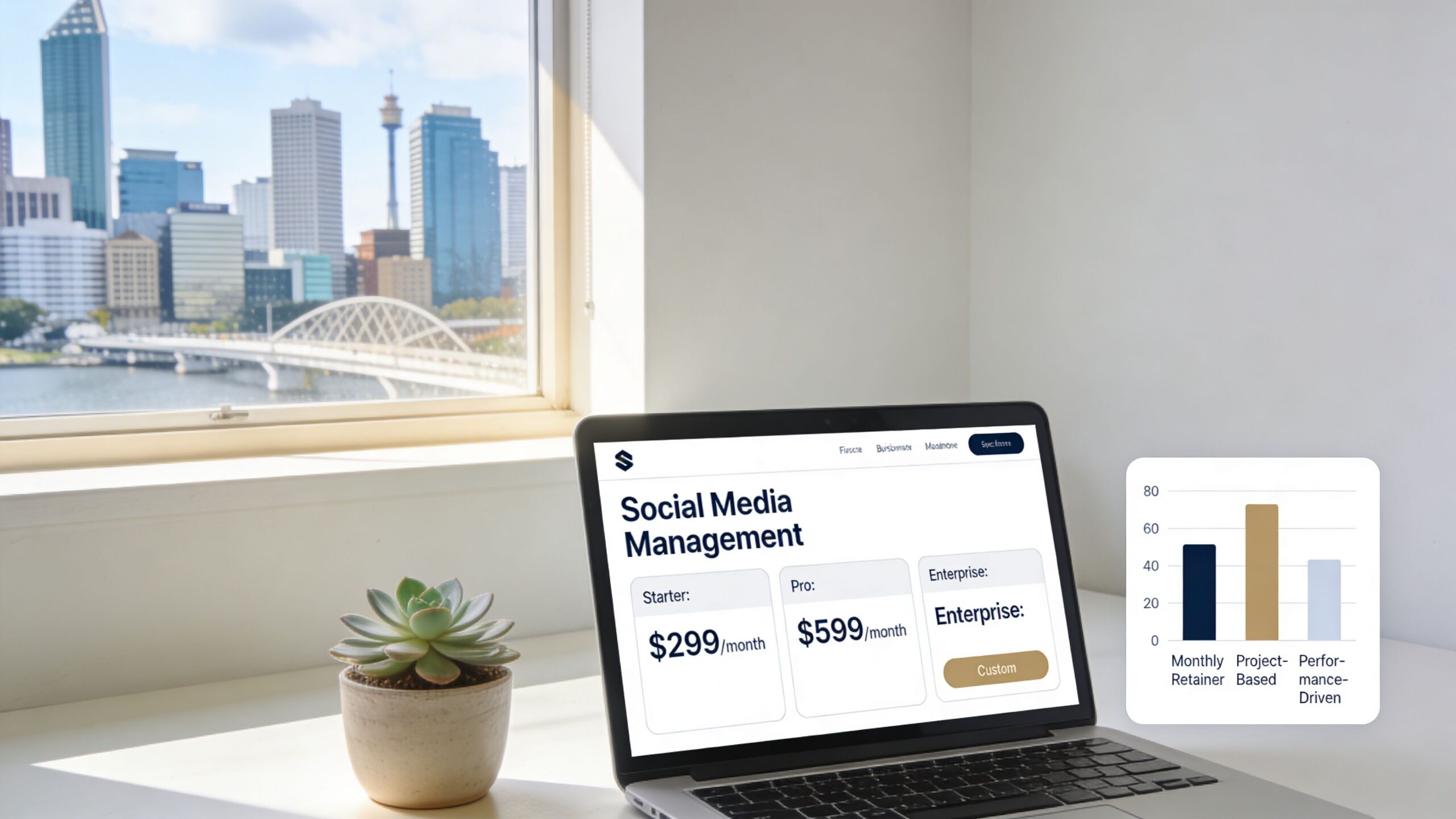
The three common ways providers charge
Most Brisbane businesses will run into one of these models.
Retainer
This is the most common setup. You pay a fixed monthly fee for an agreed scope.
It suits businesses that need regular posting, ongoing optimisation, and reporting. Restaurants, hospitality groups, and service businesses usually fit this model because their content needs don’t stop after one campaign.
Project-based
This works for short bursts of work. Examples include a venue launch, a seasonal campaign, or a construction showcase tied to a completed project.
It’s useful when a business needs a defined delivery but doesn’t want ongoing management yet.
Performance-linked or hybrid
Some providers mix a base fee with outcomes tied to paid campaigns or lead generation. This can work, but owners need to read the terms carefully. Performance pricing only makes sense when tracking is sound and both sides agree on what counts as a result.
What AI changes in the package discussion
AI is now a real dividing line in service quality. Not because it replaces strategy, but because it changes speed, testing, personalisation, and content production.
Verified data focused on the Brisbane market says 62% of Queensland SMBs plan AI integration but only 28% have implemented it, and Brisbane reportedly lags Sydney by 15% in AI marketing tool usage. The same source says agencies without AI see 24% lower engagement, while AI-optimised campaigns can yield 3x ROI for construction and solar firms, alongside a 35% growth trend in Queensland social ad spend on AI platforms over a 12-month period, according to the summary on Jayne Media’s social media manager article.
Those figures matter because they change what a package should include. If a provider still treats social media as manual posting plus a monthly PDF, they may be behind the market.
What to compare inside a proposal
Instead of asking only “how much per month?”, ask what operational layers are covered.
Look for details such as:
-
Strategy work
Audience definition, content pillars, campaign planning, and channel selection -
Creative production
Captions, graphics, editing, reels, and asset requests -
Publishing tools
Whether they use Meta Business Suite, Later, Hootsuite, Canva Pro, Adobe tools, or CRM connections -
AI-assisted tasks
Draft generation, topic clustering, testing variations, metadata support, and repurposing -
Reporting depth
Platform metrics, traffic analysis, lead tracking, and recommendations
Which package style fits which business
A small local café may only need a lean monthly service if the team can supply regular photos and approve content quickly.
A plumbing business often needs a more hands-on package because content collection is harder, jobs vary by suburb, and enquiry handling matters.
A construction or solar brand may need the broadest scope. These businesses often benefit from a mix of proof content, location relevance, educational posts, and stronger analytics because the buying cycle is longer.
If a package doesn’t explain who creates assets, who approves them, and who tracks outcomes, it’s not detailed enough to price properly.
The smartest budget decision isn’t choosing the lowest quote. It’s choosing the scope that matches your internal capacity. If your team can’t write, film, approve, publish, and respond consistently, you need a package that covers those gaps.
Local Success Stories from Titan Blue Australia
Local businesses often struggle to find examples that reflect how trades, hospitality, and construction brands use social media in Queensland. Much of the public advice is broad. It talks about “brand awareness” and “engagement” but not the practical realities of a restaurant trying to fill tables on a Wednesday night or a solar installer trying to build trust across service areas.
That gap matters. Verified background on the Brisbane market notes that industry-specific strategies remain under-served, that construction firms account for 13% of Queensland SMBs, and that only 42% of those firms are active on social media compared with 68% in national retail averages. The same summary also references Queensland Government infrastructure spend of $50B in 2025 and points to Titan Blue’s 25+ years of Queensland experience as a reason niche execution matters, based on the discussion in Bambrick’s Brisbane social media marketing article.
Because the brief prohibits invented case studies, the most honest way to handle “success stories” is to show what strong local work looks like in practice and why businesses with sector knowledge stand out.
A restaurant scenario that reflects the local challenge
A venue-based business usually has a familiar pattern. Service is busy, content gets left until late, and the posts that do go live often focus only on food shots.
A stronger local approach would look different. It would build a repeating rhythm around specials, staff personality, social proof, venue atmosphere, and event timing. It would also time posts around real audience behaviour rather than admin convenience.
For hospitality, the core shift is from random promotion to a managed weekly narrative. The feed starts answering practical customer questions before they’re even asked. Is the venue lively? What’s on this week? What should I book? What does the place feel like at night?
A trades scenario where proof beats generic branding
Trade businesses often get poor advice on social media. They’re told to “build the brand” without being shown how.
In practice, local trade marketing works best when it documents evidence. A social media manager with sector understanding will treat every completed job as a content opportunity. Before-and-after visuals, suburb-specific captions, short educational clips, and plain-language explanations of the problem solved can all move the right buyer.
The person scrolling isn’t looking for clever copy. They’re checking whether the business seems competent, current, and easy to contact.
For trades, social media works best when it looks like proof of work, not an advertising poster.
A construction and infrastructure angle many providers miss
Construction sits in an awkward middle ground. Projects can be visually strong, but the sales cycle is longer and the audience often includes developers, subcontractors, and commercial decision-makers rather than walk-in consumers.
That means content needs more structure. Project milestones, safety culture, equipment highlights, team expertise, and geo-relevant updates can all play a role. Generic social management often misses this because it treats construction like retail.
A Queensland-focused agency with long operating history is more likely to understand that local industry context. That doesn’t guarantee results by itself, but it does reduce one common problem. The strategy starts from how the sector wins work.
Why local experience still matters in an AI era
AI can speed up production, generate variants, and help reshape raw job-site information into polished posts. But it still needs direction. Without local understanding, AI will often produce content that sounds generic or detached from the market.
That’s why longevity still matters. A team with deep Queensland experience can guide AI toward suburb relevance, seasonal context, industry language, and buyer concerns that make the output useful rather than bland.
The strongest local “success story” isn’t a single viral post. It’s a business that moves from irregular activity to a repeatable system that reflects its sector and its audience.
Frequently Asked Questions About Social Media Management in Brisbane
How long does onboarding usually take
It depends on how organised the business is when it starts.
If brand assets, login access, past content, and service information are easy to gather, onboarding can move smoothly. If no one knows who has platform access, there’s no photo library, and approvals are unclear, the first stage will take longer.
A realistic early phase usually includes account access, audience review, content planning, asset collection, and approval workflow setup. Owners often underestimate this part, but it’s what prevents delays later.
Should I hire an agency or a freelancer
That depends on the amount of support you need.
A freelancer can work well if your scope is narrow and your business can supply content reliably. That often suits smaller operators with a single location or a straightforward service mix.
An agency usually makes more sense when the work spans strategy, creative production, paid support, AI workflows, reporting, and multiple channels. It can also help when you need continuity during busy periods or staff leave.
The key is not agency versus freelancer as a label. It’s whether the provider can handle the workload and process your business requires.
What should I measure month to month
Don’t focus only on follower counts.
The better question is whether social media is creating useful business movement. For restaurants, that might mean more direct messages, booking interest, or website clicks to menu and reservation pages. For trades, it may be quote enquiries, service-page visits, or messages from target suburbs. For hospitality brands, it could be stronger interaction around events, offers, and venue content.
A monthly report should help you answer three things:
- What content drew attention
- What actions people took after seeing it
- What should change next month
If the report only lists impressions and likes with no recommendations, it’s incomplete.
How detailed should reporting be
Detailed enough to support decisions, simple enough to read quickly.
Most owners don’t need a dense technical dashboard. They need a report that links activity to outcomes. That means showing what was posted, what performed best, what underperformed, what the audience responded to, and what action the manager recommends next.
A useful report should tell you what happened, why it likely happened, and what the next move is.
How involved do I need to be after hiring someone
Less involved than you are now, but not absent.
The best results usually come when the business still supplies real-world input. New offers, job photos, staff news, project milestones, and customer questions all improve the content. A manager can shape and distribute that material, but they still need access to what’s happening on the ground.
Think of it as shared ownership. You provide the raw reality of the business. The manager turns it into a consistent, strategic presence.
Conclusion and Next Steps with Clear Call to Action
For Brisbane SMBs, social media management works best when it stops being treated as spare-time marketing.
A capable manager builds a system. They plan content, organise approvals, publish at the right times, respond to customers, track outcomes, and adjust what isn’t working. For restaurants, trades, hospitality, and construction businesses, that structure matters because buyers often decide quickly and judge credibility from what they see online.
The strongest providers also bring two things that are easy to underestimate. Local market understanding and practical AI capability. One keeps the strategy relevant to Brisbane and Queensland audiences. The other improves speed, testing, and visibility in a fast-changing search and social environment.
If you’re ready to stop guessing and start managing social media properly, the next step is simple. Book a conversation, review your current channels, and identify where content, reporting, and workflow are breaking down. You can get in touch through Titan Blue Australia’s contact page.
Titan Blue Australia helps Brisbane, Gold Coast, and wider Australian businesses turn inconsistent social posting into a clear growth system. With more than 25 years in digital marketing, plus a strong focus on AI Search, content creation, and social media management, the team understands how local businesses can build visibility that leads somewhere useful. If you’d like a practical next step, book a virtual consultation and request a free social media audit through Titan Blue Australia.
Make Titan Blue a preferred source in Google
One click tells Google to surface our articles more often in Top Stories, AI Overviews and AI Mode.

Solar Installer Website Design Australia: The 2026 Guide
How solar installer websites in Australia should show CEC accreditation, real install proof and AI-ready…

Hotel & Hospitality Website Design Australia: 2026 Guide
Hotel and hospitality website design in Australia explained: booking flow, schema, AEO and what actually…
Restaurant Website Design Australia: The 2026 Guide
What a restaurant website in Australia needs: HTML menus, bookings, GBP sync, schema, and AI-ready…