


Last updated:
You’re probably at one of two points.
You run a small agency, web studio, or marketing consultancy and clients keep asking for SEO. You know it matters, but you also know hiring a strategist, technical specialist, content lead, and reporting analyst isn’t a small step. One wrong hire turns a new revenue line into a payroll problem.
Or you own a trade, hospitality, or service business and you’re looking at a practical expansion path. Maybe you already sell websites, social media, branding, IT support, or digital retainers. SEO reselling services look attractive because they let you add a recurring service without building a full in-house team first.
For Australian businesses, that timing makes sense. Search still drives buying intent, but the search environment has changed. Traditional rankings matter. Local visibility matters. And now AI-generated answers matter too. If your reseller model only covers old-school SEO and ignores AI Search Optimisation, you’re building a service line that’s already behind.
That’s the shift smart operators are making. They’re not treating seo reselling services as a stopgap. They’re treating them as a scalable delivery model that combines local SEO, technical SEO, content, and Answer Engine Optimisation from day one.
Why SEO Reselling is Your Next Growth Engine
The appeal is simple. SEO reselling services let you add a recurring offer without carrying full delivery overhead in-house. That matters when margins are tight and clients want more than one-off projects.
In Australia, the commercial case is strong. Agencies typically mark up wholesale SEO packages by 2-3x, with fulfilment costs starting at $250-$500 per month for local clients, and resellers often achieve profit margins of 30-50% on ongoing retainers according to SEO Leads. The same source notes that approximately 46% of Google searches show local intent, which is exactly why plumbers, restaurants, tradies, and local service firms keep buying search visibility.

Why the model works for local operators
A local client usually doesn’t need a sprawling enterprise campaign. They need the basics done properly.
That means:
- Technical foundations: Pages need to load cleanly, index properly, and work well on mobile.
- Local relevance: Service pages must align with suburbs, regions, and real search intent.
- Ongoing signals: Google Business Profile work, content updates, and authority building can’t stop after launch.
If you already manage websites, creative, or paid media, SEO fits naturally into that stack. It increases account value and gives clients a reason to stay longer.
Practical rule: Don’t sell SEO as a bolt-on. Sell it as the layer that makes the rest of the client’s digital spend work harder.
Why this isn’t just about classic Google rankings
A lot of agencies still think reselling SEO means outsourcing link building and sending a PDF once a month. That model is dated.
Search has become broader. Clients still want rankings, but they also want to appear in map results, featured answers, AI summaries, and the sources those systems trust. That means your reseller offer has to include content quality, entity clarity, structured information, and strong local business signals from the start.
If you need context on where SEO fits into a broader growth plan, this guide on why Australian businesses should invest in SEO is a useful reference point.
What usually stops businesses from adding SEO
The blockers are familiar:
- Hiring risk: A single SEO hire rarely covers strategy, tech, content, and local search well.
- Tool cost: Ahrefs, SEMrush, GA4 setups, reporting systems, and auditing tools add up fast.
- Operational drag: Delivery quality slips when sales teams promise what fulfilment teams can’t support.
- Reputation risk: Poor SEO hurts trust faster than not offering SEO at all.
A solid reseller arrangement removes most of that strain. You keep the client relationship, shape the offer, control pricing, and use specialist fulfilment behind the scenes. Done properly, it becomes one of the cleanest recurring revenue lines an Australian business can add.
Building Your Reseller Service Packages and Pricing
Most new resellers make the same mistake. They build packages around what the supplier offers instead of what the client needs.
That’s backwards.
Your packages should be shaped by client type, buying intent, competition level, and business model. A Gold Coast plumber doesn’t need the same package as a hospitality group with multiple venues. If both get the same deliverables, one of them is overpaying or under-serviced.
Start with the client’s budget reality
For many Australian trades and hospitality businesses, marketing budgets are constrained. Australian trades and hospitality SMBs often allocate $250-$750 per month to digital marketing, and resold local SEO services in this bracket can achieve an average 3.2x ROI versus a 1.8x national average, with agencies in underserved regions like Broadbeach reporting up to 22% higher margins according to Local SEO Guide.
That doesn’t mean you should race to the bottom. It means your packaging has to match the economics of the client.
A practical three-tier structure
Local Foundation
This is the entry package for a single-location business that needs visibility, not complexity.
A plumber, electrician, café, or small restaurant often fits here. The package should focus on the work that creates local search traction first.
Include:
- Google Business Profile optimisation: Categories, service descriptions, images, updates, and local relevance.
- On-page updates: Title tags, meta descriptions, H1s, service copy improvements, and internal linking.
- Core technical cleanup: Indexing issues, crawl errors, broken pages, redirects, and mobile basics.
- Local citation consistency: Business details aligned across relevant listings.
- Basic reporting: Keyword movement, organic traffic direction, and lead-focused commentary.
This tier is often the easiest sale because the business owner can understand it quickly. They don’t need a lesson in search theory. They need to know whether more relevant people will find them.
Growth package
Most profitable reseller relationships inhabit this domain.
Use it for businesses that already have a reasonable site, some authority, and a stronger appetite for lead flow. Think a larger plumbing firm, a builder, a multi-service trade business, or a busy venue competing in a crowded suburb.
Add:
- Ongoing content production: Service expansion pages, suburb pages, FAQs, and supporting blog content.
- Deeper technical audits: Site speed issues, duplicate content, structured data, and architecture improvements.
- Authority development: Quality backlink outreach and local relevance signals.
- AEO-ready content formatting: Clear question-and-answer sections, concise definitions, and entity-rich content blocks.
- Better reporting cadence: More context around what’s improving and what needs attention.
This is also the right level to start integrating AI Search Optimisation properly. Don’t treat that as a premium extra. Treat it as a modern requirement.
Multi-location or authority package
Restaurants with several venues, hospitality groups, and service businesses expanding across regions need a more mature structure.
This package should cover:
- Multi-location landing pages
- Consistent structured data across locations
- Broader content planning
- Reputation and local profile coordination
- Technical oversight across a larger site
- A stronger editorial process for trust and accuracy
This tier works best when your sales process is consultative rather than menu-driven.
The right package isn’t the one with the longest deliverables list. It’s the one that fixes the client’s next meaningful bottleneck.
Price for margin and delivery confidence
A reseller package only works if the unit economics are clean.
Work backwards from:
- your supplier cost
- your account management time
- your reporting time
- revision handling
- scope risk
Then build margin into the package before you ever present it. If the supplier gives you a low wholesale rate but the work quality is weak, the margin is fake. You’ll pay for it in churn, rework, and awkward client calls.
A better approach is to package by business stage and likely search opportunity, then position pricing around commercial value. This overview of Australian SEO pricing packages helps frame those conversations.
Two real packaging examples
For a plumber:
- Start with location pages, Google Business Profile work, technical cleanup, and a few tightly targeted service pages.
- Don’t oversell blog content if the primary issue is weak service intent coverage and poor local signals.
For a restaurant:
- Focus on local discovery, branded and non-branded search visibility, menu and location schema, review support, and event or seasonal content.
- Don’t default to generic backlinks if the site lacks usable venue and service content.
That’s the practical difference between a package that sells and a package that works.
Choosing the Right White-Label SEO Partner
Your reseller model will only be as good as the partner behind it. If they miss deadlines, cut corners, hide behind vague reporting, or rely on weak AI content, your brand wears the damage.
That’s why partner selection isn’t a procurement task. It’s a risk management decision.

The first filter is transparency
A polished sales deck means nothing if the reporting is murky.
Transparency matters because 78% of agencies drop partners due to unclear data, and mobile-first optimisation should be standard since mobile devices drive over 60% of Australian web traffic according to Ozopro.
If a potential partner can’t show you exactly what they did, why they did it, and what changed, walk away.
Ask for:
- Sample reports: You want actual task-level clarity, not vanity charts.
- Execution detail: What changed on the site, which pages were updated, what content was produced, what links were earned.
- Ownership boundaries: Who handles client-facing questions, revisions, and escalation.
- Quality controls: How they review AI-assisted content, fact-check local details, and avoid duplication.
The second filter is Australian relevance
A reseller can be competent and still be the wrong fit if they don’t understand the Australian market.
A local campaign here needs local judgement. That includes suburb naming, service intent, state-based competition patterns, .com.au relevance, and how Australians search for trades and hospitality services.
Ask direct questions:
How do you approach local authority in Australia
Don’t settle for “we build backlinks”. Ask where those links come from, how relevance is judged, and whether the work supports local trust rather than generic domain metrics.
How do you optimise for map visibility and local service intent
A good answer should include Google Business Profile inputs, location page structure, citation accuracy, and local content logic.
What does your content workflow look like
If they say everything is AI-generated, that’s a warning sign. AI can support research and drafting. It shouldn’t replace editorial judgement, local nuance, or subject accuracy.
Bad reseller partners hide poor work behind broad words like optimisation, outreach, and enhancement. Good partners show the actual inputs.
The third filter is whether they understand AI search
Many reseller offers fall behind because they still sell traditional deliverables as if search hasn’t changed.
Ask what they do for:
- entity clarity
- FAQ structuring
- answer-focused copy
- schema implementation
- source-quality content
- brand mentions in credible contexts
- LLM visibility considerations
If they don’t have a view on Answer Engine Optimisation, they’re building for yesterday’s search environment.
Look beyond SEO if your clients need adjacent trust signals
Sometimes the right fulfilment model includes specialist partnerships outside pure SEO. For example, if you service businesses concerned about online risk, cyber trust, or reputation visibility, a related offer such as GoSafe’s reseller program can help you broaden your retained service stack without building another in-house department. The point isn’t to bundle everything. It’s to choose partners whose fulfilment strengthens your client relationships rather than complicating them.
A short shortlist test
Before signing any partner, run a practical test.
Give them a mock brief for:
- a local plumber
- a restaurant with one venue
- a multi-location service business
Then compare how they respond.
You’re not looking for the flashiest pitch. You’re looking for whether they can think clearly, scope correctly, and communicate like an extension of your business. If you want a broader framework for evaluating providers, this selection guide on how to choose an SEO company is a useful benchmark.
Your Operational Playbook from Onboarding to Reporting
A reseller setup fails when the workflow is messy.
The biggest problems rarely come from SEO theory. They come from poor onboarding, unclear briefs, missing access, vague scopes, and client expectations that were never set properly. A strong operational playbook fixes that before delivery starts.
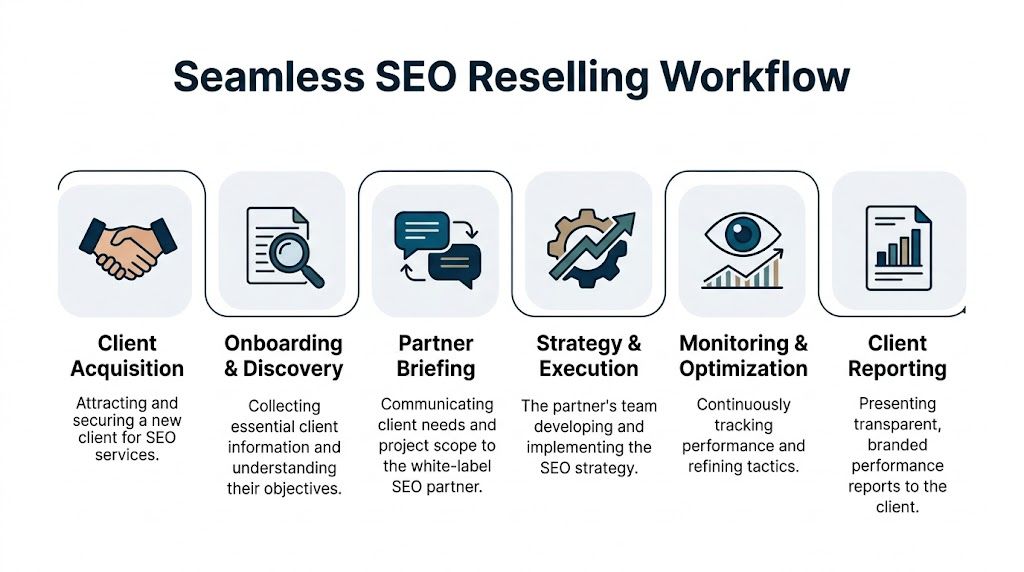
Step one means tighter onboarding, not more paperwork
Once the contract is signed, move quickly. Momentum matters.
What you need first is a compact onboarding pack that captures commercial context, not just logins.
Include:
- Business goals: More calls, more bookings, more quote requests, better suburb coverage.
- Core services: What they most want to rank for, and what’s most profitable.
- Geographic targets: Service areas, suburbs, or venue locations.
- Access list: CMS, GA4, Google Search Console, Google Business Profile where relevant.
- Known issues: Past penalties, redesigns, broken pages, tracking gaps, duplicate sites.
Most clients don’t know what matters for SEO. Your form has to lead them there without overwhelming them.
The brief to your fulfilment partner should be sharper than the client brief
Don’t just forward notes.
Translate the client conversation into an execution-ready brief. Quality often suffers for many resellers here. The supplier gets a vague summary, makes assumptions, and the campaign starts on weak footing.
Your internal brief should answer:
- what success looks like
- which pages matter most
- whether local SEO is primary
- whether content or technical issues are the bigger blocker
- what commercial constraints exist
- whether AEO should be built into page structure from the start
That one document will save you weeks of rework later.
Set expectations before work begins
At this stage, good operators separate themselves.
With rigorous methodology, SEO success rates can climb from 13% to over 50%, and 71% of clients churn due to overpromises. Weekly white-label reports via tools like Looker Studio help mitigate that by tracking realistic KPIs according to ALM Corp.
The lesson is straightforward. Don’t promise outcomes you can’t control. Promise a clear process, a sensible scope, and disciplined reporting.
Operational check: Tell the client what will happen in month one before month one starts. Fewer surprises mean fewer trust problems.
Build a monthly rhythm the client can understand
A simple campaign cycle works best.
Week one
Review data, confirm priorities, and lock the month’s tasks. You then decide whether the month leans technical, local, content-led, or authority-focused.
Week two
Execution starts. That may include page edits, brief writing, content development, local profile updates, citation work, internal linking, or technical implementation.
Week three
Review what’s landed and whether anything needs correction. This is the best time to catch content that sounds generic, local pages that need more specificity, or technical changes that weren’t deployed properly.
Week four
Prepare reporting and client commentary. Don’t just send screenshots. Explain what moved, what was completed, and what the next focus is.
What a good report actually contains
Most small business owners don’t want a jargon dump. They want a clear answer to a practical question. Is this helping the business?
A useful white-label report should include:
- Completed work: What changed this month.
- Visibility movement: Keyword direction in plain English.
- Traffic commentary: Organic changes and what likely influenced them.
- Lead relevance: Calls, forms, bookings, or directional conversion insight where tracking allows.
- Next actions: What the campaign will do next and why.
For reporting stacks, many agencies use GA4, Google Search Console, Looker Studio, and audit tools such as Ahrefs or SEMrush. If you’re reviewing your stack, this roundup of 12 Best Tools for SEO Agencies is a practical reference.
Keep your workflow brand-safe
One of the main benefits of seo reselling services is that the client sees a coherent service. To preserve that, your process needs clear rules.
Use these:
- One owner of the client relationship: The client should never wonder who is responsible.
- One reporting format: Don’t let every supplier send a different style of update.
- One feedback path: Revisions and concerns should go through your team first.
- One language standard: Reports should be readable by a business owner, not just an SEO specialist.
That operational discipline is what makes white-label delivery feel premium instead of improvised.
Marketing and Selling Your New SEO Services
You don’t need a flashy launch campaign to sell SEO. You need better conversations with the clients you already have.
That’s the easiest entry point for most businesses adding seo reselling services. Existing website clients, branding clients, paid media clients, and social clients already trust you. They don’t need to be convinced that you exist. They need to be shown where search is leaking opportunity.

Start with current clients first
Most agencies waste time chasing cold leads while warm opportunities sit in their own CRM.
If you’ve built a client’s website, ask:
- Are their service pages targeting real search demand?
- Is their Google Business Profile helping or neglected?
- Are they visible outside branded searches?
- Does their content answer common buyer questions clearly?
Those checks often reveal obvious gaps. You don’t need a 40-page audit. A short review with a few screenshots and a clear recommendation is usually enough to start the conversation.
Sell outcomes, not SEO tasks
Many sales pitches often falter. They talk about keywords, backlinks, and metadata as if the client should care.
The client cares about booked tables, quote requests, phone calls, and qualified enquiries.
For Australian businesses, that framing is supported by channel performance. Search engines are the top lead source for 57% of B2B companies, and organic traffic converts at 3.75% compared with 1.77% for display ads according to LinkGraph.
That doesn’t mean every SEO campaign wins. It does mean search is a commercially credible service to sell, especially when you position it as lead generation rather than abstract visibility.
If your pitch starts with “we’ll optimise metadata”, you’re selling labour. If it starts with “we’ll help more local buyers find and contact you”, you’re selling business value.
A simple sales angle for plumbers and restaurants
For a plumber, the pitch is usually direct. If local searchers can’t find the right service page in the right suburb at the right time, another business gets the call.
For a restaurant, the pitch is different. Visibility affects discovery, branded search, booking intent, events, menu queries, and local map behaviour. The package should reflect that commercial reality.
That’s why your offer should be vertical-aware, not generic. It’s also why useful educational content helps sales. This article on content marketing for agencies is a good example of how to support service sales with material that builds trust before the proposal stage.
Use short audits as a conversation starter
A good initial audit should do three things:
- show one technical issue
- show one content issue
- show one local visibility issue
That’s enough to prove there’s work to do without drowning the prospect in detail.
Later in the sales process, video can help explain the offer in a more approachable way. This is useful if the client is new to search services.
Build a repeatable offer, not a custom pitch every time
Custom proposals have their place, but your sales system should still be repeatable.
Keep these elements standard:
- your package names
- your onboarding steps
- your review cadence
- your service boundaries
- your explanation of what’s included and what isn’t
That consistency makes your service easier to sell and much easier to fulfil.
Scaling and Future-Proofing with AI Search Optimisation
The usual reseller growth path is straightforward. You sign a few clients, refine the workflow, standardise reporting, and add more accounts.
That’s the easy part.
The harder part is making sure the service you scale still matches how search works now. If your seo reselling services stop at rankings and ignore AI search behaviour, you’re scaling an outdated offer.
Traditional SEO still matters, but it’s no longer the whole job
By late 2025, Google’s AI Overviews appeared in 15% of Australian searches, contributing to a 28% drop in traditional organic clicks for some SMBs, and 62% of Australian consumers were using voice or AI search for local services according to Floowi Talent.
That changes the reseller conversation.
You’re no longer only optimising to win a blue link click. You’re also optimising to become a trusted source that AI systems can summarise, cite, or draw from.
What AEO changes in a reseller model
AEO doesn’t replace SEO. It sharpens it.
For your reseller packages, that means content should be built to answer questions clearly, define services accurately, and establish local trust signals in a way machines can interpret as well as humans.
Ask your fulfilment partner whether they can support:
- Answer-led content design: Clear, direct responses near the top of key pages.
- Entity clarity: Consistent references to your services, locations, brand, and expertise.
- Structured information: Schema and page formatting that support interpretation.
- Trust signals: Reviews, business details, author clarity, and strong service-page accuracy.
- Source-ready writing: Content that can be quoted, summarised, or extracted without losing meaning.
If they can’t explain this in plain English, they’re not ready for the next phase of search.
Scale with systems, not heroics
As client volume grows, don’t rely on memory or ad hoc judgement.
Create fixed internal standards for:
- page brief format
- AI content review rules
- local SEO checklists
- AEO inclusion points
- monthly review criteria
Many resellers make a common error. They grow account numbers but let quality drift. Pages become templated, content becomes generic, and reports become repetitive. That might hold for a while, but AI-driven search rewards clarity and usefulness more than mass production.
Search is moving toward fewer lazy clicks and more direct answers. Your reseller offer needs to help clients stay visible in both environments.
If you want a deeper view of that shift, this guide to AI search engine optimisation for Australian businesses is worth reading.
Frequently Asked Questions for New SEO Resellers
Do clients need to know I’m using a white-label partner
Not necessarily. In most reseller arrangements, you remain the client’s main point of contact and the service is delivered under your brand.
What matters is accountability. If the client hires you, you own communication, quality control, and outcomes.
Should I guarantee rankings
No.
You can guarantee process, reporting, responsiveness, and disciplined execution. You can’t guarantee a ranking position because search results change, competitors move, and Google updates constantly.
How long should a reseller SEO engagement run
Long enough to let the work compound.
For local businesses, SEO usually needs continuity. Technical fixes, local signals, authority, and content all build over time. If a client expects instant results, reset that expectation before the campaign starts.
What should I do if a client wants very cheap SEO
Decide whether they’re the right fit.
Low-budget clients can still be good clients, but only if the scope is narrow and realistic. Don’t force a full campaign into an unsustainable fee. Strip it back to the essentials and explain what’s not included.
What’s the biggest mistake new resellers make
Selling before they’ve defined delivery.
They promise custom strategy, premium reporting, technical improvements, content, and AI search support, then realise their partner can’t deliver all of it consistently. Build the service around fulfilment reality first. Sell it second.
How do I handle client concerns when rankings fluctuate
Keep the conversation tied to the broader picture.
A single ranking change isn’t the story. The story is whether the campaign is improving technical health, local relevance, useful content, and qualified visibility over time. Explain movement calmly and keep reporting anchored to business goals.
Should I include AEO from the beginning or add it later
Include it from the beginning.
It’s easier to structure pages, content, and local trust signals correctly the first time than to retrofit them later. Even when a client doesn’t ask for AI visibility explicitly, the underlying work still strengthens the campaign.
What makes a reseller service feel premium to the client
Three things:
- clear communication
- consistent reporting
- visible strategic thinking
Most clients won’t inspect every technical detail. They will notice whether your service feels organised, whether their questions get answered, and whether the work reflects their real business priorities.
If you want help building a profitable, future-ready SEO reseller offer with local SEO and AI Search Optimisation built in from the start, Titan Blue Australia can help. With over 25 years of digital experience from Broadbeach and a strong focus on Australian search behaviour, we help businesses create scalable SEO services that are commercially sound, operationally clean, and ready for where search is heading next.
Make Titan Blue a preferred source in Google
One click tells Google to surface our articles more often in Top Stories, AI Overviews and AI Mode.

Bing Topics Portfolio: What It Means for Australian Sites
Microsoft Bing launched Topics Portfolio in AI Performance. What it shows, whether it reaches Australia,…

Best Medical Practice Website Design Agencies in Australia: 7 Compared
Best medical practice website design agencies in Australia, compared: seven picks, what each page shows,…

Shopify Website Design Australia: The 2026 Guide
Shopify website design Australia: product pages, collections, delivery info and product data that win sales,…