


You’ve probably seen this play out already. Your website looks polished, your listings are professional, and your brand presentation is solid, but when someone searches for property advice, suburb information, or an agent in your area, your business is hard to find.
That gap matters more than most agencies realise. In real estate, visibility isn’t just a marketing problem. It’s a pipeline problem. If Google doesn’t connect your business to local search intent, you end up renting attention from portals, boosting posts that disappear in days, and relying on referral flow you don’t fully control.
Real estate seo fixes that when it’s done properly. Not with keyword stuffing, not with recycled suburb pages, and not with generic blog content. It works when your site is built around how buyers, sellers, investors, and local business owners search in Australia, and when every page has a job to do.
Why Your Real Estate Business Needs SEO Now
A lot of agencies hit the same wall. They launch a nice site, upload listings, add a few team profiles, then wait for enquiries that never arrive in meaningful volume. The site exists, but it doesn’t compete.
That’s the difference between having a website and having a search asset.
In the Australian real estate market, SEO drives 53% of website traffic for real estate agents, and organic and paid search together account for 57% of all website visitors according to real estate marketing statistics compiled here. If search is already carrying that much of the load, treating SEO as an optional extra is a strategic mistake.
Portals still matter. They can generate exposure and help move stock. But they don’t build your long-term authority. They build theirs. If a buyer remembers the portal and not your agency, or a seller compares you inside someone else’s interface, your brand gets flattened into a commodity.
What changes when SEO becomes part of the business
The value of real estate seo isn’t only higher rankings. It’s ownership.
When your own site ranks for the suburbs, property types, and questions your market cares about, you control:
- The first impression your agency makes before a lead ever calls
- The quality of the enquiry because the page can pre-frame your expertise
- The follow-up path through forms, calls, appraisal requests, and remarketing
- The brand memory that grows over time instead of being borrowed from a platform
Practical rule: If your marketing sends people to a platform you don’t own, you’re helping that platform strengthen its market position more than your own.
This is why smart operators in adjacent accommodation sectors invest in owned search visibility too. If you want a useful comparison from another property-driven niche, SEO for vacation rentals shows the same underlying principle. The businesses that win long term aren’t just listed. They’re discoverable on their own terms.
For agencies that want a broader digital strategy around listings, lead generation, and owned channels, this guide to marketing for real estate is worth reviewing alongside your SEO plan.
Understanding Your Customer's Digital Footprint
A seller in Parramatta searches “best agent for unit sale”. A buyer in the Inner West searches “walkable suburbs near good public schools”. A landlord in Brisbane searches “property manager for low-vacancy rentals”. Those are three different jobs, three different stages of intent, and three different opportunities to win a lead before a portal or aggregator shapes the decision.
Keyword research in real estate is demand mapping. It shows how people describe their problem, what they care about, and how close they are to taking action. It also gives you a clearer read on where traditional SEO ends and AI answer visibility begins. If your site does not reflect the language buyers, sellers, landlords, and investors use, Google struggles to rank it and AI systems have little reason to cite it.

Broad terms rarely tell the full story. Searchers with real intent usually add qualifiers that reveal location, urgency, price bracket, school zones, property type, lifestyle priorities, or a service need. “Homes for sale Sydney” has volume, but it is loose. “Pet-friendly townhouses in Camp Hill” or “agent for deceased estate sale Mornington Peninsula” is much closer to revenue because the need is specific.
That specificity matters in the Australian market, where suburb-level behaviour often matters more than city-level search volume. People do not choose an agent the same way they buy shoes. They compare local proof, sold results, property type experience, and whether you understand the pocket they care about.
Read intent before you build pages
A page should match a real search job. If it does not, rankings and conversion rates both suffer.
I group intent into four practical buckets:
-
Research intent
Early-stage queries about suburbs, school catchments, buying steps, market timing, and renovation impact. These searches help you get in front of future clients before they shortlist agencies. -
Transaction intent
Searches tied to action, such as appraisals, agent comparisons, rental management, auction strategy, or a property type in a specific suburb. These terms deserve tightly focused landing pages. -
Navigation intent
Branded searches for your agency, office, service, or suburb. If those pages are weak, even warm prospects hit friction. -
Adjacent commercial intent
Searches connected to the homeowner ecosystem, including finance brokers, trades, styling, removals, and legal support. These can support referral traffic, partnership content, and stronger topical authority.
Build your keyword list from real conversations
Good research starts outside the SEO tool.
Use Google autocomplete, People Also Ask, Search Console, CRM notes, appraisal forms, call recordings, listing enquiry text, and the phrases your agents hear every week. That is usually where the highest-converting language shows up. A suburb page written from an SEO template sounds generic. A page built from actual client questions sounds credible, converts better, and is easier for answer engines to extract and summarise.
Focus on patterns such as:
- Suburb plus property type such as units, acreage, duplexes, and townhouses
- Suburb plus audience such as first-home buyers, families, downsizers, and investors
- Seller problem searches such as appraisal timing, agent selection, probate sales, or preparing for auction
- Lifestyle modifiers such as beach access, school zones, cafes, transport, or pet-friendly living
- Feature or budget qualifiers that narrow relevance and improve lead quality
One of the fastest ways to sharpen this work is mapping search terms to actual decision stages. This guide to customer journey mapping is useful because it ties search behaviour to buyer and seller intent, rather than treating every keyword as equal.
What strong targeting looks like
Strong targeting gives each keyword cluster a clear destination. A suburb guide for owner occupiers. A landing page for rental appraisals in a defined service area. A market update for downsizers in a coastal pocket. A FAQ page that answers repeated seller objections in plain English.
Weak targeting tries to force every suburb, service, and audience onto one page. That usually creates thin relevance, vague copy, and poor conversion paths.
For agencies that want stronger visibility in map results and suburb-level searches, Local SEO for businesses is a useful companion read.
The commercial upside is simple. Better intent mapping brings in fewer junk enquiries, more qualified leads, and content that can surface in both search results and AI-generated answers. That is the shift many Australian real estate businesses still miss. They optimise for rankings alone, when the better play is to become the source engines use to answer the question in the first place.
How to Dominate Your Local Real Estate Market
Real estate is local even when the brand is national. People don’t just search for “real estate agent”. They search for an agent in a suburb, near a landmark, within a school zone, or close to where they already live.
That’s why local visibility isn’t a side tactic. It’s the core operating system.
In Australia, 46% of Google searches have local intent, and “near me” searches have surged 200% since 2020 according to this local SEO statistics source. If your agency isn’t built for hyperlocal search, you’re missing people who are already signalling immediate relevance.
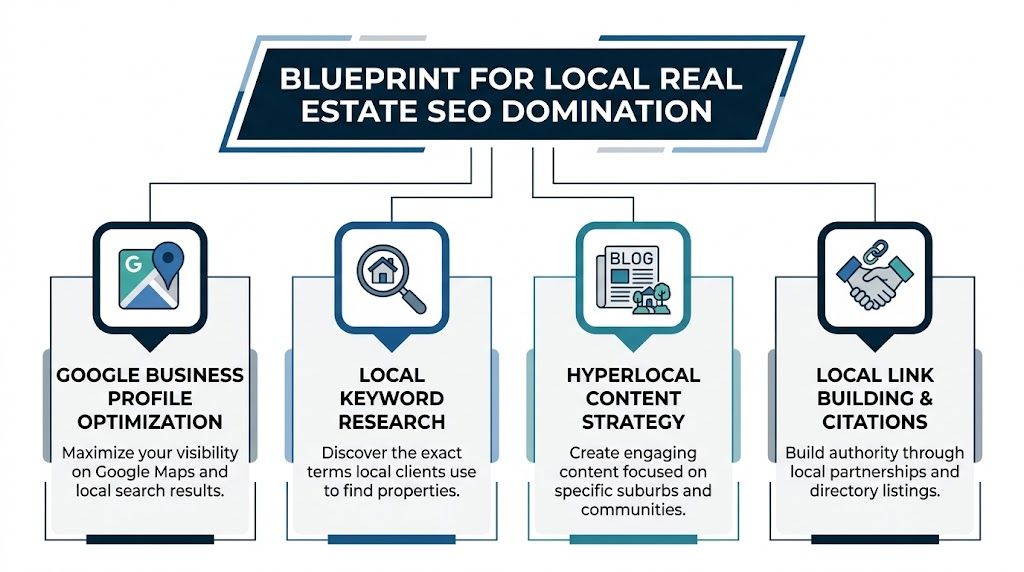
Turn your Google Business Profile into a lead asset
Many agencies claim their Google Business Profile, add a logo, then leave it to gather dust. That wastes one of the strongest local trust signals you have.
A strong profile needs ongoing management. Not vanity activity. Useful signals.
Focus on:
- Core business accuracy with the correct business name, office details, categories, service areas, and opening hours
- Service relevance through a complete services section that reflects what you offer, such as residential sales, appraisals, property management, commercial sales, or buyer advocacy
- Review quality by prompting clients to mention the suburb, service type, and experience in natural language
- Visual proof with current office photos, team photos, local community involvement, and property-related imagery
- Q&A coverage where common client questions are answered clearly before people need to call
Google Business Profile activity should support trust and local relevance. It isn’t a substitute for your website, but it can reinforce your authority at the exact moment someone is comparing options.
Fix your local consistency across the web
The next issue is citation quality. If your business details appear differently across directories, social platforms, industry sites, and local listings, you dilute trust signals.
Your agency’s name, address, and phone details should be consistent wherever they appear. That includes old directory listings, franchise pages, local chamber listings, and social profiles.
Check for:
- Outdated office addresses after a move or expansion
- Different phone numbers across old profiles
- Mismatched agency names caused by abbreviations or branding changes
- Duplicate listings competing with each other in local search systems
This work is boring. It also matters.
The agencies that dominate local search usually do the unglamorous work better than everyone else.
If you want a useful primer on the broader mechanics behind location-based visibility, Local SEO for businesses gives a solid overview that aligns well with service-area strategy.
Publish pages that prove you know the patch
Most suburb pages are thin and interchangeable. They read like they were generated to fill a sitemap. Google can detect that, and users can feel it immediately.
Your local pages should answer questions only a genuine local operator would think to address. That includes transport realities, buyer patterns, street-by-street character, stock mix, lifestyle trade-offs, and the reasons one pocket appeals to one audience more than another.
Strong local pages often include:
- Neighbourhood context that goes beyond generic amenities
- Buyer and seller guidance tied to the area’s actual property behaviour
- Internal links to related suburbs, market updates, and service pages
- Clear next actions such as book an appraisal, request a property alert, or speak with an agent
For a wider framework on building this kind of location authority, this guide to dominating your Australian market with local SEO is a useful companion.
Links that actually help local authority
Forget spammy directory blasts. Good local link building comes from relevance.
That might mean local sponsorship pages, community organisations, business associations, property publications, neighbourhood events, or partnerships with complementary service providers. A single relevant local link is often more valuable than a pile of low-quality submissions.
Real estate seo at local level is won by businesses that look unmistakably anchored in a place. Your profile, citations, pages, and local mentions all need to tell the same story.
Building a High-Performance Digital Property
A real estate website should function like a well-prepared property. Good structure. Clear flow. Strong presentation. No hidden defects that put buyers off.
Many sites fail because they look acceptable from the front but underperform where it matters. Pages load slowly. listing content is duplicated. URLs are messy. images are oversized. Search engines can’t easily understand what each page represents.

Technical SEO is where a lot of real estate gains are won because many competing sites still neglect the basics.
Get the page structure right before chasing rankings
A strong site architecture helps search engines crawl your content and helps users move naturally from discovery to enquiry.
At minimum, your structure should separate:
- Core service pages for sales, rentals, appraisals, property management, commercial, or developments
- Location pages for suburbs and regions you actively serve
- Listing pages with clean URLs, complete metadata, and indexable content where appropriate
- Resource content such as guides, FAQs, area insights, and market commentary
Don’t dump everything into a blog or rely on a feed with no editorial logic. Search engines need hierarchy. Users do too.
Property listings also need better copy than most agencies give them. If every listing uses recycled language, there’s little for search engines to differentiate. Even when stock turns over quickly, listing pages should include useful, original detail around features, location context, and buyer fit.
Use schema to earn a better search result
Schema markup is one of the most practical technical improvements available for property websites because it helps search engines understand the details on a page.
For real estate, implementing RealEstateListing schema markup can increase click-through rates by up to 30% in competitive local searches, as outlined in this technical real estate SEO resource. That lift comes from richer search results that can surface details like price and availability before the user clicks.
In practical terms, schema helps your pages present more like structured inventory and less like generic web pages.
Use it on listing pages to describe elements such as:
- Property name or headline
- Address and locality
- Number of rooms and floor size
- Offer information, including price and availability where applicable
- Agency details where relevant to the listing context
Build for clarity: If Google has to guess what a property page contains, your result will usually look weaker than a competitor’s structured page.
If you want to see how the underlying build quality affects all of this, a specialised real estate website development approach is often the difference between a brochure site and a lead engine.
Speed is a ranking issue and a sales issue
Page speed gets treated like a developer concern. It’s really a revenue concern.
Real estate sites are especially vulnerable because they rely heavily on image assets, map elements, scripts, forms, and listing integrations. If those assets aren’t managed properly, the site becomes heavy fast.
The usual fixes are straightforward:
- Convert large images to WebP rather than uploading oversized originals
- Use lazy loading so below-the-fold media doesn’t block the first screen
- Minify CSS and JavaScript where possible
- Deploy caching and CDN delivery to reduce repeat load friction
- Audit plugins and third-party scripts because many sites carry tools they no longer need
This video gives a useful primer on what technical improvements look like in practice.
What to fix first if your site is underperforming
If leads are weak and rankings are inconsistent, start with an audit that answers three practical questions:
- Can search engines crawl and understand the site cleanly?
- Does each important page match one clear search intent?
- Can a mobile user get from search result to enquiry without friction?
That last point matters more than teams admit. Real estate seo doesn’t reward sites that only look good in desktop presentations. It rewards sites that help an active buyer or seller act quickly on a phone.
The agencies getting traction usually aren’t doing magic. They’ve removed the technical drag that slows everyone else down.
Creating Content That Attracts and Converts
Content is where most real estate businesses either build authority or waste time.
The weak version is familiar. Generic market commentary. Broad lifestyle pieces with no local insight. Blog posts written because someone said “you need fresh content”. Those pages rarely rank well, and even when they do, they don’t persuade.
The stronger version does two jobs at once. It attracts search demand, and it proves you understand the local market better than a generalist ever could.
Publish assets people can actually use
The best-performing real estate content usually sits close to a real decision. Buyers want clarity about an area, a property type, a process, or a trade-off. Sellers want confidence in timing, preparation, and agent selection.
That means useful content often looks like this:
- Neighbourhood guides that explain who an area suits, what stock tends to look like, and what lifestyle trade-offs matter
- School catchment and family-area pages for buyers narrowing location choices
- Seller resources around preparing a home, choosing an agent, or understanding appraisal expectations
- Local process content such as off-market buying, auction preparation, or downsizing decisions
- Investor content focused on practical local considerations rather than generic hype
Many agencies miss the mark. They write for broad reach when they should write for buyer and seller fit.
A page doesn’t need to attract everyone. It needs to attract the right person and move them one step closer to contact.
Authority grows when content and links support each other
Content alone won’t do all the heavy lifting. It becomes more powerful when it gives other local sites a reason to reference you.
A well-built suburb guide can earn mentions from local businesses, community groups, lifestyle publishers, or relocation resources. A useful market explainer can support outreach to local media. A practical homeowner resource can open partnership opportunities with stylists, brokers, builders, or trades.
That’s a better authority model than chasing random backlinks. You publish something worth citing, then actively place it in front of relevant people.
Consider the difference:
- Weak link building chases volume and often lands on irrelevant directories or low-quality sites.
- Strong link building starts with a resource, local insight, or point of view that fits your market.
Build content clusters instead of isolated posts
One-off articles rarely create lasting visibility. Connected clusters do.
If you serve a suburb, don’t publish just one suburb page. Support it with nearby location pages, buyer guides, seller FAQs, property-type pages, and internal links that help users move deeper into the site. That network of pages tells search engines that your expertise isn’t accidental or thin.
A practical cluster might include:
- A core suburb page with area overview and service relevance
- A buying guide focused on that suburb’s audience
- A selling page tied to local vendor concerns
- Related articles on schools, lifestyle, transport, or market questions
- Supporting service pages for appraisals, management, or project marketing
This approach also improves conversion because users rarely land on one page and enquire immediately. They compare, read, click, and validate.
What content usually fails
A few patterns consistently underperform:
- Thin suburb pages spun out with only the place name changed
- AI-generated copy published without local editing or first-hand knowledge
- News reaction posts with no unique insight
- Content calendars based on frequency instead of business relevance
The fix isn’t publishing more. It’s publishing with intent.
Real estate seo rewards local usefulness. If your content helps people make better property decisions in a specific market, it can rank, earn links, and convert. If it only fills a schedule, it won’t.
Future-Proofing Your SEO for AI and Answer Engines
A lot of businesses still think search visibility means ten blue links and a map pack. That model is already changing.
People now ask AI tools direct questions about suburbs, property types, affordability, renovation choices, and service providers. They don’t always click through the same way they used to. Sometimes they want a summary. Sometimes they want a shortlist. Sometimes they want the answer before they visit a website at all.
That changes how real estate seo needs to work.

The opportunity is especially important in Australia because AI Answer Box Optimisation is an underserved area in the local real estate context, with limited region-specific guidance for appearing in LLM answer engines for local queries, as noted in this industry analysis.
Traditional ranking signals still matter, but they’re not enough
If your only strategy is “rank page one on Google”, you’re optimising for one layer of discovery. AI systems increasingly summarise, quote, recommend, and compare based on how clearly your content is structured and how trustworthy it appears.
That means your pages need to do more than mention a keyword. They need to answer a question cleanly.
Good answer-engine content usually has these traits:
- Clear question-led headings that mirror how people ask things conversationally
- Direct answers early in the section before extra commentary
- Strong factual grounding with specific local context
- Logical structure so systems can extract and summarise content accurately
- Entity clarity around suburbs, services, property types, and business identity
Write for retrieval, not just for reading
Many websites frequently fall short. They write elegant copy that sounds polished to humans but is difficult for AI systems to parse.
A better format is often:
- Ask the exact question a user might type or speak
- Answer it plainly in the first few lines
- Add local nuance, examples, and related considerations
- Link to deeper pages for users who want more detail
For example, a page targeting a local query should not bury the answer halfway down behind branding copy. Lead with the useful information, then expand.
If an AI system is scanning your page for a reliable answer, clarity beats cleverness.
This doesn’t mean robotic writing. It means disciplined writing.
Build pages AI can trust enough to cite
To improve your chances of appearing in AI-driven results, audit your site for these gaps:
- Unclear authorship where no one takes responsibility for the content
- Thin local pages with broad claims and no grounded detail
- Poor internal linking that leaves related topics disconnected
- Inconsistent terminology across services, suburbs, and property categories
- Weak FAQ coverage for recurring buyer and seller questions
One practical move is to build high-quality FAQ sections on key service and suburb pages, using natural language questions your team hears in the field. Another is to create comparison and explainer pages around real local decision points, especially where buyers and homeowners need guidance.
If you’re actively exploring this space, this resource on answer engine optimisation is a useful reference for how search visibility is evolving beyond standard rankings.
The businesses that adapt early won’t just protect traffic. They’ll shape how they’re represented when AI tools become the first touchpoint.
Measuring Real Estate SEO Success Beyond Traffic
Traffic is easy to report and easy to misunderstand.
A lift in organic sessions can look encouraging while the business sees no meaningful change in appraisals, listing enquiries, or signed work. That’s why serious real estate seo measurement has to move past visibility metrics and into commercial ones.
Start with lead quality. Not all enquiries deserve equal weight. A suburb appraisal request from an ideal vendor is more valuable than a broad contact form submission with no clear intent. Your reporting should reflect that difference.
Track the actions that signal business value
For most real estate businesses, the most useful SEO conversions include:
- Appraisal requests from owners in target locations
- Property enquiries tied to listing and location pages
- Phone calls generated from organic landings
- Inspection or consultation bookings
- Qualified form submissions with clear buying, selling, or management intent
If you only measure pageviews and rankings, you’ll optimise the wrong things. You need to know which pages introduce qualified leads, which pages assist conversion, and where drop-off happens.
Attribute outcomes, not just visits
A better framework is to ask three questions every month:
- Which organic landing pages generated real enquiries?
- Which search themes are linked to qualified pipeline, not just traffic?
- Which content or technical improvements led to stronger conversion paths?
That helps you cut vanity work. Some pages attract lots of visits but no serious opportunities. Others attract fewer visits and steadily produce better leads. The second group deserves more investment.
Rankings matter only when they connect to revenue-producing actions.
Use SEO to guide budget decisions
SEO shouldn’t sit in a separate reporting silo from paid media, CRM performance, or sales outcomes. The business needs to know whether organic search is helping reduce paid dependence, improve lead quality, or strengthen visibility in key suburbs.
That usually means connecting Search Console, GA4, call tracking, form tracking, and CRM tagging well enough to see what happened after the click. You don’t need perfect attribution to make better decisions. You do need disciplined attribution.
When you measure this way, real estate seo becomes easier to manage. You stop asking, “Did traffic go up?” and start asking, “Did organic search help create more of the right opportunities?”
If your business needs a sharper search strategy, stronger local visibility, and a practical plan for both Google and AI-driven discovery, Titan Blue Australia can help. With more than 25 years in digital, the team builds real estate-ready websites, SEO campaigns, and answer engine strategies that are designed to generate qualified leads, not just reports.
Make Titan Blue a preferred source in Google
One click tells Google to surface our articles more often in Top Stories, AI Overviews and AI Mode.

Solar Installer Website Design Australia: The 2026 Guide
How solar installer websites in Australia should show CEC accreditation, real install proof and AI-ready…

Hotel & Hospitality Website Design Australia: 2026 Guide
Hotel and hospitality website design in Australia explained: booking flow, schema, AEO and what actually…

Restaurant Website Design Australia: The 2026 Guide
What a restaurant website in Australia needs: HTML menus, bookings, GBP sync, schema, and AI-ready…