


Australians spent A$82.6 billion online in 2025, yet a staggering 24% of all retail spending now hinges on the split-second reliability and security of your checkout. You likely feel the pressure of rising domestic transaction fees, such as Stripe’s 2.9% plus A$0.30 rate, while worrying about the technical debt of a complex payment gateway integration australia. It’s frustrating when local support is absent during a payment failure or when PCI-DSS compliance feels like a moving target that threatens your business stability.
We understand that your e-commerce ecosystem deserves more than a plug-and-play fix; it requires a strategic pillar built for scale. This guide promises to help you master the complexities of the Australian payment landscape, ensuring your brand achieves a high-converting checkout and automated reconciliation. We will preview the latest 2026 Treasury regulations regarding stored value facilities, compare the performance of providers like Airwallex and Adyen, and provide a roadmap for secure, bespoke integration. Partnering with Titan Blue Australia ensures your digital payment strategy becomes a seamless extension of your brand’s commitment to excellence.
Key Takeaways
- Discover the critical mechanisms of authentication and settlement that form a secure bridge between your digital storefront and the Australian banking system.
- Evaluate major providers like Stripe, Airwallex, and NAB to determine which payment gateway integration australia aligns with your specific transaction volume and margin goals.
- Look beyond headline percentages to uncover the strategic impact of monthly fees, refund costs, and CMS compatibility on your long-term profitability.
- Streamline your implementation journey with a structured framework for securing merchant credentials and projecting technical requirements with confidence.
- Explore how payment performance influences your broader digital presence, including the intersection of checkout speed and Answer Engine Optimisation (AEO).
What is Payment Gateway Integration for Australian Businesses?
At its core, a payment gateway is the secure digital bridge that connects your e-commerce storefront to the Australian banking system. It serves as the invisible courier, carrying sensitive credit card data from your customer’s browser to the financial institutions that approve the transaction. In 2026, a robust payment gateway integration australia is the critical infrastructure required for 24/7 revenue generation and global scalability. It transforms your website from a static brochure into a high-performance engine capable of capturing value at any hour of the day.
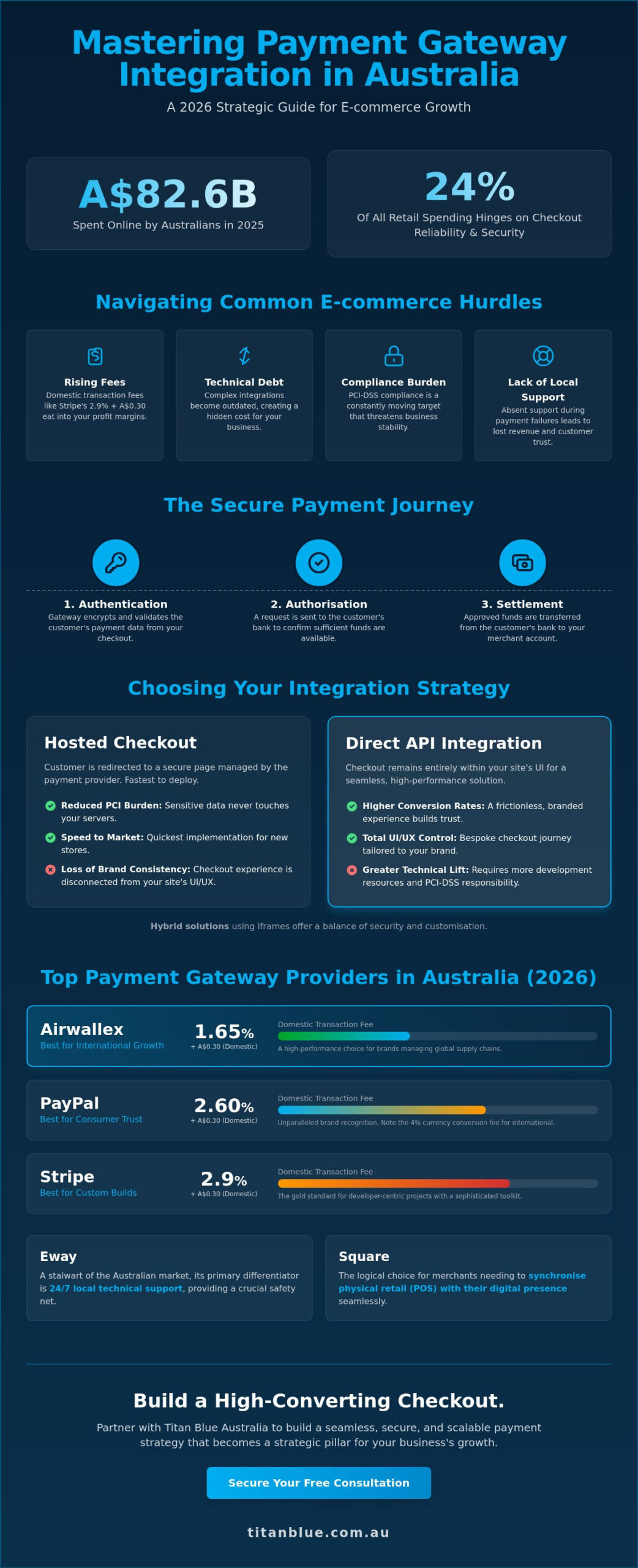
The mechanism operates through a three-stage sequence: authentication, authorisation, and settlement. First, the gateway authenticates the user’s data, ensuring the information is valid and encrypted. Next, it seeks authorisation from the customer’s bank to confirm funds are available. Finally, settlement occurs when the funds are moved into your merchant account. Moving beyond manual invoicing to this real-time digital excellence allows your business to reduce administrative friction and focus on strategic growth.
The Role of the Gateway in the AU Ecosystem
Many business owners confuse a payment gateway with a payment processor. While a processor handles the actual data transmission between banks, the gateway is the front-end interface that initiates the request. Often, these functions are bundled by a Payment Service Provider (PSP) to simplify the merchant experience. Within the Australian market, your gateway must communicate effectively with acquiring banks like CBA, NAB, or Westpac to ensure local transactions are processed in AUD. Without this local alignment, you risk exposing your customers to hidden foreign exchange (FX) fees, which can lead to cart abandonment and a loss of trust.
Common Integration Methods: Hosted vs. API-Driven
Choosing the right integration method is a balance between technical control and speed to market. Hosted checkouts are the fastest to deploy; they redirect the customer to a secure page managed by the provider. This reduces your PCI-DSS compliance burden because the sensitive data never touches your server. However, this method often results in a loss of brand consistency during the most critical moment of the journey.
For brands seeking a bespoke experience, a direct API integration offers a seamless, high-performance solution. This allows the checkout to remain entirely within your site’s UI/UX, which often leads to higher conversion rates for sophisticated e-commerce builds. Hybrid solutions also exist, using “iframes” or secure fields to embed the payment form directly into your page. This provides a balance of security and customisation, ensuring your brand identity remains intact while maintaining enterprise-level data protection.
Top Payment Gateway Providers in Australia for 2026
Selecting the right partner for your payment gateway integration australia is a strategic decision that directly impacts your bottom line. You need a solution that balances technical agility with financial reliability. While transaction fees are the most visible cost, savvy business owners also weigh settlement times and the availability of local technical support. In a market where Australians spent A$82.6 billion online in 2025, your choice of gateway can determine whether you capture that growth or lose it to checkout friction.
Global Leaders with Local Presence
Stripe remains the gold standard for developer-centric projects. Their domestic fee of 2.9% plus A$0.30 provides access to a sophisticated toolkit for custom website builds. PayPal offers unparalleled consumer trust, though merchants must account for a 2.60% plus A$0.30 domestic rate and a 4% currency conversion fee. For those prioritising international growth, Airwallex provides a visionary alternative. They offer domestic card payments at 1.65% plus A$0.30, making them a high-performance choice for brands managing global supply chains.
Local AU Specialists
Eway is a stalwart of the Australian market. Their primary differentiator is 24/7 local technical support, which provides a safety net that global entities often lack. Square is the logical choice for merchants who need to synchronise physical retail with their digital presence. Startups often gravitate toward Pin Payments, which offers a streamlined, AU-focused onboarding process without the complexity of larger international platforms.
The Australian big banks, specifically Commonwealth Bank (CommWeb) and NAB, provide enterprise-grade stability. While they might lack the rapid innovation of fintechs, they offer deep integration with your existing business accounts. As of early 2026, the adoption of PayTo is transforming the landscape. This real-time bank transfer protocol allows for instant authorisation and settlement, bypassing traditional card networks to improve merchant cash flow and reduce the risk of chargebacks.
Choosing between these options requires a clear understanding of your transaction volume and technical capacity. If you need assistance determining which path fits your growth trajectory, a professional e-commerce development partner can provide the necessary strategic oversight. This ensures your chosen gateway isn’t just a cost centre, but a performance-driven asset for your brand. By aligning your payment infrastructure with your business goals, you create a foundation for sustainable digital excellence.
Evaluating Your Integration Strategy: A Strategic Framework
Beyond the headline transaction rates, a sophisticated payment gateway integration australia requires a deep dive into the hidden variables that dictate your long-term profitability. Many merchants fixate on the standard 2.6% or 2.9% fees while overlooking the cumulative impact of ancillary costs. For instance, Stripe charges a non-refundable A$15 per dispute, while PayPal’s dispute fee sits at A$22. When you factor in refund fees and monthly account retainers, a seemingly cheap provider can quickly become a burden on your margins. A strategic framework ensures you select a partner that supports your specific business model rather than one that merely processes data.
Your choice of Content Management System (CMS) significantly dictates your technical roadmap. While platforms like Shopify offer streamlined, native connections, a bespoke WordPress build requires a more nuanced approach to maintain site performance. If your gateway relies on bloated plugins, you risk slowing down your checkout, which directly triggers cart abandonment. With mobile devices accounting for 62% of all internet traffic in Australia as of January 2026, your integration must be light, responsive, and capable of handling a 10x surge in volume during peak periods like Black Friday or Boxing Day sales.
Technical Compatibility & Performance
Technical debt is the silent killer of e-commerce growth. Choosing a gateway that offers a robust API allows for a bespoke user experience that keeps customers within your branded environment. In 2026, failing to offer mobile-first options like Apple Pay or Google Pay is a critical error, as digital wallets now account for over 50% of e-commerce transaction value. Furthermore, gateway latency can negatively impact your SEO performance. Every millisecond of delay during the authorisation phase is a missed opportunity to secure a conversion and build brand loyalty.
Security & Risk Management
Security remains the cornerstone of digital excellence. You must understand your PCI-DSS compliance requirements, specifically whether your integration sits under SAQ A for hosted solutions or the more rigorous SAQ D for direct API handling. Utilising 3D Secure 2.0 is no longer optional; it’s a vital layer of fraud prevention that protects your Australian business from liability. By implementing tokenisation, you can securely store customer card data for recurring billing or one-click checkouts without the risk of storing sensitive information on your own servers. This proactive approach to risk management transforms security from a compliance hurdle into a competitive advantage.
Step-by-Step Guide to Successful Gateway Implementation
Implementing your payment gateway integration australia requires a methodical approach to avoid costly downtime and ensure every cent is accounted for. This isn’t merely a technical task; it’s a strategic deployment that connects your storefront to your financial reporting. A successful rollout begins with a clear projection of your transaction volumes and technical requirements. If you anticipate your GST turnover exceeding A$20 million, your reporting requirements shift to a monthly cycle as of March 27, 2026. This projection dictates whether your gateway needs enterprise-level reconciliation features or a simpler, startup-focused setup.
- Step 1: Requirements Audit. Define your necessary payment methods, such as BNPL or digital wallets, and project your peak transaction bursts.
- Step 2: Credential Procurement. Secure your merchant account and API credentials from your chosen provider, ensuring they align with your AU banking partner.
- Step 3: Sandbox Development. Build the integration within a staging environment to map out error handling and webhook responses without risking live data.
- Step 4: Deployment & Traffic Monitoring. Transition to the live environment and closely monitor the first 50 transactions for any latency or authorisation anomalies.
- Step 5: Reconciliation Audit. Conduct a post-launch audit to verify that funds are settling correctly into your bank account and that GST is accurately captured.
The Sandbox & Testing Phase
The sandbox is your safety net. It allows you to simulate successful payments, card declines, and even fraudulent attempts in a controlled environment. You must test the user journey across multiple devices, especially since mobile devices now drive 62% of internet traffic in Australia. Verifying that webhooks correctly trigger inventory updates and CRM entries ensures your internal operations remain synchronised. Don’t skip testing the “edge cases,” such as interrupted connections during the authorisation phase, to prevent double-charging or orphaned orders.
AU Compliance & Reporting
Compliance in the Australian market involves more than just data security. You must ensure your payment flow correctly calculates and displays GST to stay aligned with ATO regulations. Automating the reconciliation between your gateway and accounting software like Xero or MYOB is essential for maintaining a clean ledger. Additionally, handling customer information requires strict adherence to the Australian Privacy Act. Our team can guide you through a bespoke e-commerce development strategy that integrates these compliance layers directly into your checkout, removing the administrative burden from your daily operations. This proactive approach ensures your brand remains a steady, reliable presence in the digital landscape.
Optimising Your Digital Ecosystem with Titan Blue Australia
Achieving digital excellence requires more than just selecting a provider; it demands a holistic approach where every component of your storefront works in harmony. A seamless payment gateway integration australia serves as the final, critical touchpoint in your customer’s journey. When this integration is clunky or slow, it doesn’t just cost you a single sale. It signals to search algorithms and AI agents that your user experience is suboptimal. In the modern landscape, your technical performance directly influences answer engine optimisation. AI-driven search tools prioritise businesses that demonstrate reliability and speed, making a high-performance checkout a cornerstone of your visibility strategy.
Our approach at Titan Blue Australia centres on bespoke e-commerce development that prioritises conversion over mere aesthetics. We understand that small to medium-sized businesses across Australia face unique pressures, from tightening margins to high consumer expectations. By treating your payment infrastructure as a strategic asset rather than a utility, we help you build a resilient revenue engine. This visionary perspective ensures that your brand isn’t just keeping pace with the market but is actively scaling toward long-term success.
Strategic E-commerce Integration
We recommend specific gateways based on your unique business journey and transaction profile. There is no one-size-fits-all solution in the Australian market. A startup might thrive on the simplicity of Pin Payments, while a scaling enterprise requires the multi-currency power of Airwallex. By implementing professional, clean code, we significantly reduce technical debt. This allows your website to remain agile and easy to maintain as your transaction volume grows. Empowering your brand with enterprise-level payment solutions shouldn’t be a luxury reserved for the top end of town. We make blue-chip quality accessible to every business we partner with.
Future-Proofing Your Payments
The digital landscape is moving toward AI-driven commerce and generative search shopping at a rapid pace. Preparing for these shifts requires more than a one-off installation. It requires a dedicated partner who manages regular security updates and website maintenance to protect your customer data and your reputation.
Driving traffic to a broken or inefficient checkout is a waste of resources. That’s why we offer ongoing ppc management to ensure high-intent customers land on a site that is ready to convert. We act as your trusted navigator, providing the steady hand needed to move from digital complexity to measurable results. Ready to secure your revenue and streamline your operations? Contact Titan Blue Australia for a bespoke consultation and let’s begin your journey toward digital excellence together.
Take Command of Your Digital Revenue
Mastering your payment gateway integration australia is the final step in transitioning from a simple online store to a high-performance revenue engine. By selecting a provider that aligns with your specific transaction volume and technical capacity, you eliminate the friction that leads to cart abandonment. Whether you prioritise developer-first agility or dedicated local support, your infrastructure must remain secure, compliant, and ready for future regulatory shifts. A strategic approach ensures your checkout is a seamless extension of your brand’s commitment to quality.
Building a resilient digital ecosystem requires a partner who truly understands the local landscape. Titan Blue Australia brings over 20 years of digital excellence to every project. We are proudly Australian owned and operated, offering deep expertise in custom e-commerce ecosystems that prioritise conversion and security. We don’t just build websites; we create scalable foundations for your brand’s long-term growth. Empower your e-commerce journey with Titan Blue Australia today. Your path to a seamless, high-converting checkout starts with a single strategic decision. We’re here to help you navigate this complexity with confidence and integrity.
Frequently Asked Questions
What is the most popular payment gateway in Australia?
Stripe is currently the most widely adopted choice for developer-centric payment gateway integration australia, while PayPal remains the leader in consumer trust. As of January 2026, digital wallets like Apple Pay and Google Pay account for 39% of transaction value and are projected to reach 51% by 2030. Choosing a popular gateway ensures your customers find the familiar payment methods they expect when they reach your checkout.
How much does it cost to integrate a payment gateway?
Integration costs are divided between ongoing transaction fees and the initial technical implementation. Standard domestic rates for providers like Stripe sit at 2.9% plus A$0.30 per transaction. While a basic plugin setup might be a low-cost entry point, a bespoke API integration for a high-performance e-commerce site requires a strategic investment in development time to ensure long-term scalability and enterprise-level security.
Do I need a merchant account for payment gateway integration?
You always need a merchant account, but many modern providers bundle this service with the gateway itself. Services like Stripe or Airwallex act as a combined payment gateway integration australia and merchant account provider. Conversely, if you use a traditional bank gateway like CommWeb, you’ll need to establish a separate merchant account with Commonwealth Bank before the technical integration can go live.
Is Stripe or Eway better for Australian small businesses?
Stripe is often superior for businesses requiring advanced features and global reach, whereas Eway is the preferred choice for those prioritising 24/7 local technical support. Stripe’s developer-first toolkit is ideal for bespoke builds. Eway’s strength lies in its deep roots within the Australian banking ecosystem, providing a reliable safety net for local SMEs that value direct, local communication when payment issues arise.
How long does payment gateway integration take?
A standard integration using a pre-built plugin can be completed in a few hours, but a professional API deployment typically takes 10 to 20 business days. This timeframe includes the critical sandbox testing phase where we simulate successful and failed transactions. Ensuring your webhooks and reconciliation reporting are functioning correctly is vital before you begin processing live A$ transactions for your customers.
What is PCI-DSS compliance and do I need it?
PCI-DSS compliance is the global security standard for any business that accepts credit card payments, and it is a mandatory requirement. Most Australian small businesses utilise hosted payment fields to reduce their compliance burden to the simplest level (SAQ A). This ensures sensitive card data never touches your server, protecting your brand from the legal and financial fallout of a data breach.
Can I accept international payments with an Australian gateway?
Yes, most Australian gateways allow you to accept international payments, though extra fees usually apply. Stripe, for example, adds a 1.5% fee for international cards plus a 1% currency conversion fee. If your strategy involves significant global sales, providers like Airwallex offer multi-currency accounts that help you avoid these high FX costs, keeping more of your hard-earned profit within your business.
How do I reduce cart abandonment at the payment stage?
You can reduce abandonment by offering digital wallets and keeping the checkout process entirely on your own domain. As mobile devices drive 62% of internet traffic in Australia as of January 2026, providing a one-click payment experience via Apple Pay is essential. Removing unnecessary form fields and ensuring your gateway responds in under 500 milliseconds will significantly improve your conversion rates and overall performance.
Make Titan Blue a preferred source in Google
One click tells Google to surface our articles more often in Top Stories, AI Overviews and AI Mode.

How to Make Your Website AI Friendly: The 2026 Step-by-Step Guide
How to make your website AI friendly: a step-by-step 2026 guide to getting crawled, structured…

Web Design for AI Search Optimisation: The 2026 Build Guide
Web design for AI search optimisation: crawlable HTML, clear architecture, accessible UX and trustworthy content…

AEO Web Design: How to Build Websites AI Can Cite
AEO web design creates websites that AI systems can find, understand and cite through clear…