Stay ahead with the latest tips, trends, and insights from the Titan Blue team , straight from the studio in Broadbeach.



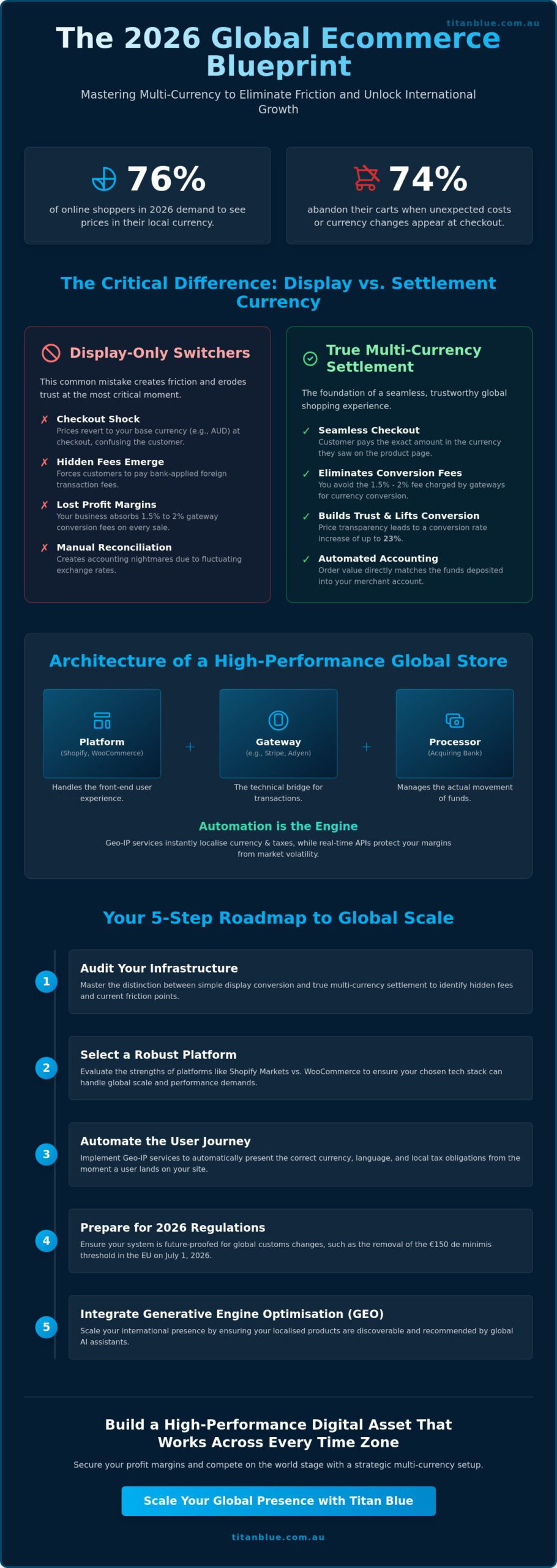
76% of online shoppers in 2026 demand to see prices in their local currency, yet many Australian businesses are still losing sales to avoidable friction. If you’re relying on a basic plugin, you’re likely battling high cross-border fees and the 74% of customers who abandon carts when unexpected costs appear at checkout. Implementing a sophisticated multi-currency ecommerce setup is no longer optional; it’s the foundation of global scale. At Titan Blue Australia, we believe your digital store should be a high-performance asset that works tirelessly across every time zone.
We understand the complexity of manual reconciliation and the anxiety that comes with changing international regulations, such as the removal of the €150 de minimis threshold in the EU on 1 July 2026. This guide provides a clear roadmap to eliminate these technical hurdles and secure your profit margins. You’ll learn how to build an automated, localised shopping experience that builds trust and empowers your brand to compete on the world stage. We’ll examine the strategic requirements for seamless checkouts, automated currency updates, and the latest 2026 regulatory shifts to ensure your international journey is both profitable and secure.
Key Takeaways
- Master the distinction between simple display conversion and multi-currency settlement to eliminate hidden fees and boost international conversion rates.
- Navigate the technical architecture of a global store, focusing on how a strategic multi-currency ecommerce setup uses geolocation to automate the user journey.
- Evaluate the strengths of Shopify Markets versus WooCommerce to select a platform that provides the reliability and performance your brand requires.
- Implement a structured 5-step roadmap to audit your digital infrastructure and stay ahead of 2026 global customs and duty regulations.
- Scale your international presence by integrating advanced Generative Engine Optimisation (GEO) to ensure your products are recommended by global AI assistants.
What is a Multi-Currency Ecommerce Setup and Why Does it Matter?
Global cross-border e-commerce is projected to exceed A$3.5 trillion (US$2.3 trillion) in 2026. For an Australian brand, capturing a slice of this market requires more than just a “select language” dropdown menu. A true multi-currency ecommerce setup is a strategic digital ecosystem that allows your store to function as a local entity in every market you serve. It’s the difference between looking like a distant international vendor and appearing as a trusted local partner. By 2026, the distinction between domestic and international shopping has largely vanished from the consumer’s perspective. They expect a “native” experience where prices, taxes, and shipping are presented in their home currency from the moment they land on your site.
Display Currency vs. Settlement Currency
Many businesses mistakenly install “display-only” currency switchers. These tools show prices in Euros or Yen on the product page, but the moment a customer reaches the checkout, the total reverts to Australian Dollars. This creates immediate friction. When a shopper sees an unexpected currency shift, they often suspect hidden fees or security risks. True multi-currency settlement ensures the customer pays, and you receive, the specific currency selected. This eliminates the 1.5% to 2% conversion fees typically charged by gateways like Shopify Payments or Stripe. It also simplifies your internal accounting by providing a direct match between the order value and the funds deposited into your merchant account; this removes the need for manual reconciliation of exchange rate fluctuations.
The Business Case for Global Localisation
The psychological impact of local pricing is profound. Research from early 2026 confirms that 74% of shoppers will abandon their cart if they encounter unexpected costs or currency confusion at the final stage. By providing a native experience, you’re building the reliability and stability that international customers crave. Localisation allows you to compete directly with domestic brands in the US, UK, or EU without the “international seller” stigma. You’ll also see a sharp decline in customer support queries regarding exchange rates and bank-applied foreign transaction fees. Businesses that embrace this level of digital excellence often see a conversion rate lift of up to 23% through improved trust and price transparency.
This setup influences every touchpoint of the customer journey. From the initial discovery via Generative Engine Optimisation (GEO) to the finality of a refund, consistency is key. If a customer needs a return, receiving the exact amount they paid in their own currency prevents dissatisfaction and costly disputes. It’s a holistic approach that transforms your store from a local shop into a global powerhouse, providing the security and performance your brand needs to scale.
The Architecture of a Global Ecommerce Store
Building a high-performance international store requires a robust three-pillar architecture: the platform, the gateway, and the processor. While your platform (like Shopify or WooCommerce) handles the front-end experience, the gateway acts as the technical bridge, and the processor manages the actual movement of funds. To achieve a seamless multi-currency ecommerce setup, these three components must communicate with absolute precision. Relying on a fragmented stack leads to data silos, where your sales reports don’t match your bank deposits, creating a reconciliation nightmare for your finance team.
Automation is the engine of this architecture. Geolocation (Geo-IP) services identify a visitor’s location in milliseconds, instantly adjusting the storefront to show the correct currency and local tax obligations. This isn’t just about convenience; it’s about eliminating the “unexpected fees” that drive 74% of shoppers to abandon their carts in 2026. Behind the scenes, Application Programming Interfaces (APIs) connect your store to real-time exchange rate providers. This ensures your margins remain protected even during periods of high market volatility. If you’re looking to scale, our team can help you build a bespoke ecommerce solution that handles these complexities automatically.
The Role of the Payment Gateway
Your choice of gateway dictates your long-term profitability. For example, as of March 2026, Stripe charges 2.9% plus 30¢ for standard transactions, but adds a 2% fee for currency conversions. To avoid these “hidden” costs, you need a gateway that supports multi-currency settlement. This allows you to hold balances in different currencies, such as USD or EUR, and transfer them to multi-currency bank accounts without forced conversion. Modern setups must also integrate local payment methods. In 2026, methods like PIX in Brazil or UPI in India are growing faster than traditional credit cards; ignoring these can alienate up to 50% of your potential market in those regions.
Dynamic Pricing vs. Fixed International Pricing
You must decide between dynamic pricing, which fluctuates with the market, and fixed international pricing. Dynamic pricing ensures your margin is always consistent relative to the Australian Dollar, but it can confuse customers when a product costs A$102 one day and A$105 the next. Fixed pricing (e.g., always charging $99 USD) offers a “blue-chip” brand experience and provides clarity for your marketing campaigns. While fixed pricing requires you to build a small buffer into your costs to account for currency shifts, the increase in consumer trust often leads to higher lifetime value. Managing this balance is essential for maintaining the digital excellence your brand represents on the global stage.
Choosing the Best Platform for Multi-Currency Sales
Selecting the right engine for your global expansion is a pivotal moment in your brand’s journey. A multi-currency ecommerce setup requires a platform that balances technical power with operational simplicity. While many business owners feel overwhelmed by the digital complexity, the decision usually rests on your specific sales volume and the bespoke nature of your business rules. In 2026, the market is dominated by a few key players, each offering a distinct approach to international trade.
Shopify Markets remains a leading choice for rapid deployment. It provides an all-in-one environment that supports over 130 currencies and automated tax calculations. However, this convenience comes with a specific cost structure. For those on a Basic plan, transaction fees sit at 2.9% plus 30¢, while Advanced plans offer a lower rate of 2.4% plus 30¢. You must also account for the 1.5% currency conversion fee and an additional 2% surcharge for international cards. For high-growth Australian brands, Shopify Plus offers the stability needed for enterprise-level scale, though the platform fee starts at approximately A$3,500 to A$3,800 per month as of early 2026.
For brands requiring maximum flexibility, WooCommerce is a powerful partner. It’s an ideal solution for businesses that need to integrate unique shipping rules or complex wholesale operations. Unlike Shopify’s structured environment, WooCommerce allows you to maintain total control over your data and hosting environment. High-volume global retailers often look toward Adobe Commerce or headless architectures. These solutions decouple the front-end presentation from the back-end commerce engine, allowing for lightning-fast load times and a highly tailored user experience in diverse markets.
Shopify vs. WooCommerce for Global Trade
Shopify is the steady hand for those who value ease of use. It handles complex tax rules, including the EU customs changes effective 1 July 2026, with minimal manual input. WooCommerce requires more hands-on management but avoids the additional 0.5% to 2% platform fees Shopify charges when using third-party gateways. If your team lacks deep technical expertise, Shopify’s managed environment reduces the burden of security and maintenance, ensuring your store remains a reliable asset for your brand.
When to Consider a Bespoke Custom Build
You’ll know it’s time for a bespoke build when off-the-shelf templates begin to limit your conversion rates or slow your site performance. In the 2026 landscape, a one-second delay can lead to a significant drop in international sales. A custom build ensures your digital ecosystem is strategic and optimised for speed, providing the reliability your customers expect. It allows us to build a performance-driven store that acts as a seamless extension of your internal team, removing the limitations of generic software.
How to Implement a Multi-Currency Setup: A 5-Step Roadmap
Transitioning to a global storefront requires a methodical approach to avoid technical debt and customer frustration. A successful multi-currency ecommerce setup isn’t a “set and forget” task; it’s a structured deployment that aligns your technical infrastructure with your international sales goals. We follow a five-step roadmap to ensure every transition is steady, secure, and profitable for your brand.
- Step 1: Market Research and Currency Prioritisation. Identify your top-performing regions using existing traffic data. Prioritise high-volume currencies like USD, EUR, and GBP before expanding to more volatile markets.
- Step 2: Technical Audit. Evaluate your current site speed and backend capabilities to ensure they can handle dynamic pricing without performance lag or database errors.
- Step 3: Gateway Integration. Connect a multi-currency processor that allows for settlement in your target currencies, effectively reducing your conversion overhead.
- Step 4: Localised Compliance. Update your terms, conditions, and tax settings to reflect regional laws and the latest duty requirements.
- Step 5: Launch and Optimisation. Deploy in phases and use real-time analytics to refine your pricing strategy based on actual consumer behaviour.
Audit and Infrastructure Preparation
Your foundation must be strong enough to support global traffic. Check your current hosting for latency; a slow site in London will kill your conversion rates regardless of how well your prices are localised. We recommend implementing a Content Delivery Network (CDN) to ensure lightning-fast load times across all continents. Verify that your shipping logic can calculate weight-based or flat-rate costs in multiple currencies. Finally, ensure your accounting software, such as Xero or QuickBooks, is configured to ingest multi-currency data. This prevents the manual reconciliation headaches that often plague expanding businesses and ensures your financial reporting remains accurate.
Compliance, Tax, and Legal Requirements
Selling abroad introduces a complex web of tax obligations. Australian businesses must correctly manage GST for exports while navigating international rules like VAT/OSS in the European Union. Remember that from 1 July 2026, the EU will remove the €150 de minimis threshold, applying a flat-rate duty to all low-value parcels. In the United States, you must monitor “Nexus” thresholds which vary significantly by state. Displaying clear terms regarding international returns and how you handle exchange rate shifts during refunds is vital for maintaining consumer trust and legal safety in every jurisdiction you enter.
Testing the Global Checkout Experience
Before going live, you must simulate the journey from your customer’s perspective. Use VPNs to view your store from New York, Berlin, or Tokyo. This confirms that your Geo-IP triggers are working and that your automated emails show the correct currency symbols. Test the refund process thoroughly to ensure your system doesn’t lose money on FX spreads during a return. If you’re ready to professionalise your global presence and eliminate digital complexity, we can optimise your ecommerce development to ensure a frictionless launch and long-term growth.
Scaling Your Global Presence with Titan Blue
Establishing a technical foundation is a vital first step, but a multi-currency ecommerce setup only delivers true value when it’s powered by a strategic marketing engine. In the competitive landscape of 2026, simply “being online” isn’t enough to capture international market share. Your store must be visible, credible, and highly performant across diverse digital ecosystems. At Titan Blue, we don’t just build websites; we create intelligent, scalable environments designed for long-term growth and measurable results. We act as a steady, experienced hand, ensuring your brand navigates the complexities of global trade with confidence.
Growth requires a multi-faceted approach that combines technical precision with aggressive discovery strategies. Strategic PPC Management allows you to test new markets with surgical accuracy, driving high-intent traffic to your localised storefronts. This ensures you’re not just guessing where your next customer is coming from; you’re using data to fuel your expansion. By aligning your paid search efforts with your multi-currency capabilities, you provide a frictionless path from the first click to the final settlement in the customer’s home currency.
Beyond the Build: Global Discovery
The way consumers find products has fundamentally shifted. Modern shoppers increasingly rely on AI-powered shopping agents and voice queries to make purchasing decisions. This is where Answer Engine Optimisation (AEO) and Generative Engine Optimisation (GEO) become essential. These strategies ensure your brand is the one recommended by global AI assistants when users ask for the best products in your category. Localising your SEO metadata involves more than just translating words; it requires a bespoke understanding of linguistic nuances and regional search intent. Global visibility is the high-octane fuel that powers your multi-currency hardware, turning a silent storefront into a thriving international hub.
Your Partnership for Digital Excellence
Scaling a brand globally is a journey, not a destination. Our managed WordPress hosting and maintenance services provide the reliability and stability you need to focus on your core business. We provide blue-chip solutions that were once only accessible to enterprise-level entities, making them available to ambitious small and medium-sized businesses. This partnership ensures you avoid costly mistakes, such as mismanaged tax compliance or performance bottlenecks that can stall your progress. We view ourselves as a seamless extension of your internal team, committed to your success and the security of your digital assets. If you’re ready to empower your brand for the global stage, we invite you to connect with us and begin your journey toward digital excellence.
Secure Your Global Future Today
Master the complexities of international trade by moving beyond basic currency switchers. A professional multi-currency ecommerce setup ensures your brand remains a reliable and stable choice for customers from London to New York. By automating your settlement processes and staying ahead of 2026 tax regulations, you protect your margins and build lasting consumer trust. This transition is about more than technology; it’s about establishing your store as a native participant in every market you enter.
Titan Blue is your trusted navigator in this fast-moving landscape. As an Australian-owned and operated agency with over 20 years of bespoke web development experience, we understand the technical rigor required to scale. We specialise in advanced AEO and GEO strategies to ensure global shoppers find your store through the latest AI search agents. Ready to go global? Consult with our ecommerce specialists today. Your journey toward digital excellence is a shared goal. We’re here to empower your brand and ensure you reach your full potential on the world stage.
Frequently Asked Questions
Is multi-currency ecommerce worth it for small Australian businesses?
Yes, it’s a strategic necessity because 76% of global shoppers prefer to see prices in their home currency. Small Australian brands can effectively compete with international giants by removing the friction of exchange rate calculations. This setup builds immediate trust and has been shown to increase international conversion rates by up to 23%. It transforms your local store into a global entity, providing the stability needed for long-term growth.
How do I avoid high currency conversion fees on my store?
You avoid these fees by implementing true multi-currency settlement rather than simple display conversion. Standard gateways like Stripe often charge a 2% fee for forced conversions. By setting up a compatible merchant account that holds balances in USD, EUR, or GBP, you can receive funds directly without losing a percentage to the bank. This approach ensures your profit margins remain protected across every transaction and simplifies your internal accounting.
Will a multi-currency setup slow down my website performance?
A professional multi-currency ecommerce setup won’t slow your site if it’s built on a high-performance architecture. Using Geolocation (Geo-IP) services and modern APIs allows currency shifts to happen in milliseconds. We recommend a robust Content Delivery Network (CDN) to ensure that international visitors experience the same lightning-fast load times as your local customers. Performance optimisation is key to maintaining high search rankings and user satisfaction globally.
Does Shopify support true multi-currency settlement for AU merchants?
Yes, Shopify supports multi-currency settlement for Australian merchants through Shopify Payments and Shopify Markets. This feature allows you to sell in over 130 currencies and receive payouts in those same currencies to a compatible bank account. However, you must account for the 1.5% currency conversion fee and the 2% international card surcharge as of March 2026. Using Shopify Plus provides even more granular control for high-volume retailers seeking a blue-chip solution.
How do I handle international GST and VAT compliance automatically?
Automation tools within platforms like Shopify or WooCommerce integrations such as TaxJar handle these calculations at checkout. These systems stay updated with regional shifts, such as the EU removal of the €150 de minimis threshold on 1 July 2026. By automating this process, you eliminate the risk of customs delays and ensure that your customers see the full landed cost upfront. This transparency significantly reduces cart abandonment and customer support queries.
Can I set different prices for different countries manually?
Yes, you can manually set fixed international prices to maintain brand consistency across different regions. While dynamic pricing fluctuates with the market, fixed pricing allows you to charge exactly $99 USD or €89 regardless of the current exchange rate. This strategy provides clarity for your marketing campaigns and helps you manage regional profit margins more effectively. It’s a hallmark of a sophisticated, strategic digital ecosystem that prioritises the customer experience.
What happens to the currency if a customer uses a VPN?
If a customer uses a VPN, the Geo-IP service will detect the IP address of the VPN server rather than the user’s physical location. This might result in the store showing a different currency than the customer expects. To solve this, always include a manual currency switcher in your site’s header or footer. This empowers the user to override the automated detection and ensures they feel in control of their shopping journey regardless of their technical setup.
How do refunds work in a multi-currency ecommerce setup?
Refunds are typically processed in the original currency the customer used at the time of purchase. This means if a customer paid in Euros, they receive the exact Euro amount back to their original payment method. Because exchange rates fluctuate daily, the Australian Dollar value you receive back might differ slightly from what you originally paid. Managing this FX risk is a vital part of a multi-currency ecommerce setup to ensure long-term financial security.

SEO vs AEO vs GEO: What’s the Difference and Which Does Your Australian Business Need?
SEO, AEO, and GEO are three distinct but complementary disciplines. This guide explains each one,…

The Complete AI SEO Glossary: Every Term Australian Businesses Need to Know in 2026
Plain-English definitions of every AI SEO, AEO, and GEO term — from RAG and entity…

How AI Search Engines Work: The 5-Stage Pipeline Behind ChatGPT, Perplexity, and Google AI Overviews
AI search engines use a five-stage pipeline — fan-out, retrieval, passage scoring, LLM synthesis, and…