

Last updated:
You’ve probably seen it already. Enquiries soften off, online bookings feel less predictable, and branded search still looks fine, yet the easy discovery traffic isn’t coming through the way it used to. For a Broadbeach restaurant, that might look like fewer “near me” bookings. For a plumber, it’s fewer emergency calls from people who used to find you through Google. For a solar installer, it’s fewer early-stage quote requests.
The problem often isn’t your service. It’s visibility. More specifically, whether AI systems can find, trust, and repeat your business when someone asks a question instead of clicking ten blue links.
An ai visibility audit is the practical way to check that. It’s not a lab exercise for enterprise brands. It’s a business health check for local operators who need to know whether ChatGPT, Google’s AI results, Perplexity, and similar tools are surfacing the right business, the right service, and the right facts.
Why Your Business Is Invisible to AI Search
A lot of local businesses still assume search visibility means ranking on Google. That’s no longer the whole picture. A customer now asks a question like “best family restaurant Broadbeach”, “emergency plumber near me”, or “who installs solar panels on the Gold Coast”, and an AI layer often answers before the customer reaches your website.
That changes the game because your website is no longer the only destination. It’s now one of the sources an AI might use. If the AI doesn’t recognise your business, doesn’t trust your content, or pulls details from an outdated directory instead, your brand can disappear from the decision stage.
The shift is already affecting Australian SMBs
This isn’t a theory. A 2025 study revealed that 68% of Australian SMBs experienced a 22-35% drop in organic traffic after the rollout of AI search features, with restaurants and plumbers on the Gold Coast reporting declines as high as 41% due to zero-click AI answers according to Semrush’s AI SEO metrics reference.
That matters because zero-click behaviour strips out the step where a customer would normally compare websites. If the AI gives one answer, or even just a shortlist, that shortlist becomes the market.
For local businesses, the damage is usually quiet at first:
- Restaurants lose discovery traffic for cuisine, location, and “best of” searches.
- Trades miss high-intent service queries where urgency matters more than browsing.
- Hospitality venues get replaced by aggregator mentions, review platforms, or generic summaries.
Practical rule: If your leads have dipped but your business itself hasn’t changed, check whether AI answers are replacing the clicks you used to rely on.
Why an audit comes first
Most owners jump straight to “fix the SEO”. That’s too broad. You first need to see where you’re absent, where you’re mentioned, and where AI is getting facts wrong.
A proper audit answers questions such as:
- Does AI recognise your business name correctly
- Do you appear for service-led searches
- Which sources are being cited
- Are opening hours, service areas, pricing context, and contact details accurate
If you want a broader primer on how businesses can gain visibility in AI search, that resource is a useful companion to the audit process. For a direct look at why brands disappear from these new search experiences, Titan Blue has also covered why your brand isn’t showing up in AI search.
The key point is simple. If AI search is now part of how customers discover local businesses, then an ai visibility audit isn’t optional maintenance. It’s how you find out whether you’re still in the conversation.
Gathering Your Tools and Defining Your Goals
Most business owners make the same mistake at the start. They run one prompt in ChatGPT, don’t like the answer, and assume the result is final. That’s not how these systems behave.
Research shows there is less than a 1 in 100 chance that AI tools will return the same brand recommendation list for identical prompts, which is why audits need repeated testing and a directional baseline rather than a single “score”, as outlined in Brainlabs’ explanation of AI visibility data accuracy.
Start with a baseline, not a verdict
An ai visibility audit is closer to fieldwork than a rank tracker. You’re looking for patterns. If your plumbing business appears in several prompt runs for blocked drains in Mermaid Beach but disappears for hot water system repair in Broadbeach, that tells you where your visibility is thin.
You don’t need a data science setup. You do need consistency.
Collect these before you start:
- Your core services. Write them the way customers ask for them, such as “emergency plumber Broadbeach”, “Italian restaurant Gold Coast”, or “solar installer near me”.
- Your service areas. Include suburbs, not just “Gold Coast”.
- Your branded terms. Business name, trading name, common misspellings, and owner name if that’s known publicly.
- Customer questions. Pull these from sales calls, bookings, emails, and staff conversations.
- Proof assets. Reviews, awards, licences, testimonials, project pages, menus, service pages, and FAQs.
Keep the tool stack simple
For most SMBs, a practical starting mix is enough:
- ChatGPT for conversational prompts
- Google’s AI search experience for discovery-style queries
- Perplexity for source visibility
- Your own spreadsheet for recording responses over repeated runs
If you later want deeper tracking, specialist tools can help. But many local businesses get useful answers with manual testing first.
Don’t chase a perfect score. Chase repeat appearances for the prompts that lead to calls, bookings, and quote requests.
Set goals that match the business
Weak goals sound like this: “show up more in AI”.
Useful goals sound like this:
- Be cited for priority non-branded service queries
- Make sure branded queries return correct business facts
- Replace third-party misinformation with owned or verified sources
- Track whether mention quality is improving over time
This is also where owners need a trade-off mindset. AI visibility work competes with other marketing tasks. If your bookings depend on location and reputation, your first priority may be profile consistency and review signals. If your jobs depend on technical trust, your first priority may be stronger service pages and evidence content.
That’s why the prep stage matters. Without defined prompts, service priorities, and source checks, you’ll waste time collecting noise instead of building a benchmark you can act on.
The AI Visibility Audit Checklist for Local Businesses
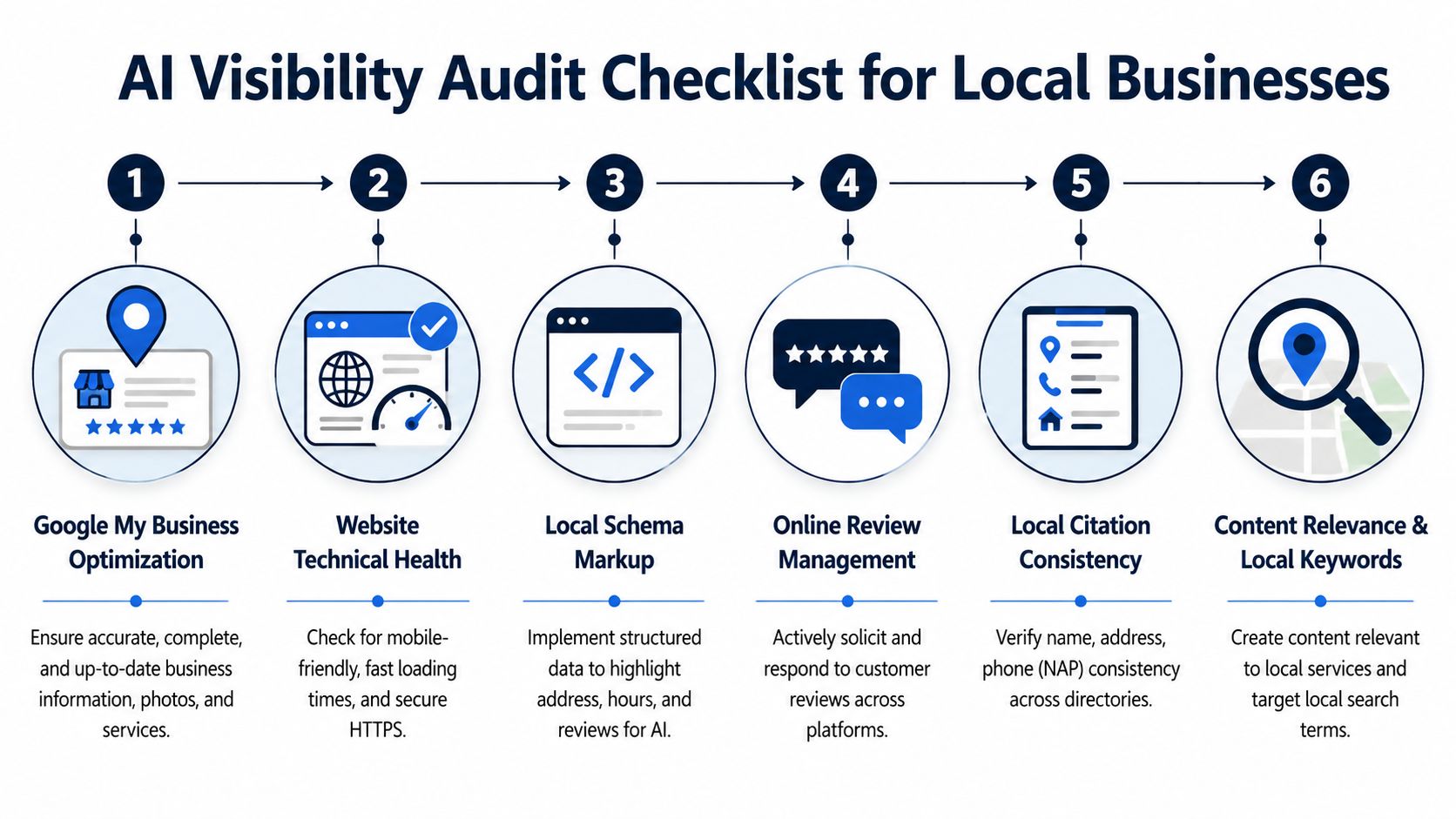
Here’s the hands-on part. For local businesses, an ai visibility audit works best when you break it into four checks. Don’t treat it like one big mystery score. Treat it like a set of business questions.
According to a 2025 IAB Australia report, 73% of Gold Coast-based SMBs in hospitality and trades failed initial AI audits, with citation scores below 10% for non-branded prompts like “emergency plumber Broadbeach”, as referenced in this AI visibility audit overview. That’s why the basics matter.
Run the branded audit
Start with your own identity. Ask the platforms direct questions:
- “What is [business name]?”
- “Is [business name] a good plumber on the Gold Coast?”
- “Where is [business name] located?”
- “What services does [business name] offer?”
You’re checking whether AI can confidently assemble the basics. If it can’t answer a branded query cleanly, your foundation is weak.
Look for:
- Name consistency across responses
- Correct suburb and service area
- Accurate service list
- References to your website, Google Business Profile, or trusted listings
A restaurant should also test menu-related and booking-related brand prompts. A solar company should test installation, servicing, and warranty-style prompts tied to its brand.
Test non-branded buying queries
Leads reside within this environment. These prompts should sound like a real buyer, not a marketer.
Examples:
- Plumber: “Who does emergency plumbing in Broadbeach?”
- Restaurant: “Best seafood restaurant near Broadbeach for dinner”
- Hospitality venue: “Family-friendly pub on the Gold Coast with outdoor seating”
- Solar installer: “Best solar panel installer Gold Coast for home systems”
Run variations. Change the wording, suburb, and intent. Some prompts should be urgent. Others should be comparative.
Record three things each time:
- Were you mentioned at all
- Were you cited as a source or just named
- Was the information accurate and useful
For local SEO groundwork that still feeds this process, Titan Blue’s guide to SEO for local businesses is worth reviewing alongside your audit notes.
Check where the AI got its information
This part is overlooked, and it’s often where the actual fix becomes obvious.
If AI mentions your business but cites:
- a stale directory,
- a review page with old details,
- a third-party article,
- or a forum discussion,
then you don’t control the message.
That creates risk. A customer may see the right business name but the wrong phone number, old opening hours, or a weak summary that doesn’t reflect your actual offer.
What works: Source diversity with consistent facts.
What fails: Hoping your homepage alone will carry the whole signal.
If your team is working through broader operational readiness as well, a practical checklist on how to prepare for AI implementation can help frame the audit as part of a wider business process, not just a marketing task.
Verify factual accuracy line by line
The final check is blunt. Is the answer correct?
Review these items carefully:
- Business name
- Phone number
- Address
- Opening hours
- Service area
- Core services
- Licences or credentials where relevant
- Brand positioning
This matters more than most owners realise. A plumber can lose urgent work if AI gives the wrong suburb coverage. A restaurant can lose bookings if dinner hours are outdated. A construction firm can be excluded if AI doesn’t understand the type of projects it handles.
Good audits don’t stop at presence. They check whether the machine is telling the truth.
Understanding What Your Audit Results Mean
The raw outputs can feel messy. One platform mentions you. Another ignores you. A third cites you but gets part of the answer wrong. That’s normal. What matters is the pattern behind it.

A useful benchmark here comes from a broader review of audit results. Analysis of over 200 AI visibility audits shows that while most sites have good technical structure, the median scores for Authority & Evidence were only 48/100, and Freshness was 45/100, according to Search Engine Land’s AI search audit findings. In plain terms, many sites are technically tidy but still fail to give AI enough trust signals or current information.
If you don’t appear for your own brand
That usually means AI lacks confidence in your basic identity. It may not find a clear enough connection between your site, business profiles, and public references.
Common causes include:
- Inconsistent business details
- Thin brand pages
- Weak external references
- Scattered mentions with mismatched naming
For business owners trying to understand this wider shift, Titan Blue’s overview of AI search gives useful context on how these systems choose and summarise information.
If you appear, but the source is wrong
This is one of the most common outcomes. Your business gets named, but the AI leans on a directory, review site, or old listing rather than your own pages.
That means you’ve won a mention but lost message control.
A few examples:
- A restaurant is recommended, but old opening hours are shown.
- A plumber is listed for emergency work, but the answer leans on a generic directory summary.
- A solar business appears in comparison prompts, but the AI doesn’t mention its installation expertise because the source content is too shallow.
Reading the result properly matters: Being mentioned isn’t the same as being represented accurately.
If your site is technically sound but still underperforms
Many owners find themselves stuck. They’ve got HTTPS, the site loads well enough, pages are indexed, and the build looks modern. Yet AI still doesn’t trust or cite them often.
That usually points to missing evidence. AI systems favour content that helps them answer a question with confidence. If your pages say what you do but don’t support it with specifics, examples, credentials, review context, or service detail, the content may be too generic to quote.
Here’s a quick decoder:
- Low branded visibility often signals identity confusion.
- Weak non-branded visibility often signals low relevance for service intent.
- Mentions with poor source selection often signal authority gaps.
- Mentions with outdated facts usually signal freshness problems.
A short walkthrough can help if you want to compare your findings against common patterns:
The commercial meaning behind the audit
An ai visibility audit should end in a business diagnosis, not a spreadsheet archive.
Ask the practical question behind every finding:
- Does this issue reduce calls
- Does it lower booking confidence
- Does it misrepresent the service
- Does it hand control to third-party sources
Once you read the results that way, the priorities become much clearer.
Turning Audit Insights into Actionable Fixes
The fastest way to waste an audit is to turn it into a long wish list. Local businesses need a short remediation plan tied to commercial outcomes.

There’s a practical financial case for this work. A Titan Blue internal study of 50 Gold Coast SMBs found that AI visibility audits costing $2,500-$5,000 AUD can yield a 3.2x ROI, driven by a 28% uplift in citations within major LLMs, based on the figures cited in this AI brand visibility audit reference.
Fix identity issues first
If AI can’t get your basics right, start there. Don’t write more blog posts until your foundation is clean.
Priority fixes include:
- Standardise your business name across your website and profiles
- Correct phone, address, and service area details
- Align your Google Business Profile with your website wording
- Remove or update stale directory listings where possible
For businesses with structured data problems, this guide on fixing incorrect schema markup issues is directly relevant because broken or inconsistent markup can make your business details harder for systems to trust.
Strengthen the pages tied to buying intent
If you’re absent from non-branded prompts, your service pages are often too broad, too thin, or too generic.
A better approach looks like this:
- Plumber pages should separate blocked drains, burst pipes, hot water, and emergency services.
- Restaurant pages should cover cuisine, dining style, location context, bookings, and standout menu categories.
- Solar pages should explain installation type, service area, process, and common buyer questions.
Don’t write for keywords alone. Write for the actual question a buyer asks before contacting you.
What usually works: Pages that answer a specific local service question clearly and completely.
What usually fails: One catch-all services page that tries to cover everything in two paragraphs.
Add evidence, not fluff
Many sites improve quickly at this stage. If your pages make claims, support them.
Useful evidence can include:
- Project examples
- Customer review themes
- Staff experience or credentials
- Service process explanations
- Local examples and suburb relevance
- Updated FAQs
This doesn’t need to become corporate jargon. A hospitality venue can explain dietary options, parking, function setup, and peak-time booking details. A trades business can explain callout process, job types, and coverage areas. A construction firm can describe project categories and compliance-related context in plain language.
Build an order of operations
Not every fix belongs in month one. Keep the plan sequenced.
A practical order is:
- Correct business facts everywhere
- Improve the priority pages tied to revenue
- Strengthen proof and authority signals
- Re-test prompts and compare the direction of change
- Expand into supporting content only after the basics improve
One mention here is enough. If a business wants help beyond manual checks and internal spreadsheets, agencies and specialist providers can support tracking and remediation. That includes services such as AI search optimisation and audit implementation from Titan Blue Australia, depending on how much internal capacity the business has.
The point isn’t to “do AI marketing”. It’s to make sure the machines summarising your market can find and trust the business you’ve already built.
Frequently Asked Questions About AI Audits
How often should I run an ai visibility audit
Run a light check regularly and a deeper review less often. For most local businesses, a quarterly check is sensible because AI answers shift, sources change, and business details can drift across platforms.
If your business has seasonal hours, changing menus, new service areas, or frequent offer updates, check more often. Restaurants and hospitality venues usually need tighter review cycles than businesses with stable operating details.
Can I do this myself
Yes, at a basic level. If you can write down your key services, test realistic prompts, and compare the answers, you can run a useful first-pass audit yourself.
An agency becomes more valuable when:
- the business has multiple locations
- results are inconsistent across platforms
- facts are being pulled from hard-to-fix third-party sources
- you need remediation, not just diagnosis
What should I fix first if everything looks wrong
Fix the facts that affect customer action. Wrong hours, wrong phone number, wrong suburb coverage, or unclear service descriptions do more immediate damage than a weak article page.
After that, focus on the pages and profiles most likely to influence high-intent prompts. Don’t try to repair every content asset at once.
Start with the information a customer would rely on before calling, booking, or asking for a quote.
Do I need expensive tools
Not always. For many SMBs, manual prompt testing and disciplined note-taking are enough to expose the main gaps. Paid tools can help with scale, tracking, and team workflows, but they aren’t the starting requirement.
If your internal team is also reviewing broader AI-related technical risk, something like an AI code security audit sits in a different category. That’s useful for software and implementation governance, but it isn’t a substitute for checking how your business appears in AI search.
Is this different from ranking in ChatGPT
Yes. ChatGPT visibility is part of the picture, but it’s not the whole picture. You also need to consider Google’s AI experiences and other answer engines because customers don’t use one tool in one way.
For practical guidance on platform-specific visibility, Titan Blue has a useful article on how to rank in ChatGPT.
How long until fixes make a difference
Treat this as a steady improvement process, not a quick patch. Some factual corrections can influence outcomes relatively quickly. Broader authority and citation improvements usually take longer because AI systems need to encounter, process, and trust those changes across multiple sources.
The businesses that get value from an ai visibility audit are usually the ones that keep checking, keep correcting, and keep improving the sources AI relies on.
If your business relies on local discovery, quote requests, bookings, or service calls, Titan Blue Australia can help you assess how AI platforms currently represent your brand and where your visibility is breaking down. From our Broadbeach base, we work with Australian businesses that need practical digital strategy, clear remediation priorities, and a grounded approach to staying findable as AI search changes customer behaviour.
Make Titan Blue a preferred source in Google
One click tells Google to surface our articles more often in Top Stories, AI Overviews and AI Mode.

ChatGPT GPT-6 Search Upgrade: What It Means for Australia
OpenAI rolled out GPT-6 to ChatGPT on 7 October 2026 with faster search. Here is…

Best Dental Website Design Agencies in Australia: 7 Compared
Best dental website design agencies in Australia 2026: seven compared on dental proof, booking, AHPRA…

Childcare Centre Website Design Australia: The 2026 Guide
Childcare centre website design Australia: show hours, ages and enrolment as text so parents and…