


TL;DR:
- Local SEO is vital for Gold Coast businesses to appear in Google Maps and the Local Pack, driving foot traffic and inquiries.
- It involves optimizing your online presence through accurate Google Business Profiles, localized website content, and active review management to improve relevance, proximity, and prominence signals.
If your business isn’t showing up when someone searches “near me” on their phone in Surfers Paradise or Broadbeach, a competitor is taking that customer. Local SEO determines which businesses appear in Google Maps, the Local Pack, and local organic results. For Gold Coast retailers and service providers, it’s one of the most direct paths to foot traffic and phone enquiries. This guide walks you through exactly what local SEO involves, which signals matter most, and the practical steps you can take right now to improve your visibility where it counts.
Table of Contents
- Understanding the essentials of local SEO
- Optimising your Google Business Profile for success
- Building your local reputation with reviews
- Localising your website and content strategy
- The local SEO tactic most businesses overlook
- Get expert help to accelerate your local SEO
- Frequently asked questions
Key Takeaways
| Point | Details |
|---|---|
| Accurate Google profiles | Precise business details and correct categories are essential for ranking well in local search. |
| Review management matters | Actively gathering and responding to customer reviews improves both reputation and local visibility. |
| Local content boosts results | Optimised local website pages and clear regional signals help search engines connect the right users to your business. |
| Consistency across platforms | Keep all business information up to date and consistent online for best discoverability. |
Understanding the essentials of local SEO
Before we address how to improve your rankings, let’s clarify what local SEO actually involves and what you’ll need to get started.
Local SEO is the process of optimising your online presence so your business appears prominently when people search for products or services in a specific location. It differs from general SEO in one key way: location is a primary ranking signal. A plumber in Robina doesn’t need to rank nationally. They need to rank when someone in Robina, or nearby, types “plumber” into Google.
General SEO focuses on domain authority, backlinks, and content quality across broad topics. Local SEO narrows that scope. It prioritises signals that tell Google where you are, who you serve, and whether your community trusts you.
The three core ranking factors Google uses for local results are:
- Relevance: Does your business match what the searcher is looking for?
- Distance: How close is your business to the searcher or the location they mentioned?
- Prominence: How well known and trusted is your business, based on links, reviews, and online mentions?
In the Gold Coast context, competition is fierce. Thousands of businesses target the same suburbs. Standing out requires more than just a website. You need SEO strategies tailored for Australian businesses that reflect local search behaviour, including seasonal tourism patterns, suburb-specific searches, and the way Australians phrase their queries.
Here’s a quick comparison of general SEO versus local SEO to clarify where your energy should go:
| Factor | General SEO | Local SEO |
|---|---|---|
| Primary audience | National or global | Suburb, city, or region |
| Key asset | Website content | Google Business Profile |
| Ranking signals | Backlinks, authority | Reviews, proximity, NAP consistency |
| Result type | Organic listings | Maps, Local Pack, local organic |
| Content focus | Broad topics | Location-specific pages and mentions |
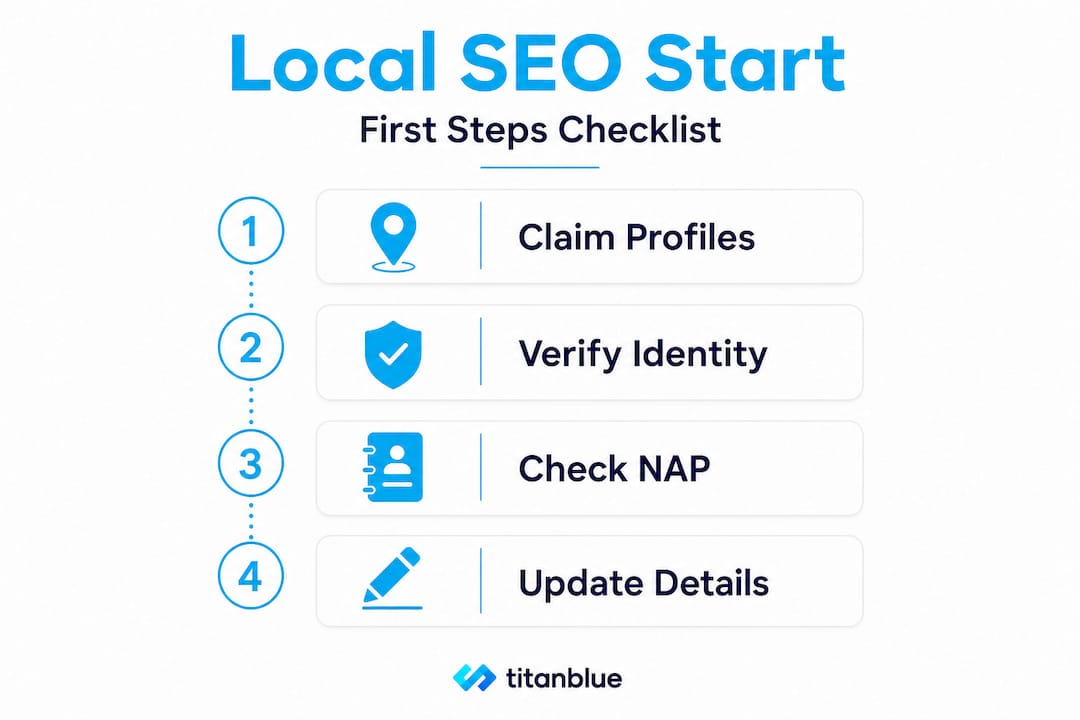
Critical first steps before anything else: claim your digital properties, verify your business identity with Google, and ensure your name, address, and phone number (NAP) are consistent everywhere online. Google Business Profile accuracy and correct category selection are critical for local visibility.
Pro Tip: Check your NAP details across every directory listing, social profile, and website. Even a minor discrepancy, such as “St” versus “Street,” can confuse Google and hurt your rankings.
For a broader overview of what this means for smaller operations, explore SEO for small business Australia to understand the full picture before diving into technical fixes.
Optimising your Google Business Profile for success
Once you understand the basics, the next step is to ensure your most important local asset, your Google Business Profile (GBP), is expertly set up.
Your GBP is the listing that appears in Google Maps and the Local Pack. It’s often the first thing a potential customer sees, well before your website. Getting it right matters enormously.
Here’s how to set it up properly:
- Claim your listing. Go to Google Business Profile and search for your business. If it exists, claim it. If not, create it from scratch. Use your exact legal business name.
- Verify your business. Google will send a postcard to your physical address, or in some cases offer phone or email verification. Complete this step. Unverified profiles have limited visibility.
- Add your core information. Fill in every field: business name, physical address, phone number, website URL, and trading hours. Do not skip any of these.
- Choose your primary category carefully. This is the most influential setting on your profile. Pick the category that most accurately describes what your business does. For example, a Gold Coast café should select “Café” not “Restaurant” unless both genuinely apply.
- Add secondary categories sparingly. You can add additional categories, but keep them directly relevant. Maintain one profile per business, keep your real-world details accurate, and avoid over-categorising.
- Upload high-quality photos. Include your shopfront, interior, team, and products or services. Businesses with photos receive significantly more direction requests and website clicks.
- Add your services or products. Use the Services or Products section to list what you offer. This adds keyword relevance to your profile without stuffing your business name.
“Your Google Business Profile is not a one-time setup. It requires regular updates, new photos, posts, and accurate information to stay competitive in local search.”
Here’s what must be correct at all times on your profile:
| Profile element | Why it matters | Common mistake |
|---|---|---|
| Business name | Matches brand and search intent | Adding keywords to the name field |
| Address | Confirms location for proximity ranking | Using a PO Box or virtual office |
| Phone number | Click-to-call for mobile users | Using a tracked number inconsistently |
| Website URL | Sends traffic to the right page | Linking to homepage when a local page exists |
| Primary category | Defines what you do for Google | Choosing too broad a category |
| Trading hours | Prevents frustrated customers | Not updating for public holidays |
Understanding how to improve local search rankings often starts and ends with this profile. It’s the single most impactful free tool available to any local business in Australia.
Pro Tip: Use Google Business Profile posts weekly. Share offers, news, or updates. Active profiles signal to Google that your business is current, relevant, and worth showing to searchers. It only takes five minutes and makes a real difference.
To see the direct impact this can have, look at how boosting your business with local search works across different Gold Coast business types.
Building your local reputation with reviews
With your Google listing set up, it’s essential to focus on the next major trust signal: your customer reviews.
Reviews are not just social proof for humans. They are a significant ranking signal for Google. The algorithm considers review quantity, average star rating, review freshness, and the presence of keywords within review text. A business with 150 recent, detailed reviews will consistently outperform one with 20 old, generic reviews, all else being equal.
Reviews and aspect ratings shape both ranking and consumer trust for local businesses. For service businesses such as electricians, accountants, or physio clinics, aspect-based ratings allow customers to score specific attributes like punctuality, professionalism, and value. These data points feed into how Google presents your business to future searchers.
Here’s how to build a strong review profile:
- Ask at the right moment. The best time to request a review is immediately after a positive interaction, when the customer’s satisfaction is fresh. For in-store businesses, a simple “Would you mind leaving us a Google review?” works well. For service businesses, a follow-up email or SMS with a direct review link converts reliably.
- Make it effortless. Send a short link directly to your review page. Every additional step reduces completion rates.
- Respond to every review. Thank positive reviewers by name. For negative reviews, respond calmly, acknowledge the concern, and offer to resolve it offline. This shows prospective customers you take service seriously.
- Never incentivise reviews. Offering discounts or gifts in exchange for reviews violates Google’s policies and can result in suspension.
- Use negative reviews strategically. A well-handled negative review often builds more trust than dozens of five-star reviews with no context.
The freshness factor is often underestimated. A business that collected 80 reviews three years ago and has received none since will be outranked by a competitor with 30 reviews gathered over the past six months. Consistency matters more than a single burst of activity.
Pro Tip: Create a QR code that links directly to your Google review page. Print it on receipts, display it at your counter, or include it on your service completion cards. It removes friction and boosts review volume without any awkward conversations.
When you’re actively working on this, combining reviews with your broader strategy is key. Here’s more on how to boost local SEO by layering reputation signals with technical improvements.
Localising your website and content strategy
Your reviews drive reputation, but your website is the anchor. Now, let’s ensure it’s optimised for local discovery.
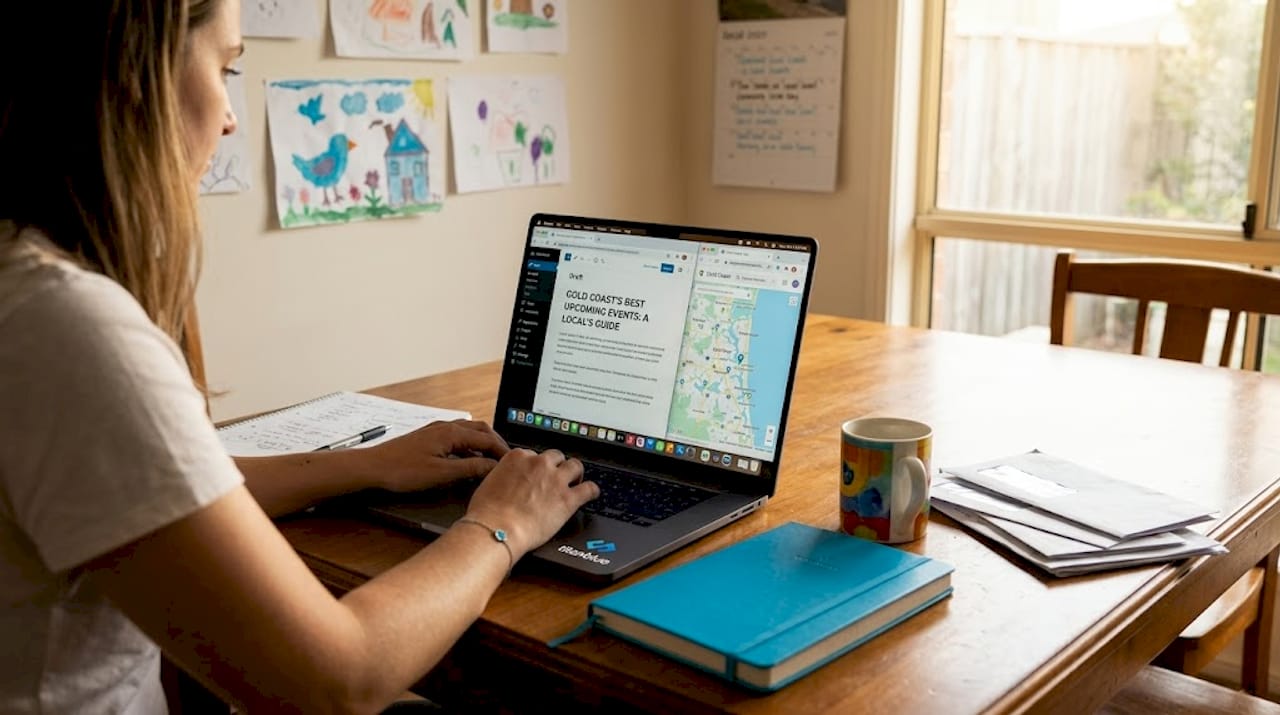
Your website needs to clearly tell Google where you operate, who you serve, and what you offer in each location. A generic homepage with no location signals is a missed opportunity, particularly if you serve multiple Gold Coast suburbs.
Here’s how to build a locally optimised website:
- Create dedicated local landing pages. If you serve Broadbeach, Robina, Southport, and Burleigh Heads, create a separate page for each. Each page should include the suburb name naturally in the heading, body content, meta title, and meta description. It should also reference local landmarks, streets, or context where genuine.
- Implement hreflang tags. If your business serves different regions with different language preferences, hreflang and local landing pages tell Google which content to show to which users. For most Gold Coast businesses, this means ensuring your site is correctly tagged for Australian English audiences.
- Keep your NAP consistent on your website. Your business name, address, and phone number on your website must match your GBP exactly. Place this information in the footer so it appears on every page.
- Use schema markup. Add LocalBusiness schema to your website. This structured data helps Google understand your business type, location, and contact details in a machine-readable format.
- Use authentic local imagery. Stock photos are recognisable and build less trust than real images of your team, premises, and work. High-quality images and current business info improve AI search results, which is increasingly important as Google’s AI-powered search features use rich content to generate answers.
Here’s a quick reference for your local content strategy:
| Content element | Local SEO purpose | Example for Gold Coast business |
|---|---|---|
| Local landing pages | Target suburb-specific searches | “Web design in Broadbeach” |
| Schema markup | Structured data for Google | LocalBusiness, OpeningHours |
| Consistent NAP | Trust and ranking signal | Same across site, GBP, directories |
| Hreflang tags | Region and language targeting | en-AU for Australian content |
| Authentic imagery | Trust and AI search visibility | Real team photos, Gold Coast locations |
Your content strategy should also include regular blog posts or news updates that reference local events, industry updates relevant to your area, or suburb-specific topics. This keeps your site fresh and builds topical authority around your location.
Explore local search strategies and important SEO strategies to round out your approach with both on-page and off-page techniques.
The local SEO tactic most businesses overlook
Having covered the key techniques, let’s cut through common myths that prevent real results for local businesses.
Most Gold Coast businesses we speak with have done the basics. They’ve claimed their Google Business Profile. They have a website. They’ve maybe collected a handful of reviews. Then they sit back and wait. That’s the mistake.
Local SEO is not a set-and-forget task. It’s an ongoing signal. Google is constantly re-evaluating which businesses deserve top local positions based on current, active, and accurate data. A business that updated its profile once in 2023 and hasn’t touched it since is sending a weak signal compared to one that posts updates weekly, responds to reviews promptly, and publishes fresh local content every month.
Here’s the uncomfortable truth: your competitors are probably not doing this well either. That creates a genuine opportunity. The businesses winning in local search in 2026 are the ones treating their online presence the way they treat their shopfront, keeping it clean, updated, and welcoming.
AI-driven search is accelerating this dynamic. Google’s AI-powered features now surface answers from business profiles, website content, and review snippets directly in search results. If your data is outdated or your content is thin, you won’t appear in those answers. Rich, accurate, current content is no longer a nice-to-have; it’s essential.
We’d also challenge the idea that local SEO is purely technical. The businesses seeing the best SEO ROI for Australian SMBs are treating it as community engagement. They’re responding to customers, sharing local stories, and positioning themselves as genuinely part of the Gold Coast community. That authentic engagement translates into signals Google values: fresh reviews, updated content, social proof, and consistent activity.
Think of it this way. Every week you don’t post an update, respond to a review, or refresh your local content is a week your competitor might. The compounding effect of consistent local SEO activity is significant.
Get expert help to accelerate your local SEO
Ready to move beyond DIY? Here’s how professional support can deliver faster, measurable local SEO wins.
Local SEO done properly takes time, expertise, and consistency. If you’re running a Gold Coast business, chances are you don’t have hours each week to manage your Google Business Profile, build local landing pages, monitor reviews, and stay across Google’s algorithm updates.
That’s where we come in. At Titan Blue, we specialise in delivering SEO solutions that are built specifically around local Australian search behaviour. Our small business SEO services cover everything from technical on-page optimisation to review strategy and GBP management. We also build Gold Coast web design that integrates local SEO from the ground up, so your site works harder from day one. Get in touch now and let’s put your business at the top of local search.
Frequently asked questions
How long does it take to see results from local SEO?
While some improvements can be seen within a few weeks, sustainable and consistent results typically show after three to six months of active local SEO effort.
What if my business serves multiple Gold Coast suburbs?
Create separate, locally optimised pages for each suburb and set accurate service areas on your Google Business Profile to ensure Google understands your full coverage area.
Do reviews from non-local customers count for local SEO?
Yes, all reviews contribute to your overall rating, but aspect-based ratings and reviews mentioning your location can have greater relevance for local ranking signals.
How do I add language or region targeting for my site?
Use hreflang tags and sitemaps to indicate which content is intended for different regions or language variants, ensuring Google serves the right version to the right audience.
Why is it risky to over-categorise my Google Business Profile?
Adding too many categories creates ambiguity about what your business actually does. Only the fewest categories that describe your core business should be used to maintain ranking clarity.
Recommended
- How to Boost Local SEO for Sydney Businesses
- Top SEO strategies for Australian businesses: improve your ranking
- What is Local SEO? The 2026 Guide to Dominating Your Australian Market – Titan Blue Australia
- Effective SEO for Small Business Australia | Boost Your Online Presence – Titan Blue Australia
Make Titan Blue a preferred source in Google
One click tells Google to surface our articles more often in Top Stories, AI Overviews and AI Mode.

Web Design Mistakes Killing Your AI Visibility (2026)
The web design mistakes killing your AI visibility in 2026, and how to fix each…

AEO Website Design Checklist 2026: The Complete Build Guide
A practical AEO website design checklist for 2026 covering crawlability, schema markup, content structure, Core…

How to Make Your Website AI Friendly: The 2026 Step-by-Step Guide
How to make your website AI friendly: a step-by-step 2026 guide to getting crawled, structured…