


Last updated:
Perplexity optimisation services make your business's online content the most accurate and authoritative answer for AI search engines, so it gets cited directly in search results. With 780 million queries a month as of May 2025 and growth from 230 million monthly queries in August 2024, Perplexity has become large enough that local Australian businesses can't treat it as an experiment anymore.
If you run a restaurant, plumbing business, solar company, trade service, or construction firm, this shift is already affecting how customers find you. A person doesn't have to scroll through ten blue links anymore. They can ask one question, get one synthesised answer, and call the business that was mentioned.
That changes the rules.
Many business owners first notice this issue when testing their own brand and discovering that Perplexity mentions a directory, a review site, or a national comparison page instead of their actual business. This situation creates a significant challenge. It is not just ranking. It's attribution. If the AI cites someone else as the source of truth for your suburb, service, or menu category, you lose the trust signal before the click ever happens.
Your Customers Are Asking AI About You
A Broadbeach plumber used to compete for a search result. Now that same business competes to become the cited answer when someone asks, “Who can fix an emergency hot water system near me?” A family restaurant used to rely on maps, reviews, and organic rankings. Now it also has to be the source Perplexity trusts when someone asks for “family-friendly restaurants with gluten-free options near Surfers Paradise”.
That's why Perplexity optimisation services matter. They aren't a layer of trendy jargon on top of SEO. They're the practical work of making sure your business is clear enough, credible enough, and structured enough to be named directly inside AI-generated answers.
Why this matters now
Businesses are already reporting 300-500% ROI from geo-targeted optimisation strategies, and Perplexity's usage is projected to reach 35-45 million queries per day in 2026 according to this Perplexity AI optimisation analysis. That's not casual traffic. These are often high-intent questions from people who want a recommendation, a provider, or a next step.
For a local operator, that intent matters more than vanity metrics.
If someone asks Perplexity which solar installer understands local rebates, or which café suits a family with dietary requirements, they're not browsing. They're narrowing. They're close to acting.
Practical rule: If your business isn't cited in the answer, you may never get the chance to compete on price, reviews, or service.
Why standard local SEO falls short
Traditional local SEO still matters. You still need strong service pages, accurate profiles, mobile usability, and a clean site. But that alone doesn't solve AI attribution.
Perplexity does not reward businesses for existing in directories. It attempts to assemble the best answer from the web in real time. That means local businesses often lose out to sites that are easier for AI to read, summarise, and trust, even when those sites do not provide the service themselves.
A lot of owners have already seen this pattern. The business is real. The reviews are solid. The team does the work locally. But the answer engine still cites a national listicle, a marketplace, or a suburb guide.
If that sounds familiar, why your brand isn't showing up in AI search is usually a good starting point.
What works and what doesn't
What works:
- Direct answers on key pages: Your emergency plumbing page should answer emergency plumbing questions fast.
- Clear local entity signals: Suburb, service, business type, and expertise need to be explicit.
- Useful source material: FAQs, service explanations, pricing context, booking details, and process pages help.
What doesn't:
- Thin suburb pages: AI can spot fluff quickly.
- Keyword stuffing: It makes content less trustworthy, not more.
- Relying on directory listings alone: That helps discovery, but not always direct citation.
The businesses that win here are the ones that stop treating their website like an online brochure and start treating it like a reference source.
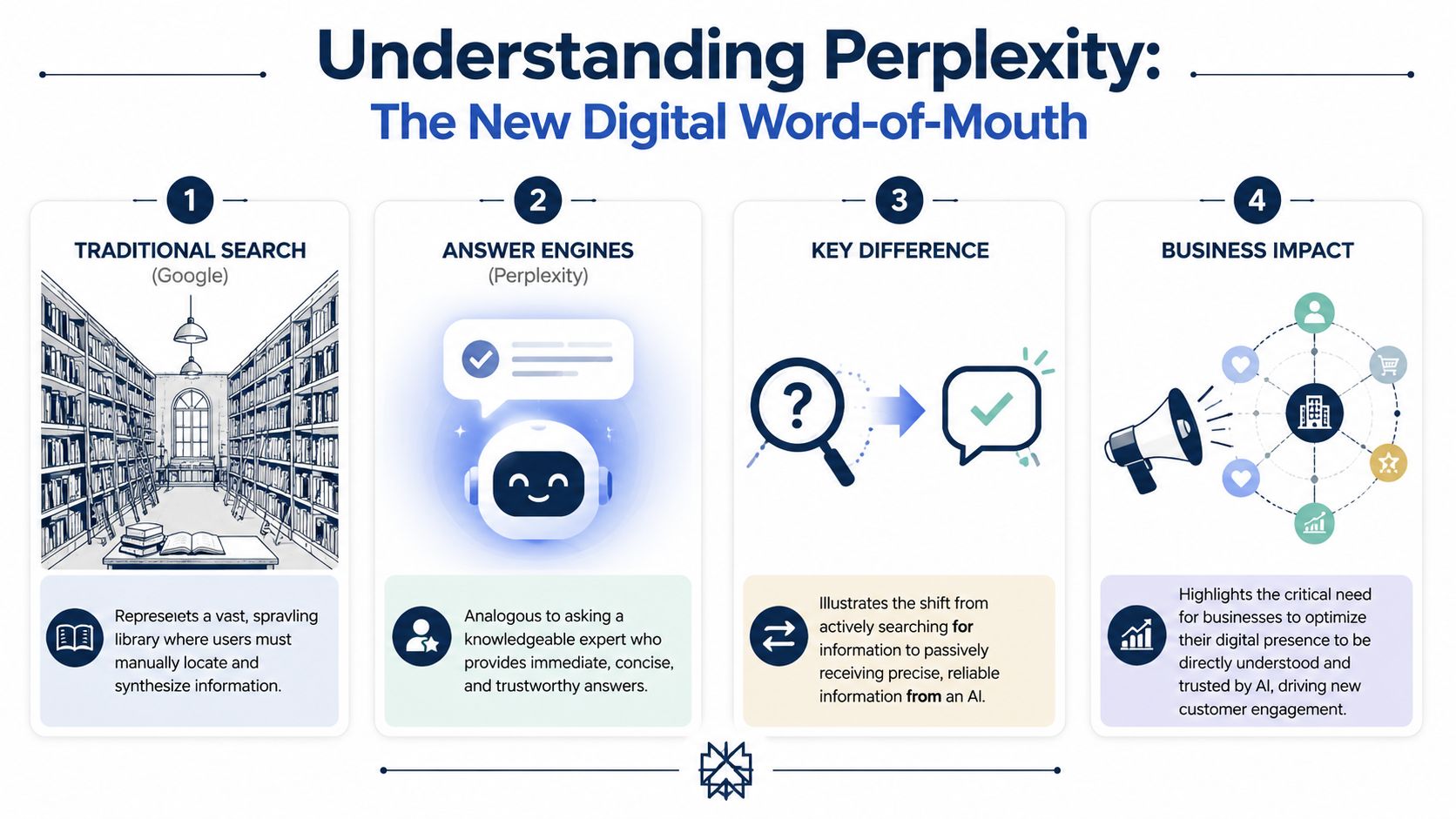
Understanding Perplexity The New Digital Word-of-Mouth
Perplexity is an answer engine. Google traditionally gives you options. Perplexity gives you a response built from sources it selects, cites, and summarises. For a small business owner, the easiest way to think about it is this: Google is like walking into a huge library and being shown shelves. Perplexity is like asking a sharp librarian to read the shelves for you and hand back the answer with notes.
That's why being cited matters so much. The recommendation is built into the response.
Why business owners should pay attention
Perplexity handled 780 million queries monthly as of May 2025, up from 230 million in August 2024, with over 22 million active users, 85% retention, and more than 53% of users aged 18 to 34, according to these Perplexity growth statistics. That age range matters for hospitality, local services, and household decision-making because it overlaps with customers who ask for recommendations on the go and expect immediate answers.
This isn't just another app people tried for a month. People are returning to it, and they're using it to ask practical questions with local buying intent.
Why it feels like word-of-mouth
Old-school word-of-mouth worked because a trusted person said, “Use this one.” AI answer engines create a similar shortcut. If Perplexity cites your business or your content as the source behind the answer, you inherit some of that trust.
That doesn't mean users stop checking reviews or visiting your site. It means the shortlist is being built earlier.
When a customer gets a direct answer with citations, your business isn't just one option on a page. It's part of the recommendation.
That's the major shift.
What this means for local operators
A local restaurant owner doesn't need to become an AI engineer. But they do need to understand that answer engines prefer businesses that are easy to verify and easy to interpret.
That's where broader reading on understanding cloud and local AI can help. It gives useful context on how AI systems process information differently depending on where and how they run. For a business owner, the practical takeaway is simple: if you want an AI platform to use your information well, you have to present it in a form the system can read confidently.
If you're still getting your bearings on the technology behind this shift, large language models in business use helps frame why these systems don't behave like traditional search engines.
How Answer Engines Find and Trust Your Business
Perplexity behaves less like a ranking list and more like a research assistant. It gathers possible sources, compares them, checks which ones are most useful, and then cites the ones it trusts enough to support the answer.
That process matters because it changes what “good content” means.

The simple version of the system
Perplexity uses a three-layer reranking process described in this technical breakdown of Perplexity optimisation. In plain English, it first casts a wide net, then compares query and page relevance more carefully, then applies another machine learning pass that includes signals such as entities and authority. That same source says domain authority accounts for approximately 15% in that final layer, which tells you something important. Authority matters, but it doesn't work alone.
The same analysis reports 97% source verification accuracy and a 92% citation integration rate. For small businesses, that means weak pages don't just rank lower. They often get filtered out before the user even sees them.
What Perplexity tends to trust
If you strip away the technical language, answer engines look for a few practical signals:
- Factual clarity: Dates, locations, services, inclusions, and service areas should be obvious.
- Thorough coverage: A page that answers the obvious follow-up questions is easier to cite.
- Structure: Strong headings, FAQ sections, and clean formatting help extraction.
- Recency: Outdated details reduce trust.
- Entity certainty: Your business needs to be clearly understood as a real local provider, not a vague brand mention.
A plumber's site that says “quality service across south-east Queensland” isn't giving much to work with. A page that clearly states emergency hot water repairs in specific suburbs, explains service scope, lists business details, and answers common repair questions is much easier for an answer engine to use.
What usually breaks citation chances
The most common failure points are ordinary things:
- JavaScript-heavy pages with weak crawlable content
- Service pages that say little beyond slogans
- Conflicting business information across the site
- No schema for FAQs or how-to content
- Important details hidden inside images or PDFs
What the AI needs: a page that can stand on its own as evidence.
That's why server-side rendered or static content often performs better for this use case. It puts the actual information in front of the crawler without making the system work for it.
If you want the broader discipline behind this approach, answer engine optimisation for modern search is the right frame. The core idea is simple. Stop optimising only for clicks. Start optimising to be selected as the answer source.
The Perplexity Optimisation Service Explained
Most businesses don't need more “content” in the abstract. They need information architecture that helps Perplexity cite them directly instead of citing a national directory, marketplace, or aggregator.
That's the core of Perplexity optimisation services for local businesses.

The local attribution problem
Perplexity pulls from live web data. Local businesses don't just compete with the shop down the road. They compete with publishers and aggregators that are often better structured for AI citation. According to this analysis of Perplexity ranking factors, businesses that solve this problem report 20-40% increases in referral traffic.
That number is useful, but the mechanism matters more. The businesses that get cited aren't always the biggest. They're often the clearest local source.
A true optimisation service has to answer one hard question: why should Perplexity treat your page as the authoritative answer for your area and service?
What a real service actually changes
A proper engagement usually touches four layers.
Content that answers the real prompt
Not keyword phrases. Real prompts.
If users ask “Who installs solar for older homes in regional Queensland?” your site needs pages that answer adjacent real-world questions. What systems do you install? What roof types do you handle? Do you explain rebates, timelines, and installation constraints in plain language?
The same logic applies to restaurants and trades. A strong service doesn't churn out generic blogs. It maps likely customer prompts and creates answer-ready pages around them.
Structured data and entity signals
Local businesses often miss the mark in this specific area. They mention their suburb casually but never define themselves clearly enough for a machine to connect the dots.
That means tightening up:
- Business identity: name, service type, service area, opening information
- Page purpose: what each page is about
- Schema markup: especially FAQ and HowTo where relevant
- Internal linking: so your site shows depth, not isolated pages
If you're comparing channels, some of the same diagnostic thinking used in improving PPC campaign performance applies here too. You don't fix results by guessing. You inspect structure, intent, leaks, and alignment.
A useful reference point for service-based implementation is generative engine optimisation services, which covers the practical work involved in making content usable for AI-driven discovery.
Citation strategy is not the same as link building
Many campaigns fail because they use old SEO instincts for a new problem.
You still care about authority, but the immediate question is whether Perplexity can confidently quote your site. That means your pages need verifiable statements, usable definitions, local specificity, and content that stands up without fluff.
A short explainer helps here:
One practical note. Titan Blue Australia offers GEO work aimed at improving visibility in AI-driven platforms including Perplexity. For a business owner, the main value of any provider isn't the label they use. It's whether they can make your business easier for answer engines to recognise, trust, and cite.
Real-World Scenarios for Australian Businesses
Theory only gets you so far. The easiest way to understand this channel is to look at what answer-ready content looks like for common local businesses.
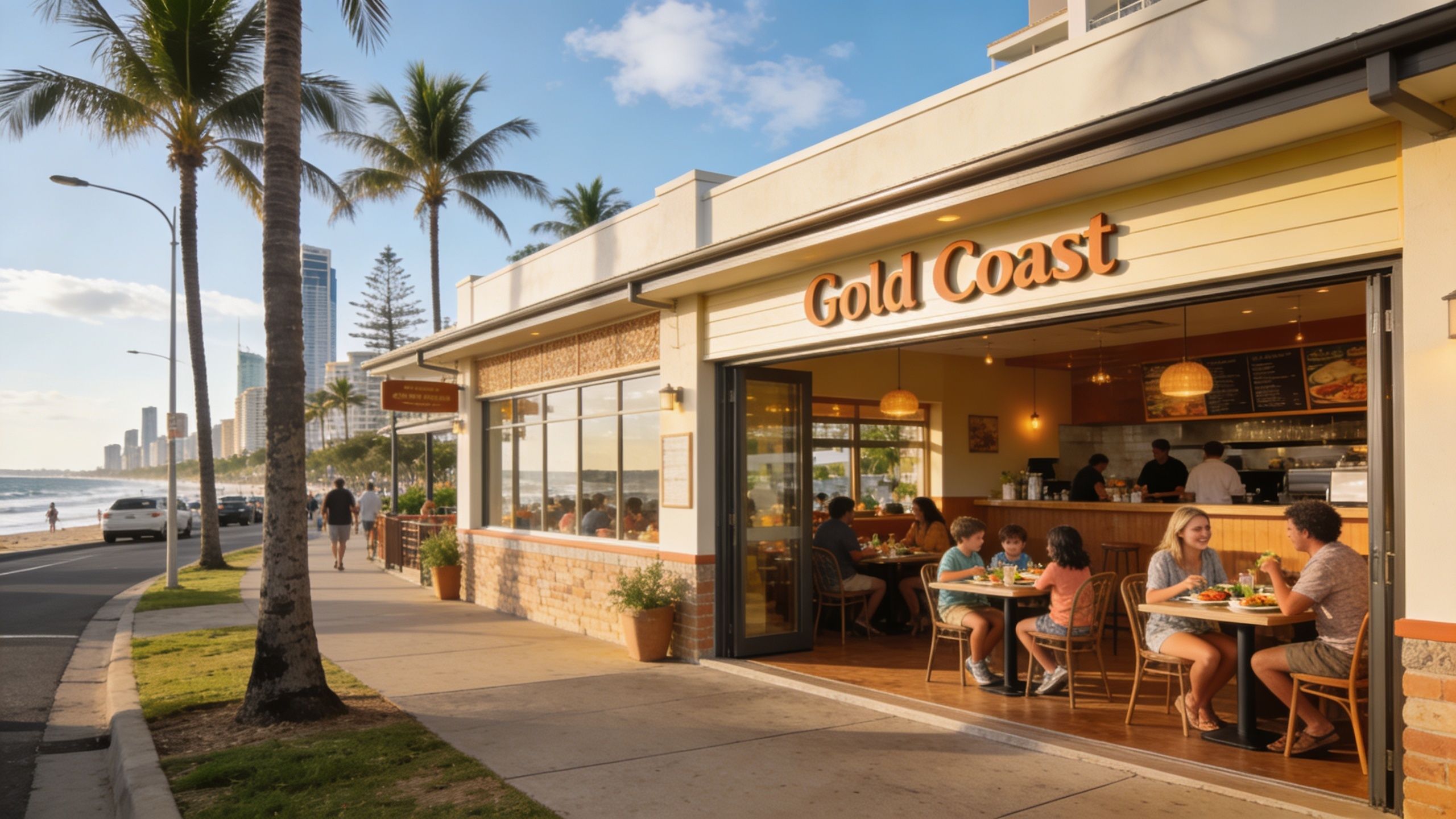
A Gold Coast restaurant
A family asks Perplexity for a family-friendly restaurant near Surfers Paradise with gluten-free options. The businesses that tend to appear are not always the ones with the flashiest homepage. They're the ones with pages that clearly state cuisine, dietary accommodations, booking suitability, location context, and current menu information.
The citation-friendly restaurant site usually has:
- A menu page with crawlable text: not a PDF only
- A page or FAQ covering dietary needs: gluten-free, kids' meals, group dining
- Clear local references: suburb, nearby landmarks, parking, opening details
- Consistent wording across the site: so the AI doesn't have to guess
A lot of hospitality sites fail here because their best information sits inside image-based menus, social posts, or booking platforms.
A suburban plumber
Now take a Brisbane plumber. A user asks Perplexity how to fix a leaking tap washer, then follows up with who can help locally if the repair doesn't hold.
The business that earns trust often publishes a practical guide first. Not because DIY content cannibalises service calls, but because it proves expertise. A short guide that explains common causes, basic steps, and the point where professional help is needed can become the source Perplexity cites.
Publish the answer your customer would ask for before they ring you. That's often the content that earns the citation.
Then the commercial path becomes obvious. The same site links that guide to a local repair page, emergency call-out information, and service area details. The content does two jobs at once. It answers the immediate question and establishes the business as a local authority.
A regional solar installer
A regional Queensland installer faces a different issue. Customers often ask layered questions around rebates, payback, roof suitability, and local installation requirements. National comparison pages dominate broad searches, but local firms can still win citations by being more specific.
The pages that work usually combine explanation with local context:
- A rebate explainer written in plain English
- Installation pages that cover roof type and site conditions
- FAQs that address timing, inspections, and household suitability
- Service area references that make the local footprint obvious
Local businesses can beat bigger sites. A generic article may talk broadly about solar. A local installer can speak directly to the conditions and decisions that matter in the region they serve.
What all three examples have in common
None of these scenarios rely on tricks.
They rely on:
- Clear service information
- Local specificity
- Pages designed to answer follow-up questions
- Content that can be quoted cleanly by an answer engine
That's the pattern. If Perplexity can lift a reliable answer from your site without having to interpret vague marketing language, your odds of being cited improve.
Choosing the Right Partner for Perplexity Optimisation
Because this field is new, plenty of agencies will rebrand normal SEO packages and call them AI optimisation. Some of that work is still useful. Some of it won't solve the actual problem.
If you're hiring help, don't ask whether they “do AI”. Ask how they'll help Perplexity recognise your business as the authoritative local source.
Questions worth asking
A good provider should be able to answer these directly:
- How will you improve local attribution? If they only talk about rankings, they're missing the main issue.
- What changes will you make on the website itself? You want specifics around content structure, schema, crawlability, and internal linking.
- How do you decide which prompts to optimise for? A strong answer mentions real customer questions, not just head terms.
- How will you measure progress? You want evidence of citation visibility, prompt testing, and qualified traffic patterns, not just generic reporting.
- How will you handle aggregator competition? Weak providers get vague on this point.
Red flags that show up early
One useful way to think about this is the same way you'd approach vetting Instagram marketing agencies. Different channel, same principle. If the provider can't explain their method in plain language, they probably don't have one.
Watch for these signs:
- They promise rankings inside Perplexity: Answer engines don't work like a ten-position results page.
- They sell backlinks as the whole strategy: Authority helps, but it won't fix poor attribution structure.
- They ignore your trade or location details: Hyper-local context is the point.
- They can't explain content formatting: If they don't mention answer-first content, they're behind.
Selection test: The right partner should be able to describe how a local plumber in one suburb can outrank a national directory in citation terms.
What a better partnership looks like
The right agency usually sounds more like a strategist than a salesperson. They'll talk about your business data, your service areas, your pages that deserve restructuring, and the prompts real customers ask before they buy.
They'll also be comfortable saying what won't work. A brand-new AI page with no supporting site depth won't carry much weight on its own. Neither will a set of suburb pages that all say the same thing. Good Perplexity optimisation services involve trade-offs. You may need to simplify a slick design to make important information easier to crawl. You may need to rewrite pages that sound polished but don't answer anything directly.
If you want a framework for evaluating agencies in this category, choosing the right engine optimisation company for 2026 is a practical checklist.
If your business should be the answer when someone asks AI who to hire, where to eat, or which provider to trust, Titan Blue Australia can help you turn your site into a clearer, more citable source for Perplexity and other AI search platforms. The work starts with local attribution, structured content, and making sure your expertise is the version the AI sees.
Make Titan Blue a preferred source in Google
One click tells Google to surface our articles more often in Top Stories, AI Overviews and AI Mode.

ChatGPT GPT-6 Search Upgrade: What It Means for Australia
OpenAI rolled out GPT-6 to ChatGPT on 7 October 2026 with faster search. Here is…

Best Dental Website Design Agencies in Australia: 7 Compared
Best dental website design agencies in Australia 2026: seven compared on dental proof, booking, AHPRA…

Childcare Centre Website Design Australia: The 2026 Guide
Childcare centre website design Australia: show hours, ages and enrolment as text so parents and…