


Last updated:
AI search engine optimisation is the next big shift in digital marketing. It’s all about moving from the old goal of ranking in a list of links to the new goal of becoming a trusted source that’s quoted directly in AI-generated answers.
Think of it this way: you’re structuring your website’s information so clearly that systems like Google’s AI Overviews pick your content to answer a user’s question.
Welcome to the New Era of Search

The Google search we've known for years is going through its biggest shake-up in over a decade. We’re leaving behind a model that felt like a library’s card catalogue—where you had to find the books yourself—and moving towards something more like a personal librarian who reads them and gives you a direct summary.
This isn’t some far-off trend. It’s happening right now with AI Overviews and conversational search tools. For Australian businesses, from a local Gold Coast restaurant to a national manufacturing firm, this is a present-day reality. Your potential customers are already getting instant, summarised answers instead of a list of blue links to click through.
Adapting to an AI-First World
The game has changed. For years, the goal was simple: get the user to click on your website. Now, the goal is to have your business's expertise featured within the AI's answer itself.
This guide introduces AI search engine optimisation not as a threat, but as the essential next step in your digital strategy. It’s about adapting so your business becomes the go-to source that AI systems learn from and trust.
To do this, you'll need to focus on:
- Authority: Proving you're an expert in your field so AI trusts your information.
- Clarity: Presenting your content in a simple, structured way that machines can easily understand.
- Relevance: Directly and clearly answering the specific questions your target audience is asking.
The Opportunity for Australian Businesses
By getting these principles right, you can turn this massive shift in search into a serious competitive advantage. The businesses that adapt first will be the ones recommended by AI, grabbing the attention of high-intent customers before they even think about visiting a website.
For service-based businesses, this means being presented as the solution, right there in the search results.
This guide will walk you through how to optimise for this new world. We'll explore the strategies needed to build trust with AI and make sure your business doesn't just survive, but thrives. You can also get a deeper understanding of the technology behind it all by reading our article on what large language models are. Let's get started.
What Exactly Is AI Search Engine Optimisation?

Let's cut through the buzzwords. At its core, AI Search Engine Optimisation (AIO) is all about making your business’s information so clear, credible, and authoritative that AI systems like Google's Gemini and ChatGPT choose to cite you in their answers. This is a fundamental shift from the SEO we’re used to.
Instead of just fighting for the top spot on a list of blue links, the new goal is to become the trusted source inside an AI-generated summary. The game has changed from ranking to influence.
Imagine a potential client asking, 'Which law firm in Broadbeach handles commercial leases?' An AI engine won't just spit out a list of websites. It will synthesise an answer using information from the most trustworthy online sources it can find. AIO is the strategy you use to become that definitive source.
The New Goal: Becoming The Source
This new approach means positioning your business as a recognised entity with real, verifiable expertise. You’re no longer just optimising for keywords; you're optimising to be understood and trusted by machines.
Think of it like becoming the expert everyone in town recommends. Both people and AI need to see you as the go-to authority. This is done through clear, structured, and factual content that answers your customers' questions directly.
This change is already hitting Australian businesses. By 2026, Google AI Overviews are reshaping search, now appearing in a massive 21% of all search results. This trend is particularly disruptive for local businesses, from restaurants to retailers on the Gold Coast. The presence of these AI answers exploded by 116% between March and May 2025, confirming it's a deliberate push towards zero-click experiences. For our clients in manufacturing or law, this means traditional SEO alone won't cut it anymore.
Core Principles of AIO
AI search engine optimisation is built on three pillars that set it apart from old-school tactics. If you want visibility in this new AI-powered world, you need to master these.
- Entity Recognition: This is about helping AI understand that your business is a real-world entity with specific expertise and a physical location. You’re building a clear, machine-readable identity online.
- Topical Authority: You have to prove you’re an expert in your niche. This isn't about one blog post; it's about creating deep, interconnected content that covers a topic from every angle.
- Structured Content: Your information must be organised in a way that machines can easily parse and understand. This means using clear headings, lists, and technical markup to give your content meaning.
To really get your head around how AI is changing the game, it’s useful to understand concepts like programmatic SEO, which uses automation to create and optimise content at scale. This is similar to how AI thinks about content—in a structured, data-driven way.
By focusing on these principles, you’re setting your website up to be a prime source for AI-generated answers. It's about playing the long game and making sure your brand’s voice is heard in the new era of search. If you're ready to explore this further, you can learn more about our specialised generative engine optimisation services.
Why Clicks Are No Longer the Whole Story
For years, the holy grail of SEO was simple: get the click. That era is officially winding down. Thanks to the rise of 'zero-click searches', users are now getting their answers directly from AI Overviews and other answer engines, often without ever needing to visit a single webpage.
This might sound like a reason to panic, but it’s actually an opportunity to rethink what success online really looks like. The new goal isn't just about driving traffic; it’s about building influence. When an AI cites your business, it’s a powerful endorsement that builds your brand’s authority and trust before a user even thinks about clicking.
The Shift From Clicks to Quality
Here’s the upside: the visitors who do land on your site from these AI-driven searches are far more valuable. Think of them as pre-qualified leads. The AI has already done the heavy lifting, presenting your business as a credible solution to their problem. While your overall click numbers might take a dip, the leads you generate will be of a much higher quality.
This is a massive shift, especially for service-based businesses like Australian tradespeople, construction firms, and local retailers. For them, the quality of a lead has always mattered more than the sheer quantity of website visitors.
And the numbers back this up. According to 2026 data from Australian SEO expert Aidan Coleman, visitors arriving from AI-driven search are worth a staggering 4.4 times more than traditional organic traffic. These users are primed to take action, having already done their initial research. You can explore more of these game-changing AI SEO statistics in Australia.
Why Zero-Click Searches Are Not a Threat
The term 'zero-click' is a bit of a misnomer. It doesn’t mean zero engagement. It just means the first point of contact happens right there on the search results page. Your brand is getting seen, building authority, and answering a user's question—all without them needing to lift a finger to click.
This is exactly where a solid ai search engine optimisation strategy makes its mark. It’s about ensuring your business is the one providing that first, authoritative answer.
This whole trend is being supercharged by Google's AI Overviews, which now serve 2 billion users monthly and are responsible for over 60% of zero-click searches. While this model certainly starves some websites of easy clicks, it funnels highly qualified traffic to the businesses smart enough to adapt.
Redefining Your Metrics for Success
To stay ahead in this new environment, you need to start measuring what actually matters now. The old metrics just don't tell the full story anymore.
- Brand Mentions and Citations: Keep track of how often your brand is mentioned or cited within AI answers. This is a direct measure of your growing authority.
- Direct Traffic Increases: As more people learn about your brand from AI, you should see more of them typing your business name straight into the search bar.
- Lead Quality Over Quantity: Pay close attention to the conversion rate of the traffic you do get. Fewer visitors converting at a higher rate is a clear sign your AI SEO strategy is working.
- Share of Voice: How visible are you in AI-generated results for your most important topics compared to your competitors? This is your new market share metric.
By embracing this shift, you’re not just surviving the end of the click-obsessed era; you’re setting up your business to attract the most valuable customers out there. To get a deeper understanding of how this works, check out our guide on Answer Engine Optimisation.
Your Practical Roadmap to AI Search Success
Knowing that AI search is changing the game is one thing. Actually doing something about it? That’s where the real work begins.
Let's break down a practical framework for AI search engine optimisation into clear, manageable steps you can start using today. This is all about building a foundation that makes sense to both people and the AI systems trying to understand your website.
This flow chart shows the fundamental shift in thinking—from chasing old-school SEO traffic to focusing on high-value outcomes in an AI-driven search world.
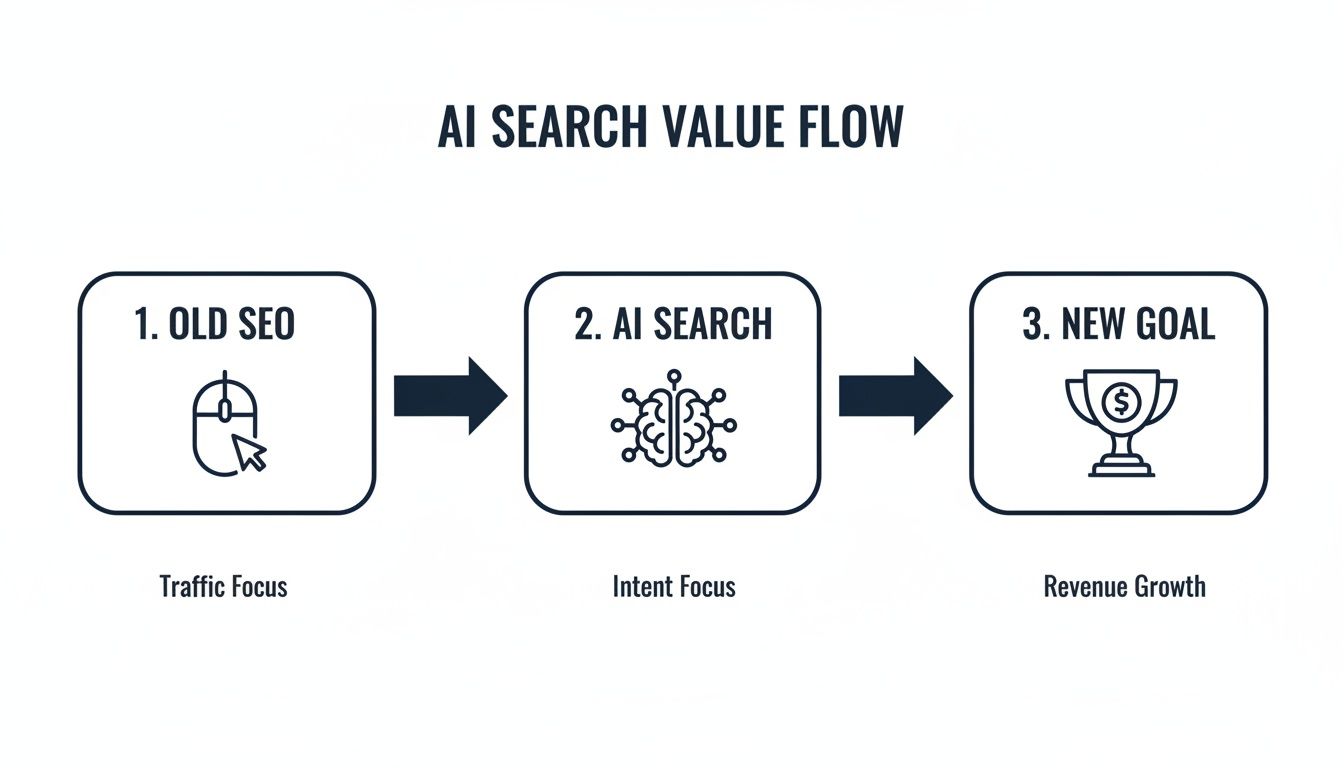
The journey from traditional clicks to AI-driven intent makes one thing clear: the goal is no longer just traffic. It's about capturing pre-qualified customers who bring in real revenue.
Build Deep Topical Authority
First things first: you need to stop thinking about your website as a random collection of pages. Instead, turn it into the definitive resource for what you do. AI engines are built to find and trust the experts. You don't prove you're an expert with one keyword-stuffed page; you prove it by covering your topic from every conceivable angle.
Imagine your website is a library dedicated to a single subject. If you’re a Gold Coast construction firm that specialises in sustainable building, your site needs content on eco-friendly materials, energy-efficient designs, local building regulations, and project case studies. Every single piece of content reinforces the others, creating a web of interconnected knowledge that screams expertise.
This approach is known as building topical authority. It’s what separates the trusted sources from the surface-level content mills in the eyes of an AI. It’s a long game, but one that pays off by making your website the most reliable source of information in your field.
Engineer Content for Humans and AI
Once you've committed to becoming an authority, the next job is to rethink how you create content. The mission is simple: write for humans first, but do it in a way that AI can easily understand. That means doubling down on clarity, structure, and factual accuracy.
AI systems don't "read" a page like a person. They parse it, breaking it down into tiny, digestible chunks of information to figure out if it's relevant and credible. To make their job easier, your content needs to be meticulously organised.
Stick to these key principles for creating AI-friendly content:
- Use Clear Headings: Your H2s and H3s are your content's table of contents. Instead of a vague heading like "Our Services," get specific with something like "Commercial Lease Services for Broadbeach Businesses."
- Answer Questions Directly: Whenever you can, structure your content in a question-and-answer format. This mirrors how people actually search and makes it dead simple for an AI to lift your answer straight into its results.
- Write with Precision: Ditch the ambiguous, fluffy language. Anchor your claims in facts, figures, and specifics. Don't just say your product is "high quality"; explain that it’s "made from 316 marine-grade stainless steel."
- Keep Sentences and Paragraphs Short: Break complex ideas into simple, direct sentences. This makes your content easier for people to read and for machines to understand.
This methodical approach ensures your valuable insights aren't lost in a wall of text. It's about making your expertise as accessible as possible. For more on this, you might find our guide to AI-powered search on the Gold Coast useful.
Demystify Your Content with Structured Data
The final piece of the puzzle is arguably the most technical, but it’s also one of the most powerful: structured data. If your content is the product, think of structured data (also called schema markup) as its nutrition label. It tells AI engines exactly what your content is about, in a language they were built to understand.
Schema markup is a bit of code you add to your website that explicitly defines elements on your page. It can identify your business's name, address, and phone number; tell an AI that a page contains a recipe or a product review; or highlight a list of frequently asked questions. It removes all the guesswork for the machines.
By adding these labels, you turn your plain text into structured information that AI can interpret with total confidence. This dramatically boosts the chances of your content being picked for AI Overviews and other answer engine features.
Here are a few real-world examples for Australian businesses:
- For a Retailer: Using 'LocalBusiness' schema helps an AI understand your physical location, opening hours, and what you sell, making you more visible in local map-style results.
- For a Law Firm: Implementing 'FAQPage' schema on a page answering common legal questions helps your precise answers get pulled directly into search results.
- For a Tradie: 'Service' schema can define the specific services you offer, like "emergency plumbing" or "electrical installations," along with your service area and even your pricing.
Implementing schema isn't just a good idea; it's a critical step in a modern AI search engine optimisation strategy. It’s the most direct way to communicate your value to the machines that now stand between you and your future customers.
How to Prove Your ROI When Privacy Comes First
So, how do you actually measure success in a world that’s rapidly ditching tracking cookies? It's a massive challenge for Australian businesses, particularly if you’re in finance, real estate, or law and handle sensitive client data. Proving the return on your AI search engine optimisation spend needs a completely new way of thinking — one that respects privacy but still shows real, tangible value.
The good news? You absolutely can demonstrate the power of your AIO strategy without creepy, invasive tracking. It’s all about shifting your focus from individual clicks to the bigger business picture.
Moving Beyond Cookies and Clicks
The old model of dropping a cookie and following someone across the web is on its last legs. With privacy laws getting stricter, businesses need a smarter, more respectful way to measure their impact. This means we start looking at correlations, not just direct, one-to-one attributions.
Instead of asking, "Did User X click our ad and then buy something?", we now ask, "After we launched our new AI-optimised content, did we see a noticeable lift in sales enquiries?" This gives you a much more holistic—and honest—view of your marketing's true influence.
This isn’t just a trend; it’s being forced by regulation. By December 2026, Australia's Privacy Principles will officially kill off third-party cookies. This puts the new reality of AI SEO on a collision course with the need for new ways to prove ROI. The Office of the Australian Information Commissioner (OAIC) is already keeping a close eye on sectors in NSW like real estate and finance that use AI for personalisation, demanding clear disclosures to avoid some pretty hefty fines.
A Smarter Way to Measure: Modern Attribution
To prove value in this new landscape, businesses are turning to modern methods like Marketing Mix Models (MMM). It sounds complex, but the idea is actually quite simple. An MMM is a statistical analysis that helps you see how all your different marketing channels work together to drive sales over time.
Think of it like this: say you publish 20 in-depth, AI-optimised articles about commercial property law in Queensland during the first quarter. An MMM can help you connect that activity to a 15% spike in people searching directly for your law firm's brand name a few months later. It connects the dots between your marketing efforts and real business results, all without tracking a single individual.
The goal is to measure the overall "weather change" your marketing creates, not just track individual raindrops. This not only keeps you compliant with privacy laws but often gives you a more accurate picture of what's actually driving your growth.
The Metrics That Matter in a Cookieless World
To prove your ROI today, you need to track the right things. Here are the key performance indicators that really matter in the age of AI search:
- Increase in Branded Search Volume: This is a huge one. When more people are Googling your business by name, it’s a clear sign your brand awareness and authority are growing. It's often a direct result of your content appearing in AI answers.
- Rise in Direct Website Traffic: Just like branded search, a jump in people typing your URL straight into their browser means strong brand recall. They know who you are and are coming directly to you for answers.
- Growth in Qualified Leads: Forget vanity metrics. While overall traffic is nice, a steady increase in high-quality leads—the ones that actually turn into clients—is the ultimate proof that your strategy is hitting the mark.
- Improved Share of Voice: This metric shows how often your brand appears in AI-generated answers for your most important topics compared to your competitors. It’s the new benchmark for market dominance.
Getting this right means using modern analytics platforms. A proper GA4 Integration is essential for tracking these high-level trends and demonstrating the real return on your AI SEO investment. And as you map out your budget, it makes sense to look at transparent SEO pricing packages that are built around these modern, outcome-focused goals. By focusing on these metrics, you can build a powerful, data-backed case for your AI search engine optimisation strategy.
Partnering for Future-Proof Growth
The shift to AI-powered search isn't something on the horizon; it's happening right now, and it's changing the rules for businesses. The old game of chasing clicks and keyword rankings is over. It’s being replaced by an urgent need to build real, verifiable authority and become a trusted source for AI.
Having a clear, strategic plan for AI search engine optimisation is no longer a nice-to-have. It’s essential.
While the technical side of things, like structured data and entity recognition, can sound complicated, the idea behind it is actually quite simple. It’s all about providing genuine value and presenting your expertise in a way that search engine AI can easily understand. This is where having an experienced partner makes all the difference.
Turning Complexity into Opportunity
For a busy business owner, trying to navigate this new landscape alone can feel overwhelming. An agency with deep expertise in AIO can cut through the noise, turning complex technical requirements into a clear, actionable plan for growth. They bring the strategic thinking and hands-on skill needed to build authority that lasts.
The real value of a partnership is having a guide who can future-proof your digital strategy. It’s about making sure your business not only survives this shift but actually thrives by becoming the go-to answer in your industry.
An expert partner will help you:
- Build a content strategy that establishes you as an undeniable expert on your topic.
- Implement the technical markup required for AI to understand and trust your value.
- Measure success with the new metrics that actually matter in a zero-click world.
For Australian businesses, whether you’re a local tradie on the Gold Coast or a national manufacturing firm, the time to adapt is now. Working with a dedicated agency turns the challenge of AI search into your biggest competitive advantage, securing your visibility and driving real growth for years to come.
Got Questions About AI SEO?
Jumping into AI search engine optimisation can feel like learning a new language, and it's natural to have a few questions. Here are some of the most common ones we hear from business owners trying to get their heads around this shift.
Is Traditional SEO Dead Because of AI?
Not even close. Think of AI SEO as building a new, smarter level on top of the house you already have. The foundations of traditional SEO—a solid technical website, quality backlinks, and genuinely helpful content—are more critical than ever. Why? Because those are the exact signals AI models use to figure out who is a credible, authoritative source.
AI SEO doesn't replace the old rules; it just adds a new playbook. The focus now is on structuring your expertise in a way that AI can easily understand, process, and reference. The two work together, not against each other. When you get them both right, you'll be in a prime position to show up everywhere your customers are searching.
How Long Until I See Results from AI SEO?
Just like its traditional counterpart, AI SEO is a marathon, not a sprint. It’s all about consistently building deep topical authority and earning the trust of AI engines, and that doesn’t happen overnight.
How long it takes really depends on how competitive your industry is and where your website is starting from. But here’s the good news: businesses that start laying the groundwork now—by adding structured data and creating content that directly answers user questions—are setting themselves up for long-term success. You could start seeing the first signs of traction within 3 to 6 months as AI systems begin to recognise your site's expertise.
Can I Handle AI Search Engine Optimisation Myself for My Small Business?
Absolutely. A savvy business owner can definitely get the ball rolling on some of the core parts of AI SEO. Your biggest strength is your expertise, so creating comprehensive content that answers your customers' questions is the perfect place to start.
However, some of the more technical pieces of the puzzle often need a specialist's touch to get right. This is where things can get a bit tricky. We’re talking about things like:
- Implementing complex schema markup to spoon-feed information to machines.
- Optimising for entity recognition to cement your business as a known authority in your field.
- Tracking performance in a cookie-less world using modern measurement tools.
Working with a digital agency can make sure your strategy is firing on all cylinders from day one. It saves you from the technical headaches and lets you focus on what you do best—running your business.
Ready to adapt your strategy for the new era of search? The team at Titan Blue Australia has over 25 years of experience helping Australian businesses thrive. Contact us today for a consultation to future-proof your growth.
Make Titan Blue a preferred source in Google
One click tells Google to surface our articles more often in Top Stories, AI Overviews and AI Mode.

Best Dental Website Design Agencies in Australia: 7 Compared
Best dental website design agencies in Australia 2026: seven compared on dental proof, booking, AHPRA…

Childcare Centre Website Design Australia: The 2026 Guide
Childcare centre website design Australia: show hours, ages and enrolment as text so parents and…

Electrician Website Design Australia: The 2026 Guide
Electrician website design Australia: what to build, what we found on eight Gold Coast electrician…