

Last updated:
The biggest AI search trends shaping Australia in 2026 are accelerating faster than most business owners realise. More than half of all Australians now use AI tools in a given month — up from single digits just two years ago. AI search traffic has grown 527% year-on-year globally, 12% of Australians now use AI as their primary way of finding information online, and Google AI Overviews reach 2 billion monthly users worldwide. If your business hasn’t adapted its online presence to these shifts, you are already losing visibility to competitors who have.
This guide covers every major AI search trend Australian businesses need to understand in 2026 — and what you need to do about each one right now.

Why AI Search Trends Matter More in Australia Than Anywhere
Australia has emerged as one of the world’s fastest-adopting AI markets. Roy Morgan’s March 2026 data shows 13.6 million Australians aged 14 and older used AI tools in a given four-week period — that’s 58% of the adult population. A year earlier, that figure sat below 35%.
Telsyte’s June 2026 research found that 12% of Australians already identify AI tools as their primary way of finding information online — up from 5% twelve months prior. In plain terms: one in eight of your potential customers may have already formed a view about your business based on what an AI tool told them, before they ever visited your website.
The competitive implication is direct. If your business appears in AI answers, you’re in the consideration set before the customer even opens a browser. If you don’t, your competitor is.
Trend 1: AI Search Traffic Is Growing at an Extraordinary Rate
According to the Previsible AI Traffic Report 2025, traffic from large language models grew 527% year-on-year when comparing January–May 2024 with the same period in 2025. Some sites are now recording over 1% of total sessions originating from ChatGPT, Perplexity, Copilot, and similar platforms.
That 1% figure sounds modest — but the trajectory matters. Semrush research projects that AI-driven website traffic will surpass traditional search engine traffic by 2028. If AI Mode becomes Google’s default experience globally, that transition could come sooner.
What this means for Australian businesses: Now is the time to establish AI visibility, not in 18 months when the transition is complete and competitive positioning has hardened. Early movers are building brand presence inside AI answers while the space is still relatively uncrowded.
Trend 2: ChatGPT and Gemini Are Now Mainstream Discovery Tools
ChatGPT now has 700 million weekly active users globally and is the fourth most-visited website in the world. In Australia specifically, Telsyte data shows 13.8 million users — meaning the majority of Australian adults have used it at some point. Google Gemini follows with 9.1 million Australian users, Meta AI with 5.6 million, and Microsoft Copilot with 5.4 million.
These are no longer niche research tools. They are mainstream information channels that Australians use every day to find businesses, compare services, and make purchasing decisions.
The implication for your SEO strategy: optimising only for Google’s blue links is no longer sufficient. Your brand needs to appear in conversational AI answers across multiple platforms. This is exactly what Answer Engine Optimisation (AEO) is designed to achieve.
Trend 3: Google AI Overviews Have Reached 2 Billion Users
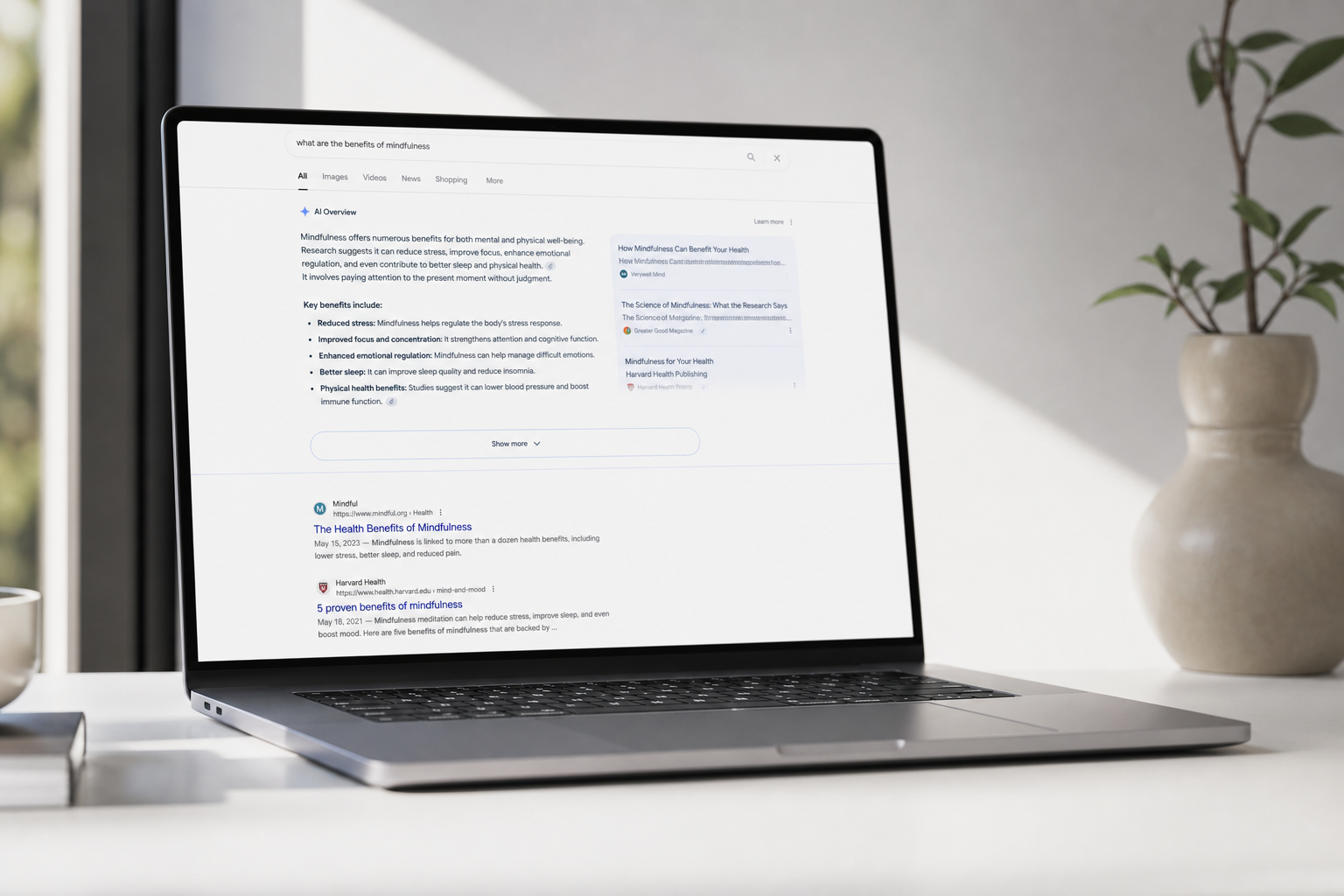
Google’s AI Overviews — the AI-generated summaries that appear above organic search results — now reach 2 billion monthly users in over 200 countries. They are no longer an experiment. They are the dominant feature on the most commercially important search results pages on the internet.
The business impact is significant. When a user searches “best accountant in Brisbane” or “emergency plumber Gold Coast,” the AI Overview often answers the question well enough that the user never clicks a website at all. Industry data from late 2025 onward consistently shows zero-click rates climbing as AI Overviews expand into more verticals including local services, legal, financial, and health.
Businesses that appear within the AI Overview get visibility without a click. Businesses that appear below the AI Overview get fewer clicks than ever. Businesses that appear in neither get almost nothing.
Your strategy must prioritise earning citations inside AI Overviews — which requires structured content, clear entity signals, and strong topical authority. Titan Blue’s Generative Engine Optimisation (GEO) service is built specifically for this challenge.
Trend 4: Conversational Search Is Replacing Keyword Queries
How people search has changed fundamentally. The shift from short keyword queries (“plumber Brisbane”) to long, natural language questions (“who is the best emergency plumber in Brisbane available tonight that accepts EFTPOS?”) is accelerating as AI interfaces normalise conversational input.
This has two major implications for content strategy:
- Long-tail intent signals matter more. Content needs to match the full question being asked, not just the core keyword.
- FAQ sections and structured answers are critical. AI engines decompose queries into sub-questions and look for direct answers. Businesses that structure content to answer specific conversational questions get cited far more often.
Google’s own AI engine now interprets the intent behind a query rather than matching literal keywords. Optimising for conversational search means writing the way your customers talk, not the way a keyword tool thinks they search.
Trend 5: Zero-Click Searches Are Now the Majority of Queries
Semrush research indicates that approximately 60% of searches now yield no clicks on any organic result. Users get their answer from an AI summary, a featured snippet, or a Knowledge Panel — and leave without ever visiting a website.
This is one of the most consequential AI search trends for Australian businesses, because it changes the fundamental value proposition of search visibility. Your website traffic may decline even as AI platforms mention your brand more frequently.
The appropriate response is not panic — it is adaptation:
- Measure brand mentions in AI, not just traffic. If AI tools are recommending your business by name, you’re winning even without clicks.
- Optimise for AI citation, not just ranking. Content that gets cited in AI Overviews builds brand authority that converts when users do click.
- Build direct channels. Email lists, SMS marketing, and social followings become more valuable when search-driven traffic becomes less reliable.
Trend 6: AI Mode Is Reshaping Google’s Core Product
Google launched AI Mode — a fully conversational, AI-first search interface — in May 2025. By early 2026, it had reached 100 million users in the US and India alone, and rolled out to over 200 countries. In Australia, AI Mode is now available to all users through Google Labs.
AI Mode represents Google’s clearest signal of where search is heading: conversational, AI-generated, and multi-step. Users can ask follow-up questions, refine their query mid-conversation, and get synthesised answers that draw from multiple sources across the web.
For businesses, AI Mode means the content that gets cited must be comprehensive, authoritative, and structured for extraction. Thin pages with weak entity signals will not appear in AI Mode answers. Detailed, well-structured content from businesses with strong topical authority will.
Check whether your website is ready to compete in AI Mode with Titan Blue’s AI Readiness Assessment.
Trend 7: Brand Visibility in AI Is Becoming a Board-Level Metric
A significant shift underway in 2026 is the elevation of AI brand visibility from a marketing metric to a business strategy metric. As more customer journeys begin inside AI tools, whether your brand is mentioned favourably by ChatGPT, Perplexity, or Google AI Overviews is becoming as important as your Net Promoter Score or organic search ranking.
Businesses that proactively monitor and manage their AI brand presence are discovering something important: AI tools do not form neutral opinions. They synthesise what is written about your brand across the web — reviews, case studies, media mentions, your own content, and competitor comparisons. Brands with rich, positive, well-structured digital footprints appear more prominently and more favourably in AI answers.
This means digital PR, consistent thought leadership, and structured brand entity signals are now directly tied to your AI visibility. Traditional SEO and Search Engine Optimisation practices that build domain authority continue to matter — they now feed into AI visibility as well as Google rankings.
Trend 8: Local AI Search Is Emerging as a Major Opportunity
One of the most significant and underprepared AI search trends in Australia involves local search. When users ask AI tools “find me a [service] near [location],” those tools are now synthesising answers from Google Business Profiles, local review data, business websites, and third-party directories.
Most local Australian businesses have not optimised for this context. Their Google Business Profiles are incomplete, their local landing pages lack structured data, and their review responses are inconsistent. AI tools queried for local services default to businesses with the richest, most coherent local entity signals — and that’s almost always the businesses that have invested in structured local SEO.
For Gold Coast businesses, local AI search is an immediate competitive advantage. Businesses that address this now will dominate local AI answers before competitors understand what’s happening.
Trend 9: Voice and Multimodal Search Are Accelerating
With the rapid integration of AI into voice assistants — Apple’s upgraded Siri, Google Assistant running Gemini, and Amazon Alexa with AI search — voice queries are growing again after years of stagnation. These platforms are now capable of synthesising complex, multi-step answers rather than reading back a single featured snippet.
Multimodal search — where users combine text, images, and voice to search — is also expanding through Google Lens, ChatGPT’s vision capabilities, and similar tools. Businesses in retail, hospitality, and real estate are increasingly discoverable through image-based queries if their visual assets are properly optimised and contextualised.
Content optimised for voice search shares the same characteristics as AEO and GEO content: direct answers, conversational phrasing, clear entity signals, and structured data. The investment in one channel reinforces all the others.
Trend 10: AI-Generated Content Has Raised the Quality Bar for Everyone
The proliferation of AI writing tools has flooded the web with thin, formulaic content. Ironically, this has created an opportunity for businesses willing to invest in genuinely expert, original content — because AI search engines are actively trying to surface the best, most authoritative sources and filter out the noise.
Google’s own guidance consistently emphasises E-E-A-T (Experience, Expertise, Authoritativeness, Trustworthiness) as core ranking signals, and these signals flow directly into AI Overview citations. Content that demonstrates real expertise — through specific data, named practitioners, case studies, and original insights — earns citations that generic AI-written content does not.
According to Semrush’s 2026 AI SEO statistics, nearly 70% of businesses report higher ROI from AI-assisted SEO — but the key word is assisted. AI as a research and drafting tool, combined with genuine human expertise, outperforms either approach alone. Businesses that use AI purely to cut content costs are producing content that the same AI tools will not cite.
What Australian Businesses Should Do Right Now
The AI search trends outlined above are not predictions — they are happening now, at measurable scale, with real commercial consequences for Australian businesses. Here is where to focus your energy:
- Audit your AI visibility. Search for your business in ChatGPT and Perplexity by asking “[service type] near [city]” and “[your brand name]”. Record what appears. This is your baseline.
- Restructure your key service pages for AI extraction. Add FAQ sections. Use clear H2/H3 headings that match conversational questions. Answer each question directly in the first two sentences of each section.
- Implement schema markup. JSON-LD schema for LocalBusiness, Service, and FAQPage is the clearest signal you can send to AI engines about what your business does and who it serves.
- Build topical authority systematically. A consistent, deep publishing strategy around your core service area builds the entity signal that AI tools use to identify genuine experts.
- Review your Google Business Profile completeness. Local AI search draws heavily on GBP data. Services listed, Q&A populated, reviews responded to, and posts maintained all contribute to local AI citations.
Titan Blue’s digital marketing team works with Australian businesses across all of these areas. If you’re unsure where to start, our AI search audit identifies the highest-impact changes specific to your business and industry.
Frequently Asked Questions: AI Search Trends 2026 Australia
How fast is AI search growing in Australia?
Rapidly. Roy Morgan data shows 58% of Australian adults (13.6 million people) used AI tools in a given month during Q1 2026 — up from below 35% a year earlier. Telsyte found 12% of Australians now use AI as their primary way of finding information online, up from 5% twelve months prior. AI search traffic globally grew 527% year-on-year between 2024 and 2025.
Which AI platforms should Australian businesses optimise for?
Prioritise Google AI Overviews (2 billion monthly users globally), ChatGPT with search (700 million weekly users globally, 13.8 million in Australia), and Google Gemini (9.1 million Australian users). Perplexity and Microsoft Copilot are secondary priorities. The good news: content structures that perform well in one AI platform tend to perform well across all of them.
Will AI search replace Google for Australian businesses?
Not in 2026 — but the gap is closing. AI-driven traffic is projected to surpass traditional search traffic by 2028. More importantly, Google itself is becoming an AI-first platform via AI Overviews and AI Mode. Optimising for AI search and optimising for Google are increasingly the same activity.
What content formats work best for AI search in 2026?
Direct-answer content performs best. This means FAQ sections with specific questions and concise answers, H2/H3 headings that mirror how people ask questions conversationally, short paragraphs with one idea each, and structured data (JSON-LD schema) that tells AI what the content is about. Pillar pages with deep topical coverage earn the strongest entity signals.
How do zero-click searches affect Australian businesses?
Semrush estimates 60% of searches now result in zero clicks on any organic result. For businesses, this means traditional traffic metrics no longer tell the full story of your search visibility. Monitor AI brand mentions separately. Focus on earning citations inside AI summaries — which build brand recognition even without immediate clicks. Invest in direct audience channels alongside search optimisation.
Is local AI search different from national AI search?
Yes. Local AI search queries (“best [service] near [suburb]”) draw heavily on Google Business Profile data, local review sentiment, local landing page content, and structured LocalBusiness schema. National AI queries depend more on topical authority signals and content quality. Local Australian businesses should prioritise GBP completeness, local schema, and service area content as their AI optimisation foundation.
How long does it take to appear in AI search results?
It varies by platform and query type. Some businesses see initial citations within 4–8 weeks of implementing structured AEO improvements. Sustained, prominent AI visibility typically develops over 3–6 months of consistent content and entity signal building. AI tools update their training and retrieval indexes at different cadences, so improvements can appear gradually rather than overnight.
The Bottom Line on AI Search Trends in Australia
The AI search transition in Australia is not a future event — it is the present reality. More than half of Australian adults are using AI tools regularly. One in eight is already using AI as their primary search method. AI search traffic is growing at over 500% per year. Google AI Overviews reach 2 billion users monthly.
Businesses that optimise for this environment now will compound their advantage over the next 18 months. Those that wait are handing ground to competitors who are already acting.
The good news: the fundamentals of AI search optimisation are learnable, implementable, and measurable. You don’t need to become an AI expert — you need a digital marketing partner that already is.
Titan Blue specialises in AI search visibility for Australian businesses. Contact us today to find out how your business can get cited, recommended, and found in the AI search platforms your customers are already using.
Make Titan Blue a preferred source in Google
One click tells Google to surface our articles more often in Top Stories, AI Overviews and AI Mode.

Plumber Website Design Australia: The 2026 Guide
Plumber website design Australia: what to build, what we found on seven Gold Coast plumber…

Beauty Salon Website Design Australia: The 2026 Guide
Beauty salon website design Australia: how to get bookings, show services as text and be…

Best Gym Website Design Agencies in Australia: 7 Compared
Best gym website design agencies in Australia compared: 7 picks, who each suits, what their…