


Last updated:
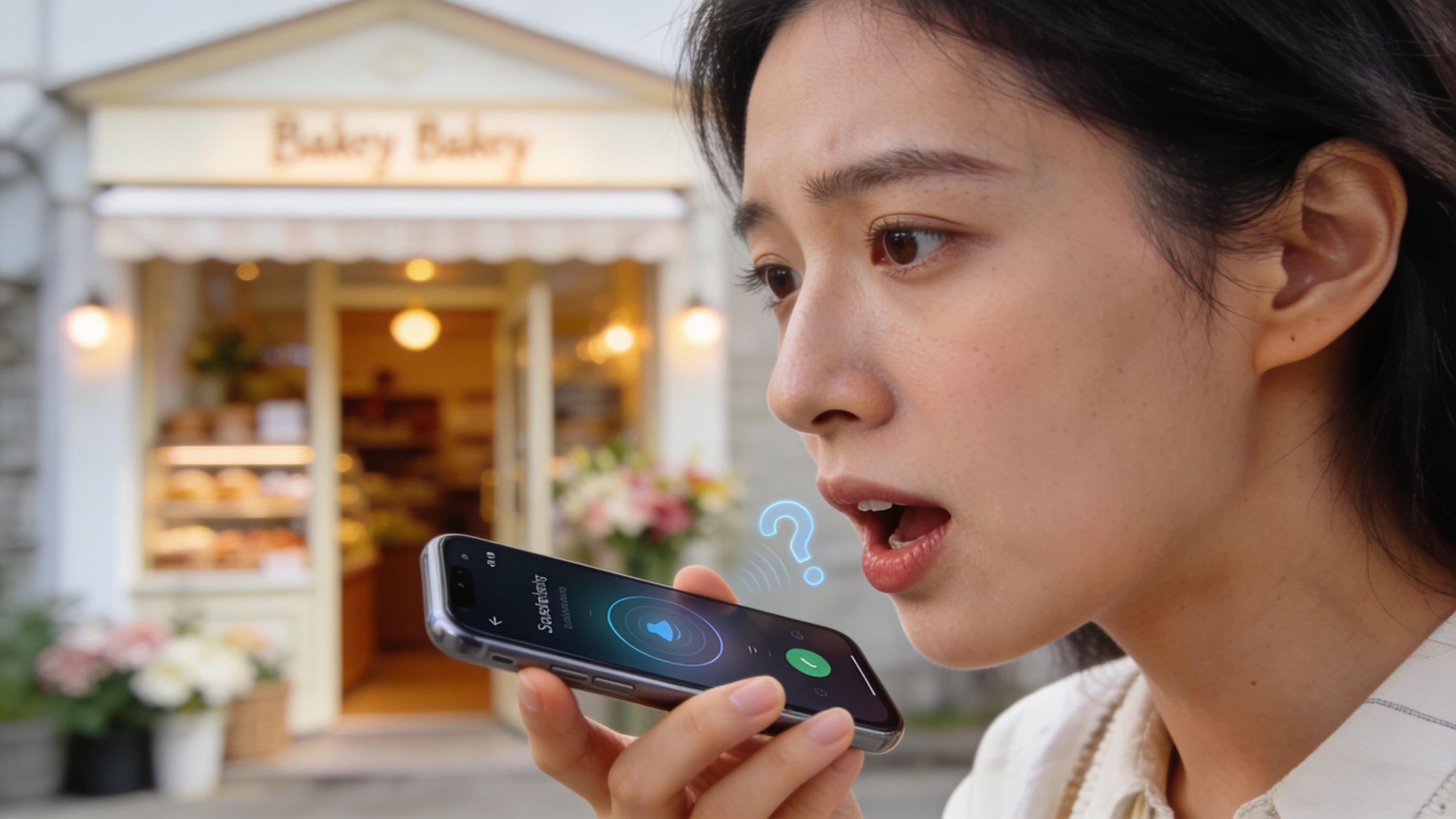
A customer stands outside your shop, phone in hand, and asks a simple question. “Best breakfast near me open now.” Or “Emergency plumber available tonight.” Or “Solar installer who can explain rebates.”
They don't always scroll through ten blue links anymore. Often, they get a summary, a shortlist, or a direct recommendation. If your business isn't part of that answer, you can lose the enquiry before your website even has a chance.
That's why answer engine optimisation services matter now. This isn't a buzzword layered on top of SEO. It's a practical response to how people search today. For local Australian businesses, especially trades, hospitality, restaurants, and service operators, the shift is simple to understand. The search result is turning into the answer itself.
Why Your Customers Are Searching Differently
A local search used to be a small journey. Someone typed a service, compared a few businesses, clicked through websites, and then decided who to call. Now that journey is shorter.
A person with a leaking pipe might ask their phone for “a plumber near me open now” and get an AI-generated summary. A tourist in Broadbeach might ask for “family-friendly dinner with outdoor seating” and see a recommendation before they ever land on a venue website. The old goal was getting the click. The new goal is being included in the answer.
This shift isn't theoretical. A widely cited SparkToro study reported that 64% of searches end without a click and only 36% send users to the open web, as discussed in this overview of the state of answer engine optimisation. If your business isn't the source of the answer, you can be invisible to most of that search activity.
What this looks like in real business terms
For a restaurant, it means fewer menu-page visits but more decisions being made before the click.
For a plumber, it means the searcher may choose the business whose hours, service area, and emergency capability are easiest for an answer engine to understand.
For a builder or solar installer, it means the brand that explains complex questions clearly can become the business the AI surfaces first when someone asks for guidance.
Practical rule: Ranking well still matters. But “number one on Google” isn't the whole game when the customer may never visit a results page in the old way.
The businesses feeling this change first are usually the ones that depend on high-intent local searches. Someone searching for a late table, a blocked drain, or a quote for a system installation isn't browsing casually. They're trying to act.
Why local operators need to pay attention
Australian businesses can't treat this like a Silicon Valley trend that might arrive later. Google dominates search behaviour here too, so any change in AI summaries and answer-style results affects local demand. Categories like hospitality, trades, construction, and solar are especially exposed because they rely on quick decisions, nearby relevance, and trust signals.
That's why many businesses are now reviewing their AI search visibility alongside their normal SEO. They're asking a different question. Not just “Do we rank?” but “Can an AI system understand us well enough to recommend us?”
That's a different problem. It needs a different type of optimisation.
Understanding Answer Engine Optimisation
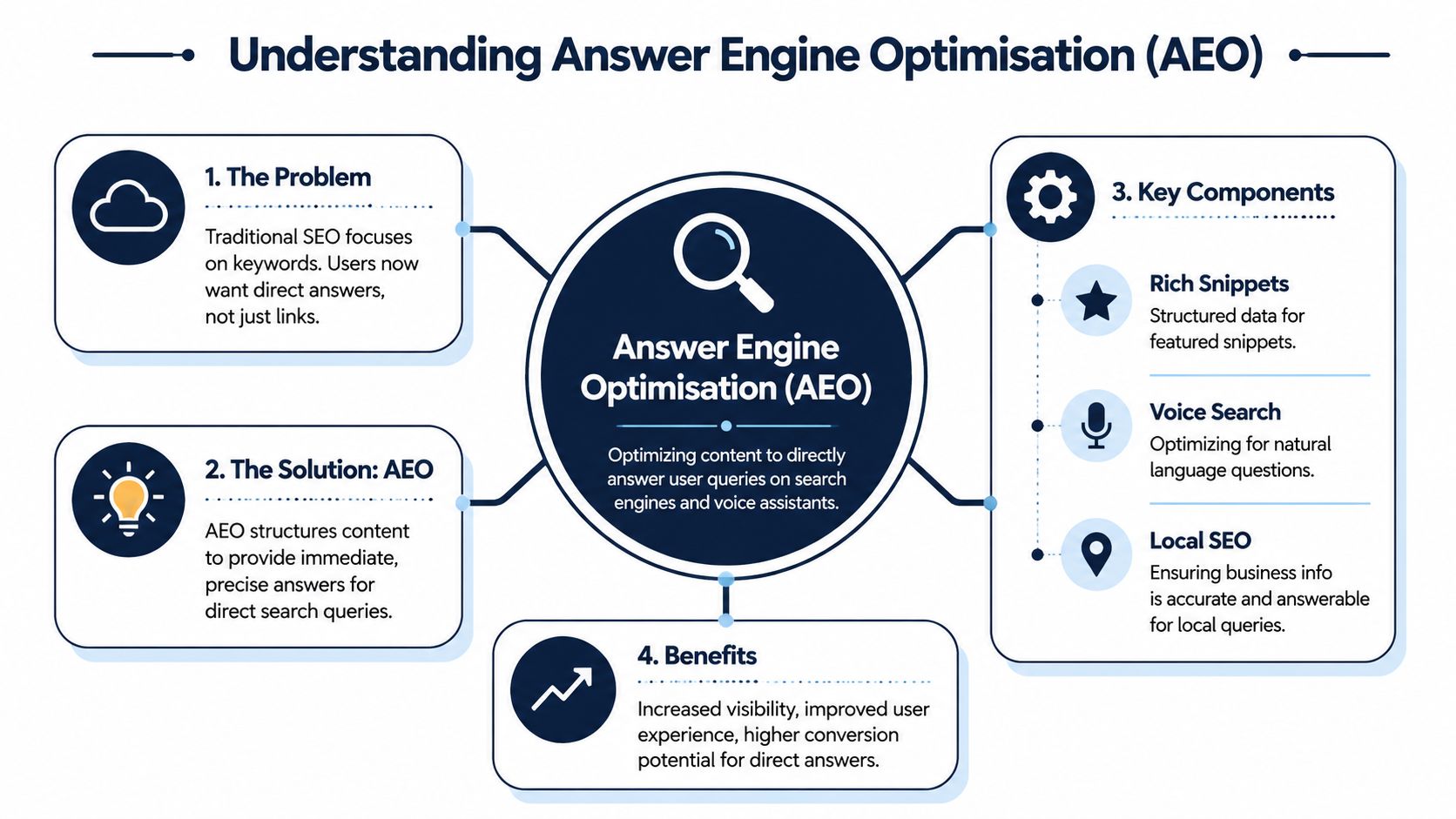
Answer engine optimisation is the work of making your business easy for AI-driven search systems to understand, trust, and cite.
The simplest way to think about it is this. Traditional SEO helps your website compete for a place on the shelf. AEO helps your business become the label the shop assistant reads out when a customer asks for the best option.
That difference matters. A search engine can rank a page because it looks relevant. An answer engine has to assemble a response. To do that, it needs clean signals about who you are, what you do, where you operate, and which questions you answer clearly.
What AEO includes
At a practical level, answer engine optimisation services usually involve a mix of these elements:
- Structured data: Schema markup helps machines understand business details such as services, opening hours, service areas, and FAQs.
- Entity consistency: Your business name, address, phone, services, and brand references need to match across your site and external profiles.
- Answer-first content: Pages need to answer real customer questions directly, not bury useful information beneath sales copy.
- Technical accessibility: If critical content only appears after heavy client-side rendering, answer engines may struggle to process it.
One of the biggest technical shifts is how AI retrieval works. Answer engines use a Retrieval-Augmented Generation process, and content with valid, thorough schema markup is “significantly more likely to be cited” in AI responses because it creates machine-readable entities that engines prioritise during retrieval, as explained in this guide to getting cited by AI through AEO.
How it differs from old-school SEO
SEO still matters. You still need crawlable pages, strong local relevance, fast load times, useful content, and authority. AEO doesn't replace that foundation. It builds on it.
What changes is the format and intent.
A traditional SEO page might target a term like “Gold Coast emergency plumber” and focus on ranking for that phrase. An AEO-ready page still targets the service, but it also answers direct questions such as:
- Do you offer after-hours plumbing?
- Which suburbs do you service?
- How quickly can you attend?
- What should I do before the plumber arrives?
Those answers help both people and machines.
AEO is less about stuffing in phrases and more about removing ambiguity. If an AI system has to guess what you do, where you work, or whether you're open, you've already made the job harder.
This is why some businesses now combine SEO with generative engine optimisation. The goal isn't just traffic. It's machine-readable trust.
What doesn't work
A lot of businesses make the same mistakes:
- Thin FAQ pages with generic questions nobody asks
- Location pages that swap suburb names but add no real information
- JavaScript-heavy layouts where business details don't appear in the initial page output
- Inconsistent contact details across web properties
- Long introductions before the useful answer appears
Machines don't reward fluff. They reward clarity.
If you run a local business, the practical test is straightforward. Can a customer, or an AI assistant, tell within seconds what you do, who you help, where you work, and how to contact you? If the answer is no, the site needs work.
How AEO Drives Leads for Local Businesses
AEO only matters if it leads to business outcomes. For most local operators, that means calls, bookings, quote requests, and walk-ins.
That's where a lot of generic advice falls short. It talks about citations and visibility as if they're the finish line. They're not. Visibility is useful only if it helps a customer choose you.

In Australia, that local intent is strong. 76% of people who search for a local service on their smartphone visit a related business within a day, according to this discussion of AEO services and local conversion intent. That's why answer engine optimisation services need to focus on local action, not just answer inclusion.
A plumber needs urgency, not theory
If someone searches for help with a burst pipe, they don't want a polished brand essay. They want to know:
- do you service their area
- are you available now
- what number should they call
- what to do in the next five minutes
AEO helps surface that information in a format answer engines can use. The winning page is often the one that puts the urgent answer near the top, clearly names suburbs or regions served, and makes the phone number hard to miss.
A page that says “we provide an extensive range of plumbing solutions” is weak. A page that says “Emergency plumber servicing Southport, Broadbeach, Robina and nearby areas. Call now for urgent burst pipe help” is much stronger.
A restaurant needs to remove friction
A restaurant owner usually cares about bookings, opening hours, dietary questions, and location signals. If someone asks an AI-powered search for “best seafood near Broadbeach with outdoor seating,” the answer engine looks for extractable information.
That means details like:
- outdoor seating availability
- booking options
- cuisine type
- opening hours
- dietary answers such as gluten-free or vegetarian options
If that information sits in clean headings, FAQ sections, and schema-backed business details, the restaurant has a better chance of appearing in the answer and converting that interest into a booking.
A short explainer on where AEO fits into this shift can help frame the opportunity:
A solar installer needs authority
Solar is different again. Customers often ask layered questions before they're ready to enquire. They want plain-English answers on suitability, costs, installation process, rebates, timelines, and maintenance.
That's where AEO can support lead quality. Instead of relying on a generic service page, a solar business can publish clear answer-led content that addresses the actual decision path. The AI summary may answer part of the query immediately, but if your business becomes the trusted source behind that answer, branded searches and quote requests become more likely.
The right AEO content doesn't just say “we do the work.” It proves you understand the question the buyer is trying to solve.
Many operators now assess this through a local-lead lens rather than a pure ranking lens, which is the right way to think about why AEO matters for Aussie businesses and local leads.
The practical pattern across industries
Whether you run a café, plumbing business, or installation company, the pattern is the same:
- High-intent searches need immediate answers
- Local trust signals need to be machine-readable
- Conversion details need to be obvious
AEO doesn't replace your sales process. It improves the moment before the sale, where the customer decides whether you're worth contacting at all.
Our Proven Answer Engine Optimisation Process
Good AEO work is organised. It isn't a bag of hacks, and it isn't a one-off FAQ page added to the site.
The process starts by checking whether your business can be understood clearly across the web. If your site, Google Business Profile, directory listings, service pages, and brand mentions all describe you slightly differently, answer engines receive mixed signals. Mixed signals produce weak recommendations.
Step one starts with the business entity
The first job is to audit the digital entity itself. That includes your core business details, service categories, areas served, review signals, location references, and the way your website presents them.
For a local operator, this usually uncovers practical issues fast:
- Inconsistent naming: One version of the brand on the website, another on profiles
- Missing service-area detail: The business says “Gold Coast” but never clarifies which suburbs it covers
- Patchy local relevance: Pages mention services but not the context that helps an answer engine connect them to place and intent
An AI visibility audit is useful because it shows whether your business can be extracted, interpreted, and matched to the kinds of questions your customers are asking.
Step two reshapes content for extraction
AEO content has to be easy to lift. That sounds mechanical, but it's really about clarity.
The most important information should appear close to the heading that introduces it. According to MarketingProfs, the essential information should be within the first 100 words after each heading, and key content needs to render in the initial HTML because AI crawlers may time out on pages that rely heavily on client-side JavaScript, as outlined in this article on AEO vs SEO and zero-click search.
That changes how pages should be written.
Instead of this:
“Welcome to our business. We pride ourselves on quality service and have built a reputation over many years…”
A stronger structure is closer to this:
“Emergency plumber servicing Broadbeach, Mermaid Waters, Robina and nearby suburbs. Available for urgent blocked drains, burst pipes and hot water issues.”
The second version gives both people and machines something usable immediately.
Field note: If your best answer is buried halfway down a page, don't expect an answer engine to do the digging for you.
Step three adds machine-readable reinforcement
After the page structure improves, technical markup supports it. This often includes business schema, location details, service references, breadcrumbs, and FAQ markup where it provides value.
Then the work moves beyond the website. Citations, business profiles, and external references need to reinforce the same entity signals. That consistency is what helps an answer engine trust that your brand is a real, relevant local source rather than just another webpage.
One option businesses use for this kind of work is Titan Blue Australia, which provides answer engine optimisation services as part of broader AI search preparation. What matters most, though, isn't the label on the service. It's whether the process covers entity clarity, extractable content, and technical readiness together.
What a proper process avoids
A weak AEO process usually shows up as random activity:
- publishing AI-themed blogs unrelated to buyer intent
- adding schema without fixing page clarity
- chasing broad informational topics while neglecting local service pages
- treating citations as the goal instead of the path to leads
That's why the method matters. AEO works best when the technical, editorial, and local signals all support the same commercial objective.
Measuring Real Business Impact from AEO
The hardest question in this space is the right one. “How do I know this is making money?”
That question matters because AEO changes where visibility happens. Some value appears before the click. Some appears in branded search uplift. Some appears in better lead quality because the person contacting you already understands your offer.
The challenge for Australian businesses is that ROI frameworks are still catching up. As noted in this analysis of AEO agencies and ROI questions, a practical AEO framework needs to focus on which specific query types justify investment and how to measure incremental bookings in competitive local markets.
Start with the queries that affect revenue
Not every query deserves the same investment.
If you run a trade business, “how does a hot water system work” may help authority, but “hot water repair near me” is closer to revenue. If you run a restaurant, “what is modern Australian cuisine” isn't as commercially useful as “restaurant open now with outdoor dining.” If you install solar, broad educational content may help trust, but location-aware buying questions are usually more valuable.
That's why measuring AEO starts with query classes:
- Immediate service intent such as emergency help or same-day availability
- Local comparison intent where users are choosing among nearby providers
- Pre-enquiry trust questions involving process, pricing context, timing, or suitability
- Low-intent research queries that may support awareness but not immediate leads
A lot of businesses waste time trying to “win AI visibility” everywhere. That's too broad. Measure where the business outcome is most plausible.
The metrics that actually matter
Traffic alone won't tell the whole story. A page can lose clicks and still contribute more commercial value if the business is being surfaced correctly in answer-led search.
The useful indicators are more grounded:
- Increase in qualified calls: Are more callers asking for the exact service pages you've improved?
- Booking and enquiry quality: Are leads arriving better informed and further along in the decision process?
- Branded search behaviour: Are more people searching your business by name after seeing it referenced in AI-driven answers?
- Coverage of high-intent topics: Are your priority service questions being answered clearly and consistently across the site?
- Local conversion actions: Are users calling, requesting directions, checking hours, or submitting quote forms from the pages aligned to answer intent?
AEO should be judged the same way you'd judge a good salesperson. Not by how many conversations they start, but by whether they help the right customers take the next step.
How to think about pricing and investment
AEO isn't a bolt-on expense if your business relies on search visibility. It's part of keeping your demand pipeline aligned with how customers now discover providers.
For some businesses, the right move is a foundational clean-up. Fix entity consistency, restructure priority service pages, add essential schema, and improve extractability. For others, the work is ongoing because new customer questions, AI interfaces, and local competitors keep changing the search environment.
The practical benchmark isn't “Did we get more pageviews?” It's closer to this:
- Are more high-intent queries leading to contact?
- Are more bookings tied to pages designed for answer extraction?
- Are we easier to choose in the moment a customer is ready to act?
If the answer is yes, the investment is doing its job.
How to Choose Your AEO Services Partner
AEO is still new enough that plenty of providers talk confidently without showing a clear operating model. That's a problem for local businesses, because this work affects the pages and signals that drive real enquiries.
The first thing to look for is local commercial understanding. A provider should know the difference between a content plan for a national publisher and one for a Gold Coast plumber, a restaurant, or a construction firm. Local businesses don't need vague “AI authority.” They need a stronger path to calls, bookings, and quote requests.
Questions worth asking before you sign
Some questions will tell you very quickly whether the agency understands the job:
- How do you prioritise query types? They should separate informational topics from bottom-funnel service searches.
- What technical issues do you look for first? A serious provider will talk about rendering, schema, extractability, and entity consistency.
- How do you connect AEO to local conversion? They should mention booking flows, click-to-call actions, opening hours, and service-area clarity.
- How will success be measured? If the answer is just “more visibility,” keep digging.
If you're comparing providers more broadly, this resource on finding SEO partner firms gives a useful framework for assessing strategic fit, technical capability, and communication quality. Those same filters apply here.
What strong partners do differently
A good AEO partner won't treat answer engine optimisation services like a magic trick. They'll treat it like a disciplined extension of search strategy.
That means they should be able to:
- explain trade-offs clearly
- show how content, technical SEO, and local signals work together
- avoid vanity reporting
- talk in business terms, not just platform jargon
Experience matters too. Search changes fast, but pattern recognition still counts. Agencies that have worked through multiple search shifts tend to be calmer, more methodical, and less likely to chase gimmicks.
For a deeper look at what to assess, this guide to choosing the right engine optimisation companies for 2026 is a useful starting point.
The right partner should leave you with more clarity, not more confusion. If they can't explain how your business will become easier for answer engines to understand and easier for customers to contact, they're probably selling a trend, not a service.
If your business depends on local discovery, now is the time to ensure AI-driven search can understand and recommend you. Titan Blue Australia helps businesses align SEO, local search, and answer engine optimisation so online visibility turns into practical outcomes like calls, bookings, and qualified enquiries.
Make Titan Blue a preferred source in Google
One click tells Google to surface our articles more often in Top Stories, AI Overviews and AI Mode.

Best Dental Website Design Agencies in Australia: 7 Compared
Best dental website design agencies in Australia 2026: seven compared on dental proof, booking, AHPRA…

Childcare Centre Website Design Australia: The 2026 Guide
Childcare centre website design Australia: show hours, ages and enrolment as text so parents and…

Electrician Website Design Australia: The 2026 Guide
Electrician website design Australia: what to build, what we found on eight Gold Coast electrician…