Attorney seo marketing: Proven Strategies to Grow Your Practice
Struggling to bring in high-value clients in a seriously crowded online space? You're definitely not alone. The fact is, specialised attorney SEO marketing is what separates thriving modern law firms from the ones that get lost in the noise. It’s about moving past generic advice and getting inside the head of a potential client, right from their first panicked Google search to the moment they book a consultation.
Why Generic SEO Fails Law Firms
Standard search engine optimisation tactics just don't cut it for the legal industry. A law firm isn't selling a t-shirt; you're offering a high-stakes, trust-based service when people are often at their most vulnerable. Their decision-making process is entirely different, usually driven by urgency, stress, and a desperate need for proven expertise.
Generic SEO completely misses these critical details.
A typical approach might target broad, high-volume keywords, but this usually just brings in traffic that will never convert. Think about it: someone searching "what is a contract" is just looking for information. But someone searching "breach of contract lawyer Sydney" has a real, urgent problem they need solved now. The intent is worlds apart.
The Problem with a One-Size-Fits-All Approach
Trying to apply a retail or B2B SEO playbook to a law firm ignores what makes the legal field unique. This is where a specialised focus is non-negotiable.
Building Real Trust and Authority: Potential clients need to see you know your stuff. This is about more than just stuffing keywords onto a page. It requires content that showcases deep legal knowledge and builds authority—what Google calls E-E-A-T (Experience, Expertise, Authoritativeness, and Trustworthiness).
Navigating Strict Ethical Rules: Legal advertising is a minefield of ethical guidelines that change depending on where you practice. A generic SEO agency could easily use language that lands your firm in hot water. Specialised attorney SEO marketing operates within these crucial boundaries from day one.
Winning the Local Battle: Most people look for a lawyer nearby. A winning strategy has to be laser-focused on local SEO, making sure your firm dominates the Google Map Pack and shows up for all those "near me" searches.
At the end of the day, SEO for lawyers isn't about chasing vanity metrics like traffic numbers. It's about attracting the right client—the one whose case is a perfect fit for your practice and who is ready to pick up the phone. This demands a much deeper, more strategic approach than what a generic agency can ever offer.
You can learn more about building a solid foundation in our detailed guide on marketing for a law firm. We lay out the essential pillars you need, from client-focused keyword research to creating content that builds undeniable trust.
Decoding Client Intent With Keyword Research
Effective attorney SEO marketing all comes down to one thing: knowing exactly what your potential clients are searching for online. This goes way beyond basic terms like "lawyer near me." It’s about digging deep to find the high-intent phrases that signal someone is actively looking for legal help and is ready to act.
Think about the difference. Someone searching "what is a will" is just dipping their toes in the water, gathering information. But a person typing "how to contest a will in NSW" or "unfair dismissal claim process QLD" has a real, urgent problem. Your entire strategy should be geared towards connecting with that second person, addressing their immediate legal needs head-on. This is how you attract qualified leads, not just random website visitors.
To get there, you first need a crystal-clear picture of your ideal client. Understanding how to go about creating detailed buyer personas is a fantastic starting point, as it forces you to define who you're trying to reach and what problems keep them up at night.
Moving Beyond Basic Keywords
The trick is to think like your client. What words would they use when they're stressed, confused, or in desperate need of legal advice? It's highly unlikely they'll use formal legal jargon. Instead, they’ll use natural, question-based language that just describes their situation.
This is where specialised tools come in. We use them to uncover these valuable phrases, see how many people are looking for them, and confirm they have real commercial value. It’s all about creating a clear map that links specific search terms to the different stages of a potential client's journey.
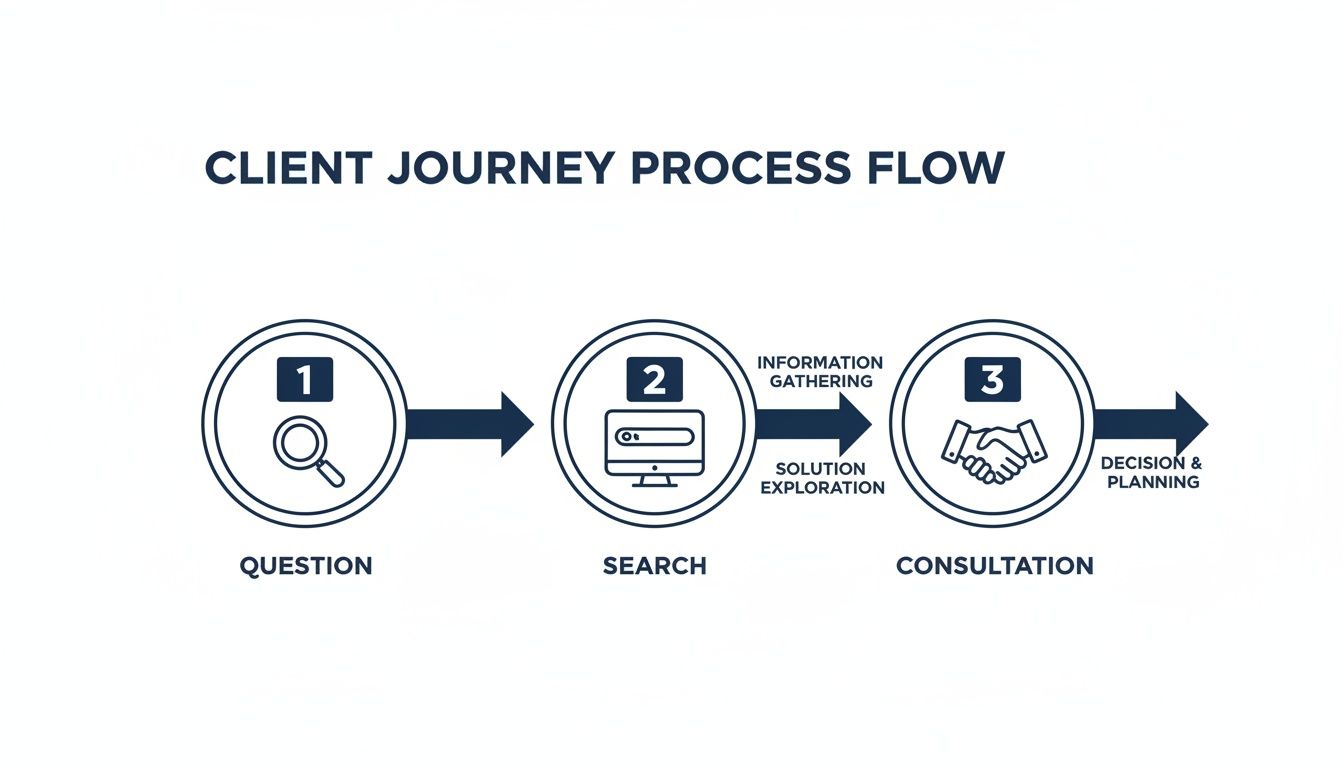
It usually looks something like this:
As you can see, every potential client starts with a question. That question leads them to a search engine long before they even think about picking up the phone. Your keyword strategy needs to meet them at each phase to guide them straight to your firm.
Mapping Keywords to the Client Journey
To build a strategy that actually works, you need to sort your keywords based on intent. This lets you create laser-focused content that speaks to potential clients exactly where they are in their decision-making process.
Informational Intent: These are the "top-of-funnel" searches. Think of questions like "what are the grounds for divorce in Victoria" or "employee rights during redundancy." While these people aren't ready to hire you today, ranking for these terms positions your firm as a trusted authority they'll remember when the time comes.
Transactional Intent: This is where the money is. These are the "bottom-of-funnel," high-value searches that scream "I need to hire a lawyer now!" These keywords almost always include terms like "lawyer," "attorney," or "solicitor," plus a location or an action word like "hire," "consultation," or "fees." A perfect example is "best family lawyer Gold Coast."
Focusing on these transactional terms is where you’ll see the most direct ROI. In the cut-throat Australian legal market, firms ranking on page one of Google for high-intent keywords like 'personal injury lawyer Sydney' can attribute a massive 60% of their leads to their online presence. For context, Google's data shows over 3,600 monthly searches for that term alone, with an average cost-per-click (CPC) of $84.88 AUD—which shows just how valuable those organic rankings are.
By focusing on transactional and long-tail keywords, you filter out casual researchers and attract individuals with genuine legal issues who are actively looking for representation. This targeted approach dramatically improves lead quality and conversion rates.
At the end of the day, a solid keyword strategy does more than just bring traffic. It ensures the right people find you at the right time, turning your website into a consistent, reliable source of high-value cases. For a deeper dive into the nuts and bolts of this process, check out our guide on mastering keyword research with Titan Blue.
Dominating Your Local Search Market
For most law firms, the best clients aren't on the other side of the country; they're right in your local community. This means winning in local search isn't just an option—it's the entire game. Your attorney SEO marketing efforts deliver the most direct and tangible results right here, connecting you with people actively looking for legal help in your area.
The whole process really begins and ends with your Google Business Profile (GBP). You could argue it's the single most important local ranking factor for your firm. Think of it as your digital front door. With nearly 50% of all Google searches being for local information, a well-optimised GBP is your ticket to appearing in the highly coveted "Map Pack" results.
Optimising Your Google Business Profile
Just having a GBP isn't enough. To truly stand out, you need to treat it like an active marketing channel, feeding Google and potential clients rich, accurate, and compelling information.
First up is your category selection. Don't just pick "Law Firm." Get specific. If you’re a family lawyer, choose "Family Law Attorney." If you handle criminal cases, select "Criminal Justice Attorney." Google offers plenty of specific legal categories, and choosing the most relevant ones is a powerful signal of your specialisation.
Next, you'll want to craft a compelling business description. This is your chance to tell your story. Mention your key practice areas, highlight your years of experience, and include what makes your firm unique. It's the perfect place to naturally weave in important keywords like "Parramatta criminal defence lawyers" if that's your focus.
Building Consistent Local Citations
Beyond your GBP, Google looks for consistency across the web to verify who you are, what you do, and where you are. This is where local citations come into play. A citation is simply any online mention of your law firm's name, address, and phone number (NAP).
Consistency here is absolutely critical. Your NAP must be identical across every single directory and platform you're listed on. Even a tiny variation, like using "St." on one site and "Street" on another, can dilute your local authority and confuse the search engines.
To build a strong foundation, focus on getting your firm listed correctly in key Australian directories. It is important to have listings on broad Australian directories that carry significant authority. Additionally, listings on legal-specific directories, such as those from Law Society sites or specialised legal portals, are invaluable. They not only build citations but also function as powerful, industry-relevant backlinks.
Building these citations manually can be a slow process, but it’s a foundational element of any successful local SEO strategy for businesses.
A robust and consistent citation profile acts like a series of votes of confidence for your firm's physical location. It reinforces to Google that you are a legitimate, established local business, which is a major factor in Map Pack rankings.
Creating Hyper-Local Service Pages
To capture those highly targeted, suburb-level searches, you need to go beyond a generic "Services" page. Create dedicated pages on your website for each combination of practice area and location you serve. We call these "location pages" or "hyper-local service pages."
For example, instead of just having a single page for "Family Law," create separate, unique pages for:
"Family Lawyers Parramatta"
"Divorce Solicitors Chatswood"
"Child Custody Experts Hornsby"
Each of these pages should be filled with unique content that's actually relevant to that specific suburb. You could mention your proximity to local landmarks like the Parramatta Justice Precinct, discuss specific local regulations if they apply, or include testimonials from clients in that area. This highly targeted approach shows Google you're the go-to authority for that service in that exact location, dramatically increasing your chances of ranking.
The Power of Online Reviews
Finally, don't forget that your online reputation is a cornerstone of local SEO. Positive reviews are a direct ranking signal, and a steady stream of recent, positive feedback shows Google that you're an active and trusted business. More importantly, 93% of consumers say online reviews have influenced their purchasing decisions.
You need to actively and ethically solicit reviews from satisfied clients. Make the process as easy as possible for them with a direct link to your GBP review section. Just as important is how you manage the feedback you receive. Respond professionally and promptly to every single review, both positive and negative. A thoughtful response to a negative review can often win over more potential clients than a dozen five-star ratings, as it shows you’re attentive, professional, and dedicated to client satisfaction.
Building a Technically Sound Website
Your website is the foundation of your entire attorney SEO marketing strategy. It’s where potential clients form their first impression and where Google looks for signals of professionalism and credibility. If the technical elements aren't right, even the best content and keyword strategy will fall flat.
Think of your website like your physical office. If it’s slow to get into, hard to navigate, or looks like it's falling apart, potential clients will just turn around and leave. The exact same thing happens online, where a poor user experience sends qualified leads straight to your competitors.
Prioritising Speed and Mobile Experience
These days, speed isn't a luxury; it's non-negotiable. With more than half of all web traffic now coming from mobile devices, your site has to be flawless on a smartphone. A slow-loading or clunky mobile site is one of the fastest ways to lose a potential client, especially someone who is likely searching for help under stressful circumstances.
This isn't just an opinion—it's a massive ranking factor. A recent audit of leading Australian law firm websites revealed some pretty startling issues. Nearly 28% failed Google's Core Web Vitals tests, which directly measure user experience through loading speed, interactivity, and visual stability.
Just a one-second delay in page load time can slash conversions by 7%. That’s a huge loss when you’re competing for high-value cases. You can explore the full findings and what they mean for the legal search landscape in this detailed law firm SEO report.
You can get a quick diagnosis of your site's performance using free tools like Google's PageSpeed Insights. It gives you a clear score and practical recommendations to improve your load times.
Creating a Logical Site Structure
A well-organised website is crucial for both users and search engines. A logical structure, what we call "site architecture," makes it simple for visitors to find what they need and helps Google understand how all your pages relate to each other.
A simple, effective structure for a law firm usually looks something like this:
Homepage: Your digital front door, introducing your firm.
About Us: Builds trust by showcasing your team's expertise.
Practice Areas: A main page that links out to specific service pages.
Specific Service Pages: E.g., "Criminal Defence," "Family Law," "Wills & Estates."
Blog/Resources: Demonstrates your authority and answers client questions.
Contact Us: Provides clear, easy ways to get in touch.
This organised hierarchy allows for smart internal linking. By linking from a blog post about divorce proceedings back to your main "Family Law" service page, you pass authority and guide users towards taking that next step. A strong site structure is a core part of any professional law firm website development project.
Speaking Google's Language with Schema Markup
While a good structure helps, you can give search engines even more explicit information using Schema markup. It's a type of code you add to your website to give clear context about your content. Think of it like adding labels to your information so Google doesn't have to guess.
For a law firm, certain Schema types are incredibly valuable:
LegalService: This tells Google that a page is about a specific legal service you offer.
Attorney: You can use this on your team or bio pages to identify individual lawyers.
FAQPage: Use this on pages with questions and answers to become eligible for rich snippets in search results.
Implementing this markup helps Google understand your firm's expertise, location, and services with absolute clarity. This massively boosts your chances of appearing in more prominent search features, like map packs and rich results, which directly supports your overall attorney SEO marketing goals. It’s a technical step that translates directly into better visibility and more qualified leads.
Creating Content That Builds Authority and Trust
In the legal world, a potential client's decision almost always comes down to one thing: trust. Your website's content is your best shot at building that trust long before they ever think about picking up the phone. A smart attorney SEO marketing plan isn't just about ranking for keywords; it’s about proving your expertise is undeniable.
This all comes back to demonstrating your firm's Experience, Expertise, Authoritativeness, and Trustworthiness (what Google calls E-E-A-T). Google puts a massive emphasis on these signals, especially for high-stakes industries like law. Your content needs to do more than just get eyeballs on the page—it has to answer real, pressing questions with clarity and confidence, turning visitors into clients.
Developing Content Beyond the Blog
While a blog is a great tool, your most critical content assets are your core practice area pages and deep-dive legal guides. These are the pages that speak directly to someone who is ready to hire a lawyer right now. They need to be comprehensive, logically structured, and put your firm's deep legal knowledge on full display.
Think of these pages as digital consultations. They should anticipate every question a client might ask in your office, offering tremendous value upfront. A powerful practice area page on "Workplace Discrimination" won't just list what you do. It will explain what legally constitutes discrimination, map out the legal process in your state, and subtly weave in your firm's experience.
Showcasing Expertise Ethically
Sharing your wins is a powerful trust-builder, but you absolutely must play by your jurisdiction's ethical rules. Vague claims like "best lawyer" are often prohibited and, frankly, don't work anyway. The smarter move is to demonstrate your expertise through detailed, anonymised case studies.
Here’s a simple framework for highlighting successful outcomes while protecting client confidentiality:
Describe the Client's Initial Problem: Start with the challenge they faced, keeping it general. For example, "A client approached us after being unfairly dismissed from a role they'd held for over a decade…"
Outline the Legal Strategy: Walk through the steps you took. This highlights your strategic thinking without giving away privileged details.
Detail the Positive Outcome: Clearly state the successful result, like securing a significant settlement or a winning verdict.
This method proves your firm's capabilities with real-world examples, not empty promises.
High-quality, authoritative content is the absolute cornerstone of E-E-A-T for any law firm. It’s not just about what you say, but how you prove it through detailed guides, helpful resources, and demonstrated success—all while upholding the highest professional standards.
The Vital Role of Off-Page Authority
What others say about your firm online carries just as much weight as what you say about yourself. That's the core of off-page SEO. For lawyers, this mostly boils down to earning high-quality backlinks. A backlink is essentially a vote of confidence from another website, signalling to Google that your firm is a credible authority.
Of course, not all links are created equal. A single link from a local news story covering a case you won is worth more than a hundred links from generic, low-quality directories. The goal is to focus on quality over quantity, earning backlinks from relevant and respected sources.
Here are a few effective strategies for building a strong backlink profile:
Legal Associations: Getting a listing or publishing an article with a local or national bar association is a massive credibility signal.
Industry Publications: Contributing an article or expert commentary to a legal journal shows you're a thought leader in your field.
Local News Outlets: Position yourself as a go-to legal expert for local journalists. This can lead to high-authority media mentions and powerful backlinks.
This kind of strategic link building is a fundamental part of any serious attorney SEO marketing campaign. It reinforces your firm's authority in the eyes of both potential clients and the search engines that guide them to you.
Adapting Your SEO for AI and Analytics
The way potential clients find a lawyer is changing, and it's changing fast. The rise of AI and answer engines, like Google's new AI Overviews, is completely reshaping the search game. If your attorney SEO marketing is still stuck on old-school keyword tactics, you're going to get left behind.
It's all about the shift to natural, conversational language. People aren't just typing "divorce lawyer Melbourne" anymore. They're asking their phones real questions, like, "What are the first steps to file for a no-fault divorce in Victoria?" To show up in these new AI-powered answers, your content needs to provide clear, direct responses to these very specific queries.
Optimising for Answer Engines
Getting your firm ready for this isn't just a matter of tweaking a few pages. It requires a fundamental shift in how you think about your entire digital presence. The new goal? Become the definitive, trusted source that AI models rely on to answer legal questions. This is where a focused strategy on what's now called Generative Engine Optimisation becomes crucial.
This isn't some far-off future trend; it's happening right now. Recent reports show that a staggering 35% of Australians are already using AI assistants to research legal matters before they even think about clicking on a law firm's website. This completely upends the traditional client discovery journey.
To capture this growing audience, you need to double down on your E-E-A-T signals and ensure your mobile site is lightning-fast. It also helps to understand the tools of the trade; knowing the best AI for legal professionals can give you a serious edge in efficiency and content creation.
Proving Your ROI with Analytics
A great strategy is useless if you can't prove it's working. Without solid data, you're just throwing money at the wall and hoping something sticks. That’s why tools like Google Analytics 4 (GA4) and Google Search Console are absolutely non-negotiable.
These platforms provide a direct window into your SEO performance. They help you answer the critical questions that connect your marketing budget to actual, tangible business growth.
You need to be tracking a few key metrics:
Organic Traffic: How many people are finding you through search without you paying for an ad?
Keyword Rankings: Are you showing up on page one for the high-intent keywords that lead to clients?
Lead Conversions: Of the people who find you via search, how many are actually picking up the phone or filling out your contact form?
Tracking these specific metrics is how you move past vanity numbers like website visits and start focusing on what really counts: generating qualified leads and signing new cases. It's the only way to demonstrate a clear return on your marketing investment.
Answering Your Attorney SEO Questions
Making the right call on your firm's digital marketing is a big deal. Let's cut through the noise and get straight to the most common questions we hear from lawyers about SEO.
How Long Until I See SEO Results?
This is the big one, and the honest answer is: it takes time. While you might see some early movement within 3-4 months, like better keyword rankings or a slight uptick in traffic, the real, meaningful results usually take 6 to 12 months to materialise.
Think of it like building a reputation in the real world—it doesn't happen overnight. Factors like how competitive your practice area is, the current state of your website, and how consistently you work on it all play a huge part. SEO isn't a quick fix; it's a long-term investment in building a reliable, consistent stream of new clients for your firm.
Should I Do SEO In-House or Hire an Agency?
While you can certainly handle some of the basics yourself, the world of legal marketing is a minefield of complexity. A specialised agency lives and breathes this stuff—we understand the unique challenges, the strict ethical advertising rules, and the advanced strategies that actually move the needle for law firms.
For most firms serious about growth, partnering with a specialist delivers a much greater return on your investment. More importantly, it frees up your time to do what you do best: practise law and serve your clients.
What's More Important: Local SEO or Content Marketing?
That's like asking if you need an engine or wheels in a car. You need both, and they work together. You can't really have one without the other.
Local SEO is what gets your phone ringing right now. It makes sure potential clients in your city find your firm the moment they search for a lawyer.
Content marketing is about building trust and authority for the long haul. It captures potential clients when they're still in the research phase, demonstrating your expertise and making you the obvious choice when they're ready to act.
A winning strategy weaves them together seamlessly. Great content makes your local presence stronger, and a solid local SEO foundation ensures your content gets in front of the right people in your area.
Ready to build a powerful digital presence that brings in high-value cases? At Titan Blue Australia, we have over 25 years of experience helping law firms dominate online. Find out how our specialised SEO strategies can work for you.
Titan Blue is your go-to digital partner for smart, results-driven solutions. We blend strategy, creativity and tech to grow your brand and get real results fast.