A Complete Guide to Content Marketing Services in Australia
Content marketing services aren't just about churning out blog posts or social media updates. Think of them as a complete system designed to help your business attract, engage, and keep an audience by creating and sharing genuinely useful stuff. It’s a strategic way to build long-term relationships and position your brand as an authority, moving the focus away from the hard sell.
Ultimately, it’s about becoming a trusted resource in your industry, which naturally drives profitable customer action.
Understanding the Shift to Value-First Marketing
Imagine you're trying to build a reputation in a new town. You could stand on a street corner shouting ads, hoping someone pays attention. Or, you could consistently help your neighbours, offer great advice, and become known as a trusted, reliable figure in the community.
Content marketing services work like the second option. It’s a major shift away from old-school, disruptive advertising and towards a trust-based approach that pulls customers in.
This isn’t just about writing an article here and there. It’s a full-blown strategy built to provide real value before you ever ask for a sale. By answering your audience's biggest questions and helping solve their problems, you build serious credibility and establish your brand as the go-to expert in your field.
Moving Beyond the Hard Sell
Traditional ads interrupt people. Content marketing attracts them. The idea is simple: if you consistently deliver valuable information to your ideal customers, they'll reward you with their business and loyalty down the track. It's exactly why so many Aussie businesses are making it a core part of their plan for sustainable growth.
The goal is to stop thinking of "content" as a buzzword and start seeing it as a powerful engine for building brand authority. This foundational work is critical for any successful digital marketing strategy.
The proof is in the numbers. Australia's content marketing industry has ballooned into a $453.2 million market. It's expanded at a compound annual growth rate of 4.3% over the last five years, which shows just how vital these strategies have become. Even more telling, the number of businesses offering these services has grown by 9.2% in the same timeframe, proving the demand for expert help is on the rise.
The Foundation of Modern Customer Relationships
At its heart, this approach is about creating valuable assets for your business. A well-written blog post, a helpful tutorial video, or an in-depth guide doesn't just disappear after you hit 'publish'. It keeps attracting, informing, and converting customers long into the future, creating a durable advantage that paid ads just can't match.
This strategy is especially powerful for businesses that rely on trust and expertise to win clients. When a potential customer already sees you as a reliable source of information, the sales process feels like a natural next step, not an uphill battle. To get a deeper understanding of how this works, check out this ultimate guide to content marketing for professional services.
The Core Components of a Modern Content Strategy
Let's move from the big-picture concept to what actually goes into making it work. A modern content strategy is the blueprint for any successful content marketing service. It’s not about churning out content for the sake of it; it's about having an organised plan where every single piece has a specific job to do.
Think of it like building a house. You don't just start stacking bricks and hope for the best. You need a detailed plan that maps out the foundation, the structure, and all the finishing touches. Your content strategy does exactly that for your marketing, making sure every element is strong, purposeful, and contributes to the final result.
Understanding Different Content Formats
Different types of content are like different tools in a toolbox, each designed for a specific task. A professional service knows exactly which tool to grab to achieve a particular goal, whether that's attracting brand new visitors or helping a potential client decide to make a purchase. The real skill is understanding how each format fits into the bigger picture.
Here are some of the key deliverables you'll see and the strategic role they play:
Consistent SEO-Optimised Blog Posts: These are the foundation for attracting organic traffic. By consistently answering the questions your audience is typing into Google, you build authority on specific topics and create a steady stream of new visitors to your website.
In-Depth Guides and Whitepapers: This is your long-form, detailed content that cements your business as an industry authority. These pieces are brilliant for lead generation because people are often happy to exchange their contact details for high-value, expert information they can't get elsewhere.
Compelling Video Content: Video is fantastic for grabbing attention, especially on social media, and for breaking down complex topics into something easily digestible. It’s a highly engaging format that shows off your brand's personality and builds a stronger connection with your audience.
Case Studies and Testimonials: Nothing builds trust like social proof. Case studies offer concrete evidence of your success, showing potential clients exactly how you've solved similar problems for others. They are an absolutely crucial tool for closing sales.
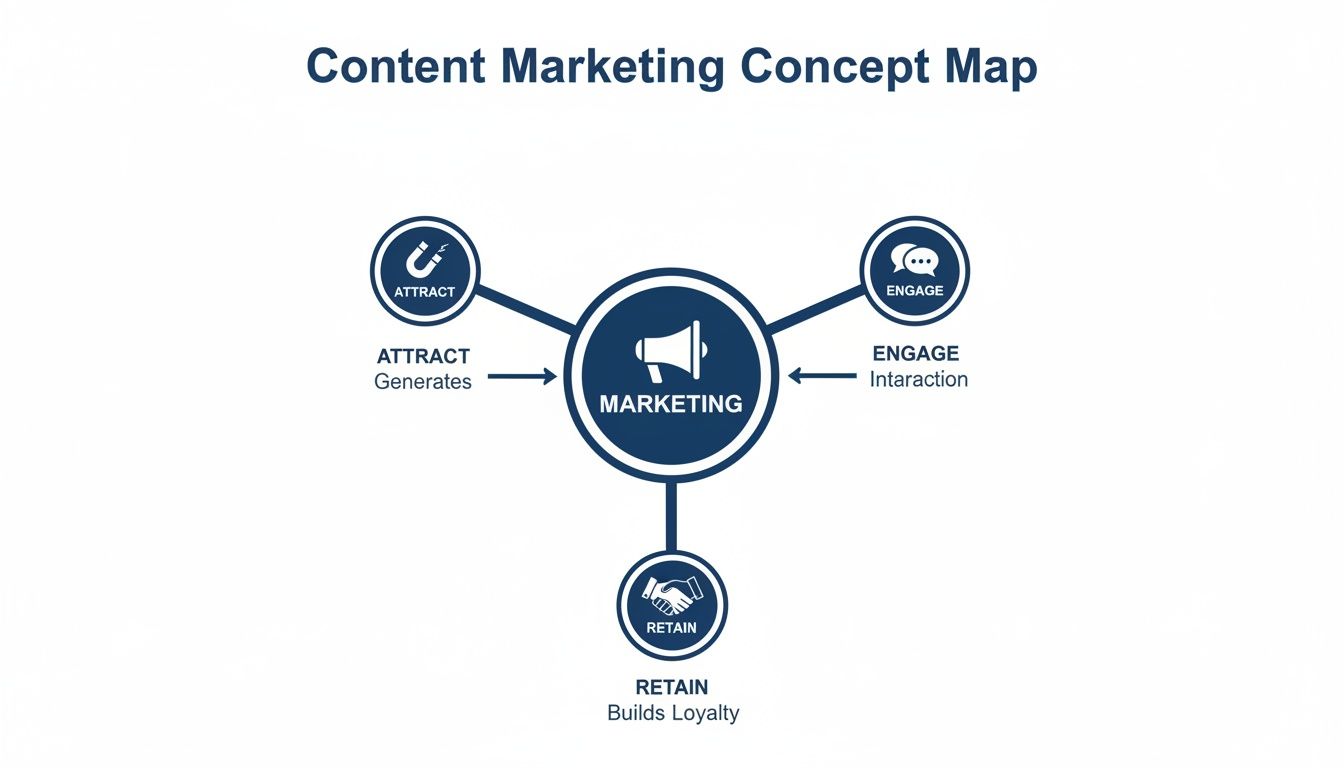
This diagram helps to visualise how all these different components work together to attract, engage, and ultimately retain your customers.
As the map shows, effective marketing isn't just a one-off action. It's a continuous cycle designed to build lasting relationships with your customers.
The Strategic Workflow Behind the Content
Creating these assets isn't random; it follows a very structured workflow. It all starts with deep research into your audience to truly understand their pain points and what motivates them. This is followed by rigorous keyword analysis to find out what they're actually searching for online.
Only then does the content creation begin, guided by all these strategic insights. This process ensures every piece of content is not just well-written, but also perfectly matched to what the audience needs and what search engines are looking for. Once it's created, the content is then distributed across the right channels to make sure it reaches as many people as possible.
If you want a more detailed walkthrough of this process, you can learn more about creating an effective content plan in our dedicated guide.
Future-Proofing with Answer Engine Optimisation
A critical piece of any modern strategy is preparing for the future of search. This means looking beyond traditional SEO and embracing Answer Engine Optimisation (AEO). What is AEO? It’s all about structuring your content to give direct, clear answers to questions.
This makes it much more likely that your content will be featured in AI-powered search results (like Google's AI Overviews) and used by voice assistants like Siri or Alexa.
This forward-thinking approach is essential for staying visible as search technology continues to evolve. By creating clear, authoritative, and easily digestible answers, you position your brand as a go-to source of information for both people and AI models. This isn't just a fleeting trend; it’s a fundamental part of future-proofing your entire digital presence.
How to Measure Success and Prove Your ROI
Pouring money into content marketing services can feel like a leap of faith. The big question every business owner lands on is always the same: "How do I know this is actually working?" It’s a fair question. Moving away from traditional ads means you have to think about results differently. Instead of just counting ad clicks, success is all about how well you build an audience and gently guide them toward becoming customers.
It’s time to move beyond fuzzy metrics and zero in on real business outcomes. The end game is to turn your content from just another creative expense into a predictable, data-driven engine for growth. This is exactly why having a clear, documented strategy is so critical—it’s how you track progress and prove your return on investment (ROI).
Connecting Metrics to Business Goals
Every blog post, video, or social media update needs to have a job. And every metric you track should tie directly back to a business objective. Generic reports packed with numbers are pretty useless without context. A professional service will give you customised reporting that clearly shows how your content is impacting what you actually care about—your bottom line.
Here’s how to connect the dots between common metrics and real-world results:
Organic Traffic Growth: This is a clear sign your brand is becoming more visible. When more people find you through search engines, it means your content is hitting the mark, answering their questions, and building your authority.
Keyword Ranking Improvements: Watching your position climb in search results is a direct measure of your growing influence. A construction firm that starts ranking for "commercial builder Gold Coast" is capturing highly relevant traffic from people ready to make a decision.
Conversion Rates: This is where the magic happens. A conversion isn't just a sale; it could be a quote request, a product purchase, or a simple newsletter sign-up. High conversion rates on your key pages prove your content isn’t just attracting eyeballs—it’s persuading people to act.
Lead Quality: It’s not about how many leads you get, but how good they are. Are the inquiries coming from your ideal customers? Better leads mean your content is resonating with the right audience, which makes your sales process a whole lot easier.
Tracking Key Performance Indicators That Matter
To measure these outcomes properly, you need to focus on the right Key Performance Indicators (KPIs). These are the specific, measurable data points that tell you how healthy your content strategy is. A good provider will help you pinpoint the ones that matter for your specific goals.
Some of the most important KPIs to keep an eye on include:
Unique Visitors: The number of individual people visiting your site.
Time on Page: How long visitors are actually sticking around to read or watch your content.
Bounce Rate: The percentage of visitors who land on a page and leave without clicking anywhere else.
New vs. Returning Visitors: Helps you understand audience loyalty and how well your content brings people back.
Getting a handle on these numbers is essential for understanding what’s working and what isn't. You can learn more about the top Google Analytics metrics in our detailed guide. This data-first approach is what separates guessing from growing.
A structured plan is proven to get better results. In fact, companies with a documented content strategy see an ROI 3.2 times higher than those flying blind. It's clear Australian businesses are catching on, with 74% now working with a formal strategy. This shift is also showing up in team structures, as 48% of businesses now have dedicated content strategists managing these efforts. This level of planning ensures every dollar is accounted for, turning your investment into measurable success.
Content Marketing in Action Across Australian Industries
Theory is great, but seeing how content marketing actually works in the real world is where it all clicks. There’s no such thing as a one-size-fits-all strategy. What works for a local tradie on the Gold Coast would fall completely flat for a national B2B manufacturer.
The core idea is always the same: provide genuine value. But how you do that changes dramatically depending on who you’re talking to. A successful strategy isn’t just about making content; it’s about making the right content, for the right person, at the right time.
This adaptability is what sets a professional content marketing service apart. It’s about understanding the unique challenges and goals of different businesses across Australia.
Let’s look at a few practical examples to see what this looks like on the ground.
For Local Trades and Construction
Picture a local Gold Coast electrician or a construction company. For them, local visibility is everything. Their customers aren't digging through dense whitepapers; they have an immediate problem and need a quick, reliable solution.
The content strategy here is all about owning the local search results. Think practical, helpful, and right to the point.
Helpful DIY Video Guides: Short, simple videos showing a homeowner how to safely test a circuit breaker or choose the right outdoor lighting. This stuff builds instant trust and positions them as the go-to expert.
Location-Specific Blog Posts: Articles like "Common Electrical Faults in Queensland Homes" or "Choosing a Builder for Your Gold Coast Renovation" pull in exactly the kind of local traffic they need.
Project Showcase Galleries: Nothing sells work like seeing it. High-quality before-and-after photos of local jobs act as powerful social proof.
The end goal? When someone in their service area has a problem, this business is the first and most trusted name that pops into their head.
For National Manufacturing and B2B
Now, let's switch gears to a national manufacturing company. Their world is completely different. They’re talking to engineers, procurement managers, and operations directors—people making high-stakes decisions based on hard data and proven results.
Their content has to be detailed, authoritative, and backed by numbers. A winning strategy here would include:
Technical Whitepapers: In-depth guides that tackle major industry challenges, explore new tech, or detail the benefits of a specific manufacturing process.
Detailed Case Studies: This is where the trust is built. A case study showing how their solution helped another Aussie company boost operational efficiency by 15% is far more powerful than any sales pitch.
Product Specification Sheets: Clear, downloadable resources that give engineers all the technical data they need to make a confident decision.
This approach establishes them not just as a supplier, but as a thought leader in their field, which is crucial for a long and complex B2B sales cycle.
For Professional Services Like Law and Accounting
For a boutique law firm or an accounting practice, the name of the game is trust and expertise. Their clients are often small business owners or individuals navigating stressful, complex situations. They need clear, reliable advice.
Content for these professionals must be authoritative yet easy to digest. For instance, our work in SEO for accountancy firms shows just how powerful targeted content can be for building a solid client base.
Effective strategies often involve:
Authoritative Articles: Blog posts that break down complicated legal updates or new tax rules into plain English that their target clients can actually understand and use.
Informative Webinars: Hosting online sessions on topics like an "End of Financial Year Checklist for Small Businesses" is a fantastic way to generate high-quality leads.
This kind of content proves their expertise and makes them the obvious first call when someone needs professional help.
How AI and Local Expertise Shape Modern Content Services
Content marketing isn't what it used to be. These days, the best services are powered by a dynamic duo: sophisticated artificial intelligence and irreplaceable local insight. This blend creates a strategy that's both technically sharp and genuinely human, ensuring your content doesn't just reach an audience—it actually connects with them.
Technology now sits at the heart of understanding what your audience is looking for. AI-driven tools sift through mountains of data to uncover search trends, question-based queries, and the exact words your customers are using. This allows us to create content that perfectly matches what people are searching for, dramatically increasing its chances of ranking high on Google.
It's about taking the guesswork out of content creation. Instead of just hoping an article hits the mark, every strategy is built on a solid foundation of data. This means every single piece of content has a clear, strategic purpose right from the start.
Optimising for the Future of Search
There’s a massive shift happening in how people find information online. With the rise of generative AI, content needs to be optimised not just for search engines, but for answer engines. This is the whole idea behind Answer Engine Optimisation (AEO), a forward-thinking approach that structures content so it can be easily understood and served up by AI chatbots and conversational search tools.
Getting this right is essential for future-proofing your visibility. As more people turn to AI for direct answers, businesses with properly optimised content will have a serious competitive edge. To get a better handle on this, check out our guide on Generative Engine Optimisation services.
As AI continues to reshape the industry, knowing how to use the best AI social listening tools can also give you powerful insights for your content strategy. These platforms help you keep an ear to the ground, monitoring online conversations to give you real-time data on what your audience is thinking and feeling.
The Irreplaceable Value of Local Knowledge
While AI tells us what to write about, genuine local expertise tells us how to write it. Technology can spit out a keyword, but it can’t possibly grasp the subtle nuances of the Australian market. This is where human insight is absolutely critical.
A deep understanding of local culture is what makes content feel authentic instead of robotic. This includes knowing:
Regional Slang and Phrasing: Using language that sounds natural to someone on the Gold Coast or a business owner in Melbourne.
Specific Consumer Behaviours: Understanding the unique buying habits and decision-making processes in different Australian cities and industries.
Cultural References: Weaving in local touchpoints that build an instant connection and show you’re part of the community, not an outsider looking in.
This human layer ensures the data-driven strategy is delivered with a voice that’s relatable, trustworthy, and real.
Ultimately, the most effective content marketing services harmonise these two elements. AI brings the scale, speed, and analytical power needed to compete in a crowded digital space, while local expertise provides the authenticity and cultural relevance that builds lasting customer relationships. It’s this powerful combination that drives real, measurable results.
How to Choose the Right Content Marketing Partner
Picking the right content marketing services provider is a massive business decision. This goes way beyond just comparing quotes. You’re not just hiring someone to write a few articles; you’re looking for a long-term partner who acts like an extension of your own team, someone who gets your goals and can drive real, measurable growth.
Get this choice right, and it can completely transform your digital presence. Get it wrong, and you're looking at wasted money and missed opportunities. You need to look past the slick sales pitches and focus on the substance, the strategy, and the results they can actually prove.
Assessing Their Portfolio and Industry Fit
First things first: dive into their past work. A strong portfolio isn’t just a gallery of pretty designs. It’s hard evidence that they can produce high-quality content that actually connects with specific audiences and hits tangible business goals. Look for proof they have experience in your industry or with businesses that have faced similar challenges to yours.
While direct industry experience is a massive plus, what’s even more important is their ability to get their head around complex topics and turn them into compelling, authoritative content. An agency that’s successfully marketed a niche B2B manufacturing firm probably has the strategic chops to handle the finer points of a boutique law practice. Their portfolio should show you they're versatile and know how to think strategically.
Scrutinising Their Strategic Process
A reputable partner will have a clear, documented process they can walk you through, no problem. If you get vague answers about "creating great content," that's a major red flag. You want to see a structured approach that covers everything from the initial research and strategy building right through to content creation, promotion, and ongoing analysis. A documented strategy is a non-negotiable.
This is also the time to get clear on how they handle communication and reporting. How often will you meet? What do their reports actually look like, and how do they connect the numbers back to your specific business goals? A good, collaborative relationship relies on clear, consistent communication so everyone is on the same page and working towards the same outcomes.
Essential Questions to Ask Potential Partners
To really figure out if an agency is the right fit, you have to ask insightful questions that get below the surface. Arm yourself with a checklist to make sure you cover all the critical bases when you're sizing them up.
Here are a few key questions to get the ball rolling:
Strategic Alignment: How will you measure success specifically for our unique business goals, not just generic vanity metrics?
Workflow and Collaboration: Can you walk me through your entire content development and approval workflow, from the initial idea to hitting publish?
Results and Reporting: What KPIs do you prioritise, and can you show us a sample report that demonstrates ROI for a previous client?
Adaptability: How do you stay on top of changes in search algorithms and audience behaviour, especially with the rise of AI?
The answers you get will tell you everything you need to know about their strategic depth, their transparency, and whether their approach lines up with your vision for a successful, results-driven partnership.
Got Questions? We’ve Got Answers
Stepping into the world of content marketing often brings up a few questions. It’s a big investment, and it’s smart to understand the nuts and bolts before you dive in. Here are some of the most common queries we hear from business owners just like you.
How Long Does It Take to See Results From Content Marketing?
This is the big one, and the honest answer is: content marketing is a long game, not a quick win. Think of it less like a vending machine and more like planting a tree. You have to nurture it consistently before it bears fruit.
You’ll likely see early signs of life—like a bump in website traffic or a few more social media shares—within the first 3 months. But the real, game-changing results? We’re talking about significant search engine rankings and a steady stream of organic leads. That typically takes a solid 6 to 12 months of dedicated work.
The exact timeline depends on how competitive your industry is, but the goal is always the same: to build a valuable asset that keeps paying you back for years.
Is Content Marketing a Good Fit for Small Businesses?
Absolutely. In fact, it’s one of the most powerful and cost-effective tools a small business can have in its arsenal.
Unlike paid ads that disappear the second you stop paying, a great piece of content works for you 24/7, indefinitely. A well-written blog post or a genuinely helpful guide can keep pulling in traffic and leads long after it’s published.
A smart agency can tailor a content package that fits a smaller budget by zeroing in on the things that make the biggest impact first. This usually means focusing on:
Foundational SEO Blog Content: Creating a solid library of articles that answer the exact questions your customers are asking Google.
Local Search Optimisation: Targeting keywords and creating content designed to help you dominate your local service area.
Targeted Social Media: Picking one or two platforms where your customers actually hang out and going all-in there.
What Is the Difference Between SEO and Content Marketing?
It’s easy to get these two mixed up, but they have a simple, symbiotic relationship. The best way to think about it is this: your content is the car, and SEO is the GPS and the fuel that gets it where it needs to go.
Content marketing is the act of creating and sharing genuinely valuable stuff—articles, videos, guides, you name it—to attract and connect with your target audience.
SEO (Search Engine Optimisation) is the technical side of things. It’s all the work that goes on behind the scenes to make sure search engines can find, understand, and rank your content for the right searches.
You can’t have one without the other if you want to see real success. The most brilliant article in the world is useless if nobody can find it. And the most technically perfect website won’t get you far if the content on it is rubbish. That’s why modern content marketing services bake SEO into everything they do from day one.
Ready to build a content strategy that delivers real results? Titan Blue Australia combines over 25 years of digital marketing expertise with advanced AI insights to create content that drives growth. Learn more about our services and get started today.
Titan Blue is your go-to digital partner for smart, results-driven solutions. We blend strategy, creativity and tech to grow your brand and get real results fast.