Content Writing for Websites: A Practical Guide to Engaging Audiences
Website content writing is the art of creating the words, pages, and articles that fill your digital space. This isn't just about filling blanks on a page; it’s the core of how you talk to your customers, build trust, and ultimately, convince search engines that you’re the best answer to someone’s problem.
Think service pages, blog posts, product descriptions—all the stuff that turns a website from a digital brochure into a genuine business asset.
Why Your Website Is Your Hardest Working Employee
Imagine your website as a digital storefront. Good, solid content is the expert salesperson working inside, 24 hours a day, seven days a week. It never calls in sick or takes a holiday.
Instead, it’s always there to greet every visitor, answer their questions with endless patience, and gently guide them from being a curious browser to a loyal customer. That's the real muscle behind strategic content writing for websites. It's not just some marketing add-on; for businesses across Australia, it's the engine driving real growth.
Building Trust Before the First Handshake
In today's market, trust is everything. Before a customer in Brisbane calls a plumber or a couple in Melbourne picks a restaurant, they go online. They're looking for signs of expertise, for proof that you know your stuff.
Well-written content is that proof.
A detailed blog post on fixing a common leaky tap shows you're a knowledgeable expert, not just someone trying to make a sale.
Clear, jargon-free service pages tell customers you understand their problems and can explain the solution in a way that makes sense.
An authentic 'About Us' page shares your story and values, forging a human connection that sticky, faceless brands just can’t replicate.
To really get it, it helps to understand the difference between content writing vs copywriting. Copywriting is all about the immediate sale, that final push. Content writing, on the other hand, plays the long game—it’s about building an audience and nurturing trust over time.
Attracting Customers Who Are Ready to Act
Every single day, thousands of your potential customers are turning to search engines for solutions. They aren't just typing in business names; they're asking real questions.
Think about it. A Gold Coast construction company with an article answering "What are the stages of a home renovation?" is far more likely to get found than a competitor with just a basic contact page.
This is where content writing becomes your secret weapon for attracting qualified leads. By creating pages that speak directly to the needs and headaches of your ideal customer, you ensure your business shows up at the exact moment they need you most.
Great content doesn’t just sit around and wait for customers—it actively goes out and finds them. This is the foundation for all the other powerful customer engagement strategies you'll use in 2025. You can find out more about how this works in our guide to customer engagement.
Knowing Your Customer and What They Search For
Before you even think about writing a single word, the first, most critical step is to get crystal clear on who you're writing for. Effective website content isn't about shouting your message into the void; it's about having a quiet, helpful conversation with a very specific person. If you guess, you’ll end up with generic content that speaks to no one.
This is where creating a simple customer persona becomes so powerful. Think of it as a semi-fictional sketch of your ideal customer, giving you a sharp picture of their needs, goals, and what keeps them up at night. It turns a vague "target audience" into a real, relatable individual.
Building Your Ideal Customer Persona
You don't need fancy software or a massive budget for this. A great starting point is to think about your best existing customers. What do they all have in common? What problems are you constantly solving for them?
For example, a Perth-based plumbing company might create a persona called "Suburban Steve." He's a homeowner in his late 40s who values reliability way more than the cheapest price. His biggest frustration? Tradies who don't show up on time. When you write for Steve, your content needs to hammer home your punctuality, experience, and transparent pricing.
Or what about "Renovator Rachel" on the Gold Coast? She's planning a major home extension, feels completely overwhelmed by the building process, and is desperate to find a builder she can trust. Content for Rachel should be reassuring. It needs detailed project galleries, glowing client testimonials, and clear, simple explanations of each building stage. These personas guide your tone, the topics you cover, and the very words you choose.
To really nail this, you need a solid strategy for audience segmentation, which is just a way of breaking down your customer base into smaller, more manageable groups like Steve and Rachel. You can start building these profiles with some basic market research. Our guide on how to conduct market research is a great place to begin.
Decoding What Your Customers Search For
Once you know who you're talking to, the next job is to figure out what they're actually typing into Google. This is the bedrock of keyword research. It’s all about uncovering the exact phrases your local customers use when they need your services.
The investment in getting this right is huge. In fact, Australian businesses are forecast to spend a staggering $1.5 billion on SEO services. This explosion shows just how vital SEO-optimised content is for competing in Australia's digital economy, especially for businesses in the trades and hospitality sectors.
This idea, known as search intent, is the 'why' behind every search. Nailing the intent with your content is the secret to attracting the right visitors at exactly the right time.
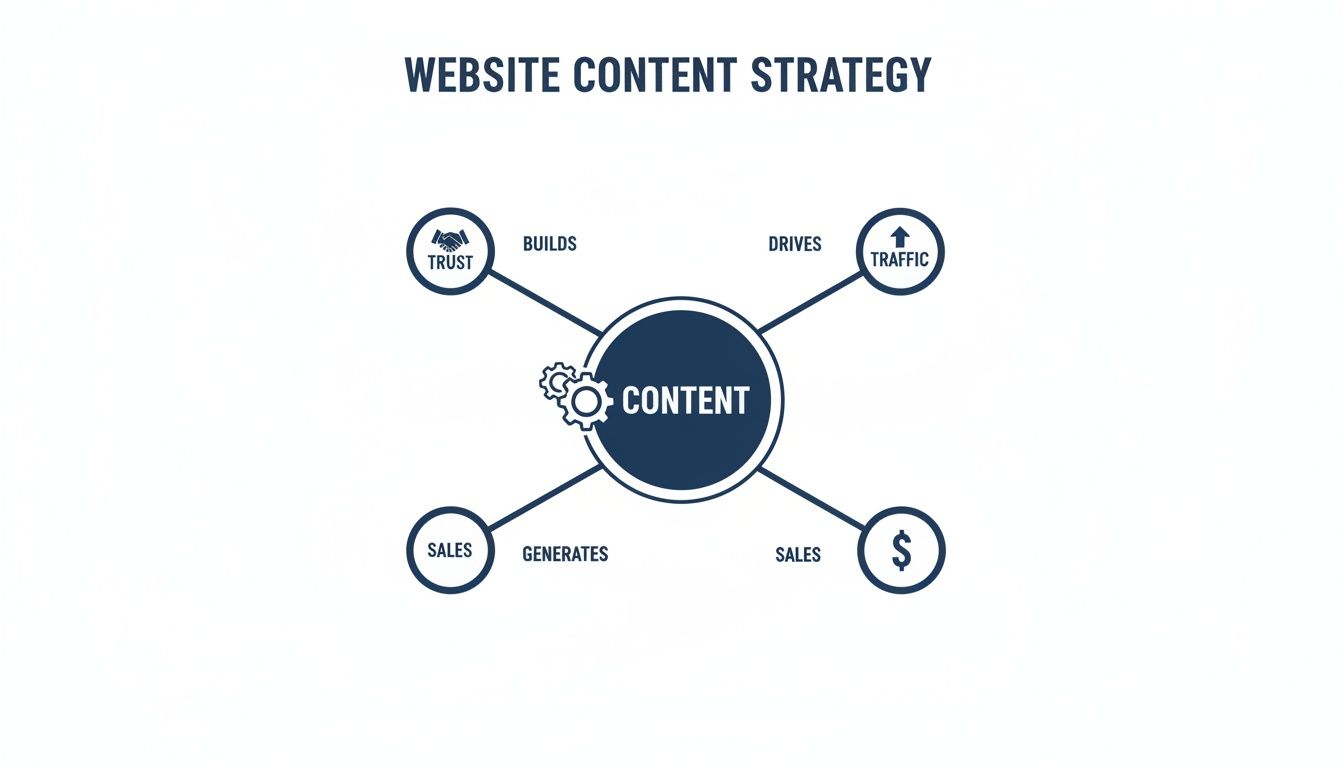
This diagram shows how smart content acts as the engine for your business—it drives traffic, builds trust, and ultimately, generates sales.
The key takeaway here is that content isn't just one thing. It’s a versatile tool that supports every single part of the customer journey, from that first moment of discovery right through to the final purchase.
Here’s a practical breakdown for a local plumber:
Informational Intent: Someone searching for "how to fix a leaking tap" wants answers, not a hard sell. The perfect response is a helpful blog post or a quick DIY video guide. This builds your authority and makes you the first person they'll call when the problem gets too big to handle alone.
Navigational Intent: A search for "[Your Plumbing Business Name]" means they are actively looking for you. Your homepage and contact page need to be dead simple to use, with your phone number and address impossible to miss. Don't make them hunt for it.
Transactional Intent: A search like "emergency plumber Sydney" screams urgency. This person is ready to buy. They need a persuasive service page with a bold headline, a massive phone number, and a direct call-to-action like "Call Now for Immediate Service." This is the content that has to close the deal.
Writing for Google Search and AI Assistants
Not long ago, getting found on Google felt like a technical game of stuffing as many keywords as possible onto a page. That whole approach is now completely redundant. Modern content writing for websites isn't about trying to trick an algorithm; it’s about providing the best, most direct answers to a person's questions.
Think of it this way: every time someone searches, they have a problem they need to solve. Your website's job is to be that solution, presented clearly and without any fluff. This means structuring your content so that search engines can easily understand it and serve it up to the right people at the right time.
This shift in thinking is critical because how we search is changing, too. We’re no longer just typing a few words into a search bar. We're asking questions out loud to our phones, smart speakers, and AI assistants. To stay visible, your content has to evolve to meet people where they are.
Mastering the Basics of On-Page SEO
On-page Search Engine Optimisation (SEO) covers all the tweaks you make directly on your website to help it rank higher. It might sound technical, but at its heart, it’s all about making your content as clear as possible for both people and search engines.
Two of the most crucial elements are your title tag and meta description. These are the very first things a potential customer sees in the search results—they act like the headline and summary of an article. They need to be sharp enough to earn that all-important click.
Here are the key on-page elements to get right:
Title Tag: This is the clickable headline in the search results. It should be direct, include your main keyword (like "emergency plumber Melbourne"), and stay under 60 characters so it doesn't get cut off.
Meta Description: This is the short blurb of text under the title. It won’t directly affect your rankings, but a punchy meta description (around 155 characters) can make a huge difference to your click-through rate.
Headings (H1, H2, H3): Use headings to give your content a logical structure, just like chapters in a book. Your main page title is your H1, with sub-topics broken down under H2s and H3s.
Internal Linking: Linking to other relevant pages on your own website is a big one. It helps search engines see how your content is connected and encourages visitors to stick around longer.
When you nail these fundamentals, you build a solid foundation that makes it much easier for Google to recognise your website as an expert in its field.
Writing for the Future of Search
The way we find information is going through another massive change, and this time it's being driven by AI. Tools like Siri, Google Assistant, and ChatGPT are becoming the new go-to for answers, giving conversational responses instead of just a list of links. This is where Answer Engine Optimisation (AEO) comes into play.
To keep your website relevant for years to come, you need to start structuring your content to answer questions directly. This means thinking in full, natural sentences, just like your customers do. For example, instead of just targeting the keyword "roof repair cost," you should create content that explicitly answers, "What's the average cost of a roof repair in Melbourne?"
This approach does two things at once. First, it lines up perfectly with how modern SEO works—Google loves content that gives comprehensive answers. Second, it primes your website to become a trusted source for AI assistants. When someone asks their device a question, you want your content to be the answer it serves up. Our deep dive into Generative Engine Optimisation explores this shift in more detail.
By optimising for both traditional search and AI assistants, you’re making sure your business stays visible and helpful, no matter how your customers choose to find you.
Crafting High-Converting Website Pages
Knowing who you're writing for and how they search is half the battle. Now it's time to turn that research into reality and build the actual pages that will drive your business forward. These are the core digital assets where a casual visitor decides whether or not to become a paying customer.
Each key page on your website has a specific job to do. Your service pages need to persuade, your 'About Us' page has to connect, and your blog posts must establish you as a trusted authority. The goal is to move beyond simply listing facts and start guiding your visitor on a journey.
To do this well, we can use a simple yet powerful framework called AIDA. It stands for Attention, Interest, Desire, and Action, and it's a proven model for structuring your content in a way that naturally leads a reader from initial curiosity all the way to making a decision.
Building a Persuasive Service Page
Your service pages are your digital sales pitches. They need to work hard to turn interest into leads. They have to be clear, compelling, and laser-focused on solving the customer's problem—this is where your content writing for websites directly impacts your bottom line.
A high-converting service page follows a logical flow. You start by grabbing their attention with a bold headline that speaks directly to their pain point. For a builder, this might be something like, "Stress-Free Home Renovations on the Gold Coast."
Next, you build interest by outlining the problems you solve and showing you understand their frustrations. Then you create desire by detailing your process, showcasing your expertise, and using powerful social proof like testimonials or project photos. Finally, you drive action with a clear, unmissable call-to-action (CTA).
Here’s how the AIDA model breaks down for a service page:
Attention: A benefit-driven headline that instantly answers, "What's in it for me?"
Interest: Briefly explain the problem and show you understand their challenges.
Desire: Detail your solution, focusing on the outcomes and transformations you deliver. Showcase past work and testimonials.
Action: Tell them exactly what to do next with a strong CTA like "Request Your Free Quote Today" or "Call Now for a Consultation."
Telling Your Story with an 'About Us' Page
So many businesses treat their 'About Us' page as an afterthought, filling it with dry corporate history. This is a huge missed opportunity. This page is your chance to build a genuine human connection and show the people and passion behind your brand.
Your story is your unique selling proposition. It’s what separates you from a competitor down the road. Use this page to share your 'why'—what inspired you to start your business? What are your core values?
For example, a local cafe's 'About Us' page could tell the story of the owners' journey to find the perfect coffee beans, highlighting their commitment to quality and community. This narrative builds trust far more effectively than a generic mission statement ever could. It's on pages like this where you can really see the impact of learning what is conversion rate optimisation and how telling your story plays a crucial role.
Establishing Authority with Expert Blog Posts
Blog posts are your platform to prove your expertise and become a go-to resource in your industry. While other pages sell, the blog's main job is to educate and inform. A well-written blog post can attract visitors who are just starting their research, building trust long before they are ready to buy.
When you're writing a blog post, aim for a length of over 1,500 words if you really want it to rank well on search engines. These longer, in-depth articles are seen as more authoritative and provide much more value to the reader.
Think about the most common questions your customers ask you. Every single one of those questions is a potential blog post topic. A plumber could write an "Ultimate Guide to Choosing a Hot Water System," positioning themselves as a helpful expert, not just a salesperson. This strategy ensures your content writing for websites serves your audience first, which in turn serves your business.
Amplifying Your Content Beyond Your Website
Creating a fantastic piece of content for your website is a huge win, but its job isn't done once you hit 'publish'. Letting a brilliant blog post or an insightful service page just sit there is like cooking an amazing meal and not telling anyone it's ready. To really get a return on your writing efforts, you have to push that content out to where your customers are already hanging out.
Think of your website as the central hub of your brand. Every other channel—social media, email newsletters, you name it—are the spokes connecting that hub to your wider audience. Quality content writing for websites is the fuel for every single one of those spokes, creating a powerful loop that constantly brings people back to your core business asset.
Turning One Post into a Week of Social Media
A single, well-researched blog post has enough gold in it to fuel your social media for days, maybe even a whole week. Instead of just dropping a link and hoping for the best, you need to slice and dice that article into smaller, bite-sized pieces perfect for different platforms.
This isn't about being repetitive; it's about reinforcing your message in different ways to reach more people. It’s the definition of working smarter, not harder, by squeezing every drop of value from the content you’ve already created. You can find more strategies like this in our guide on social media marketing services.
This is especially critical here in Australia. With 20.9 million social media users—that’s 77.9% of the entire population—it's a safe bet your customers are scrolling right now. They spend an average of 1 hour and 57 minutes on these platforms every single day, making it a golden opportunity to get your website's content in front of them. You can dig into more of these numbers in the digital trends in Australia report from DataReportal.
Fuelling Your Email Marketing Engine
Your email list is one of your most valuable assets. It’s a direct line to people who have already raised their hand and shown interest in what you do. Your website content is the perfect material to nurture that relationship and keep your brand front and centre.
Forget sending purely promotional emails. Instead, provide real value by sharing your latest blog posts or helpful guides.
By consistently delivering useful information directly to their inbox, you build trust and position your business as a generous expert. When the time comes for them to make a purchase, your name will be the first one they think of.
Here are a few simple ways to repurpose your website content for email:
Weekly Newsletter: Tease your latest blog post with a compelling summary and a clear call to "read the full article" on your website.
Educational Series: Break down a big, in-depth guide from your site into a multi-part email series dripped out over several days.
Highlight a Service: Send an email that zooms in on a specific customer problem, then link directly to the service page on your site that solves it.
By building this content ecosystem, you make sure every piece of writing you produce works as hard as possible. Your website remains the authoritative core, while your other channels act as powerful amplifiers, constantly bringing new and existing customers back into your world. This consistent, multi-channel presence signals to everyone that you are a reliable and active authority in your field.
Common Questions About Website Content Writing
As you start shaping your website's voice, it's completely normal for questions to pop up. Making smart decisions about your content is crucial for growth, so let's walk through some of the most common queries we hear from Australian small business owners.
Think of these as your go-to answers for navigating the world of website content with a bit more confidence.
How Often Should I Update My Website Content?
This is a great question, and the best way to think about it is to split your website into two parts: your core pages and your dynamic content.
Your core pages are the foundations of your site – think 'About Us', 'Contact', and your main service pages. These don’t need a complete overhaul every week, but they absolutely shouldn't be left to gather digital dust. A good rule of thumb is to give these pages a once-over every 6 to 12 months. Just check that everything is still accurate – are your services, team details, or pricing up to date? A quick audit keeps your most important information fresh and reliable.
Then you have your dynamic content, which is mostly your blog. Here, consistency is the name of the game. Regularly publishing new articles signals to search engines like Google that your website is active, current, and a trustworthy source of information.
For a small business, a realistic and highly effective goal is to publish one or two new, high-quality blog posts per month. The key phrase there is 'quality over quantity'. One genuinely helpful, well-researched article is worth far more than four rushed, superficial posts.
Can I Use AI to Write All My Website Content?
AI is an incredibly powerful assistant for content creation. It's fantastic for brainstorming blog ideas, creating a solid outline, or helping you power through a nasty case of writer's block. However, letting AI write all your website content is a risky move.
AI-generated text often misses the human touch that builds real trust and connection. It struggles to capture your unique brand voice, it can't share personal stories or hard-won experiences, and it usually misses the subtle nuances that show you really get your customer's problems. The result? Content that feels generic and soulless, which is the last thing you want.
The best approach is a hybrid one. Use AI as your creative partner, not your replacement.
Brainstorming: Ask an AI tool for a list of common questions your customers might have about solar panel installation.
Outlining: Use it to create a logical structure for a detailed guide on home renovation stages.
First Drafts: Let it generate a rough first draft that you then heavily edit, refine, and inject your expertise into.
Always make sure a human – you, or someone who lives and breathes your business – has the final say. That personal touch is what makes your content truly yours and builds the kind of customer relationships that last.
What Is More Important: SEO or Writing for People?
This question comes up all the time, but it’s based on a bit of an old-school myth. The truth is, it's a false choice. The two have become the same thing.
Years ago, SEO was all about technical tricks and stuffing keywords into pages. That era is long gone.
Today, modern SEO is all about providing an excellent user experience. Google's one and only goal is to give its users the most helpful, relevant, and engaging answer to their questions. Their algorithms have become incredibly sophisticated at figuring out which content does that best.
When you focus on writing clear, valuable, and well-structured content for your human audience, you are automatically doing all the right things for modern SEO. Think about it: what does a person want? A clear answer, an easy-to-read format, and genuinely useful information. That's exactly what Google wants to see. So, your priority should always be to focus on your customer first, and the search engine rankings will naturally follow.
How Do I Measure the Success of My Website Content?
Measuring your content's impact is the only way to know what's working and where you should put your effort next. Success isn't just about getting more website visitors; it's about getting the right visitors and guiding them to take action.
A great place to start is with a free and powerful tool like Google Analytics. Don't get overwhelmed by all the data. Just focus on a few key numbers that tell a clear story.
Here are the key metrics to track:
Organic Traffic: This shows how many people find your site through search engines. If this number is going up, your SEO efforts are paying off.
Time on Page: This tells you how long people are actually spending reading your content. A longer time on page is a strong signal that what you've written is engaging and valuable.
Bounce Rate: This is the percentage of people who leave after looking at just one page. A high bounce rate could mean your content isn't what they expected to find.
Most importantly, you need to connect your content to real business goals. Are more people filling out your contact form? Are you getting more phone calls? Is your online booking system busier? Tying your content's performance back to these tangible results is how you truly know if it's a success.
Ready to transform your website from a simple brochure into your hardest-working employee? At Titan Blue Australia, we've spent over 25 years helping Australian businesses grow with strategic content that builds trust and drives results. Discover how our expert team can craft a custom content strategy for you at https://titanblue.com.au.
Titan Blue is your go-to digital partner for smart, results-driven solutions. We blend strategy, creativity and tech to grow your brand and get real results fast.