

Effective content writing on website pages is all about planning, creating, and publishing copy that actually connects with your target audience and helps you hit your business goals. It's what turns a basic online presence into a dynamic asset—one that pulls in search traffic, builds real trust, and encourages people to take action.
Why Great Website Content Is Your Strongest Asset
In a packed marketplace, your website is often the very first—and most important—interaction someone has with your business. It's not just a digital brochure; it’s your 24/7 salesperson, your brand storyteller, and your best channel for building authority. High-quality content is the engine that makes it all run.
This guide gives you a practical framework for mastering website content that genuinely converts. It’s built for Australian small and medium-sized businesses (SMEs), whether you’re a local restaurant, a law firm, or a national manufacturing company. The goal here is to turn theory into action, so you can transform your website into a powerful, lead-generating machine.
The Foundation of Digital Success
Exceptional content does so much more than just fill up a page. It’s the very foundation of any solid digital marketing strategy, directly shaping how your business is seen and found online.
- It Builds Trust and Credibility: When you consistently publish helpful, well-researched content, you position your business as an expert. This builds a foundation of trust long before a potential customer is ready to buy.
- It Drives Organic Search Traffic: Smart content is the backbone of Search Engine Optimisation (SEO). By directly answering the questions your customers are typing into Google, you attract highly qualified traffic to your site for free.
- It Nurtures Leads and Generates Sales: From an insightful blog post to a persuasive service page, every piece of content can guide a visitor along their journey, ultimately leading them to make an enquiry or a purchase.
Here in Australia, where 97.1% of the population is online, getting this right isn't optional. Think about this: websites that keep a regular blog see a massive 55% increase in traffic compared to those that don't. It’s clear proof that consistency is key.
To truly unlock your website's potential, you need a holistic approach focused on building an effective online presence for small businesses. To see how all these pieces fit together into a bigger puzzle, check out our guide on what is a digital marketing strategy.
Mapping Your Content Strategy and Audience
Before you even think about writing a single word, you need a plan. A winning content strategy isn't about guesswork; it’s about knowing exactly who you're talking to and what you want to achieve.
Jumping straight into writing without this foundation is like building a house without a blueprint. Sure, you might end up with something, but it’ll probably be unstable and definitely won't serve its purpose. This initial planning phase is what separates content that just sits there from content that actually delivers results. It's all about digging deep into who your ideal customer is, what problems they're facing, and how they search for solutions online.
Defining Your Audience Personas
You can't connect with a faceless crowd. You need to create detailed audience personas—these are essentially semi-fictional profiles of your ideal customers, built on real data and research. Don’t just list demographics; give them a name, a job, and real-world challenges.
Take a Gold Coast construction company, for instance. They aren't just targeting "builders." They're talking to people like:
- "Dave the Project Manager": He's 45, values reliability and clear timelines, and is always worried about staying on budget.
- "Sarah the First Home Buyer": She's 32, feels completely overwhelmed by the building process, and is probably searching for "affordable custom home builders Gold Coast."
Creating these personas forces you to step into your customer's shoes. It helps you uncover their genuine pain points and the exact questions they’re typing into Google. This deep understanding is the bedrock of content that truly hits home.
Uncovering Your Customer's Journey
Once you know who your audience is, you need to map out the path they take from discovering their problem to finding a solution. This is the customer journey, and it's vital for creating targeted content for each stage. We explore this concept in more detail in our guide explaining what customer journey mapping is.
A customer doesn’t just wake up one day and decide to hire a commercial lawyer or buy a new piece of mining equipment. Their journey involves distinct awareness, consideration, and decision stages, and each one needs a different type of content to nudge them along.
This process ensures every blog post, service page, and case study has a clear purpose. It guides your content creation, helping you decide whether you need a simple "how-to" article for someone just starting their research, or a detailed comparison guide to help seal the deal.
This diagram shows how strategic website content guides a potential customer from that first moment of visibility, through building trust, and ultimately to driving business growth.
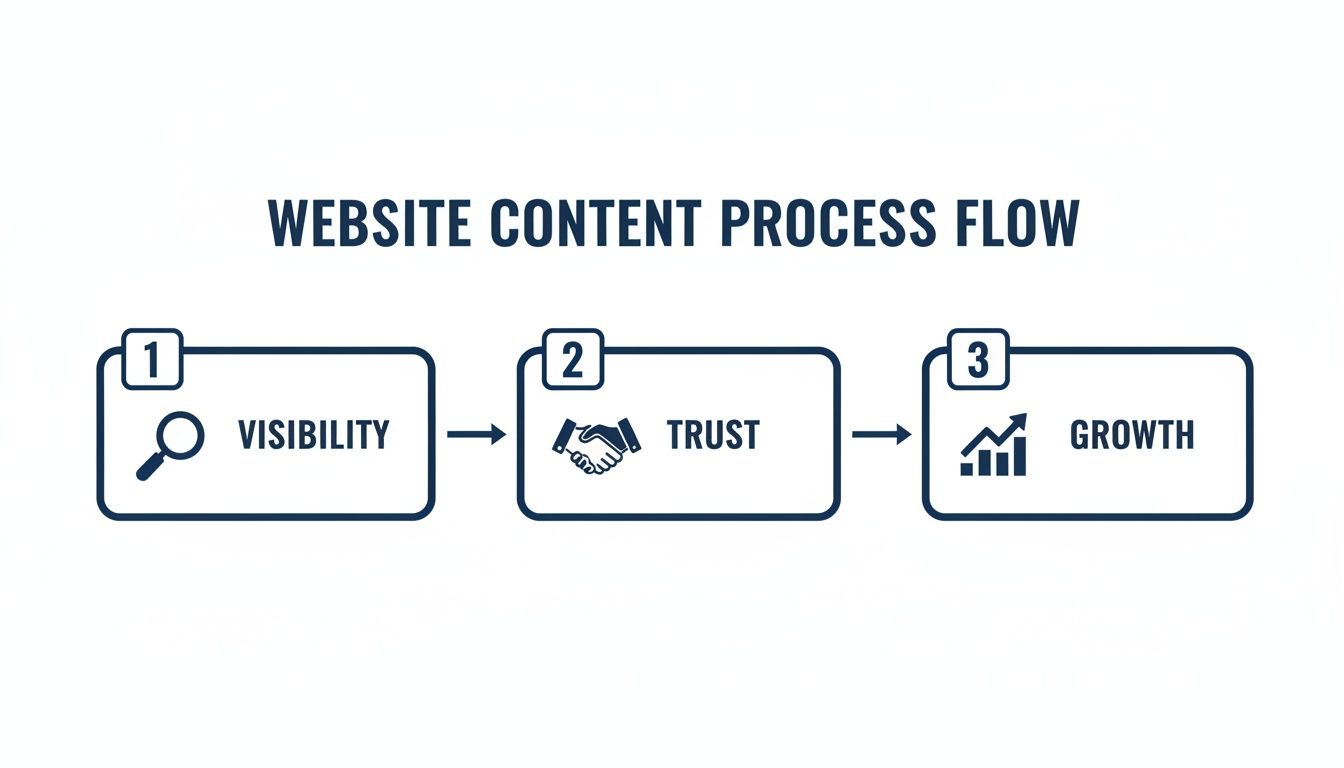
The key takeaway here is that content serves different functions at each stage. A planned, strategic approach will always be far more effective than just creating random articles and hoping for the best.
Building a Purpose-Driven Content Calendar
With your personas and customer journey mapped out, the final piece of the puzzle is organising your ideas into a content calendar. This is much more than a simple schedule; it's a strategic tool that aligns every single piece of content with a specific business goal.
Your calendar should detail the topic, target keyword, intended audience persona, and the call-to-action for each piece. This organised approach keeps your efforts focused and consistent. For instance, a local retailer might plan content around seasonal promotions, while a B2B manufacturing firm could schedule a series of technical guides to establish itself as an industry authority.
This strategic planning transforms your website from a passive digital brochure into an active, lead-generating machine that consistently delivers measurable returns.
Crafting Compelling Website Content That Converts
This is where all your strategic planning turns into actual words on a page. Forget the generic advice for a moment. Let's get into a practical framework for creating website content that actually works—content that informs, persuades, and gets people to take action.

Effective content writing on website pages boils down to making smart choices. For instance, a manufacturing firm looking to build authority might invest in a detailed technical guide. On the other hand, a Gold Coast construction business will get far more mileage from a slick, visual portfolio that lets their work do the talking. Every single piece of content needs a clear job to do.
Structuring Content for Readability and SEO
Let's be honest: people don't read websites; they scan them. Your content structure needs to accept this reality and make it incredibly easy for visitors to find what they're looking for. A giant wall of text is the fastest way to send someone straight back to Google.
To avoid that fate, think in terms of visual hierarchy. Use clear, descriptive headings (your H2s and H3s) to break up different ideas. Keep your paragraphs short—two to three sentences, max. And use bold text to make key points pop off the screen. This isn't just about making things look nice; it helps search engines understand your content structure, too.
Choosing the Right Content Formats
Not all content formats are created equal. The best choice for your business depends entirely on your industry, your audience, and what you're trying to achieve. The goal is always to present information in the most engaging way for the specific person you're trying to reach.
A few tried-and-true formats include:
- In-Depth Guides and Articles: Perfect for B2B sectors like manufacturing or law where you need to showcase deep expertise and answer complex questions.
- Visually-Driven Portfolios and Case Studies: Absolutely essential for trades and construction companies. You need to show the quality of your work to build trust.
- Compelling Service Pages: A must-have for local businesses like restaurants or retailers to clearly spell out what you offer and what makes you special.
This isn't just about filling pages. It’s about choosing the right tool for the job to show customers you understand their problems and have the solution.
Developing a Brand Voice That Connects
Your brand voice is essentially the personality your business shows through its words. Are you a formal and authoritative law firm? Or are you a friendly, approachable local cafe? Nailing this down is critical for creating a consistent and memorable experience.
This voice should echo through everything you write, from the main headline on your homepage to the tiny text on a call-to-action button. Consistency builds familiarity and trust, making your brand feel more human and relatable. It’s what separates sterile, corporate-speak from content that genuinely connects with people.
The most powerful brand voices are authentic. They reflect the true values of the business and speak directly to the customer's needs, creating a connection that goes beyond a simple transaction.
Writing Powerful Calls to Action
Every piece of content on your website should have a purpose. The call-to-action (CTA) is what tells the reader what you want them to do next. A page without a clear CTA is a dead end—and a massive missed opportunity.
Your CTAs need to be unmissable, compelling, and feel like the logical next step. Ditch the lazy "Click Here" and use action-oriented language that spells out the value for the user.
- "Get a Free, No-Obligation Quote Today"
- "Download Your Ultimate Guide to Home Renovations"
- "Book Your Table for an Unforgettable Dinner"
Getting this right is a huge focus for businesses across Australia. Heading into 2025, a massive 74% of businesses already have a documented content strategy, and 62% say it's a top priority. This is especially true for competitive industries like restaurants, retail, and manufacturing.
To see how powerful content and design can be when they work together, it's worth checking out some real-world examples of high-converting landing pages.
Optimising Content For Modern Search Engines
Writing fantastic content is only half the job; you have to make sure people can actually find it. For many business owners, Search Engine Optimisation (SEO) feels like a complex, technical puzzle. Let's break down the essentials into practical, actionable steps.
You’ll learn how to weave keywords into your content naturally, making your pages just as appealing to search engines as they are to your readers. We'll cover the on-page fundamentals that are absolutely crucial for ranking—from meta descriptions to internal linking—and look ahead at how to structure your content for an AI-driven search future.
Mastering On-Page SEO Essentials
On-page SEO refers to all the changes you make directly on your website pages to help them rank higher in search results. Think of it as leaving clear signposts for Google, telling it what your content is about and why it’s valuable.
A great starting point is your primary keyword. This is the phrase a customer would type into Google to find what you offer, like "commercial lawyer Gold Coast" or "durable workwear for mining." Once you’ve nailed this down, you need to place it strategically.
- Page Title (Title Tag): This is the blue link that shows up in Google’s search results. It’s your most important piece of SEO real estate, so your keyword must be here, preferably near the start.
- Meta Description: The short blurb of text under your title in the search results. While it’s not a direct ranking factor, a compelling description that includes your keyword will encourage more people to click through to your site.
- Headings (H1, H2, H3): Your main keyword should be in your H1 (your main page title). Use variations of it in your subheadings (H2s and H3s) to create a clear structure for both your readers and the search engines.
It's crucial to make this integration feel natural. Your goal is always to write for people first and search engines second. Stuffing keywords everywhere will make your text unreadable and can actually get you penalised by Google.
The Critical Role Of Technical On-Page Elements
Beyond the keywords in your main text, a few technical elements play a huge part in your search visibility. Ignoring them is a common mistake that can hold back even the best content.
Image Alt Tags are short, descriptive texts you add to the images on your website. They serve two key functions: they make your site accessible for visually impaired users who use screen readers, and they tell search engines what an image is about, helping it rank in image search. For a construction company’s portfolio, an alt tag like "custom-built patio deck on Gold Coast home" is far more effective than "image123.jpg".
Internal Linking is simply the practice of linking to other relevant pages on your own website. This helps search engines discover more of your content and understand the relationships between your pages. For example, a blog post about "choosing the right work boots" should definitely link back to your main work boots product category page.
A strong internal linking structure keeps users on your site longer, signals your topical authority to Google, and spreads ranking power (often called "link equity") throughout your website. It’s one of the most underrated yet powerful SEO tactics out there.
Preparing Your Content For The AI Search Era
The way people search is changing. AI-powered tools like ChatGPT and Google's Gemini are becoming central to how we all find information. This shift means your content needs to be structured not just for traditional keyword searches, but for these new conversational interfaces as well. This practice is what we call Generative Engine Optimisation.
The key here is to write conversationally and answer questions directly. Instead of just targeting a keyword like "restaurant Broadbeach," you should create content that answers questions like "What are the best restaurants in Broadbeach for a family dinner?" This approach aligns perfectly with how people interact with AI assistants.
Getting found on page one of Google is more important than ever. With page one Google results boasting a 27.6% click-through rate versus just 15.8% on page two, high-quality, keyword-rich website content is what gets restaurants in Broadbeach or manufacturing firms nationwide noticed first. You can discover more insights about Australian search behaviour on sixgun.com.au. To prepare for this future, learn more about how Titan Blue is pioneering Generative Engine Optimisation for Australian businesses.
Your Simple Pre-Publish SEO Checklist
Before you hit that "publish" button, quickly run through this checklist. It will help ensure every piece of content you create is primed for success.
- Primary Keyword Integrated: Is your main keyword in the title tag, meta description, H1, and naturally within the first 100 words?
- Readability Check: Are your paragraphs short and easy to scan? Have you used headings, bullet points, and bold text to break up the content?
- Images Optimised: Does every image have a descriptive file name and a keyword-rich alt tag?
- Internal Links Added: Have you included at least one or two links to other relevant pages or posts on your site?
- Compelling Title: Does your page title grab attention and accurately tell the reader what the page is about?
Following these steps for every piece of content you create will significantly improve your chances of ranking well and attracting the right audience to your website.
Promoting And Measuring Your Content Impact
So you’ve hit ‘publish’. Great work. But if you think the job is done, think again. The old "if you build it, they will come" fantasy simply doesn't fly with website content. Getting your carefully written words in front of the right eyeballs demands a real promotion strategy that goes way beyond a single social media post.

This is the final, crucial stage. It's where you amplify your efforts, gather the data you need to prove your content’s worth, and figure out how to do it even better next time. It's all about creating a feedback loop that drives genuine improvement.
Effective Content Promotion Strategies
A smart promotion plan ensures your content actually reaches your target audience instead of just sitting on your blog, waiting for search engines to find it. You need to figure out where your ideal customers hang out online and meet them there with genuinely helpful information.
A few proven strategies we use all the time include:
- Leveraging Your Email Newsletter: This is your most direct line of communication. Sharing new articles with your subscribers drives immediate, high-quality traffic from people who already know and trust your brand. Don't skip this.
- Engaging in Industry Communities: Get active in relevant forums, LinkedIn groups, or even local Facebook groups. Share your content when it actually helps answer a question or solve a problem. This positions you as a helpful expert, not a spammer.
- Strategic Social Media Sharing: Don’t just post a link and call it a day. Create custom graphics, pull out a compelling quote, or even record a short video summarising the key points. You need to do something to capture attention on noisy platforms.
The whole point is to extend the life and reach of your content, maximising the return on the time and effort you poured into creating it. Consistently executing these content marketing best practices will absolutely set you apart.
Understanding Key Performance Indicators
You can't improve what you don't measure. Diving into your website's analytics is the only way to truly understand what's working, what's falling flat, and where to focus your energy next. Don't get overwhelmed by all the data; just focus on a few key performance indicators (KPIs) that tie directly back to your business goals.
For most Australian SMEs, these are the metrics to watch in a tool like Google Analytics:
- Organic Traffic: This shows how many people are finding your site through search engines like Google. A steady increase here is a strong sign your SEO and content efforts are paying off.
- Keyword Rankings: Use a tool like Google Search Console to see which keywords your pages are ranking for. This tells you if you're hitting the right search intent and can uncover some surprising new opportunities.
- Conversion Rate: This is the ultimate measure of success. It tracks how many visitors take a desired action—filling out a contact form, making a purchase, or downloading a guide. A healthy conversion rate means your content writing on website pages is successfully persuading people to act.
Measuring these KPIs is what allows you to move from guesswork to a data-driven strategy. It’s how you prove your content’s ROI and make informed decisions to refine your approach for even better results.
Turning Data Into Actionable Insights
Gathering data is just step one. The real value comes from figuring out what it means so you can make smarter decisions.
If a blog post is getting tons of traffic but has a rock-bottom conversion rate, maybe the call-to-action is weak or in the wrong spot. If another article is ranking for keywords you never even thought of, that could be a signal for a whole new content pillar to explore.
This data-driven approach is what separates content strategies that win from those that fizzle out. Yet, here's the kicker: less than 40% of marketers publish content weekly, leaving a huge opportunity for forward-thinking agencies to step in with strategies that ensure content not only ranks but resonates.
By consistently analysing your performance, you can double down on what works, fix what doesn’t, and build a powerful, lead-generating content engine for your business.
Your Top Website Content Questions Answered
Even with a solid strategy in place, you’re bound to hit a few roadblocks once you start writing. It happens to everyone. To help you push through, we’ve put together answers to some of the most common questions we get from Australian businesses.
Think of this as your quick-reference guide for those moments of uncertainty. We'll cut through the jargon and give you practical advice to keep your content on track and delivering results.
How Often Should I Be Publishing New Content?
The golden rule here is consistency over frequency. Don't burn yourself out trying to publish every day. For most businesses, one high-quality, genuinely helpful article per week is a fantastic goal. It shows search engines your site is active and keeps giving your audience fresh value.
But your ideal schedule really depends on your business and your resources. A local Gold Coast cafe might post a weekly blog about a new special or a chat with their barista. A national accounting firm, on the other hand, might publish one in-depth analysis of tax changes each month.
The key is to commit to a realistic schedule you can actually stick to.
One authoritative, 1,500-word guide that solves a real customer problem is worth ten times more than five rushed, 300-word posts that say nothing new. Quality always, always wins.
What’s the Difference Between SEO Content and Other Website Content?
Here's a simple way to think about it: all your content should be written for your customers, but SEO content is also specifically engineered to be found by them through search engines. It’s built for discoverability from the ground up.
Your 'About Us' page, for example, is all about telling your brand's story. SEO content, however, is built around the exact keywords and questions your potential customers are typing into Google. It’s less about what you want to say and more about what they need to know.
This means it’s deliberately structured for search engines, with things like:
- Clear Headings: A proper H1, H2, and H3 structure that acts like a roadmap for Google, helping it understand what your page is about.
- Internal Links: It strategically links out to other relevant pages on your site, like services or other blog posts, creating a strong, connected network of information.
- Optimised Metadata: It has carefully written meta titles and descriptions that are designed to grab attention and earn clicks right from the search results page.
At its core, the goal of SEO content is to bring in new, organic traffic by being the best possible answer to someone's search query.
Can I Just Use AI to Write All My Website Content?
AI tools are brilliant for getting you started – they can help with brainstorming ideas, structuring an outline, or even writing a first draft. But letting AI handle all your content from start to finish is a mistake that can seriously damage your brand.
Why? Because AI-generated text often feels generic. It lacks the unique personality, deep industry knowledge, and personal stories that build real trust with your audience. People can spot robotic, soulless content a mile away, and it instantly harms your credibility.
The best approach is a hybrid one:
- Use AI as your assistant: Let it help you smash through writer's block, generate different angles, and organise your thoughts.
- Bring in a human expert: Always, always have someone with real-world experience review, edit, and inject their authentic voice and insights into the final piece.
This way, you get the efficiency of AI without sacrificing the human connection that actually turns readers into customers.
How Can I Measure the ROI of My Content?
Measuring the Return on Investment (ROI) of your content simply means connecting your writing efforts to real business results. It’s about proving your content is doing a job, not just sitting there looking pretty.
You need to track metrics that show a clear impact on your bottom line. An online clothing store, for instance, could track how many sales came directly from a blog post on "How to Style a Linen Shirt." A local plumber could track how many quote requests came from their detailed "Blocked Drain Solutions" page.
By using free tools like Google Analytics and Google Search Console to link your content to these tangible outcomes, you can clearly show its financial value and make a strong case for investing more into your content strategy.
At Titan Blue Australia, we build digital strategies that deliver measurable results. If you're ready to transform your website content into a powerful engine for growth, we can help.
Find out how our expert team can elevate your online presence by visiting us at https://titanblue.com.au.
Make Titan Blue a preferred source in Google
One click tells Google to surface our articles more often in Top Stories, AI Overviews and AI Mode.

Future Proof Website Design Australia: 2026 Guide
Future proof website design Australia means modular architecture, schema and AEO built in from day…

Web Design for Google AI Overviews: The 2026 Guide
How web design earns Google AI Overview citations in 2026: answer-first structure, schema, tables and…

Web Design for ChatGPT Visibility: The 2026 Guide
What makes a website visible in ChatGPT answers: crawler access, structured data, and answer-first content.…