

Last updated:
In today’s connected environment, digital marketing is simply marketing. It’s the art of using online channels—search engines, social feeds and email—to reach your audience, build credibility and drive real growth. This approach ensures your business doesn’t just exist quietly; it’s seen by the right people at the right time.
Whether it’s a well-placed Google ad or a snippet in someone’s inbox, every effort funnels interested prospects toward your brand.
Why Digital Marketing Is Your Business Lifeline
Picture a brilliant local shop tucked away on a quiet side street with no sign out front. You may stock the best products in town, but if no one can find you, that quality counts for very little.
Digital marketing acts like bright, unmistakable signage scattered across town—turning your hidden store into the go-to destination in Gold Coast.
- Google Search: When someone types “best coffee near me,” a well-optimised site becomes the front door.
- Social Media: A vibrant Instagram feed featuring latte art offers another inviting entry point.
- Local Maps: A precise, five-star Google Maps listing serves as a virtual signpost guiding customers straight to you.
Each of these channels gives you a shot at capturing attention exactly when potential clients need what you offer. In essence, smart digital marketing transforms a hidden gem into a local landmark.
Meeting Customers Where They Are
The effect is even clearer when you look at how Australians shop online. In 2025, the digital advertising market in Australia climbed to AUD $15.6 billion—a 9.7% jump compared with the previous year.
More than 23.3 million Aussies are active internet users—that’s 91% of the population.
Your customers aren’t merely browsing; they’re on their phones and laptops hunting for plumbers, law firms and cafés right now. A robust digital plan means you’ll be the solution they stumble upon.
You can learn more about how a tailored strategy works by exploring our comprehensive guide to digital marketing in Australia.
By embracing these channels, you’re not just running ads—you’re forging a vital lifeline that links your business to a steady stream of customers, ensuring sustainable growth and lasting relevance.
Understanding Your Digital Marketing Toolkit
To get ahead online, every Australian business needs a few essential digital tools. Think of this as your digital marketing toolkit, where each tool has a specific job, but they all work together to build a powerful engine for your brand. Getting a handle on these core components is the first step toward building a strategy that delivers real-world results, whether that’s getting more calls or boosting sales.
These tools aren't complicated in principle. They’re just modern ways of doing what businesses have always done: building trust, starting conversations, and staying top-of-mind with customers. The real magic happens when you combine them effectively to hit your business goals.
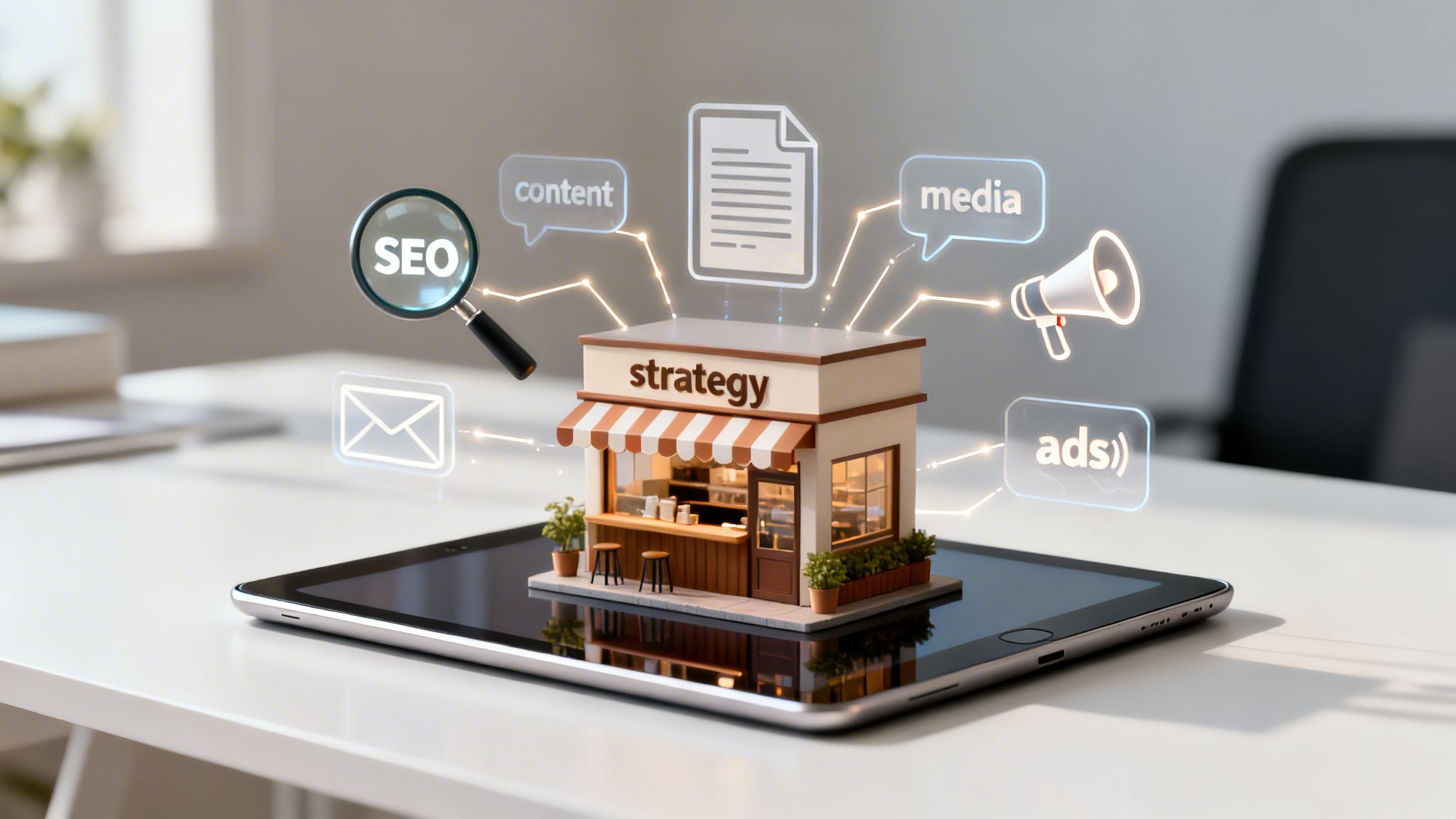
This diagram shows how the key digital marketing channels connect your business to your audience.

As you can see, foundational activities like search and social media are the main pillars holding up your wider digital marketing efforts, which in turn drive business growth.
The Four Pillars of Your Online Strategy
Your toolkit has four main instruments that form the bedrock of most successful campaigns. Each plays a unique role, but they’re at their best when they work in sync. Let's break down what each one does and how a local business might use it.
-
Search Engine Optimisation (SEO)
SEO is all about making your website more visible and credible to search engines like Google. Think of it as making sure your business is the first and most trusted listing in the modern-day phonebook. When a potential customer searches for what you offer, a strong SEO strategy puts you right at the top of the results.- Example in Action: A Perth-based emergency plumber uses local SEO to rank for terms like "burst pipe repair Perth." When a homeowner frantically searches, their business is the first one they see, leading to an immediate call.
-
Content Marketing
This is the art of creating and sharing valuable, relevant, and consistent content to attract and keep a specific audience. Instead of a hard sell, you’re providing genuinely helpful advice that builds trust. It positions your business as the go-to expert in your field.- Example in Action: A Sydney accounting firm writes blog posts answering common tax questions for small business owners. This helpful content attracts entrepreneurs looking for financial advice, establishing the firm's credibility and bringing in high-quality leads.
-
Social Media Marketing
Social media is about joining conversations and building relationships where your customers already hang out. It’s less about selling and more about showing your brand’s personality, engaging with followers, and nurturing a loyal community.- Example in Action: A Melbourne boutique uses Instagram to post daily outfits, run polls on new styles, and share behind-the-scenes stories. This consistent engagement drives traffic to their online store and gets local followers into the shop.
-
Email Marketing
Email is your direct line to people who’ve already shown interest in your business. It’s a fantastic tool for nurturing leads, announcing promotions, and keeping loyal customers in the loop with personalised messages. For many businesses, email delivers one of the highest returns on investment.
These four pillars are powerful on their own, but their true strength is unlocked when they work together. For instance, great content can be promoted on social media and shared via email, while SEO ensures that same content gets discovered by new audiences through search.
Automating parts of this can make your life a lot easier, too. You can learn more about how to do this by checking out our guide on what marketing automation is and how it can help. By mastering these tools, you build a robust and interconnected marketing engine that consistently drives growth.
How to Win Customers with Search Engine Optimisation

So, what exactly is Search Engine Optimisation (SEO)? It’s how your business shows up as the top answer right when a customer is looking for you online.
Think of it this way: Google is the world’s biggest library, and your customers are constantly asking the librarian for help. SEO is the art of making sure your website is the most helpful, well-organised, and trusted "book" on the shelf. When it is, the librarian (Google) hands it to every person asking about your products or services.
It’s about way more than just sprinkling a few keywords onto a page. Real optimisation is about proving to search engines that you are the most credible and useful choice for what someone is searching for. This long-term focus is precisely why a solid SEO foundation consistently delivers one of the best returns on your marketing spend.
The proof is in the numbers. In 2025, Australian businesses are expected to pour a massive $1.5 billion into SEO services. That’s a 12% jump from 2024, which shows just how vital search visibility has become for staying in the game. You can dig into the specifics in the latest Australian marketing trends report.
The Three Core Pillars of SEO
To really get your website noticed by search engines, you need to nail three distinct but connected areas. Getting each one right is essential for building a strong online presence that attracts the right kind of attention.
- On-Page SEO: This is all about optimising everything on your actual website. It means organising your content with clear headings, using relevant keywords naturally in your text, and making sure your pages load fast. A well-structured site makes it easy for search engines to figure out what you do and who you help.
- Off-Page SEO: This pillar focuses on building your authority and trustworthiness outside of your website. It’s mostly about earning backlinks—links from other reputable websites pointing to yours. When another trusted site links to you, it acts like a vote of confidence, telling search engines your content is valuable.
- Local SEO: For any business serving a specific area, this is non-negotiable. Local SEO is what gets you found in "near me" searches and on Google Maps. It involves fine-tuning your Google Business Profile and collecting positive customer reviews to prove you’re a trusted local expert.
Why SEO Is a Marathon, Not a Sprint
Paid ads are great for a quick boost, but they stop working the second you stop paying. SEO is different. It builds sustainable, long-term value. The effort you put in today continues to pay off for months, and even years, down the track. Each optimised blog post and every backlink earned is like laying another brick in your business's digital foundation.
This approach is what builds your organic traffic—visitors who find you through unpaid search results. These visitors are usually highly motivated because they were already actively looking for a solution you provide.
A well-executed strategy means your business shows up at the exact moment a customer on the Gold Coast needs a plumber, a law firm, or a new restaurant to try. This makes SEO an indispensable part of any serious digital marketing plan. Our in-depth guide offers more practical advice on implementing SEO for a small business to help you get started.
Ultimately, by focusing on creating genuine value for your users, you align your business with Google's own goals. It's a win-win that drives lasting growth.
Connecting with Your Audience on Social Media

Think of social media as the modern-day town square. It’s a bustling digital space where people gather, share recommendations, and discover new businesses. For your business, this isn't just a place to post updates; it's a golden opportunity to build a genuine community and engage directly with the people who matter most.
Effective social media marketing is about much more than just having a profile. It’s about joining conversations, showing your brand’s personality, and providing value that keeps people coming back for more. This approach builds trust and loyalty over time, creating a solid foundation for customer relationships.
Choosing the Right Platforms for Your Business
Not every social media platform will be the right fit for your business. The secret is to go where your ideal customers are already spending their time. Spreading yourself too thin across too many channels will just dilute your efforts, but focusing on the right one or two can deliver powerful results.
Here’s how different Australian businesses might choose their platforms:
- For a Gold Coast trade business: Facebook is often the perfect place to connect with local families. You can share before-and-after photos of your work, post customer testimonials, and get involved in community groups to build a rock-solid local reputation.
- For a hospitality venue like a cafe: Instagram and TikTok are visual powerhouses. High-quality photos of your food, behind-the-scenes videos of your team, and engaging Reels can attract a steady stream of new patrons.
- For a professional services firm: LinkedIn is the go-to platform for establishing authority. A law firm or consultant can share industry insights, connect with other professionals, and build a network that generates high-value referrals.
To truly connect with your audience, it's worth exploring a range of platforms, like the saucial platform. Understanding the unique vibe of each channel is a core part of a winning digital marketing strategy.
Accelerating Your Reach with Paid Advertising
While organic social media builds community for the long haul, paid advertising acts as a powerful accelerator. It lets you bypass the slow build and get your message in front of a hand-picked audience almost instantly. Think of it as putting your best offer on a billboard that only your ideal customers can see.
Paid social ads are incredibly versatile. You can target users based on their location, age, interests, and even their online behaviours. This means a solar installer can show ads specifically to homeowners in a certain Gold Coast suburb, or a restaurant can promote a lunch special to people working within a few kilometres.
This level of precision ensures your budget is spent wisely, reaching people who are most likely to become customers. Our dedicated team can help you build and manage these campaigns; learn more about our expert social media management services.
The investment in this area is growing for a reason. Social media advertising in Australia is projected to hit AU$7.5 billion in 2025, capturing 29% of all digital ad spend. With 20.9 million active social media users in the country, it's a massive opportunity for businesses to connect with a huge audience.
Even a small, well-targeted ad budget can generate immediate leads and sales. This gives your business a vital boost while your long-term organic strategies, like SEO and content marketing, continue to build momentum.
Navigating the Future with AI in Marketing
The way people search for things online is going through a massive shake-up, and Artificial Intelligence is right at the heart of it. For what feels like forever, digital marketing has been a race to the top of a list of blue links on a search results page. That whole game is changing, and fast.
The future is less about sifting through lists and more about getting straight answers. This shift brings a new, critical concept to the table for businesses: Answer Engine Optimisation (AEO).
Here’s a simple way to think about it. Traditional SEO was like trying to be the best book in the library, so the librarian would point people in your direction. AEO is about being the expert the librarian quotes directly to answer a question on the spot. Your goal is to become the definitive source of truth.
The Rise of Answer Engines
Search engines are quickly turning into "answer engines." Instead of just handing over a bunch of links, AI-driven tools like Google’s AI Overviews and chatbots like ChatGPT are designed to give you an immediate, conversational answer. They pull together information from the best online sources to give one, clear, consolidated response.
This means the new frontier for marketing is making sure your content is the trusted source these AI systems lean on. When a potential customer asks an AI a question about your industry, you want your business’s expertise front and centre in that answer.
For Aussie small businesses, this is both a challenge and a massive opportunity. If you adapt your strategy now, you can cement your brand as a genuine authority and get a serious jump on competitors still stuck in the old way of thinking. To get a deeper understanding of this, check out our detailed guide on Generative Engine Optimisation and what it means for your business.
How to Optimise for AI and AEO
So, how do you get your content ready for AI? The trick is to create incredibly clear, authoritative, and well-structured information that directly answers the real questions your customers are asking. Vague, waffly, or poorly organised content just won't cut it anymore; these smart systems will simply ignore it.
Here are a few practical things you can do right now:
- Focus on Conversational Questions: Build your content around full questions, just like how people actually talk. Instead of only targeting a keyword like "solar installer Gold Coast," create content that properly answers, "What is the average cost of solar installation on the Gold Coast?"
- Use Clear and Simple Language: Ditch the industry jargon and write in a straightforward style that anyone can understand. AI models favour content that gets straight to the point without any fluff.
- Structure Your Content Logically: Make good use of clear headings (H2s, H3s), bullet points, and numbered lists. This kind of formatting is like a roadmap for AI crawlers, helping them easily pull out key bits of information, like steps in a guide or a list of benefits.
- Build Authority and Trust: Consistently put out high-quality, factual content that proves you know your stuff. Backing up your claims with credible data, showing off case studies, and featuring customer testimonials all help build your site's authority.
By embracing AEO, you’re not just optimising for a machine. You're also fundamentally making your content clearer and more valuable for your human readers. It’s a strategy that ensures you stay visible and relevant as the way we search continues to evolve.
How to Create Your Digital Marketing Plan
Having a powerful set of tools is one thing; knowing how to use them together is what actually builds a successful business. A winning digital marketing strategy doesn’t start with vague hopes for more traffic or sales—it begins with a clear, deliberate plan.
Think of it as your roadmap. It stops you from throwing money at channels that don't reach your audience and focuses your energy on activities that deliver a real return. Without one, you're essentially marketing in the dark. This framework will guide you through creating a practical plan from the ground up, turning your goals into measurable actions.
Define Your Specific Business Objectives
First things first: you need to define what you actually want to achieve. Vague goals like "get more leads" are impossible to measure and, frankly, not very motivating. What you need are specific, measurable, achievable, relevant, and time-bound (SMART) objectives.
So, what does this look like in the real world for an Aussie business?
- For a solar installer on the Gold Coast: "Generate 15 qualified quote requests per month through our website within the next six months."
- For a local restaurant in Adelaide: "Increase online table bookings by 25% on weekends over the next quarter."
- For a tradie in Melbourne: "Receive 10 new job calls per week directly from our Google Business Profile."
See the difference? These goals are crystal clear and quantifiable. They give you a precise target to aim for and a concrete way to know if your marketing efforts are actually working.
Identify Your Ideal Customer
You can't talk to everyone, so don't even try. Before you spend a single dollar, you need to paint a detailed picture of your ideal customer. This goes way beyond basic demographics like age and location.
Get inside their head. Think about their daily challenges, what motivates them, and where they hang out online. What questions are they typing into Google at 10 PM? What social media feeds are they scrolling through after a long day? Knowing this is how you choose the right channels and craft messages that genuinely connect.
By understanding your customer's journey—from the first problem they search for to the moment they decide to buy—you can strategically place your business at every important touchpoint. This is the very core of an effective digital marketing plan.
Select the Right Channels and Tactics
Now that you have clear goals and you know who you’re talking to, you can pick the most effective digital marketing channels. The key is to avoid trying to be everywhere at once. Focus your resources where they will make the biggest impact.
Let’s map out a simple strategy for an Adelaide-based electrician targeting homeowners:
- Local SEO: The first priority is to optimise their Google Business Profile. This gets them showing up for "electrician near me" searches and in local map results. A big part of this is actively gathering positive customer reviews.
- Helpful Blog Content: They could create articles answering common questions like, "How do I know if my switchboard needs an upgrade?" This isn't just content for content's sake; it builds trust and attracts organic traffic from people who are actively looking for solutions.
- Targeted Facebook Ads: Finally, they can run ads aimed specifically at homeowners in certain Adelaide suburbs who have shown an interest in home renovation or DIY projects.
This simple, three-pronged approach cleverly combines long-term organic growth with a tap for immediate leads.
When you’re putting your own digital marketing plan together, it often helps to see how it fits into your wider business strategy. Resources like the general plan website can offer that broader perspective, making sure your marketing efforts are always driving real, measurable growth.
Common Digital Marketing Questions Answered
If you're a business owner in Australia dipping your toes into digital marketing, you've probably got a few practical questions. Let's cut through the noise and get you some straightforward answers so you can make smart decisions about your budget, time, and where to focus your energy.
How Much Should a Small Business Spend on Digital Marketing?
Look, there’s no magic number that fits everyone, but a solid rule of thumb is to set aside 7-10% of your revenue for marketing. For most small businesses around Australia, a starting budget of $1,500 to $3,000 per month is a realistic sweet spot to kick off a focused campaign, like local SEO or a solid social media ads strategy.
The smartest way to go about it is to start with an amount you're comfortable with and watch your return on investment like a hawk. Once you see which channels are bringing in the customers, you can double down and reinvest your profits there. A good agency will help you map out a cost-effective plan that’s tied directly to your growth goals, not just a shot in the dark.
How Soon Can I Expect to See Results?
This one really depends on the path you take. If you go with paid advertising, like Google Ads or Facebook ads, you can see traffic and leads coming to your website almost immediately—sometimes within a few days of launch. It's the fast track.
On the other hand, organic strategies like SEO and content marketing are more like planting a tree. They take a bit of patience to really take root and grow. You should start seeing some real momentum and measurable results within four to six months of consistent effort. The payoff for that patience? A strong, sustainable online presence that keeps delivering value long after you’ve put in the work.
Should I Do Digital Marketing Myself or Hire an Agency?
Going the DIY route is definitely an option, but let’s be honest—the online world is a beast. It's complex, and the rules seem to change every other week. For most business owners, your time is your most valuable asset, and it's better spent running your business.
Partnering with a professional agency gets you a team of specialists who live and breathe this stuff every single day. They come armed with the right tools, proven strategies, and the kind of experience that lets them sidestep common pitfalls. It frees you up to focus on what you do best while the experts handle your online growth, which almost always leads to a faster and bigger return.
Ready to build a digital marketing strategy that drives real growth for your business? The team at Titan Blue Australia combines over 25 years of experience with local Gold Coast knowledge to deliver results. Contact us today to get started.
Make Titan Blue a preferred source in Google
One click tells Google to surface our articles more often in Top Stories, AI Overviews and AI Mode.

Best Dental Website Design Agencies in Australia: 7 Compared
Best dental website design agencies in Australia 2026: seven compared on dental proof, booking, AHPRA…

Childcare Centre Website Design Australia: The 2026 Guide
Childcare centre website design Australia: show hours, ages and enrolment as text so parents and…

Electrician Website Design Australia: The 2026 Guide
Electrician website design Australia: what to build, what we found on eight Gold Coast electrician…