

Last updated:
At its core, e-commerce SEO is a specialised set of tactics designed to get your online store seen in search engine results. It’s all about optimising your website’s technical guts, its content, and its overall authority to pull in more qualified traffic—people who are actively looking for the exact products you sell. The end game? More sales.
Why SEO is Crucial for Australian Online Stores
In Australia’s crowded digital marketplace, having amazing products just isn't enough. Your customers have to be able to find you.
Think of it this way: your online store is like a physical shop in a massive, sprawling city. Without clear signposts pointing the way, you’re basically hidden down a back alley, invisible to everyone.
Professional e-commerce SEO services are those signposts. They guide customers with high intent—the ones ready to buy—directly to your digital front door. It's the engine that drives sustainable, long-term growth by connecting your brand with the right people at the right time.
Unlike paid ads, which stop delivering the second you turn off the spend, a well-built SEO strategy creates lasting value. It’s an investment in your store's digital real estate, making it more visible, authoritative, and trustworthy in the eyes of both customers and search engines like Google.
Driving Real Business Outcomes
A proper SEO strategy isn't about chasing vanity metrics like website clicks. It’s about focusing on what actually matters: generating qualified traffic that turns into sales. This requires a multi-faceted approach that touches every part of your online presence.
Here are the key areas we focus on:
- Technical Site Health: This is the bedrock of your store. It ensures your website is fast, secure, and easy for search engines to crawl and understand. Think of it as making sure a physical store has a solid foundation and easy-to-navigate aisles.
- Compelling On-Page Content: This is your digital merchandising. By optimising product descriptions, category pages, and blog posts, you can attract and engage shoppers, answering their questions and gently guiding them towards a purchase.
- Powerful Local Signals: For Aussie businesses, local search is a goldmine. Optimising for local intent helps you capture customers searching for products "near me," driving both online sales and foot traffic if you have a physical store.
The Growing Importance of SEO in Australia
The reliance on search optimisation is only getting stronger. The Australian SEO market is proof of this, projected to explode to a staggering $1.75 billion valuation by December 2025. This massive growth is fuelled by the rise of AI-driven search and the critical need for hyper-local targeting.
Ultimately, investing in professional SEO is about building a resilient and profitable online business. It helps you keep up with constantly changing search algorithms and stay ahead of Australian consumer behaviour. If you’re just starting out, our guide on how to increase online sales is a great place to build some foundational knowledge to go along with your SEO efforts.
The Core Pillars of an Effective E-commerce SEO Strategy
A powerful e-commerce SEO strategy stands on three core pillars. Think of it like building a house: you need a solid foundation, a well-designed structure, and a great reputation in the neighbourhood. If you neglect any one of these, the whole thing becomes unstable. But when they work together, they create a powerful framework that drives visibility, traffic, and sales for your online store.
Let's break it down using a physical retail shop analogy. First, you need a solid building that's safe and easy for customers to get into. Then, you need clear signs and attractive product displays inside. Finally, you need a good reputation around town to bring people through the door. Simple, right? Online works the same way.
Technical SEO: The Digital Foundation
Technical SEO is the digital architecture of your online store. It’s all the behind-the-scenes stuff that ensures search engines can find, crawl, and understand your website without hitting any roadblocks. If this foundation is shaky, even the best products and most compelling content will go completely unnoticed.
Imagine a customer walking into a shop with flickering lights, messy aisles, and a door that’s hard to open. They’d turn around and leave. The same thing happens online. A slow, insecure, or badly structured website frustrates users and tells search engines that your site offers a poor experience.
Key parts of technical SEO include:
- Site Speed: A slow-loading website is a certified sales killer. Research shows that just a one-second delay in page load time can cause a 7% drop in conversions. Your site needs to be lightning-fast.
- Mobile-First Design: A huge chunk of online shopping now happens on phones, so your website must work perfectly on mobile. Google now primarily uses the mobile version of a site for indexing and ranking, making this non-negotiable.
- Secure Connection (HTTPS): For any e-commerce store, an encrypted connection is essential. It protects your customers' data and is a confirmed Google ranking factor.
- Clean Site Architecture: A logical site structure helps both users and search engine bots navigate your store easily. A smart SEO strategy starts with a well-planned website, and implementing effective category management best practices is a huge part of that. The underlying structure is so critical, which is why professional e-commerce web design is foundational to any real SEO success.
On-Page SEO: Your Storefront and Merchandising
Once your technical foundation is solid, it's time to focus on on-page SEO. This is all about optimising the content and elements on your actual web pages—your product pages, category pages, and blog posts. It’s the online equivalent of your store’s merchandising, signage, and customer service.
This is where you make it crystal clear to both shoppers and search engines what you’re selling. Good on-page SEO helps you rank for the specific keywords your potential customers are typing into Google to find products just like yours. It’s about creating a compelling and informative shopping journey.
Effective on-page SEO for an online store zeroes in on:
- Keyword Optimisation: Strategically placing relevant keywords where they count—in page titles, product descriptions, headings, and URLs.
- Compelling Meta Descriptions: Writing persuasive meta descriptions that act like mini-ads in the search results, convincing people to click through to your site instead of a competitor's.
- High-Quality Images and Alt Text: Using clear, high-resolution product photos with descriptive alt text. This improves accessibility and gives search engines another way to understand and show your products.
- Unique Product and Category Descriptions: Crafting original, benefit-driven content that isn’t just copied from the manufacturer. This is your chance to speak directly to your audience and stand out.
Off-Page SEO: Building Your Reputation and Authority
The final pillar is off-page SEO. This covers all the activities you do away from your website to build its authority and reputation online. Think of it as your shop’s word-of-mouth reputation around town. Positive reviews, mentions in local publications, and recommendations from other respected businesses all build trust.
Off-page SEO is fundamentally about building trust and authority. When other reputable websites link to your store, it's a powerful vote of confidence that tells search engines your content is valuable and trustworthy.
The most critical part of off-page SEO is earning high-quality backlinks. A backlink is simply a link from another website to yours. But here, quality matters far more than quantity. A single link from a respected industry blog is worth more than hundreds of links from spammy, low-quality sites.
Building these authoritative links signals to Google that your store is a credible source, which in turn boosts your rankings and drives valuable referral traffic.
Navigating the New Frontier of AI Search and Zero-Click Results
The way your customers find products online is being turned on its head. Traditional search results are no longer the only show in town, thanks to the explosion of AI Overviews and the constant rise of zero-click searches. This isn't a small tweak—it's completely changing the customer journey before anyone even thinks about clicking on your website.
Picture a shopper asking Google, "what are the best noise-cancelling headphones under $200?" Instead of just getting a list of links, they now see a neat, AI-written summary right at the top of the page, pulling in key details from all over the web. The answer is served up on a platter, often making a click to your site unnecessary. This is the new reality for every e-commerce store out there.
This shift in search behaviour hits organic traffic and click-through rates hard. When people get their answers without ever leaving Google, fewer of them will visit your product pages—even if your site provided the info for the AI summary. It's a massive challenge that demands a smarter, more nimble approach to SEO.
Thriving in an AI-Powered Search World
The good news? This disruption also opens up some incredible opportunities. Instead of trying to fight the current, the real goal is to become the go-to source for these AI-generated answers. A forward-thinking strategy can flip this challenge into a huge competitive advantage, cementing your brand as the trusted authority in your space.
The key is to start optimising your content not just for clicks, but for direct inclusion in these new search features. It’s a mental shift: stop thinking about just ranking, and start thinking about being featured. You have to get inside your customers' heads, anticipate their questions, and serve up the clearest, most authoritative answers possible.
This map really drives home how interconnected modern e-commerce SEO is. Your technical foundations, on-page content, and off-page authority all have to work in sync to win.
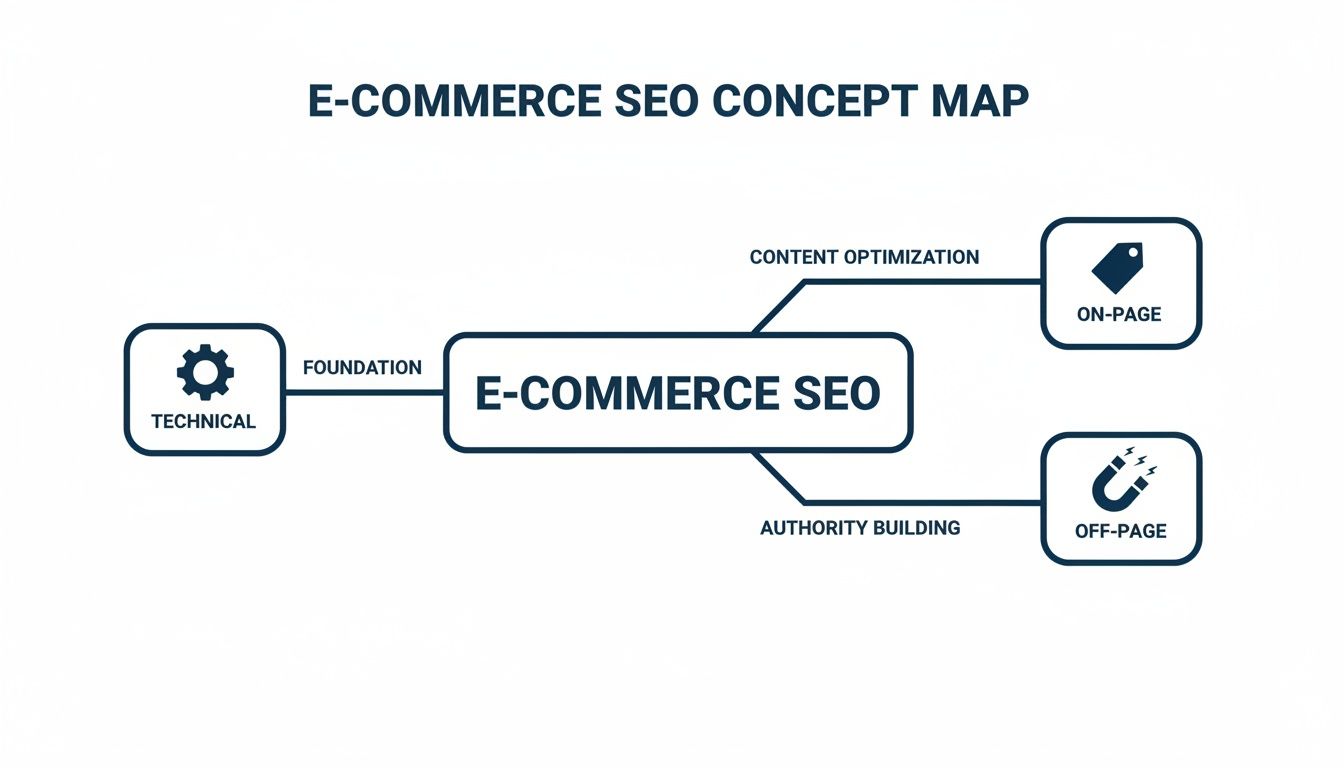
You simply can't afford to neglect one area, as it weakens the others—especially when you’re trying to adapt to something as game-changing as AI search.
Actionable Strategies for the AI Era
To come out on top, your e-commerce SEO services provider needs to be laser-focused on specific, targeted actions. It's all about feeding search engines clean, structured information that AI models can easily grab, understand, and feature.
Here are the tactics that matter most:
- Optimise for Featured Snippets: Get straight to the point. Structure your product descriptions, blog posts, and especially your FAQ sections in a clear question-and-answer format. Think about the most common queries your customers have and answer them directly.
- Leverage Structured Data (Schema Markup): This is basically like putting labels on your website’s code to tell search engines exactly what everything is. By adding schema for products, reviews, and FAQs, you make it dead simple for AI to pull accurate info like pricing, stock levels, and ratings right into the search results.
- Build Unshakeable Brand Authority: In a world of AI summaries, a strong, trusted brand is your ultimate defence. When users see your name pop up as the source, it builds instant credibility and encourages them to look for you directly, completely bypassing the zero-click problem.
For Australian businesses, this isn't a future problem—it's happening right now. The latest data shows AI Overviews are already appearing in 39% of search results in Australia, and they're cutting clicks to the #1 organic result by another 34.5%. This is contributing to a staggering 32% drop in overall organic traffic compared to earlier this year. With zero-click searches expected to climb to 70% by 2025, adapting isn't just a good idea; it's essential for survival.
The core idea is simple: make your website the most helpful and easiest-to-understand resource in your industry. When you do that, you're not just serving your human visitors—you're also becoming the favourite source for the AI models that are shaping the future of search.
Getting your head around these changes is the first step. The next is putting a strategy in place that gets ahead of them. This is where expert knowledge of generative engine optimisation services becomes critical, making sure your online store stays visible and profitable, no matter how much search changes.
The Power of Local SEO for Australian E-Commerce
For many Australian online stores, some of your best customers aren't halfway across the globe—they’re right in your backyard.
Capturing high-intent local traffic from searches like 'buy running shoes near me' is an absolute game-changer. It transforms your e-commerce site from just another online retailer into a trusted, local option. This is exactly where a focused local SEO strategy becomes one of your most powerful tools for driving sales.
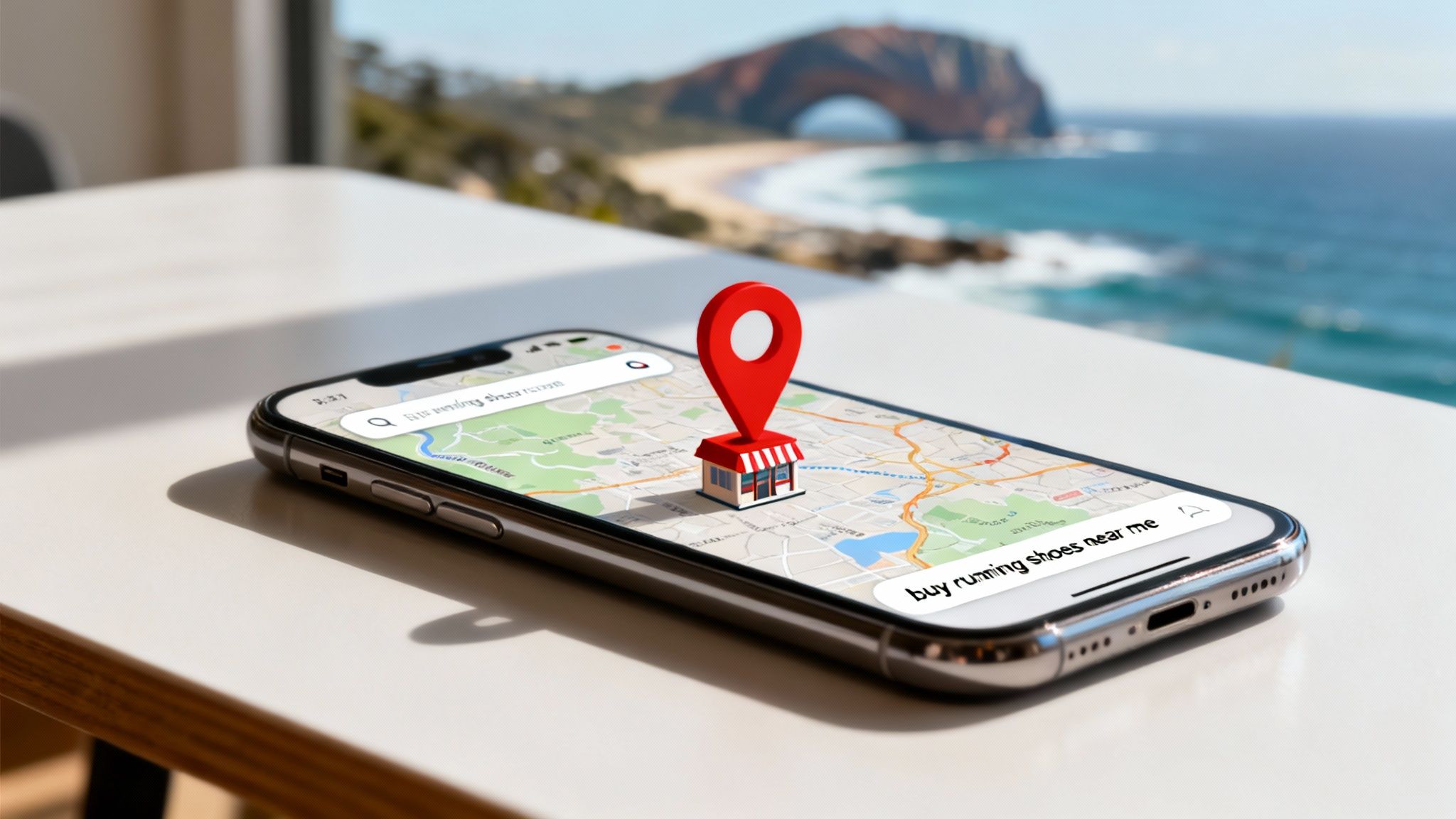
Think of local SEO as digital signposting for your immediate community. When someone searches for a product you sell with local intent, Google’s top priority is to show them the most relevant, geographically close results. Getting your business to pop up in the 'map pack' and local listings is how you attract these ready-to-buy customers.
This approach builds a serious competitive advantage in your home market. You’re no longer just a website; you're part of their community. It perfectly bridges the gap between your online presence and your physical service area, even if you don't have a traditional brick-and-mortar shop.
Mastering Your Google Business Profile
Your Google Business Profile (GBP) is the absolute cornerstone of any effective local SEO effort. It's a free tool from Google that acts like a mini-website right inside the search results, giving potential customers a quick snapshot of your business. Optimising it correctly isn't just a good idea—it's non-negotiable.
A well-managed profile gives customers everything they need to make a fast decision: business hours, contact details, service areas, and most importantly, social proof in the form of reviews. Keeping this information accurate and fresh is the first step toward building local trust.
Here are the key areas to focus on for maximum impact:
- Manage Reviews Actively: Encourage happy customers to leave reviews and make sure you respond to all feedback, good and bad. It shows you’re engaged and that you actually care.
- Upload Compelling Photos: Show off your products, your team, or your process with high-quality, authentic images. This helps potential buyers visualise what you offer.
- Utilise Google Posts: Use this feature to announce new products, share special offers, or post company news. These posts show up directly in your profile and are a fantastic way to keep your listing looking active and engaging.
Expanding Your Reach With A Multi-Location Strategy
For e-commerce businesses serving multiple cities or those with several physical locations, a tailored multi-location SEO strategy is essential for real growth. This means creating distinct, optimised online presences for each service area to ensure you capture local search traffic across all your target regions.
This approach doesn't just improve your visibility—it multiplies it. Instead of competing on a broad national level for every keyword, you can completely dominate local searches in specific, high-value areas. This requires creating location-specific landing pages on your website and optimising each Google Business Profile to reflect its unique community.
The impact of a well-executed local strategy cannot be overstated. It connects you directly with the most motivated buyers—those searching for solutions right in their immediate vicinity.
The data for Australian businesses is pretty compelling. Local SEO is a dominant force, driving 28% of total search traffic and converting at a rate three times higher than standard organic results. What's more, businesses that roll out multi-location strategies see 557% more traffic on average than single-site operations. That's a critical insight for any e-commerce brand looking to expand its footprint.
Ultimately, a strong local presence creates a powerful and sustainable competitive advantage in your home market. For a deeper dive, check out our complete guide on local SEO for businesses to learn how to put these principles into action.
Measuring Success and Proving the ROI of Your SEO
Investing in e-commerce SEO services is a strategic move, not just another line on the expense sheet. But how do you actually know if it’s paying off? We need to look past vanity metrics like a general uptick in traffic. The real proof is in the numbers that tie directly back to your revenue.
It’s all about asking the right questions. Are more people finding your store through searches that don’t include your brand name? Are your most profitable product pages climbing the rankings for the keywords that matter? Answering these questions means getting comfortable with the data that really drives your business forward.
This isn’t about getting lost in spreadsheets. It’s about cutting through the noise to see a clear, undeniable line between your SEO efforts and a healthier bottom line.
Key Performance Indicators That Matter
To measure the real impact of your SEO, you need to zero in on the metrics that reflect genuine business growth. While every online store is different, a few core KPIs will always give you an accurate picture of your campaign’s health and effectiveness.
These are the numbers that tell you if you're attracting the right crowd and, more importantly, turning them into paying customers.
-
Organic Traffic from Non-Branded Keywords: This is a big one. It shows you how many new customers are discovering your store through general searches (like "women's linen shirts") instead of just looking you up by name. When this number grows, you know you’re expanding your market reach.
-
Keyword Rankings for High-Value Terms: You need to obsessively track your position in Google for your most important product and category keywords. Seeing these terms climb onto the first page is a direct signal that you’re becoming more visible to shoppers who are ready to buy.
-
Organic Conversion Rate: This KPI tells you what percentage of visitors from organic search actually complete a purchase. A rising conversion rate is solid proof that your SEO isn't just bringing in more traffic—it's bringing in the right traffic.
From Data to Dollars: Calculating ROI
At the end of the day, the only metric that truly matters is your return on investment (ROI). You need to know that for every dollar you put into SEO, you’re getting significantly more back. Calculating this isn't as complicated as it sounds, and it's the single best way to justify your marketing spend.
To really nail down the value of your e-commerce SEO, it’s crucial to understand how to calculate marketing ROI across all your digital channels. The basic formula is refreshingly simple: (Revenue from SEO – Cost of SEO) / Cost of SEO.
Let’s say you generate $15,000 in sales from organic traffic after investing $3,000 in SEO services. Your ROI is a massive 400%. That’s a powerful figure that proves the tangible, financial benefit of your strategy.
SEO is a long-term strategy, and its financial returns often compound over time. Unlike paid ads that stop when you stop paying, SEO builds a lasting asset that continues to generate value and sales month after month.
Tools like Google Analytics and Google Search Console are your best friends here. They let you track organic revenue, see which pages are driving the most sales, and pinpoint which search terms are bringing in customers who convert. Any good SEO partner will use this data to provide transparent, easy-to-understand reports that clearly connect their work to your bottom line. Just remember, significant results don't happen overnight; understanding how long SEO takes to work is key to setting realistic expectations for seeing this ROI.
How to Choose the Right E Commerce SEO Partner in Australia
Choosing a partner for your e-commerce SEO services is one of the biggest calls you’ll make for your store's future. This isn't just about outsourcing a task; it's about bringing a team into your corner that will directly impact your traffic, sales, and bottom line.
Get it wrong, and you could be looking at a wasted budget, flatlining growth, and watching your competitors zoom past in the busy Australian market. The right partnership, however, is built on trust, transparency, and a genuine understanding of where you want to take your business. You need someone who doesn't just talk technical jargon but takes the time to get to know your products, your customers, and your vision.
Vetting Potential Partners
Before you sign on the dotted line, you need to ask the tough questions. A good provider won’t just have slick answers; they’ll show you their depth of experience and strategic thinking. They should be completely open and welcome a deep dive into how they operate.
Here are the essential questions to get you started:
- Industry Experience: "Have you actually worked with online stores in our niche before? Show me some examples and the results you delivered."
- Strategic Approach: "What's your process? How do you plan to build an SEO strategy that's customised for us, not just a cookie-cutter template?"
- Reporting and Communication: "What do your reports look like, and how often will we connect? Who will be my day-to-day contact?"
- Understanding the Australian Market: "How do you factor in Australian consumer habits and local search trends into your strategy?"
Understanding Pricing Models
The cost of SEO can be all over the place, so it’s vital to understand the different pricing models to find what fits your budget and goals. There’s no single “best” option—it all depends on the scope of work and how involved you want the agency to be.
You'll typically come across a few common structures, including monthly retainers, which involve paying a fixed fee for ongoing SEO management, and project-based fees that are ideal for one-off jobs like a technical audit or site migration. Another option is hourly consulting, which works well when you need high-level strategic advice or help with a specific, complex problem.
Red Flags to Watch Out For
Knowing what to look for is only half the battle; knowing what to run from is just as crucial. Some promises are simply too good to be true and are massive red flags for an inexperienced or untrustworthy provider.
Be very wary of any agency that makes these kinds of claims:
- Guaranteed #1 Rankings: Nobody—and I mean nobody—can guarantee a specific ranking on Google. It’s an impossible promise and a classic sign of someone who doesn't know what they're doing.
- Instant Results: SEO is a marathon, not a sprint. Anyone promising overnight success is either lying or using risky, black-hat tactics that will get your site penalised down the track.
- A Lack of Clear Communication: If an agency is cagey about their methods, can't explain their strategy in plain English, or fails to provide clear, data-backed reports, it’s time to walk away.
Your E-commerce SEO Questions, Answered
To wrap things up, let's tackle some of the most common questions Australian business owners have about e-commerce SEO. Think of this as a quick guide to help you set realistic expectations for what a professional strategy can do for your online store.
How Long Does It Take To See SEO Results?
This is the big one, and the honest answer is: SEO is a long game, not an overnight fix. While you might spot some small wins in the first few months, it generally takes about four to six months to see meaningful results, like a real jump in organic traffic and sales.
Why so long? Because good SEO involves a lot of moving parts. We're talking technical website fixes, creating high-quality content, and building your store's authority online. Search engines need time to recognise these changes. Patience is key here, because the results build on each other and create lasting value—unlike paid ads that disappear the second you stop paying.
Is SEO Better Than Paid Ads For E-commerce?
It's not about one being "better" than the other; they're different tools for different jobs, and they work brilliantly together. SEO builds a sustainable, long-term asset. It generates organic traffic month after month without you having to pay for every click, establishing trust and authority along the way. Your return on investment just keeps growing over time.
Paid ads, on the other hand, deliver immediate traffic and visibility. They're perfect for launching a new product, running a sale, or getting eyes on your brand right now. A powerful strategy uses both: paid ads for the quick wins while SEO builds a solid foundation for consistent, cost-effective growth.
Can I Do E-commerce SEO Myself?
While you can definitely handle some of the SEO basics yourself, a truly comprehensive strategy is another beast entirely. It demands deep technical knowledge, expensive specialised tools, and a huge time commitment. The world of search is always changing, especially with new developments like AI Overviews making things more complex.
For most business owners, partnering with an agency that lives and breathes e-commerce SEO services is simply more effective. It frees you up to focus on what you do best—running your business—while knowing your online growth is in the hands of experts.
Ready to turn clicks into customers and build a powerful online presence? Titan Blue Australia has over 25 years of experience helping Australian businesses thrive with expert digital strategy. Let's build your success story together. https://titanblue.com.au
Make Titan Blue a preferred source in Google
One click tells Google to surface our articles more often in Top Stories, AI Overviews and AI Mode.

This Week in Australian AI Search: Google’s UGC Data Program
Google's UGC Fresh Data Program and Indexing API quota update, plus our Google AI Mode…

Google AI Mode Adds Official Links: What It Means for Australia
Google is adding more links to AI Mode and testing an official websites section. Here…

Best AEO and GEO Agencies in Australia (2026): 7 Compared
Best AEO agency and GEO agency in Australia, compared: seven agencies, what their own pages…