Email Marketing Agency: Grow Faster with Measurable ROI in 2026
At its core, an email marketing agency is a team of specialists focused on one thing: using your email list to grow your business. They take care of everything from the big-picture strategy and content creation right down to the technical details and performance reports. Essentially, they turn your email list into a reliable asset for driving sales and building customer loyalty.
What an Email Marketing Agency Actually Does
Think about trying to build a high-performance engine with just a basic toolbox from your garage. You might get it to splutter to life, but it’s never going to be powerful or efficient. An email marketing agency is your master mechanic, equipped with specialised tools, deep expertise, and a proven blueprint for performance.
These teams don’t just work for you; they work with you as strategic partners. Their job is to design and run email campaigns that hit specific business goals, going far beyond just sending out a monthly newsletter. It's about building a direct, profitable channel between your brand and your customers.
More Than Just Sending Emails
A professional agency doesn’t just log into your email software and hit send. They build an entire system designed for engagement and conversion. This is a multi-layered approach that includes:
Strategic Planning: They map out entire customer journeys to make sure the right message hits the right person at the perfect time.
Audience Segmentation: They break your audience down into smaller, targeted groups to deliver content that’s highly relevant and personal.
Content and Design: They create compelling copy and eye-catching visuals that grab attention and get people to click.
Technical Management: They work behind the scenes to ensure your emails actually land in the inbox, not the spam folder, and keep your contact list healthy.
This whole process transforms your email marketing from a simple broadcast tool into a sophisticated system for nurturing leads and encouraging repeat business. Understanding this difference is key to seeing the real value they bring. For a closer look, you can explore what an EDM in marketing truly involves and how it fits into a wider strategy.
The Power of Specialised Focus
By focusing only on this one channel, an agency develops a level of expertise that’s almost impossible to replicate with an in-house team. They live and breathe the nuances of deliverability, complex automation workflows, and A/B testing—the small, incremental gains that lead to significant long-term growth. This specialised knowledge is what unlocks the full potential of your email list.
The financial payoff from this expertise is huge. In Australia's digital marketing scene, email marketing is the undisputed champion of ROI, delivering a staggering $42 for every single dollar invested. This isn't some generic global stat; it’s a powerful testament to professionally managed email campaigns right here in Australia. You can see more of these findings in the latest Australian marketing statistics from Eloquent. This incredible return is exactly why so many businesses are now turning to a dedicated email marketing agency to manage this critical revenue stream.
The Core Services That Drive Email Marketing Success
When you bring on an email marketing agency, you’re not just paying someone to send a few emails. You're investing in a complete system built to generate revenue and forge stronger customer relationships. The real value is in a cohesive set of expert services that work in sync to turn your email list into one of your most powerful business assets.
These services can be broken down into four key pillars. Each one is critical for delivering results you can actually measure. Understanding how these pieces fit together helps you see exactly what you’re paying for and how it all contributes to your bottom line.
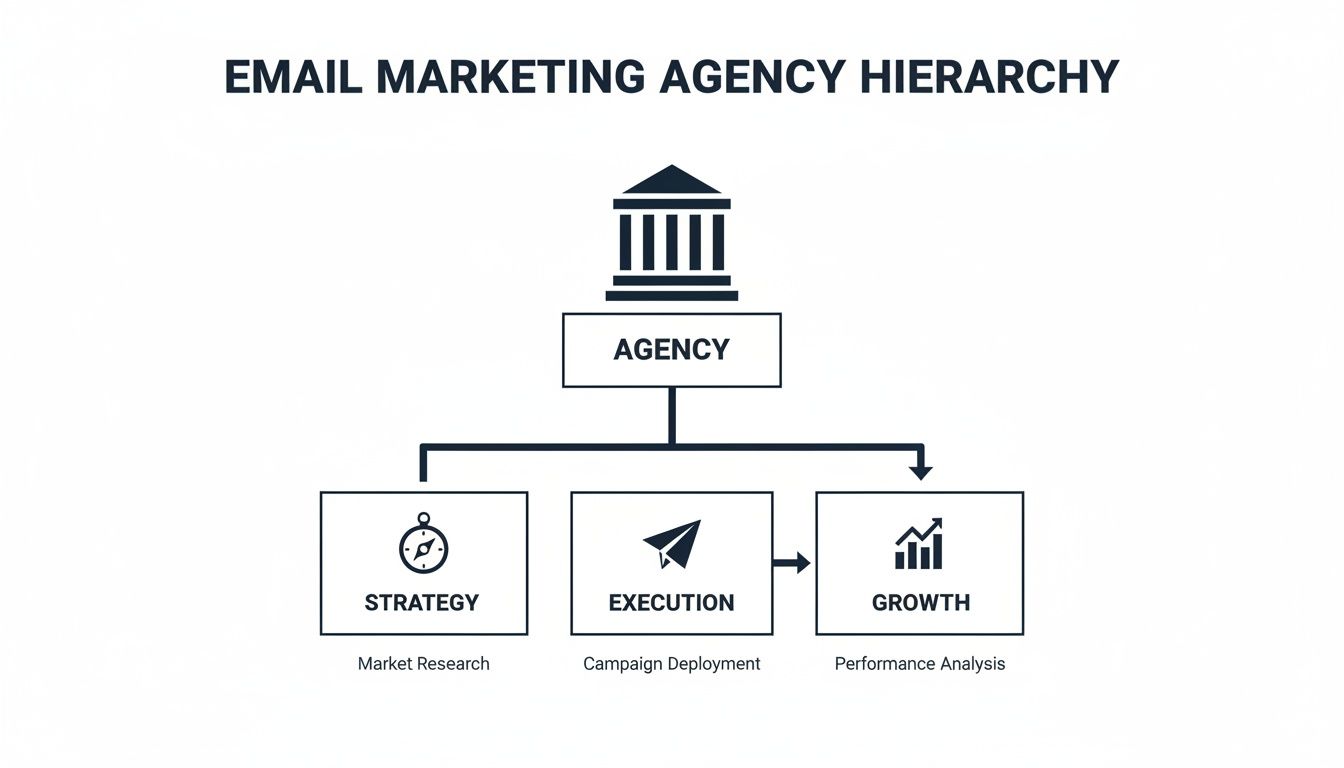
This diagram shows how an agency’s core functions—Strategy, Execution, and Growth—all work together.
As you can see, a successful partnership always starts with a rock-solid strategy, moves to flawless execution, and never stops focusing on continuous growth.
Strategy and Segmentation
The foundation of any great email program is a clear, intelligent strategy. An agency doesn’t just guess what might work; they dive into your data to build a roadmap designed around your specific business goals and how your customers behave.
This initial phase is all about deep analysis. The agency will get to know your ideal customers, map out their journey with your brand, and pinpoint the best moments to communicate with them.
A huge part of this is audience segmentation. Instead of blasting the same generic message to everyone on your list, an agency splits your audience into smaller, more relevant groups based on things like:
Purchase history: Treating first-time buyers differently from your loyal, repeat customers.
Engagement level: Sending special offers to highly engaged subscribers, and a different kind of message to those who haven't opened an email in months.
Demographics and interests: Personalising content based on what you actually know about your subscribers.
This targeted approach makes your messaging far more relevant and effective, which is a cornerstone of all email marketing best practices.
Creative and Content Development
Once the strategy is locked in, the focus shifts to creating emails that actually get noticed and drive action. This is where expert copywriting and design make all the difference. An agency's creative team knows how to write subject lines that demand to be opened and craft content that convinces people to click.
They design emails that are not only on-brand and look great but are also optimised for mobile devices—where most people read their emails now. Every single element, from the headline right down to the call-to-action button, is carefully thought out to get the best possible result. For many businesses, this includes smart coupon management to boost conversions and build loyalty through exclusive deals.
Technical Automation and Management
Behind every successful email campaign is a technical setup that just works. An email marketing agency handles all the complex, behind-the-scenes work that makes sure your program runs like a well-oiled machine. This includes setting up and managing your email platform, which can be an incredibly technical and time-consuming job.
A key service here is marketing automation. The agency builds out automated email sequences that are triggered by specific actions a user takes. For example, an agency can set up an automated "welcome series" for new subscribers, a "cart abandonment" sequence for e-commerce stores, or a "re-engagement" campaign for contacts who have gone quiet.
This ensures timely, relevant messages go out automatically, nurturing leads and recovering sales 24/7 without you having to lift a finger. They also manage list hygiene and deliverability, making sure your emails actually land in the inbox and protecting your all-important sender reputation.
Performance Analytics and Optimisation
Finally, a top-tier email marketing agency is obsessed with results. They don't just launch campaigns and hope for the best; they track, measure, and analyse everything to figure out what's working and what isn't.
They keep a close eye on key performance indicators (KPIs) like open rates and click-through rates but, most importantly, on conversion rates and revenue. This data-first approach allows for constant improvement.
The agency will run A/B tests on subject lines, content, and calls-to-action to find the winning formulas for your specific audience. It's this continuous cycle of testing and optimising that drives long-term growth and makes sure you get the highest possible return on your investment.
The Real-World ROI of Professional Email Management
When you're running a business, every dollar spent has to count. So, when considering an email marketing agency, the big question isn't "What does it cost?" but "What's the return?" It's not about adding another expense to your books; it's about making a strategic investment that pays for itself, and then some.
The right agency does more than just send out a monthly newsletter. They transform your simple list of contacts into a powerful revenue-generating machine. Every email that goes out has a clear purpose, meticulously tied to a real business goal—whether that's getting more bookings, selling more products, or bringing old customers back.
When you see how a sharp strategy and great content work hand-in-hand to produce measurable results, the agency fee no longer feels like a cost. It becomes a high-yield investment in your own growth.
Unlocking Direct Financial Returns
An agency's number one job is to make you money. It’s that simple. They do this by rolling out targeted strategies that turn curious visitors into paying customers and convince the ones you already have to come back for more. This isn't about throwing ideas at the wall and seeing what sticks; it's about using proven tactics that are tracked, tested, and fine-tuned for pure financial performance.
Take a local plumber in a busy market. After bringing an agency on board, they set up an automated system that sends a professional follow-up email to every single quote that goes out. That one small change can easily lead to a 20% jump in job approvals, turning maybes into confirmed work without the plumber lifting a finger.
That’s what professional email management looks like in the real world. It's about building smart, automated systems that consistently bring in revenue.
Boosting Customer Lifetime Value
Getting a new customer through the door is great, but the real money is made in keeping them around. A skilled email marketing agency is a master at increasing Customer Lifetime Value (CLV)—that’s the total amount of money a single customer is likely to spend with you over time. They achieve this by setting up smart, automated email sequences that keep your business top-of-mind.
These automated campaigns often include:
A Warm Welcome Series: This makes a brilliant first impression on new subscribers, introduces them to your brand story, and often includes a little something to encourage that first purchase.
Post-Purchase Follow-Ups: After a customer buys, you can send them helpful tips, ask for a review, or suggest products that complement what they just bought. It shows you care and nudges them toward another sale.
Re-Engagement Campaigns: For customers who've gone quiet, a personalised email with a special offer can be just the thing to reignite their interest and win them back.
Each of these sequences is carefully designed to build a genuine relationship with your customers, helping turn one-time buyers into loyal fans who tell their friends about you. This systematic approach is a core part of how professional business growth with email marketing delivers results that last.
Reclaiming Your Most Valuable Asset: Your Time
If there's one thing every business owner needs more of, it's time. Running a truly effective email marketing program is a huge time sink. It demands strategy, copywriting, design, technical setup, and non-stop analysis. When you try to juggle it all yourself, it either gets done halfway or gets pushed to the bottom of the to-do list.
Handing this responsibility over to an agency can instantly free up dozens of your hours every single month. Instead of battling with email templates or getting lost in automation workflows, you can get back to what you actually do best—running your business, leading your team, and looking after your customers.
The value of that reclaimed time and mental energy is massive. By bringing in a dedicated email marketing agency, you’re not just buying their expertise; you’re buying back your own focus, empowering you to work on your business, not just in it.
Theory is one thing, but what does a high-performing email strategy actually look like on the ground for an Australian business?
The real power of working with an email marketing agency comes alive when you stop talking in broad strokes and start applying proven tactics to specific, real-world challenges. It’s all about moving from abstract ideas to concrete actions that drive bookings, secure jobs, and fill tables.
Let’s break down how tailored email strategies can solve distinct problems for different industries right here in Australia. These aren’t just concepts; they are practical, results-focused approaches that generate a tangible return on your investment.
For Hospitality a Gold Coast Resort
A resort on the Gold Coast faces ferocious competition, not just from other hotels but from online travel agents (OTAs) that skim a huge cut from every single booking. The goal is simple: drive more direct bookings and get past guests to come back again and again. An email marketing agency can build a powerful system to make this happen.
The strategy would centre on two crucial automated campaigns:
A "Direct Booking" Incentive: The moment someone signs up for the newsletter, an automated email hits their inbox. It offers an exclusive deal—think a complimentary room upgrade or a dining voucher—but only when they book directly through the resort's own website. This immediately trains guests to bypass the OTAs.
A Personalised "We Miss You" Flow: For guests who haven't stayed in over a year, an automated email goes out with a subject line like, "It's been a while, [Guest Name]! The Gold Coast is calling." Inside, you'd feature stunning new photos of the property and a special "welcome back" rate, reminding them of the great time they had before.
These targeted emails build a direct relationship with guests, cutting out the middleman and boosting the profit margin on every booking.
For Trade Services a Sydney Electrician
For a sparky in Sydney, the sales cycle is completely different. It’s not about impulse buys; it’s about building trust and turning a quote into a confirmed, paid job. The biggest hurdles are converting those quotes and creating a stream of recurring revenue beyond one-off projects.
An agency would set up a lead nurturing and retention strategy. This looks like:
Quote Follow-Up Automation: As soon as a quote is sent, an automated email sequence kicks in. The first email confirms the quote was sent. A few days later, another one follows up, maybe highlighting a few customer testimonials or explaining the safety benefits of the work proposed. This keeps the electrician top-of-mind and adds value while the customer is making their decision.
Annual Safety Check Reminders: One year after a job is done, an automated email is sent to the client, reminding them it’s time for an annual safety inspection. This simple, hands-off reminder creates a consistent stream of recurring work and positions the electrician as a proactive expert who cares about their safety.
This approach transforms a simple contact list into a machine for converting leads and retaining clients, generating work automatically.
For Local Restaurants and Cafes
A local cafe in Melbourne lives and dies by its regulars and local buzz. Their challenges are driving foot traffic during quiet periods, managing event bookings, and building a loyal customer base that picks them over the countless other options. We've written a lot about this, and you can dive deeper in our guide on email marketing for restaurants.
An expert email strategy here is all about community and exclusivity. A well-run email list is a restaurant's most valuable asset. It's a direct line to your most loyal customers, allowing you to bypass the noise of social media and speak straight to the people who already love what you do.
Key campaigns would include:
Weekly Specials & Events: Every Tuesday, an email lands in subscribers' inboxes announcing the "Chef's Special" for the week or promoting an upcoming trivia night. This one simple message drives mid-week traffic and fills seats on event nights.
A Digital Loyalty Program: Forget flimsy paper cards. Loyalty is managed through email. Subscribers get exclusive offers like "Your 5th coffee is on us!" or get first dibs on booking for special occasions like Mother's Day. It makes customers feel like valued insiders and gives them a real reason to keep coming back.
In each of these Australian examples, the email marketing agency isn't just sending emails. They're building strategic, automated systems that solve core business problems and deliver measurable growth.
How to Choose the Right Email Marketing Partner
Picking the right email marketing agency is a massive decision, one that can shape your campaign success for years. This isn’t just about outsourcing a task; it's about finding a genuine partner who gets your vision and has the skills to bring it to life. The choice demands a bit of homework to make sure you end up with a team that’s focused on real, measurable results.
A great partner becomes an extension of your own team, dedicated to hitting your specific business goals. It means looking past the fancy presentations and digging into how an agency actually works.
Evaluate Their Experience and Past Performance
Before you do anything else, you need to see proof that they can deliver on their promises. An agency's track record is the single most reliable sign of whether they can help your business grow. Don’t just take their word for it—ask for hard evidence of their past wins.
A huge part of this is looking closely at their case studies. You want to see detailed examples of their work with businesses like yours, especially other Australian companies in your industry. A proper case study should clearly lay out the problem, the strategy they put in place, and most importantly, the quantifiable results.
Look for metrics like:
Higher open and click-through rates.
Growth in conversion rates and direct revenue from email.
Improvements in customer lifetime value (CLV).
A drop in subscriber churn.
If their case studies are fuzzy on the details or don't include hard numbers, that’s a major red flag. You want a partner who is proud to show off their data-backed successes.
Ask the Right Questions During the Vetting Process
Your first few chats with a potential agency are the best chance you'll get to see how they think, what they know, and if they’re a good fit for your company culture. Walk into those meetings with a list of sharp, specific questions designed to uncover how they operate.
Don't be afraid to dig deep. Their answers will tell you everything about their strategic thinking and how committed they are to their clients' success.
Here are a few essential questions to get you started:
How do you define and measure success? A top-tier agency will talk about business outcomes like revenue and customer retention, not just surface-level stats like open rates.
What’s your onboarding and communication process like? They should have a clear, structured plan for getting to know your brand and setting up regular check-ins and reporting.
Can you walk me through your strategic process? Listen for a methodical approach. They should start by understanding your goals and audience before jumping into creative ideas.
How do you handle list segmentation and personalisation? A generic, one-size-fits-all approach is a bad sign. They should be talking about creating tailored experiences for different groups within your audience.
Their answers should feel honest, confident, and customised to your business—not like a script they’ve run through a hundred times.
Watch Out for Common Red Flags
Knowing what to look for is only half the battle; you also need to know what to avoid. Some agencies make massive promises they can’t possibly keep, using buzzwords to hide a lack of real substance. Spotting these red flags can save you from a costly and frustrating mistake. Trust your gut. If an agency’s promises sound too good to be true, they probably are. A trustworthy partner sets realistic expectations and focuses on building sustainable, long-term growth.
Be careful with any agency that:
Promises guaranteed results: Nobody can guarantee a specific ROI or a "#1 spot." Marketing has too many variables, and anyone making those kinds of promises is either inexperienced or dishonest.
Is vague about their methods: If they can't—or won't—explain their strategy in simple terms, they might be using shady tactics or, worse, don't have a clear plan at all.
Offers a rigid, one-size-fits-all package: Your business is unique, so your email strategy should be too. An agency trying to squeeze you into a generic package isn’t truly interested in your specific needs.
Lacks transparency in reporting: You should expect regular, easy-to-understand reports that clearly show progress toward your goals.
Choosing the right email marketing agency is an investment in your business’s future. By taking a measured, critical approach to the selection process, you can find a partner who will help you build a powerful and profitable email program.
Using AI and Advanced Automation to Win the Inbox
The next frontier in email marketing isn’t about replacing your strategy with robots; it’s about supercharging it with artificial intelligence (AI) and clever automation. Any forward-thinking email marketing agency uses these tools to unlock a level of personalisation that was simply out of reach before.
This technology allows for smarter, data-backed decisions that capture attention in an already overflowing inbox.
Think of AI as a brilliant analyst, working around the clock to understand your audience, one person at a time. It can comb through massive amounts of customer data—like purchase history, browsing habits, and email engagement—to predict what each subscriber actually wants to see next.
This is what lets an agency move beyond basic group segmentation and into hyper-personalisation. Instead of blasting one offer to a big list, AI helps create and send thousands of unique variations, each one fine-tuned to a single user's likely interests.
How AI Delivers Better Results
Imagine an AI notices a customer has been looking at solar panel inverters on your website. Instead of getting your generic company newsletter, the system automatically sends them an email with a detailed guide on choosing the right inverter, complete with a personalised offer. That’s the power of AI-driven automation in action.
This approach creates a far more relevant and engaging experience for the customer, which leads directly to better results for your business. The key benefits are clear:
Predictive Sending Times: AI can figure out when an individual is most likely to open their emails and then schedule your messages for that perfect moment.
Dynamic Content: The content inside an email can change automatically based on the recipient. A restaurant could show a vegan special to a customer who’s ordered vegan meals before, while showing a steak special to another.
Smarter Subject Lines: AI tools can test and predict which subject lines will perform best for different audience segments, giving your open rates a serious boost.
The Role of LLMs in Smarter Content
This intelligence doesn't stop at delivery; it extends to how the content itself is created. Modern agencies now use insights from search behaviour and customer data to fuel email content that perfectly matches what the user is looking for. Large Language Models (LLMs) are a huge part of this, helping to generate relevant copy at scale. If you are curious, you can learn more about what Large Language Models are and how they function. By integrating insights from search and behavioural data, an email marketing agency can create a seamless journey. The conversation that starts on a search engine is continued directly in the customer’s inbox, building trust and accelerating the path to conversion.
Ultimately, an agency that uses AI and advanced automation gives your business a serious competitive advantage. It ensures your email marketing is not just a broadcast but a highly intelligent, one-on-one conversation with every single customer.
Your Questions on Hiring an Agency Answered
Even with all the benefits laid out, it’s completely normal to have a few lingering questions before you bring an email marketing agency on board. We get it. Here are some straight-talking answers to the most common queries we hear from Australian business owners just like you.
What Is the Typical Cost of an Email Marketing Agency?
The cost of an agency really comes down to what you need them to do. A basic package to simply manage your campaigns might only be a few hundred dollars a month. On the other hand, a full-blown strategy with complex automation and daily management can run into several thousand.
The trick is to stop thinking of it as a cost and start seeing it as an investment. A good agency should deliver a return that makes their fees look small. They’ll always be upfront about this, giving you a detailed proposal that breaks down every dollar before you commit.
Will an Agency Understand My Unique Brand Voice?
Absolutely. In fact, a professional agency’s first job is to become a natural extension of your team. The whole point of the onboarding process is for them to do a deep dive into what makes your business tick—your brand’s personality, who your customers are, and what you’re trying to achieve.
They’ll create all your content based on that shared understanding, and there must be a clear process for you to review and approve everything. You always have the final word. Their role isn't to replace your voice, but to expertly amplify it so it reaches more people.
How Quickly Will I See a Return on My Investment?
While you’ll see some quick wins almost straight away—like better open and click-through rates—the real, game-changing results from email marketing take a bit of time to build. You should start seeing a meaningful uptick in leads and sales within three to six months.
Why that long? Because that’s the time it takes to properly grow your email list and for the strategic automations to really kick in and start doing their job effectively. Any agency worth its salt will set clear expectations from day one and give you regular reports to show you exactly how you’re tracking toward your goals.
Ready to see how a dedicated email strategy can actually fuel your business growth? The team at Titan Blue Australia brings over 25 years of digital marketing experience to the table, combining it with smart AI and automation to get you measurable results. Contact us today for a personalised strategy session.
Titan Blue is your go-to digital partner for smart, results-driven solutions. We blend strategy, creativity and tech to grow your brand and get real results fast.