


Last updated:
The future of search engines is already here — and it looks nothing like the ten blue links we’ve relied on since 1998. AI-powered search engines including Google AI Mode, ChatGPT Search, and Perplexity are rapidly changing how people find information, how businesses get discovered, and what it means to “rank” online. For Australian businesses, understanding this shift isn’t optional — it’s a survival requirement. This guide maps out where search is heading, what the data says, and exactly how to position your business to stay visible in the AI era.
How AI Is Fundamentally Changing Search
Traditional search engines work on a simple premise: a user types keywords, an algorithm matches those keywords to indexed pages, and a ranked list of ten results appears. That model is being dismantled.
In its place, AI search engines do something fundamentally different. They understand intent, synthesise information from multiple sources, and return a direct, conversational answer — often without the user ever needing to click through to a website. This is the zero-click era, and it’s accelerating.
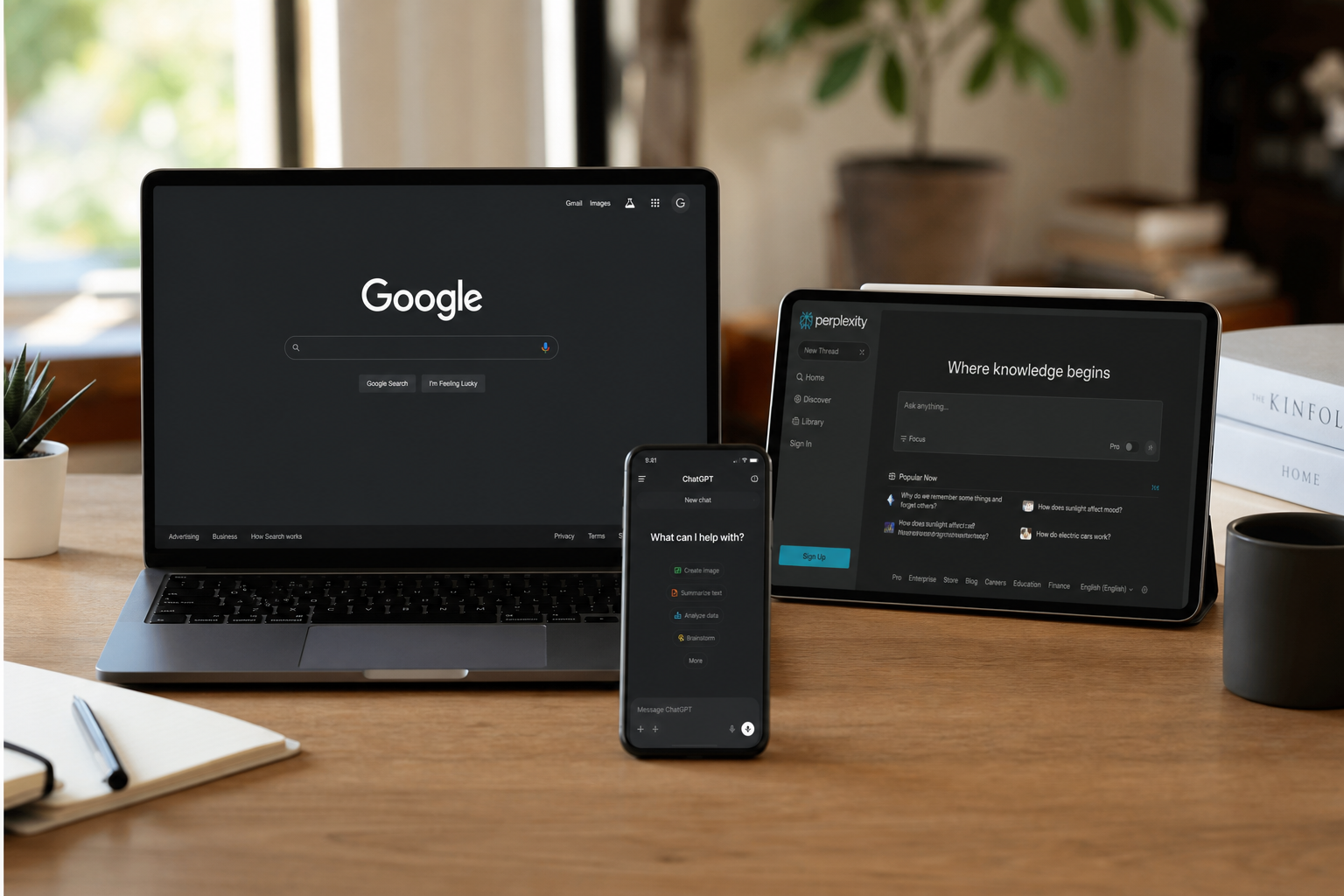
Google confirmed at I/O 2026 that AI Mode has surpassed one billion monthly users, with queries more than doubling every quarter since launch. Meanwhile, ChatGPT Search processes between 250–500 million search-intent queries per week — making it one of the top five search properties globally by volume. Perplexity, the AI-native answer engine, has surpassed 100 million active users worldwide.
These aren’t niche tools used by tech enthusiasts. They are mainstream search platforms reshaping billions of queries every month.

The Death of the Ten Blue Links (For Informational Queries)
The classic search engine results page — a list of ten ranked links with titles and meta descriptions — is being phased out for informational queries. AI Overviews, AI Mode answers, and Perplexity-style summaries are replacing traditional results for the queries that used to drive the most organic traffic.
According to research from AISOS, by the end of 2027 classic organic results will be pushed below the fold for the majority of informational queries. Sparktoro data shows 58% of Google searches in Europe now end without a click. Similar patterns are emerging in Australia.
The impact on traffic is measurable and sobering:
- Non-branded informational query traffic is down 15–30% across content sites in 2026 (Digital Applied / Similarweb data)
- eCommerce traffic loss sits at 5–15% — lower, but still significant
- Google retains dominance on navigational and transactional queries but has ceded ground on research, learning, and commercial investigation queries to AI platforms
For businesses that built their visibility strategy entirely on traditional SEO, this is a structural problem — not a temporary dip.
The Five Platforms Shaping the Future of Search
Understanding where search is heading means understanding the major players competing for query volume in 2026 and beyond.
1. Google (AI Mode + AI Overviews)
Google still holds approximately 80% of global search market share, but its product is evolving rapidly. AI Overviews — AI-generated answer summaries that appear at the top of results — now trigger for 47% of informational queries. AI Mode, powered by Gemini 3.5 Flash, offers a fully conversational search experience that Google launched as its biggest Search upgrade in 25 years. Google is also introducing “search agents” — autonomous AI that can monitor topics and proactively surface information on your behalf.
For businesses, this means Answer Engine Optimisation (AEO) is now a core requirement alongside traditional SEO. Getting cited in AI Overviews requires structured, authoritative, entity-rich content — not just keyword-ranked pages.
2. ChatGPT Search (OpenAI)
OpenAI’s ChatGPT Search has grown into a major search platform with 250–500 million weekly queries. It specialises in informational and research queries (58%), commercial investigation (22%), and is growing in shopping-intent searches. ChatGPT Search tends to cite sources inline, making it critical that your business’s website content is structured in a way that AI can parse and reference.
3. Perplexity AI
Perplexity processes approximately 50 million weekly queries, with high concentration among researchers, journalists, analysts, and developers — premium audiences for B2B and professional services businesses. Perplexity’s “answer with citations” format means appearing as a cited source is the equivalent of ranking #1 on Google for that audience segment.
4. Microsoft Copilot (Bing AI)
Microsoft’s Copilot is integrated across Windows, Microsoft 365, and Bing. For businesses targeting enterprise and professional audiences, Copilot represents a meaningful discovery channel — particularly for decision-makers using Microsoft tools. Copilot uses Bing’s web index as its knowledge base, meaning strong Bing SEO remains relevant for AI visibility here.
5. Apple Intelligence + Siri
Apple Intelligence, rolled out with iOS 18 and macOS 15, integrates AI into Siri and Safari. As Apple’s AI capabilities mature, they represent a significant hidden channel — particularly for local queries and on-the-go Australian users searching on iPhone. Apple is reportedly negotiating with Google, Perplexity, and others to power its AI search layer.
Five Major Trends Defining the Future of Search
Trend 1: Agentic Search
The next frontier of search is agentic — AI that doesn’t just answer questions but takes actions on your behalf. Google’s “information agents,” OpenAI’s Operator, and similar tools can conduct research, compare options, and complete tasks without the user typing a single query. Being “recommended by an agent” will be the new form of ranking — and it requires AI systems to trust your brand as an authoritative source.
For Australian businesses, this means reputation, expertise signals, and entity recognition across the web are becoming as important as page rankings. Our Generative Engine Optimisation (GEO) service is designed specifically to build this kind of AI-facing authority.
Trend 2: Multimodal Search
Future search isn’t text-only. Google’s new intelligent Search box accepts text, images, files, videos, and Chrome tabs as inputs. Users are increasingly asking questions with photos, voice notes, and mixed inputs. By 2027, industry experts predict queries like “find me agencies similar to this one [photo] near Gold Coast” will be commonplace.
Practical implications for businesses: image alt text, video transcripts, structured data, and voice-optimised content all become part of a comprehensive search visibility strategy.
Trend 3: Conversational, Multi-Turn Search
The single-query, single-result model is giving way to conversations. Users expect to ask follow-up questions, refine their search, and receive contextual answers that remember earlier parts of the conversation. Google has confirmed that contextual follow-up is now seamlessly integrated into AI Mode. For content creators, this means covering a topic deeply — not just targeting one keyword but answering the full conversation arc a user might have around a subject.
Trend 4: Personalised Search Results
AI search engines are moving toward highly personalised results based on user history, preferences, and context. This creates both a challenge and an opportunity. The challenge: you cannot guarantee a single ranking for a given query. The opportunity: brands that build genuine authority and trust signals across the web will appear more consistently, because AI engines will recognise them as reliable sources regardless of personalisation filters.
Trend 5: The Merger of SEO and AEO
Industry analysts predict the distinction between traditional SEO and Answer Engine Optimisation will blur significantly by 2027. Agencies and businesses that still think of these as separate disciplines are already behind. The term “SEO” will naturally expand to encompass optimisation for AI engines — meaning structured data, entity-based content, expertise signals, and AI-readable formats will become standard SEO requirements.
What This Means for Australian Businesses Right Now
The shift from traditional search to AI-powered discovery isn’t coming — it’s happening. Here’s what Australian businesses need to do to stay visible.
1. Audit Your AI Readiness
Start by assessing how your current website performs for AI engines. Can Googlebot and AI crawlers access and parse your content? Do you have schema markup? Is your content structured with clear headings, FAQ sections, and direct answers? Titan Blue’s AI readiness audit identifies the gaps stopping AI engines from citing your business.
2. Prioritise Structured Data
Without schema markup, your site risks being invisible to AI agents. Schema.org markup — including FAQ schema, Article schema, LocalBusiness schema, and Product schema — tells AI engines exactly what your content means and how to attribute it. This is no longer optional; it’s foundational infrastructure for AI search visibility.
3. Build Topical Authority
AI engines trust sources that comprehensively cover a topic. A single well-optimised page isn’t enough. You need a cluster of interlinked content that answers every sub-question a user might have around your core services. This is what topical authority looks like in the AI era — and it’s how Titan Blue’s content strategy is built for every client.
4. Optimise for Citation, Not Just Ranking
In AI search, being cited is the new ranking. AI engines select sources based on authority signals: consistent information across the web, mentions in trusted publications, structured and factual content, and clear expertise signals (author credentials, E-E-A-T). Every piece of content should be written with the goal of earning a citation in an AI-generated answer.
5. Don’t Abandon Traditional SEO
Google still holds 80% market share and transactional queries remain heavily traditional-search-dominated. A balanced strategy invests in traditional SEO while layering AEO and GEO on top. Businesses that pivot entirely away from SEO to chase AI visibility risk losing their existing traffic base.
The Gold Coast Opportunity
For Gold Coast and Queensland businesses, the AI search shift presents a genuine competitive advantage — if you act now. Most local competitors are still focused exclusively on traditional SEO, leaving the AI search visibility landscape relatively uncrowded. Businesses that establish topical authority and AI-readable content now will build a compounding advantage as AI search volumes grow through 2026 and 2027.
At Titan Blue, we’ve been helping Gold Coast businesses navigate the transition from traditional search to AI-powered discovery since AI Overviews first launched. Our integrated approach combines technical SEO, AEO content strategy, GEO entity building, and ongoing optimisation as the AI search landscape evolves.
Frequently Asked Questions
Will AI replace Google Search?
No — not entirely or imminently. Google holds approximately 80% of global search market share and is actively integrating AI into its own products (AI Mode, AI Overviews, Gemini). Rather than being replaced, Google is evolving into an AI-first platform. The more accurate frame is that the nature of search is changing, not that Google is disappearing.
How is AI search different from traditional search?
Traditional search returns a ranked list of links. AI search synthesises information from multiple sources and returns a direct, conversational answer — often without requiring the user to click through to a website. AI search understands intent rather than just matching keywords, and can handle multi-turn conversations, multimodal inputs (text, images, voice), and complex research tasks.
What is agentic search and why does it matter for businesses?
Agentic search refers to AI systems that take actions autonomously — not just answering questions but conducting research, comparing options, and completing tasks on behalf of users. Google’s information agents and OpenAI’s Operator are early examples. For businesses, being “recommended” by an AI agent will become the new first-page ranking — making brand authority and AI trust signals critical.
How quickly is AI search growing in Australia?
While precise Australian data is limited, global signals are strong: AI Mode has surpassed one billion monthly users globally, ChatGPT Search processes 250–500 million queries per week, and 42% of European adults now use a generative AI assistant weekly (Eurostat, 2026). Australia’s adoption follows similar patterns, particularly among professional and business audiences.
What happens to my website traffic as AI search grows?
Non-branded informational query traffic is already down 15–30% across content sites in 2026 compared to pre-AI baselines. eCommerce sites are seeing 5–15% losses. Businesses that adapt — by optimising for AI citation, building structured content, and earning authority signals — will maintain and grow visibility. Those that don’t will see ongoing traffic erosion.
Do I still need to do traditional SEO if AI search is growing?
Yes. Google still commands roughly 80% of search market share, and transactional queries (where purchase intent is high) remain dominated by traditional search results. The optimal strategy is to layer AEO and GEO on top of a strong traditional SEO foundation — not to replace it. Both are needed in 2026.
What’s the single most important thing Australian businesses can do to prepare for AI search?
Ensure your content directly and clearly answers the questions your customers are asking. AI engines prioritise factual, structured, authoritative content that directly addresses user intent. FAQ sections with clear answers, schema markup, and well-organised headings are the most actionable starting points for most businesses.
Conclusion: The Future of Search Is Already Here
The search landscape is undergoing its most significant transformation in 25 years. AI-powered platforms — from Google AI Mode to ChatGPT Search to Perplexity — are reshaping how information is found, how businesses are discovered, and what visibility actually means. For Australian businesses, the window to build AI search advantage is open right now — before the majority of competitors catch on.
Titan Blue has been helping Australian businesses adapt to the AI search revolution from day one. Whether you need an AI readiness audit, a comprehensive AEO strategy, or a full digital presence overhaul, our Gold Coast team is ready to help. Get in touch with us today to find out how we can keep your business visible as the future of search arrives.
Make Titan Blue a preferred source in Google
One click tells Google to surface our articles more often in Top Stories, AI Overviews and AI Mode.

Plumber Website Design Australia: The 2026 Guide
Plumber website design Australia: what to build, what we found on seven Gold Coast plumber…

Beauty Salon Website Design Australia: The 2026 Guide
Beauty salon website design Australia: how to get bookings, show services as text and be…

Best Gym Website Design Agencies in Australia: 7 Compared
Best gym website design agencies in Australia compared: 7 picks, who each suits, what their…