


Last updated:
A customer is sitting in the ute outside a job site or scrolling on the couch after work. They ask ChatGPT for a family-friendly restaurant near Broadbeach, an emergency plumber on the Gold Coast, or a local solar installer they can trust. They get an answer straight away, often with a short list of businesses and a few cited sources.
If your business isn't in that answer, you miss the chance before the customer even reaches Google.
That's why get cited by ChatGPT has become a practical marketing job, not a tech curiosity. For local businesses, this sits somewhere between SEO, content writing, and reputation management. You still need a solid website. You still need local credibility. But now you also need pages that an AI system can quickly understand, trust, and reuse.
Why Your Business Needs to Be on ChatGPT
Local search has changed shape. Plenty of customers still use Google, but more of them are now asking full questions in natural language. They're not typing “plumber Gold Coast” and comparing ten tabs. They're asking for the fastest option, the most reliable option, or the best fit for a very specific need.
That shift matters for small businesses because AI answers compress the shortlist. Instead of a whole search results page, the customer may see a direct recommendation with only a handful of brands mentioned.

AI answers are becoming local referrals
For a restaurant, that can mean a booking decision made in seconds. For a plumber, it can mean the job goes to the business that was mentioned first when the pipe burst. For a hotel or solar installer, it can mean your business enters the conversation before the customer visits a directory, reads reviews, or checks your socials.
The upside is simple. Smaller businesses can punch above their weight if their website gives clean, direct answers. Big brands still have advantages, but AI systems also reward clarity and usefulness. A well-built local page can outperform a vague one.
Practical rule: If a customer can't get the answer from your site in a few seconds, ChatGPT usually won't work hard to find it for them.
This is also why Answer Engine Optimisation matters now. If you want a grounded overview of how that fits into the broader shift in AI, Titan Blue has a useful explainer on AI search for Australian businesses.
Why local operators have a real opening
A local business already has something national publishers don't. Real service areas, real team knowledge, and real-world details. A Broadbeach café knows its busy times, menu strengths, and customer fit. A Gold Coast tradie knows suburbs, callout patterns, and the questions locals ask before booking.
That kind of practical specificity lines up with where AI is heading. Broader industry changes in practical machine learning breakthroughs for 2026 point in the same direction. Systems are getting better at matching useful answers to real questions, not just rewarding pages that happen to rank.
If your site helps the model answer a local question cleanly, you've got a shot. If it buries the answer under waffle, stock phrases, or thin service pages, you probably won't.
Understanding How AI Finds Your Business
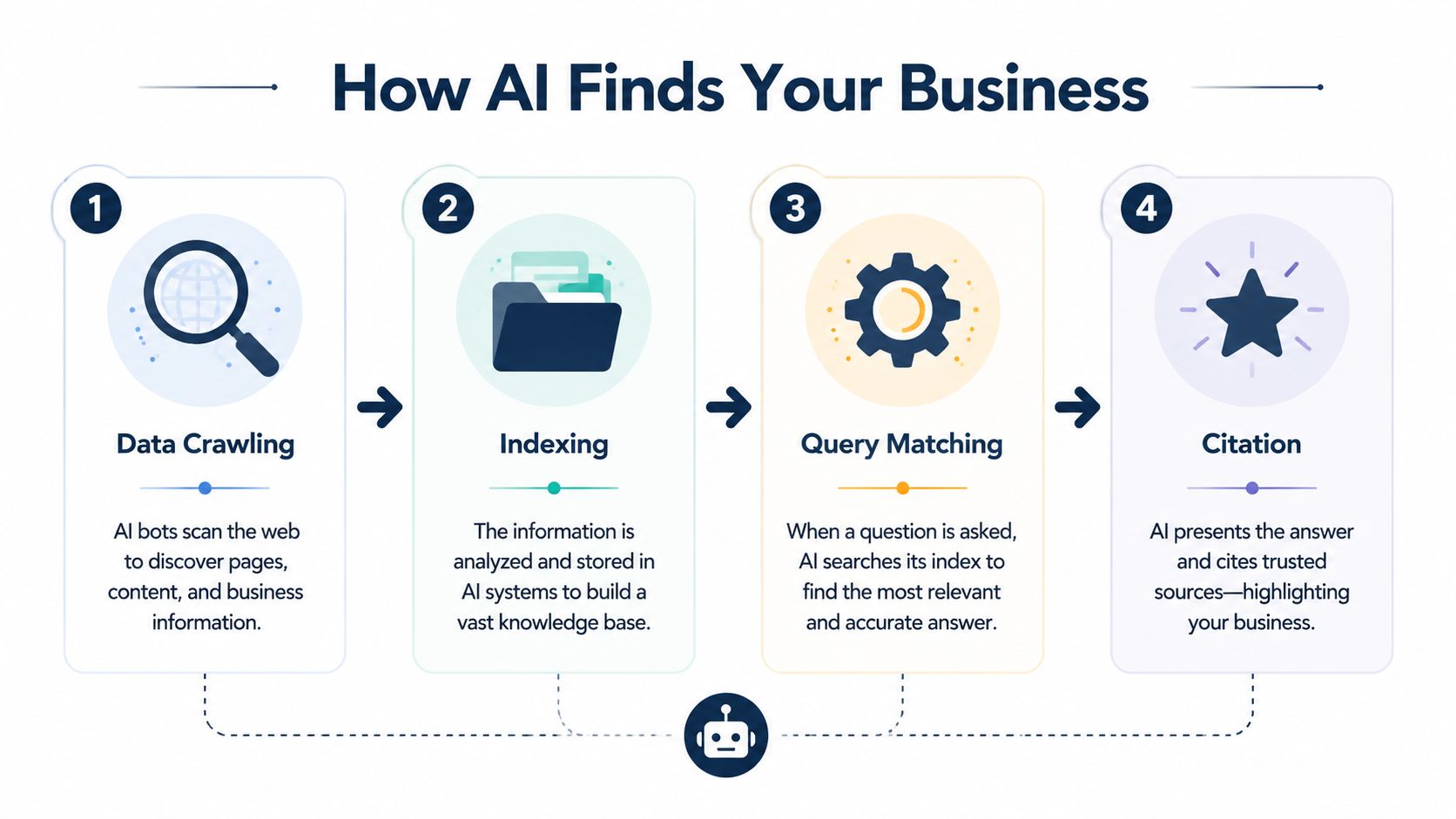
ChatGPT doesn't “discover” a business the way a person does. It behaves more like a research assistant. First it gathers a pool of possible sources. Then it narrows that pool down to the pages it trusts enough to cite.
That distinction matters because being found and being cited are not the same thing.
Retrieval comes first
A global analysis found that 88% of URLs cited by ChatGPT are sourced directly from general web search results, and ChatGPT retrieves an average of 16.57 URLs before only citing a fraction of them. That shows a two-stage process. First comes relevance, then comes a much stricter citation filter based on utility and structure, as outlined in this ChatGPT citation analysis summary.
For a local business owner, that means this. Your page has to be discoverable enough to enter the first batch. Then it has to be clear enough to survive the second cut.
A lot of business websites fail at one of those points. Some are hard to crawl or poorly targeted. Others rank reasonably well but still don't get cited because the page is messy, thin, or indirect.
Citation is the harder part
Once the system has several candidate pages, it leans toward the ones that make its job easy. It wants a direct answer, useful structure, and signals that the content is worth repeating.
Here is the simplest way to view the process:
- Retrieval asks whether your page is about the topic.
- Citation asks whether your page answers the question well enough to reuse.
- Selection rewards pages that are easy to scan, easy to validate, and easy to summarise.
A page can be relevant without being quotable. That's where a lot of local sites fall over.
Old-school SEO and newer AEO start to diverge at this point. SEO often focuses on rankings, traffic, and keyword targeting. AEO focuses more tightly on whether your content can be lifted into an answer.
If you want the plain-English version of the technology behind that, Titan Blue has a helpful explainer on what large language models are and how they work.
What this means for a plumber or restaurant
If you run a plumbing business, don't assume your “Services” page is enough. If it says you offer blocked drains, hot water repairs, and emergency callouts, that tells the AI what you do. It doesn't always answer the customer's actual question.
If you run a restaurant, the same issue applies. A generic page about your venue may describe the atmosphere beautifully, but it may not answer “Is this place good for kids?”, “Do they take group bookings?” or “What kind of menu suits a family dinner?”
That's why AI-friendly content usually looks more direct than brand-led brochure copy. It answers first and sells second.
Crafting Content That Gets Cited
The content that gets cited is usually the content that gets to the point.
A global audit found that 72.4% of cited blog posts include an identifiable answer capsule, which means a self-contained block that gives a direct answer. The same audit found that pages combining answer capsules with original or owned data were cited more often than pages without those traits, according to this analysis of the content traits LLMs quote most.
That finding lines up with what works on local business sites. Clear answer blocks beat rambling intros. Specific facts beat padded marketing copy.

What an answer capsule looks like
An answer capsule is a short section on a page that can stand on its own. It usually sits under a clear heading and answers one question directly without sending the reader on a treasure hunt.
It works because AI systems don't want to piece together a dozen vague sentences from across the page. They prefer a compact section they can understand quickly.
A solid answer capsule usually includes:
- A direct heading such as “Do you offer same-day emergency plumbing on the Gold Coast?”
- A short answer first in plain English.
- A few supporting details like service area, availability, or process.
- Minimal clutter around the answer itself.
Before and after for a trades business
A weak version often sounds like this:
We are a trusted local plumbing company servicing homes and businesses across the Gold Coast with a wide range of quality plumbing solutions tailored to your needs.
That tells the customer almost nothing.
A stronger version sounds like this:
- Heading Do you offer emergency plumbing on the Gold Coast
- Answer Yes. We handle urgent plumbing callouts across the Gold Coast for blocked drains, burst pipes, leaking taps, toilet issues, and hot water faults. If the issue is causing damage or stopping you from using water safely, contact us for priority support.
- Support Our team services residential and commercial properties and can explain the next step before we arrive.
That's easier for a customer to read, and easier for ChatGPT to reuse.
Before and after for a restaurant
A weak restaurant paragraph often reads like venue copy:
Our restaurant offers a welcoming dining experience with fresh flavours, exceptional service, and a relaxed atmosphere perfect for all occasions.
Nice words. No answer.
A stronger local answer block might be:
- Heading Is this restaurant good for family dinner
- Answer Yes. Our menu includes share-friendly dishes, familiar favourites for kids, and flexible seating for small family groups. Early evening bookings suit families who want a relaxed dinner before the late dining rush.
- Support If you need a pram-friendly table or space for a larger group, contact the team when booking.
What works: direct questions, direct answers, and details that remove doubt.
Use original information where you genuinely have it
Owned data doesn't have to mean a glossy research report. For a local business, it can be practical information only you can provide. Common booking questions. Most requested services. Clear service inclusions. Real process notes. Seasonal menu details. Local delivery conditions.
The key is that it's specific and verifiable, not puffery.
Good examples include:
- Service specifics what's included in an emergency plumbing callout
- Operational details whether your restaurant takes walk-ins, group bookings, or dietary requests
- Process clarity how your solar quote process works from inspection through installation
- Local knowledge the suburbs you service, not a bloated list copied from a competitor
If you need help tightening the writing itself, this guide to writing website content that sells is worth a look. The same writing discipline that improves conversions also improves citation potential.
Building the Right Technical Foundations
Good content won't help much if bots can't access it properly or the page sends mixed signals.
For Australian SMBs, a 2025 audit reported that combining answer capsule content with FAQ schema was a key factor in a 67% average citation rate uplift. The same audit also noted that allowing GPTBot in robots.txt and keeping content recently updated, defined there as under 90 days, were critical for avoiding exclusion, based on this Australian SMB AEO playbook.

Schema is just clear labelling
The easiest way to explain schema is this. If your website were a storeroom, schema would be the labels on the boxes. The stock is still the stock. The labels just help machines sort it properly.
For local businesses, the most useful schema types are usually:
- LocalBusiness schema for your business name, location, opening hours, and contact details
- FAQPage schema for common customer questions and direct answers
- Author-related schema where relevant for articles and expert content
Without that labelling, AI systems can still read the page. They just have to work harder. When the web offers plenty of alternatives, harder usually loses.
The technical basics that matter most
You don't need a massive dev project to improve your chances. You do need the basics sorted.
Start with these:
- Check crawl access Make sure your site isn't blocking GPTBot or other important crawlers by accident.
- Refresh key pages Service pages, suburb pages, and FAQs shouldn't sit untouched for ages.
- Add FAQ schema properly Don't just dump random questions on the page. Tie them to real customer queries.
- Keep the page clean If a service page is buried in pop-ups, sliders, and clutter, readability suffers.
- Prioritise mobile use A lot of local customers ask these questions on their phones.
A lot of owners overlook the freshness issue. If your page talks about old offers, old staff, or outdated operating details, that hurts trust fast.
One practical check: open your main service pages and ask, “Would I trust this if I landed here today for the first time?”
Don't confuse distribution with authority
Directory listings can still help people find you and can support entity consistency across the web, but they don't replace a strong source page on your own site. If you're launching a new service or location, practical distribution work like directory outreach for new product launches can support discoverability. It just shouldn't be your whole strategy.
Your website still needs to hold the authoritative answer.
For businesses that want a clearer framework for AI-focused implementation, Titan Blue's overview of generative engine optimisation is a useful starting point.
A short explainer can help if your team needs to see how the broader AI ecosystem is changing search behaviour:
What usually doesn't work
Many local sites commonly waste time here.
Common problems include:
- Thin FAQ pages with one-line answers that say nothing useful
- Overwritten service pages packed with repeated keywords and no substance
- JavaScript-heavy content experiences that look slick but make machine access harder
- Set-and-forget websites that haven't been reviewed in months
Technical foundations aren't glamorous. But if they're wrong, the rest of the work struggles to get off the ground.
Proving Your Expertise and Trustworthiness
AI systems don't just look for an answer. They look for a source they can justify using.
That's why trust signals matter. If two pages answer the same question, the one that looks more credible often gets the nod. Not because it's louder, but because it gives the system more confidence.
Benchmark data indicates that adding validation signals such as author schema linked to an expert profile can improve a page's credibility score for AI. For Australian queries, having a .com.au domain provides a further 15% advantage in validation, as covered in this Australian guide to AI citation validation signals.
Trust starts with visible people and real experience
A lot of small business websites still hide the humans. That's a mistake.
If you run a trade business, show who's behind the work. If you run a venue, show the operators, chefs, or management team. If you publish advice content, attach it to a real person with a role, a short bio, and a visible connection to the business.
That doesn't mean dressing up every page with corporate fluff. It means making expertise obvious.
Useful trust signals include:
- A genuine About page with your background, service area, and how long you've been operating
- Named authors on articles and guides
- Consistent contact details across your site and business listings
- Clear business identity so the same name, location, and phone number appear consistently
- A .com.au domain if your market is Australia and especially if your work is location-driven
Local authority beats generic copy
For a Gold Coast plumber, “servicing South East Queensland” is weaker than naming the actual area you serve and showing local evidence across the site. For a restaurant, “modern Australian dining experience” is weaker than practical details about who the venue suits, when it's busiest, and what sort of booking experience people can expect.
The page that sounds like a real local operator usually beats the page that sounds like a generic template.
That's also why fake breadth can backfire. If a small business claims to service half the country with no proof, the site feels less trustworthy. AI systems are trying to reduce uncertainty, not increase it.
A simple credibility checklist
Before publishing a key page, check whether it answers these questions:
- Who wrote this or stands behind it
- Why should a customer trust this business on this topic
- Does the page reflect Australia, or does it read like imported copy
- Are the business details clear and consistent
- Would a cautious customer feel comfortable contacting you after reading it
That's the standard. Not clever wording. Not hype. Just enough evidence that the source is real, relevant, and reliable.
Tracking and Measuring Your AI Visibility
This part is still evolving, so keep it practical. You're not looking for perfect attribution. You're looking for signs that the work is improving visibility and generating business.
Internal Titan Blue data from 2026 shows a 35% citation-to-lead conversion rate for optimised trades pages, compared with 5% for unoptimised pages, which points to a real commercial upside when AEO is done properly, based on this analysis of ChatGPT citation ROI and lead conversion.
What to monitor first
Start with direct checks.
Ask ChatGPT the same sorts of questions your customers ask:
- Local service questions such as emergency plumbing, family dining, solar installation quotes
- Comparison questions where customers are weighing options
- Problem-based questions where they want advice before booking
See whether your business appears, whether your page is cited, and which pages keep showing up.
Then look at your analytics. Track referral patterns where possible, especially if your links include UTM parameters. Keep an eye on service pages and FAQ pages that were rewritten for AI visibility. If those pages start attracting more qualified enquiries, that matters even if attribution isn't perfect.
Use a repeatable review cycle
A sensible cadence looks like this:
- Monthly checks Ask key prompts and record whether you're cited
- Content updates Refresh pages that are stale, vague, or losing relevance
- Lead quality review Ask your team whether enquiries are sounding more informed
- Page comparison Compare optimised pages against older pages that haven't been reworked
You can also use a structured review process like Titan Blue's AI visibility audit to identify where your site is easy for AI to find, where it's being ignored, and which pages need work first.
Key takeaway: treat AI visibility the way you treat SEO. It's not a one-off fix. It's an ongoing cycle of testing, improving, and checking what actually moves enquiries.
The businesses that stick with this will learn faster than the ones waiting for a perfect playbook.
If you want a practical plan to get cited by ChatGPT without guessing your way through it, Titan Blue Australia can help assess your current visibility, tighten your content, and identify the pages most likely to earn AI citations for local search.
Make Titan Blue a preferred source in Google
One click tells Google to surface our articles more often in Top Stories, AI Overviews and AI Mode.

ChatGPT GPT-6 Search Upgrade: What It Means for Australia
OpenAI rolled out GPT-6 to ChatGPT on 7 October 2026 with faster search. Here is…

Best Dental Website Design Agencies in Australia: 7 Compared
Best dental website design agencies in Australia 2026: seven compared on dental proof, booking, AHPRA…

Childcare Centre Website Design Australia: The 2026 Guide
Childcare centre website design Australia: show hours, ages and enrolment as text so parents and…