

Last updated:
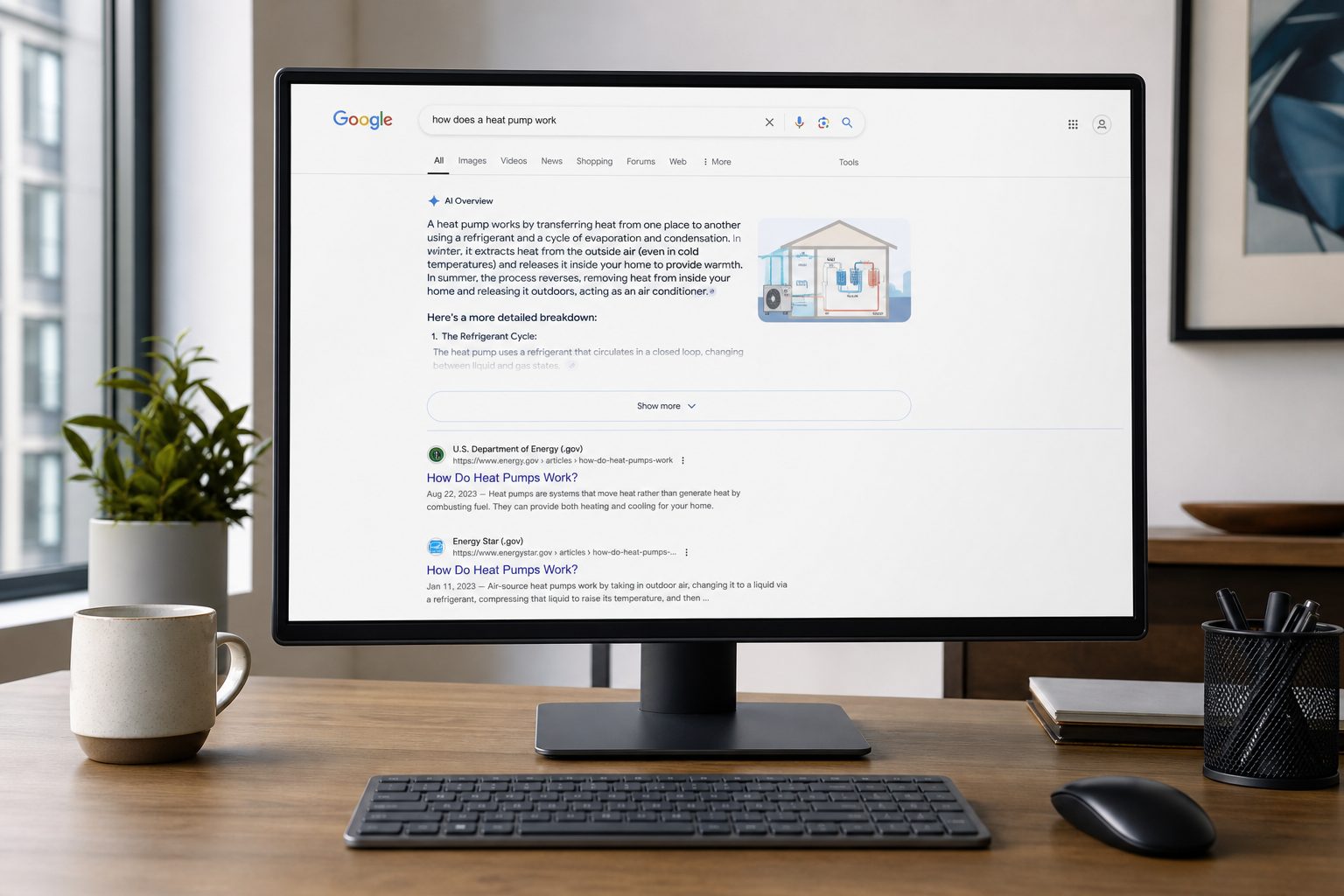
Google AI Overviews are AI-generated summaries that appear at the very top of Google search results, above all organic listings, providing users with a direct answer to their query drawn from multiple websites. For Australian businesses, this means your content can now appear as a cited source in a prominent AI summary — or you can be bypassed entirely, losing clicks even when you rank well on page one. Understanding how AI Overviews work, when they appear, and how to position your content for inclusion is now a core part of any serious digital marketing strategy.
What Exactly Are Google AI Overviews?
Google AI Overviews (formerly called Search Generative Experience, or SGE) are AI-powered response boxes that sit at the top of Google’s search results page. When a user types a query, Google’s AI analyses content from across the web, synthesises the most relevant information, and presents a concise answer — complete with links to the source pages it drew from.
Launched publicly in the US in May 2024 and rolled out globally (including Australia) through 2025, AI Overviews represent the most significant change to Google Search in two decades. They are powered by Google’s Gemini AI model and are designed to answer informational queries directly, reducing the number of clicks users need to make to get an answer.
Think of it this way: instead of your website being one of ten blue links on the page, it could be one of three to five sources cited inside an AI-generated answer that’s the first thing every user sees. That’s a fundamentally different type of visibility — and a fundamentally different type of threat if you’re not in the box.

How Do AI Overviews Actually Work?
Google uses a technique called “query fan-out” to generate AI Overviews. Rather than answering your query with a single search, Google’s AI breaks the question into multiple sub-queries, searches across dozens of relevant pages, and synthesises the best answers into one coherent response. According to Google’s own Search Central documentation, this fan-out technique allows AI Overviews to surface a wider, more diverse set of helpful links than traditional search would.
Here’s the process in simple terms:
- User types a query — e.g. “how do I choose a digital marketing agency?”
- Google decomposes the query into sub-questions: What should I look for? What’s a fair price? How do I evaluate their track record? What questions should I ask?
- AI scans indexed content across the web, prioritising pages that directly and clearly answer each sub-question
- A synthesised summary is generated in real time, with links to 3–5 source pages displayed alongside
- Users see the AI answer first — organic results appear below
Critically, Google does not pay content creators for being cited in AI Overviews, and there are no additional technical requirements to be eligible — any indexed page that’s eligible to appear in standard search can be cited in an AI Overview.
When Do AI Overviews Appear — and When Don’t They?
AI Overviews don’t appear for every search. Google only shows them when its systems determine they would add value beyond a standard results page. According to a large Semrush study of over 10 million keywords, AI Overviews appeared for approximately 15–16% of all Google searches by late 2025, after peaking at 24.6% in mid-2025.
Queries That Typically Trigger AI Overviews
- Informational queries — “How does X work?”, “What is Y?”, “Why does Z happen?”
- Research and comparison queries — “Best practices for…”, “X vs Y explained”, “Pros and cons of…”
- How-to guides — “How to set up…”, “Step-by-step guide to…”
- Health and medical queries — 60.7% of health queries trigger AI Overviews
- Home and garden — 50.4% trigger rate
- Technical and educational topics — tutorials, explanations, industry concepts
Queries That Rarely Trigger AI Overviews
- Local searches — “digital marketing agency Gold Coast” or “plumber near me”
- Branded queries — searches for a specific business name
- Transactional queries — “buy running shoes online”, “book a dentist”
- Real estate and automotive — lower trigger rates due to transactional intent
- News and current events — Google tends to use traditional results for breaking news
This is actually important context for Australian small businesses and service providers: if most of your revenue comes from local searches, AI Overviews may not directly affect your traffic right now. But that can change — Google is actively expanding AI Overviews into commercial and transactional queries.
The Real Impact on Business Traffic: What the Data Shows
Here’s what Australian businesses need to understand: AI Overviews are genuinely disrupting organic traffic patterns. The data is clear, and the impact is significant.
The Click-Through Rate Decline
When a Google AI Overview appears for a query, organic click-through rates (CTR) drop substantially:
- Average organic CTR decline when AI Overviews are present: 34.5%
- Top-ranking pages losing clicks: up to 64.4% on some queries
- Desktop CTR can drop by 50%; mobile sees roughly a 30% decline
- Approximately 26% of users end their search session immediately after seeing an AI Overview — they got what they needed without clicking
The Silver Lining: Being Cited Boosts Visibility
Here’s the flip side — if your content is cited inside an AI Overview, your click-through rate from that source actually increases. Pages cited inside AI Overviews can see CTR climb from around 0.6% to approximately 1.08%, and crucially, they receive brand visibility even from users who don’t click through at all.
Being cited in an AI Overview is like having your brand mentioned in a trusted editorial piece. Even if people don’t click, they see your name associated with authority and expertise. For Australian businesses building brand recognition, this is a meaningful benefit.
Zero-Click Searches Are Now the Norm
It’s worth placing AI Overviews in broader context: approximately 58% of all Google searches now end without a click. AI Overviews are accelerating this trend. The implication for businesses isn’t to panic — it’s to adapt. The goal shifts from “rank high and get clicks” to “be cited as an authoritative source.” That requires a different content strategy.
What Types of Content Get Cited in AI Overviews?
Google’s AI doesn’t cite randomly. Analysis of AI Overview citations consistently shows that certain content characteristics correlate strongly with being selected as a source. Here’s what the data reveals:
Direct, Clear Answers
Content that answers a question directly in the first paragraph is far more likely to be cited than content that buries the answer or uses a preamble. AI engines extract the clearest, most definitive answer they can find — so your opening paragraph needs to be that answer.
Structured Formatting
Pages using H2 and H3 headings that mirror user questions, bullet points, numbered lists, and short paragraphs are substantially easier for AI to parse and summarise. If your content looks like it could be read by a text-to-speech engine and still make sense, it’s probably structured correctly.
Established Domain Authority
While not the only factor, Google’s AI favours content from domains with strong authority signals — quality backlinks, consistent publishing history, and E-E-A-T (Experience, Expertise, Authoritativeness, Trustworthiness). This is why building topical authority in your niche matters more than ever. Learn more about our Answer Engine Optimisation services to see how we help businesses build this kind of authority.
Schema Markup and Structured Data
Pages using appropriate schema types — FAQPage, HowTo, Article — give Google’s AI clear signals about the nature of the content. FAQ schema, in particular, directly maps to the question-answer format that AI Overviews extract from.
Content Freshness
AI Overviews tend to cite more recently updated content, particularly for fast-moving topics like technology, health, and finance. Regularly refreshing your key pages with updated statistics, tools, and insights signals to Google that your content is current and reliable.
AI Overviews vs AI Mode: What’s the Difference?
A common point of confusion for business owners: Google now has both “AI Overviews” and “AI Mode.” They’re related but distinct features:
- AI Overviews — Appear automatically in standard Google Search when Google determines they’re helpful. Most users see these without opting in. They’re concise summaries with a handful of source links.
- AI Mode — A dedicated AI-powered search experience (similar to a chat interface) that users must actively choose. AI Mode is designed for more complex, multi-step queries and provides longer, more conversational responses with more extensive citations.
For most Australian businesses in 2026, AI Overviews are the immediate priority because they affect everyone who uses standard Google Search. AI Mode is still opt-in and used by a smaller audience — but its usage is growing, and the content strategies that work for AI Overviews largely work for AI Mode as well.
Both features use query fan-out and share similar eligibility criteria. Content optimised for AI Overviews will generally perform well across both features. Our Generative Engine Optimisation (GEO) service covers both.
5 Practical Steps Australian Businesses Can Take Right Now
Understanding AI Overviews is one thing. Acting on that understanding is another. Here are five concrete steps to improve your chances of being cited:
1. Audit Which of Your Pages Could Answer Informational Queries
Look at your existing content and identify pages that answer broad “what”, “how”, and “why” questions relevant to your industry. These are your AI Overviews candidates. If they’re not currently structured with direct answers in the opening paragraph, rewrite them. Use Google Search Console to find queries you’re ranking for that might trigger AI Overviews.
2. Structure Content Around Questions, Not Topics
Shift from organising your content around general topics (“Digital Marketing Tips”) to specific questions (“How Do I Choose a Digital Marketing Agency in Australia?”). Each H2 and H3 heading should reflect a real question a user might type into Google. This directly mirrors how AI engines decompose queries.
3. Add FAQ Sections to Every Key Page
An FAQ section with five to eight concise question-answer pairs at the bottom of each key page dramatically increases your chances of being cited. Keep answers under three sentences — the more extractable the answer, the more useful it is to AI. Pair this with FAQPage schema markup. Our SEO services include structured data implementation as a standard component.
4. Build E-E-A-T Signals Into Your Content
Google’s AI prioritises content that demonstrates real-world experience and expertise. This means citing your credentials, referencing specific client results, linking to authoritative external sources, and keeping content updated with current data. If you’re an accountant writing about tax planning, your content should reflect 20 years of practice — not generic advice from a template.
5. Check if Your Website Is AI-Ready
Technical factors matter too. Pages need to be indexed, crawlable, and free of snippet-blocking directives. Run a basic audit using Google Search Console’s URL Inspection tool. Better yet, explore our AI Readiness Assessment to get a complete picture of how your site performs against AI engine criteria.
Should Australian Businesses Be Worried About AI Overviews?
The honest answer: businesses that rely heavily on organic traffic from informational queries should take AI Overviews seriously. If your traffic analysis shows a drop in clicks from queries that now trigger AI summaries, that’s a real problem that requires a real response.
But businesses built primarily around local search, transactional queries, or branded searches are largely insulated for now. Google has been clear that AI Overviews are not designed to appear for “near me” or specific location-based queries — the very searches that drive most local service businesses.
The bigger strategic shift is this: organic search is evolving from a link-ranking game to a content-citation game. The businesses that win in 2026 and beyond will be the ones who produce content so clear, so accurate, and so well-structured that AI engines can’t help but cite it. That’s exactly what Answer Engine Optimisation is designed to achieve.
Frequently Asked Questions About Google AI Overviews
Do I need to do anything special to appear in Google AI Overviews?
No additional technical setup is required. Any page that is indexed and eligible to appear in standard Google Search can be cited in an AI Overview. However, content that is clearly structured, directly answers questions, uses schema markup, and has strong E-E-A-T signals is significantly more likely to be selected.
Will AI Overviews reduce my website traffic?
For informational content, yes — AI Overviews reduce organic CTR by an average of 34.5%. However, if your content is cited inside an AI Overview, you gain brand visibility even from non-clicking users, and your CTR from that source can increase compared to a standard ranking position.
Are AI Overviews shown in Australia?
Yes. Google rolled out AI Overviews globally through 2025, and they are now active for Australian users across most devices. The feature appears in both English and other languages supported by Google Search.
How is an AI Overview different from a Featured Snippet?
A Featured Snippet pulls content from a single page and displays it verbatim. An AI Overview synthesises information from multiple pages into an original AI-generated response, then cites those sources. AI Overviews are longer, more conversational, and often cite three to five sources rather than one.
Can I opt out of having my content used in AI Overviews?
Yes. You can use nosnippet or max-snippet directives to restrict how Google displays your content. However, this also prevents your pages from appearing in Featured Snippets and other rich results — so it’s a significant trade-off. Most businesses are better served by optimising for inclusion rather than opting out.
What industries are most affected by AI Overviews?
Health (60.7% trigger rate), home and garden (50.4%), and transportation (31.4%) are the most affected industries. Businesses in these sectors that rely on informational content for SEO traffic need to adapt their strategies most urgently.
Does being cited in an AI Overview help with brand awareness?
Yes. Even when users don’t click through, seeing your brand name cited as an authoritative source builds recognition and trust. For businesses investing in thought leadership content, AI Overview citations are a form of earned media visibility that extends well beyond direct click traffic.
The Bottom Line for Australian Businesses
Google AI Overviews represent a structural change in how search works — not a passing experiment. With AI Overviews appearing in roughly 15–20% of all searches and reducing organic CTR by up to 64% when present, this is a shift every Australian business with an online presence needs to understand and plan for.
The strategy isn’t complicated: create content that directly and clearly answers the questions your potential customers are asking. Structure it so AI can extract and cite it easily. Build your authority so Google trusts your site as a source. And check that your technical setup doesn’t accidentally block you from being cited at all.
At Titan Blue, we help Australian businesses navigate exactly these kinds of shifts — from Gold Coast to Sydney and beyond. If you’re ready to start showing up in AI Overviews and future-proofing your search visibility, get in touch with our team today.
Make Titan Blue a preferred source in Google
One click tells Google to surface our articles more often in Top Stories, AI Overviews and AI Mode.

Best Dental Website Design Agencies in Australia: 7 Compared
Best dental website design agencies in Australia 2026: seven compared on dental proof, booking, AHPRA…

Childcare Centre Website Design Australia: The 2026 Guide
Childcare centre website design Australia: show hours, ages and enrolment as text so parents and…

Electrician Website Design Australia: The 2026 Guide
Electrician website design Australia: what to build, what we found on eight Gold Coast electrician…