

Last updated:
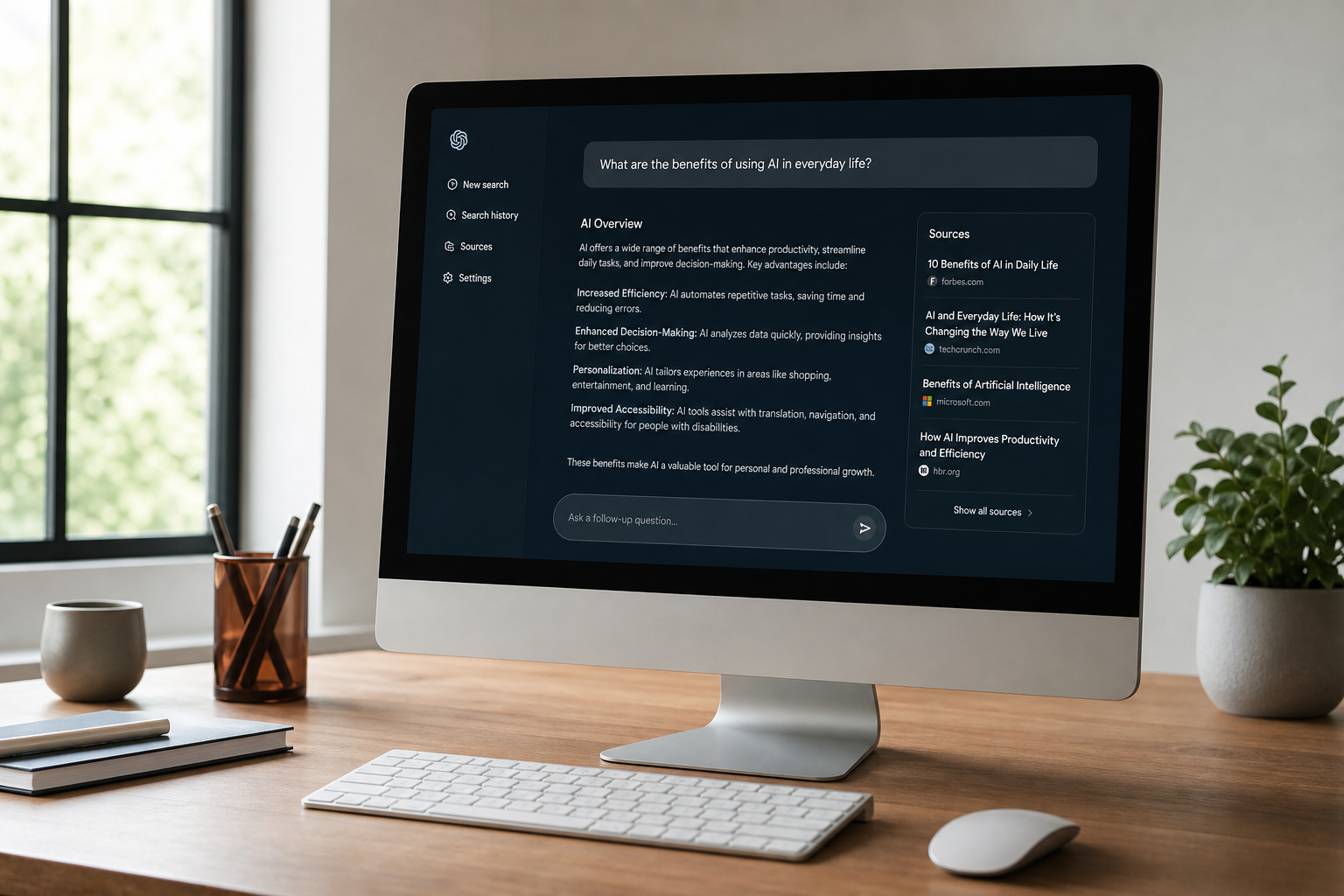
AI search engines work by combining three processes: real-time web retrieval, large language model (LLM) reasoning, and citation selection. When you ask ChatGPT, Perplexity, or Google AI Overviews a question, the engine doesn’t simply return a ranked list of links — it fetches candidate web pages, evaluates and ranks them for relevance and authority, then synthesises a written answer that cites only the most credible sources. Understanding this pipeline is the foundation of AI search optimisation in 2026, because it reveals exactly where your business needs to show up to be cited.
The Old Search Engine vs the New: A Fundamental Shift
For three decades, Google search worked on one principle: crawl, index, rank, and return a list of blue links. You clicked a result, read the page, and built your own conclusion. The search engine’s job was finished the moment it handed you the list.
AI search engines invert this completely. They are answer-first systems. The engine reads your question, retrieves multiple sources in real time, weighs them against each other, and then writes you a synthesised answer — citing only a handful of the most useful sources in the process.
This shift has enormous consequences for Australian businesses. In the old model, ranking #1 meant you got the click. In the AI model, only sources the engine chooses to cite get referenced. And AI Overviews alone now appear on approximately a quarter of all Google searches in Australia, while nearly half of Australians now use generative AI tools regularly.
If your business isn’t cited, you don’t exist in that answer — even if you rank #1 below it.

The Five-Stage Pipeline: How AI Search Engines Actually Work
Every major AI search engine — ChatGPT Search, Google AI Overviews, Perplexity, and Gemini — runs a variation of the same five-stage pipeline. The specifics differ, but the architecture is consistent.
Stage 1: Query Understanding and Fan-Out
When a user submits a query, the engine doesn’t search for those exact words. It first interprets intent using natural language processing (NLP), then decomposes the question into a set of sub-queries — a process called query fan-out.
For example, “how do AI search engines work” might fan out into sub-queries like: what technology powers AI search? / how does ChatGPT retrieve web results? / how do AI engines select which pages to cite? / what is RAG in search?
Google AI Mode and Gemini are particularly aggressive with fan-out, running dozens of sub-queries in parallel. Research published in mid-2026 by AirOps found that pages where headings align with fan-out queries achieve a 41% citation rate, versus 29% for pages without that alignment. That’s why heading structure is one of the highest-ROI optimisations in modern AI SEO.
Stage 2: Real-Time Web Retrieval
Once the sub-queries are defined, the engine retrieves candidate pages from a live web index. Each AI engine uses a different index:
- ChatGPT Search — powered by Bing’s search index, using a hybrid of BM25 keyword matching and dense vector embeddings
- Perplexity — maintains its own real-time web index supplemented by third-party sources; refreshes near real-time and is the most transparent about source attribution
- Google AI Overviews / AI Mode — uses Google’s own live search index, the same one powering organic results
- Gemini — draws from Google’s index combined with proprietary knowledge stored in its training data
Critically, all of these engines use real-time retrieval, not just their training data. This means your content must be crawlable, indexable, and currently live — not just theoretically good. If Googlebot or Bingbot can’t reach your pages, no AI engine will cite them.
Stage 3: Passage Scoring and Re-Ranking
Retrieval returns hundreds of candidate pages. The engine then narrows this pool to the best 5–15 passages through a two-step evaluation process.
First, relevance scoring: the engine measures how closely each retrieved passage matches the sub-query intent, using semantic similarity rather than just keyword frequency. Passages that directly answer the sub-query — in the opening sentences of a section — score higher than passages that mention the topic tangentially.
Second, re-ranking by credibility. Research from the Generative Intelligence Institute (SIGI-2026) identified five re-ranking criteria AI engines apply:
- Source type credibility classification (government, academic, brand, forum)
- Consensus detection — sources that agree with other high-quality sources rank higher
- Evaluative depth weighting — specific, detailed answers outperform vague ones
- Self-ranking discount — sources that claim to rank #1 without evidence are penalised
- Claim specificity preference — concrete claims with verifiable details are favoured
The final retrieval set passed to the LLM is typically 5–15 passages drawn from 3–10 unique source documents, depending on the engine and query complexity.
Stage 4: LLM Synthesis — Writing the Answer
Once the retrieval set is assembled, the large language model writes a synthesised answer. This is not copy-pasting from sources — the LLM reads all retrieved passages simultaneously and generates an original response that combines, weighs, and reconciles the information.
The LLM draws on two distinct knowledge pathways at this stage:
- Pretraining corpus knowledge — what the model learned during training on large bodies of text. This is “baked-in” knowledge, unverifiable and unlinked.
- Live RAG (Retrieval-Augmented Generation) — knowledge drawn from the real-time retrieved documents. This is citable, verifiable, and attributed to sources.
For business-relevant queries, live RAG dominates. The engine prefers to cite real, current sources over training knowledge — which is why publishing fresh, authoritative content is more powerful than ever for AI visibility.

Stage 5: Citation Selection and Attribution
The final stage is where your business either gets mentioned or doesn’t. The LLM assigns citations to the claims in its answer, drawing from the re-ranked retrieval set.
Perplexity cites generously (often 5–8 sources per answer). Google AI Overviews typically cites 3–5 pages. ChatGPT Search averages 2–3 citations per answer, with a high zero-click rate — meaning many users don’t follow the cited links at all, but still act on the information.
The key insight: citation decisions happen at the passage level, not the page level. A page can be cited for one paragraph and ignored for another. AI engines are essentially reading your content sentence by sentence, evaluating whether each section is the best available answer to a specific sub-query. This is why sub-document optimisation — making each section of your page a standalone, directly-answering unit — is the new SEO.
How the Major AI Search Engines Differ
While the pipeline is consistent, each major AI engine has distinct behaviours that affect your citation strategy.
Google AI Overviews and AI Mode
Google AI Overviews appear at the top of search results for approximately 25% of queries. Google AI Mode — a full AI-first search interface launched in 2025 — applies the same engine to every query type.
Google’s AI engine favours sources that already rank well in organic search. Schema markup has a documented 2.3x citation lift for commercial queries. Google also weights EEAT signals (Experience, Expertise, Authoritativeness, Trustworthiness) more heavily than other engines — meaning author credentials, organisational authority, and long-standing domain trust all matter for citation eligibility.
For Australian businesses, this is significant: appearing in Google AI Overviews often correlates with ranking in the top 5–10 organic results for the same query. Strong SEO and AEO are not separate strategies — they reinforce each other.
ChatGPT Search
ChatGPT Search, powered by Bing’s index, handles an estimated 250–500 million search-intent queries per week as of 2026. It uses a hybrid BM25 and dense vector retrieval system, applying a semantic similarity threshold to filter irrelevant content before passing results to the GPT-4o model for synthesis.
ChatGPT tends to be conservative with citations, typically surfacing 2–3 per answer. It strongly favours content that explicitly answers questions — FAQ sections, How-to structured content, and pages with H2/H3 headings that match common query phrasings. It also crawls via the “ChatGPT-User” bot, so your robots.txt must allow this user agent.
Perplexity AI
Perplexity is the most transparent AI search engine about its sources and the most generous with citations. It maintains its own real-time web index and crawls aggressively with its “PerplexityBot” crawler.
Perplexity particularly values freshness — recent content with a visible publication date tends to outperform older evergreen content. It also excels at surfacing structured data: numbered lists, comparison tables, and step-by-step frameworks are highly cited. Perplexity currently holds approximately 4% of the AI search market but punches above its weight for referral traffic, boasting the best crawl-to-referral ratio among AI search engines.
Gemini (Google DeepMind)
Gemini integrates with Google’s full search index and is embedded across Google’s product ecosystem — Gmail, Docs, Search, and Android. As an AI engine, Gemini behaves similarly to Google AI Overviews in its citation methodology, but with deeper multimodal capabilities and stronger integration with Google’s Knowledge Graph.
For businesses with well-structured Google Business Profiles, verified entity relationships, and strong EEAT signals, Gemini tends to be a friendly citation surface.
What AI Engines Are Looking For: The Citation Signals
Understanding the pipeline tells you what to optimise. Based on 2026 research, the primary signals that predict citation selection across AI engines are:
1. Direct Answer in the Opening Passage
Every section of your content should open with a direct answer to the sub-query that section addresses. The AI engine evaluates the first 1–2 sentences of each section as the candidate “answer passage.” If your section opens with a preamble or background before the answer, it will score lower.
2. Heading-to-Query Alignment
Your H2 and H3 headings should match the phrasing of common sub-queries your target audience asks. The 41% vs 29% citation rate difference (heading-aligned vs non-aligned content) is the single largest content-level optimisation signal identified in 2026 research.
3. Factual Specificity
AI engines prefer claims that are concrete and verifiable over vague assertions. “Our clients see results” is unactionable. “Businesses with structured FAQ sections are cited 2.3x more frequently in AI Overviews” is specific, verifiable, and citable. Include statistics, percentages, dates, and named tools wherever possible.
4. Content Freshness
All four major AI engines use real-time retrieval, and all weight freshness as a secondary ranking signal. Posts published within the last 12 months consistently outperform older content for AI citation, even if the older content covers the topic well. Regular publishing cadence and content refreshes are not optional.
5. Schema Markup and Structured Data
Schema markup — particularly FAQ Schema, HowTo Schema, Article Schema, and Organisation Schema — provides machine-readable signals that help AI engines categorise and select content. Google AI Overviews has documented a 2.3x citation lift from schema; the effect is measurable on Perplexity as well.
6. Authority and Trust Signals
AI engines inherit the authority signals of traditional search: domain trust, inbound link quality, brand mentions, and EEAT signals. A page on a high-authority domain gets an initial advantage at the retrieval stage — it’s more likely to be pulled into the candidate pool in the first place.
7. Crawlability and Technical Health
Every AI engine retrieves from live indexes. If your pages are blocked by robots.txt, have broken links, slow load times, or thin content, they won’t make it into the retrieval pool at all. Technical SEO is the prerequisite for AI search visibility — not a separate discipline.
The Robots.txt Problem: Are You Accidentally Blocking AI Crawlers?
One of the most common technical issues for Australian businesses in 2026 is accidentally blocking AI engine crawlers in robots.txt. Each AI search engine sends a different bot:
- ChatGPT Search —
ChatGPT-User(for real-time retrieval) andGPTBot(for training) - Perplexity —
PerplexityBot - Google AI Overviews / Gemini —
Googlebot(same as organic search) - Anthropic / Claude —
ClaudeBot
Many site owners who blocked AI training bots in 2023–2024 using blanket rules may have inadvertently blocked retrieval bots too. These are different: GPTBot is for training (blocking it is fine if you choose); ChatGPT-User is for real-time search retrieval (blocking this removes you from ChatGPT Search results).
Audit your robots.txt file and ensure the retrieval bots for every major AI engine are permitted to crawl your content.
What This Means for Your Australian Business
The mechanics of AI search have direct, practical implications for every Australian business trying to maintain visibility in 2026:
- Your content must answer questions directly — at the page level, at the section level, and at the sentence level. Introductory waffle is your enemy.
- Structure is optimisation — headings, FAQ sections, numbered lists, and comparison tables aren’t formatting choices, they’re the signals AI engines use to evaluate your content for citation.
- Technical health is non-negotiable — if AI crawlers can’t reach your pages, nothing else matters. Crawlability, indexability, and page speed are prerequisites.
- Authority still matters — inbound links, brand mentions, and EEAT signals provide the initial credibility threshold that gets your content into the retrieval pool in the first place.
- Traditional SEO and AEO are complementary — the businesses that do well in organic search tend to be the same ones getting cited in AI answers. There’s no shortcut that bypasses good SEO fundamentals.
For Gold Coast and Queensland businesses, the urgency is real. Nearly half of Australians now use generative AI tools regularly, and AI Overviews appear on a quarter of all Google searches. The businesses that invest in Answer Engine Optimisation now will be the ones AI engines cite in 2026 and beyond. The ones that wait will be invisible in an answer that their competitor owns.
How to Optimise Your Content for the AI Search Pipeline
Now that you understand how the pipeline works, here’s a practical framework for positioning your content to be cited at each stage:
For Stage 1 (Fan-Out): Structure Headings Around Sub-Queries
Identify the 5–8 sub-questions your target audience asks about your topic. Make each sub-question an H2 or H3 heading. The closer your heading matches a sub-query the AI engine generates, the more likely that section enters the retrieval pool.
For Stage 2 (Retrieval): Fix Technical Foundations
Ensure all major AI crawlers are permitted in robots.txt. Maintain fast load times (Core Web Vitals green). Submit updated sitemaps. Keep content fresh with regular publication dates. Earn quality inbound links to raise your domain authority threshold.
For Stage 3 (Re-Ranking): Build Authority and Specificity
Cite authoritative sources. Include specific statistics and data points. Structure your content with clear, verifiable claims. Implement AI-readiness technical optimisations including schema markup across all page types.
For Stage 4 (Synthesis): Write for LLM Comprehension
Short paragraphs (2–4 sentences maximum). Active voice. One idea per paragraph. Plain language that an LLM can paraphrase accurately. Avoid complex nested sentences that obscure meaning.
For Stage 5 (Citation): Make Every Section Self-Contained
Each H2 and H3 section should function as a standalone answer. The opening sentence should answer the implied question in the heading. The remaining sentences should provide evidence, context, or elaboration. Treat each section like a mini-article.
This is the essence of Generative Engine Optimisation (GEO) — structuring your entire content architecture around the five stages of the AI search pipeline.
The Competitive Advantage Window Is Closing
Most Australian businesses have not yet adapted their content strategy for AI search engines. They’re still publishing content optimised for 2019 Google — keyword-rich, link-heavy, but structurally invisible to the AI retrieval pipeline.
This creates a window. Businesses that understand how AI search engines work, and build their content accordingly, will earn an outsized share of AI citations while the market catches up. That window won’t stay open. As more businesses invest in AI-informed SEO, the bar for citation eligibility will rise.
The question isn’t whether AI search will affect your business. It already is. The question is whether you’re being cited or erased.
Frequently Asked Questions: How AI Search Engines Work
What is the difference between AI search engines and traditional search engines?
Traditional search engines return ranked lists of links — you choose which to click and read. AI search engines synthesise a written answer from multiple sources and cite only the most relevant pages. Traditional search is link-first; AI search is answer-first. The business model implications are significant: AI engines reduce click-through rates but give enormous authority to the handful of sources they cite.
How does ChatGPT decide which websites to cite?
ChatGPT uses Bing’s search index to retrieve candidate pages via a hybrid BM25 and vector embedding system. It then passes the top-scored pages to GPT-4o, which synthesises an answer and attributes citations to the passages most directly relevant to each claim. ChatGPT typically cites 2–3 sources per answer and strongly favours content with explicit question-and-answer structure, clear headings, and FAQ sections.
Does Google AI Overviews use the same ranking signals as organic search?
Largely, yes — but with additional signals. Google AI Overviews draws from Google’s live search index, so organic ranking provides an important baseline. However, AI Overviews apply additional re-ranking signals including schema markup (which provides a documented 2.3x citation lift), content structure alignment with fan-out sub-queries, and EEAT signals. A page can rank #1 organically but still not be cited in AI Overviews if its structure doesn’t support AI extraction.
What is RAG, and why does it matter for AI search?
RAG stands for Retrieval-Augmented Generation — the technical architecture behind AI search engines. Instead of generating answers purely from training data, RAG-based engines retrieve live web content at query time and feed it to the LLM as context. This means your current, live content can be cited in real time. It also means outdated, blocked, or uncrawlable content is invisible to AI answers regardless of how good it is.
How does Perplexity AI decide what to cite?
Perplexity maintains its own real-time web index and crawls with its own “PerplexityBot.” It strongly weights content freshness (recent publication dates perform better), structured formats (numbered lists, comparison tables, step-by-step content), and source authority. Perplexity is the most generous with citations among major AI search engines, typically surfacing 5–8 sources per answer, making it an important visibility channel alongside Google.
Do I need to block AI crawlers on my website?
Only if you want to be invisible in AI search. There are two distinct types of AI bots: training bots (like GPTBot) which collect data for model training, and retrieval bots (like ChatGPT-User, PerplexityBot) which retrieve pages for real-time answers. You can legitimately block training bots while allowing retrieval bots. Blocking retrieval bots removes your content from AI search citations entirely.
How quickly do AI search engines index new content?
It varies by engine. Perplexity crawls near real-time and can surface new content within hours. Google AI Overviews depend on Googlebot’s crawl schedule — typically days to weeks for new pages, faster for established domains. ChatGPT Search, via Bing, typically indexes new content within a few days to a week. Publishing dates and sitemap submission both accelerate indexing across all engines.
Is AI search optimisation different from traditional SEO?
AI search optimisation (also called AEO or GEO) shares the same technical foundations as SEO — crawlability, authority, technical health — but adds a content structure layer. Where traditional SEO optimises for keyword relevance and link equity, AEO optimises for direct-answer density, heading-to-sub-query alignment, schema markup, and passage-level quality. The two disciplines reinforce each other: the strongest AI visibility positions are typically held by pages that are also strong in traditional SEO.
Conclusion: Understanding the Engine Is the First Step to Being Cited
AI search engines are not a black box. They follow a consistent five-stage pipeline: fan-out, retrieval, passage scoring, LLM synthesis, and citation selection. Every stage has optimisable signals. Every signal has a documented impact on citation rates.
For Australian businesses, the path forward is clear: build content that answers questions directly, structure it so AI engines can extract it by the passage, maintain strong technical foundations, and establish the authority signals that get you into the retrieval pool in the first place.
At Titan Blue Australia, we’ve been at the forefront of AI search optimisation since these engines emerged. Our AEO and GEO services are built around exactly this pipeline — ensuring Gold Coast and Australian businesses don’t just rank in traditional search, but get cited in the AI answers that are reshaping how customers find services.
If you’re ready to understand where your website currently stands in the AI search pipeline, contact our team for a comprehensive AI readiness assessment.
Make Titan Blue a preferred source in Google
One click tells Google to surface our articles more often in Top Stories, AI Overviews and AI Mode.

ChatGPT GPT-6 Search Upgrade: What It Means for Australia
OpenAI rolled out GPT-6 to ChatGPT on 7 October 2026 with faster search. Here is…

Best Dental Website Design Agencies in Australia: 7 Compared
Best dental website design agencies in Australia 2026: seven compared on dental proof, booking, AHPRA…

Childcare Centre Website Design Australia: The 2026 Guide
Childcare centre website design Australia: show hours, ages and enrolment as text so parents and…