How SEO boosts online sales: proven strategies for 2026
Most Australian business owners believe SEO is just about climbing search rankings, but that’s only half the story. Research reveals that effective SEO delivers a substantial impact on actual online sales, not just visibility. When done properly, SEO transforms your website into a sales engine by connecting you with customers actively searching for your products or services. This guide cuts through the confusion to show you exactly how SEO drives revenue, which strategies deliver results, and how to measure your success. You’ll discover actionable insights backed by contemporary research that small to medium businesses across Australia can implement immediately.
Effective SEO converts visibility into sales by connecting with customers actively searching for your products or services.
Quality content matters
High quality content that targets relevant keywords attracts qualified traffic and improves search rankings.
Backlinks boost trust
Backlinks from reputable sites act as votes of confidence, increasing credibility and lifting search positions.
Target transactional keywords
Focusing on buyer intent terms signals ready buyers and increases conversion chances.
Ongoing optimisation
Sustained success comes from continually aligning SEO with broader marketing strategies and optimising over time.
How SEO influences online sales growth
SEO transforms website visibility into revenue by ensuring your business appears when potential customers search for solutions you provide. When your site ranks higher in search results, you capture qualified traffic from people already interested in what you offer. This isn’t theoretical. Meta-analysis from 10 studies showed SEO has a high effect size (d=1.049) on search rankings and traffic, influenced by content quality, keywords, and backlinks.
The connection between rankings and sales is direct. Higher positions dramatically increase click-through rates, with the top three results capturing over 60% of all clicks. When you rank on page one, you’re visible. When you rank on page two, you’re essentially invisible to most searchers. This visibility gap translates directly into lost sales opportunities.
Quality content targeting relevant keywords acts as a magnet for buyers. When you answer the specific questions your customers ask, search engines recognise your authority and reward you with better positions. Understanding the importance of SEO for business means recognising that every piece of content should serve both search engines and human readers.
Backlinks from reputable websites function as votes of confidence in your credibility. When established sites link to yours, search engines interpret this as a signal that your content deserves trust. This trust translates into higher rankings, which then converts into increased traffic and sales. The relationship is measurable and substantial.
Consider these core ways SEO drives sales:
Attracts customers actively searching for your products or services, not passive browsers
Builds long-term organic visibility that continues generating traffic without ongoing ad spend
Establishes your brand as an authority in your industry, increasing customer confidence
Targets specific buyer intent keywords that capture users ready to purchase
Creates compound growth as improved rankings lead to more backlinks, which further boost rankings
“SEO isn’t just about being found. It’s about being found by the right people at the right moment in their buying journey. That’s when visibility converts to revenue.”
The evidence is clear. SEO delivers measurable impact on online sales when executed strategically. For Australian SMEs competing in increasingly digital markets, ignoring SEO means surrendering sales to competitors who understand its power.
Key SEO strategies to drive e-commerce sales success
Implementing effective SEO requires more than understanding its importance. You need specific strategies that translate effort into results. Effective SEO strategies, including keyword research, optimised content, and backlink building, are essential to drive online traffic and sales. Here’s how to deploy them systematically.
Conduct thorough keyword research focusing on buyer intent. Not all keywords are equal. Someone searching “running shoes” is browsing, whilst someone searching “buy Nike Air Zoom Pegasus 40 Australia” is ready to purchase. Target transactional keywords that indicate purchase readiness. Use tools to identify long-tail keywords with lower competition but higher conversion potential.
Create high-quality, engaging content that addresses customer needs. Your content must answer questions comprehensively whilst remaining scannable and engaging. Break up text with subheadings, bullet points, and visuals. Address pain points directly and provide solutions that position your products as the answer. Quality content keeps visitors on your site longer, reducing bounce rates and signalling value to search engines.
Build authoritative backlinks to strengthen domain authority. Reach out to industry publications, partner websites, and local business directories for link opportunities. Create linkable assets like original research, comprehensive guides, or useful tools that naturally attract backlinks. Guest posting on relevant blogs establishes your expertise whilst earning valuable links.
Optimise technical SEO aspects like site speed and mobile-friendliness. Page speed directly impacts both rankings and conversions. A one-second delay in load time can reduce conversions by 7%. Ensure your site loads quickly on mobile devices, as over 60% of searches now occur on smartphones. Compress images, enable browser caching, and minimise code bloat.
Use structured data to improve search engine understanding of products. Schema markup helps search engines display rich snippets showing prices, availability, and reviews directly in search results. These enhanced listings increase click-through rates significantly. Implement product schema, review schema, and breadcrumb markup to maximise visibility.
Pro Tip: Focus on ecommerce SEO strategies that prioritise product page optimisation. Each product page should target specific keywords, include detailed descriptions, showcase customer reviews, and feature high-quality images. These elements work together to convert organic traffic into sales.
The most successful top SEO strategies share one characteristic: consistency. SEO isn’t a one-time project but an ongoing process of refinement and improvement. Regular content updates, continuous link building, and persistent technical optimisation compound over time to deliver substantial results.
Australian businesses competing in local markets benefit enormously from location-specific SEO. Optimise for “near me” searches, claim and optimise your Google Business Profile, and build citations in local directories. This local focus captures customers in your service area who are ready to buy.
Measuring SEO impact on online sales: tools and metrics
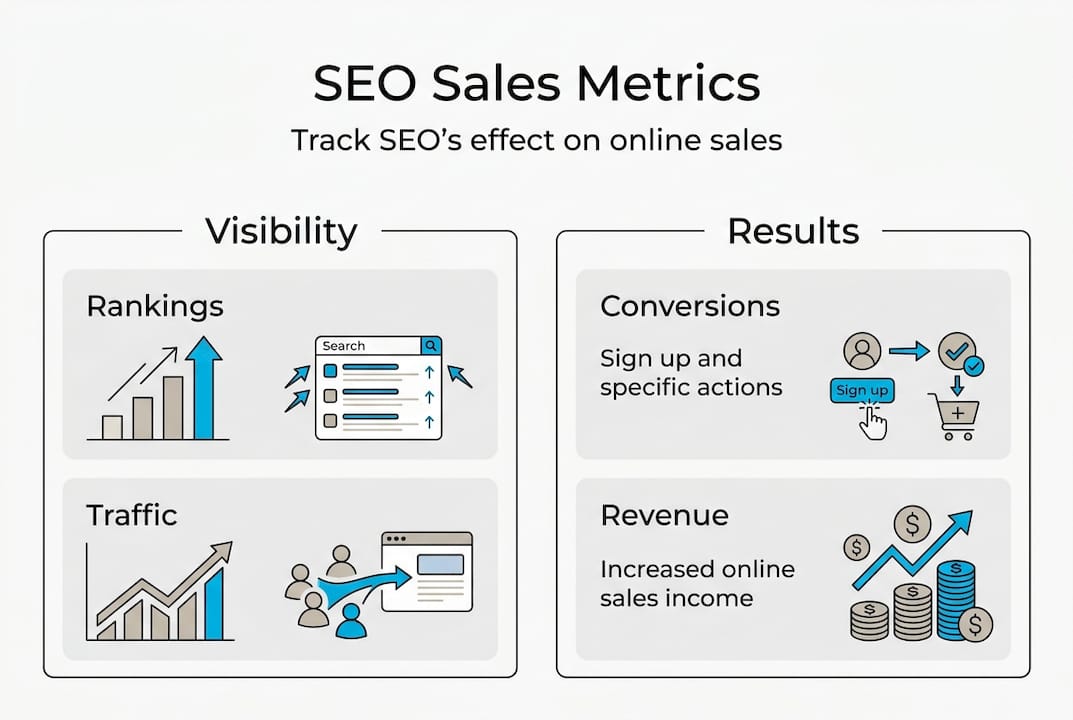
You can’t improve what you don’t measure. SEO performance is primarily assessed via rankings, organic traffic, user engagement, and sales conversions, all of which correlate strongly. Tracking these metrics reveals whether your SEO efforts translate into actual revenue growth.
Keyword rankings provide the foundation for visibility measurement. Track positions for your target keywords weekly to identify trends. Rising rankings indicate your optimisation efforts are working, whilst declining positions signal the need for content updates or additional backlinks. Focus on keywords that drive revenue, not just traffic.
Organic traffic growth serves as a clear indicator of SEO success. Monitor the number of visitors arriving from search engines month over month. Analyse which pages attract the most organic traffic and which keywords drive those visits. This data reveals what’s working and where opportunities exist for expansion.
Conversion rates from organic search visitors matter most. Traffic means nothing if it doesn’t convert to sales. Calculate the percentage of organic visitors who complete purchases, submit enquiries, or take other valuable actions. Compare conversion rates across traffic sources to understand organic search’s true value.
Metric
What it measures
Why it matters
Target benchmark
Organic traffic
Visitors from search engines
Indicates visibility and reach
20-30% month-over-month growth
Keyword rankings
Position in search results
Shows competitive standing
Top 3 positions for priority keywords
Conversion rate
Percentage of visitors who buy
Reveals traffic quality
2-5% for e-commerce sites
Bounce rate
Visitors who leave immediately
Signals content relevance
Below 50% for product pages
Average session duration
Time spent on site
Indicates engagement level
2-3 minutes minimum
Google Analytics provides comprehensive data about organic traffic behaviour. Set up goals to track conversions, analyse user flow to identify drop-off points, and segment organic traffic to understand which keywords drive the most valuable visitors. This free tool offers insights that inform strategic decisions.
Google Search Console reveals how search engines view your site. Monitor click-through rates for different queries, identify pages with declining impressions, and discover new keyword opportunities. The Performance report shows exactly which searches trigger your site’s appearance and how often users click through.
Specialised SEO platforms like SEMrush, Ahrefs, or Moz offer advanced features for tracking rankings, analysing competitors, and identifying backlink opportunities. Whilst these tools require investment, they provide data that accelerates SEO progress for SEO measurement for small businesses serious about growth.
Pro Tip: Create a monthly SEO dashboard that tracks your key metrics in one place. Include organic traffic, conversion rate, top performing pages, keyword rankings, and revenue attributed to organic search. This consolidated view makes it easy to spot trends and demonstrate SEO metrics and impact to stakeholders.
Regularly review and refine SEO tactics based on performance data. If certain keywords aren’t converting despite high traffic, consider whether they match buyer intent. If specific pages have high bounce rates, improve content quality or page speed. Data-driven optimisation ensures continuous improvement.
The most valuable metric is ultimately revenue attributed to organic search. Use attribution modelling to understand how organic search contributes to your sales funnel. Many customers research organically before converting through other channels, so give SEO appropriate credit for its role in the customer journey.
Integrating SEO with wider digital marketing for sustained online growth
SEO delivers maximum impact when integrated with complementary marketing channels. SEO works best in conjunction with social media, paid advertising, and content marketing to boost sales effectively. Isolated strategies underperform compared to coordinated approaches that reinforce each other.
SEO builds organic visibility and trust over time. Whilst it takes months to see substantial results, the traffic it generates costs nothing per click and continues flowing long after you stop active optimisation. This makes SEO the foundation of sustainable digital marketing, providing consistent returns that compound over years.
Paid advertising provides immediate traffic that complements SEO’s long-term approach. Use Google Ads to capture high-intent keywords whilst your organic rankings improve. Paid campaigns also generate data about which keywords convert best, informing your SEO strategy. The combination ensures you capture demand immediately whilst building organic presence.
Social media drives engagement and brand awareness that supports SEO efforts. Social signals don’t directly impact rankings, but social media increases brand searches, attracts links to your content, and builds the audience that engages with your website. Share your best content across social platforms to maximise its reach and link-earning potential.
Content marketing aligns perfectly with SEO to offer valuable user-centric information. Every blog post, guide, or video you create serves dual purposes: attracting organic search traffic and nurturing customer relationships. Quality content earns backlinks naturally, answers customer questions, and establishes your authority. Understanding digital marketing basics means recognising content as the fuel that powers SEO.
Marketing channel
Primary benefit
SEO integration point
Combined advantage
Paid advertising
Immediate traffic and sales
Keyword data informs SEO targeting
Capture demand now whilst building organic presence
A coordinated digital marketing approach yields higher online sales than isolated strategies. When customers encounter your brand across multiple touchpoints, recognition and trust increase. Someone might discover you through social media, research you through organic search, and convert through a paid ad. Each channel plays a role in the journey.
Integrating SEO in marketing mix requires strategic planning. Align keyword targeting across paid and organic channels. Use social media to promote content that targets important SEO keywords. Ensure your email campaigns drive traffic to optimised landing pages. This coordination maximises efficiency and results.
Key integration tactics include:
Use paid search data to identify high-converting keywords for SEO prioritisation
Promote your best-performing organic content through paid social amplification
Include social sharing buttons on content to encourage organic distribution
Retarget organic visitors who didn’t convert with display advertising
Feature customer testimonials across all channels to reinforce trust signals
The most successful Australian SMEs don’t choose between SEO and other marketing channels. They recognise each channel’s strengths and create integrated strategies where channels support and amplify each other. This holistic approach delivers sustained growth that single-channel strategies cannot match.
SEO provides the foundation, but integration provides the multiplier effect. When all your marketing efforts work together, you create a presence that’s greater than the sum of its parts. That’s when online sales growth becomes predictable and sustainable.
How Titan Blue helps Australian businesses succeed with SEO and web design
Understanding SEO’s impact on sales is one thing. Implementing effective strategies that deliver results is another entirely. Titan Blue specialises in helping Australian small to medium businesses transform their online presence into revenue-generating assets through expert SEO for small businesses and strategic web design.
We combine technical SEO expertise with compelling web design gold coast Australia that converts visitors into customers. Our approach integrates search optimisation with user experience, ensuring your site ranks well and converts effectively. Every design decision considers both search engine requirements and human behaviour.
Our ecommerce SEO marketing solutions help online retailers capture and convert shoppers throughout their buying journey. From product page optimisation to technical performance improvements, we implement strategies that boost visibility and sales simultaneously. Australian businesses choose us because we deliver measurable results, not just promises.
Frequently asked questions
What are the most important SEO factors for online sales?
Content quality, keyword relevance, and authoritative backlinks are the top SEO factors that influence search rankings and drive sales. These elements work together to establish your site’s credibility and visibility. Technical SEO aspects like site speed and mobile usability also affect user experience and conversions significantly.
How long does it take for SEO to affect online sales?
SEO impact usually becomes noticeable in 3 to 6 months, depending on competitiveness and effort invested. Initial improvements in rankings may appear sooner, but substantial traffic and sales growth requires sustained effort. Consistent optimisation and content updates are crucial for sustaining and improving results over time.
Can SEO alone guarantee increased online sales?
SEO significantly boosts visibility but is most effective when combined with other marketing channels. Whilst strong SEO drives qualified traffic, conversion depends on factors like website design, product quality, pricing, and customer service. Integrated digital marketing strategies maximise traffic quality and conversion rates for optimal sales growth.
What tools help measure SEO’s effect on sales?
Common tools include Google Analytics, Google Search Console, and specialised SEO platforms for tracking rankings and conversions. Google Analytics reveals traffic sources and conversion behaviour, whilst Search Console shows search performance data. These tools provide data to refine SEO strategies and demonstrate ROI clearly to stakeholders.
Titan Blue is your go-to digital partner for smart, results-driven solutions. We blend strategy, creativity and tech to grow your brand and get real results fast.