


Your phone should be ringing more than it is.
If you run a plumbing business in Mermaid Waters, a restaurant in Broadbeach, or a solar company servicing the wider Gold Coast, you’ve probably had the same thought: we do solid work, so why does the competitor down the road keep getting the calls? In most cases, the answer isn’t quality. It’s visibility.
Local business seo is what decides who appears when a nearby customer searches with intent. It affects who shows up in Google Maps, who gets the tap from a mobile search, and who gets ignored because their profile, pages, or reviews send weak signals. On the Gold Coast, that gap matters fast, because people searching locally usually need something now.
Why Your Local Business is Invisible Online
A common pattern looks like this. A plumber has a website built a few years ago, a Facebook page that gets updated when someone remembers, and a Google Business Profile that was claimed once but never really finished. A competitor nearby has fewer years in business but shows up everywhere. Maps. Local pack. Branded searches. Review panels. “Near me” results.
That’s not luck. That’s local business seo working as it should.
In Australia, 96% of consumers discover nearby businesses through online searches, and 88% of smartphone local searches lead to a store visit or call within a day according to these local SEO statistics. If you’re not visible at the moment of search, you miss the enquiry before the customer ever sees your name.
Search has also changed. Your website isn’t the only thing Google reads anymore. It weighs your Google Business Profile, your reviews, your service pages, your location signals, your mobile experience, and the consistency of your business details across the web. If those signals are weak, Google has no reason to trust that you’re the best local answer.
Most local visibility problems aren’t caused by a penalty. They’re caused by incomplete information, weak location signals, and generic pages that could belong to any business in any suburb.
If you want a useful plain-English primer on how paid search and organic search work together, this overview of Search Engine Marketing and SEO is a good companion read.
If you’re already asking why your listing isn’t appearing where it should, start with this practical guide on why your business is not showing up on Google.
What invisibility looks like in practice
It usually comes down to one or more of these issues:
- An unfinished profile with missing services, wrong hours, weak categories, or no recent updates.
- A generic website that says “quality service” but never says where you work or what jobs you do.
- Poor local trust signals such as thin reviews, inconsistent contact details, or no local mentions.
- A clunky mobile experience that makes people bounce before they call.
None of that is dramatic. It’s just enough friction to cost you calls.
Master Your Google Business Profile and Local Audit
If your local business seo is underperforming, start with your Google Business Profile. For many Gold Coast businesses, it drives more immediate action than the homepage does. A customer can call, get directions, read reviews, check trading hours, or compare you with another business without ever visiting your site.
That’s why this profile needs to be treated like a live sales asset, not an admin listing.
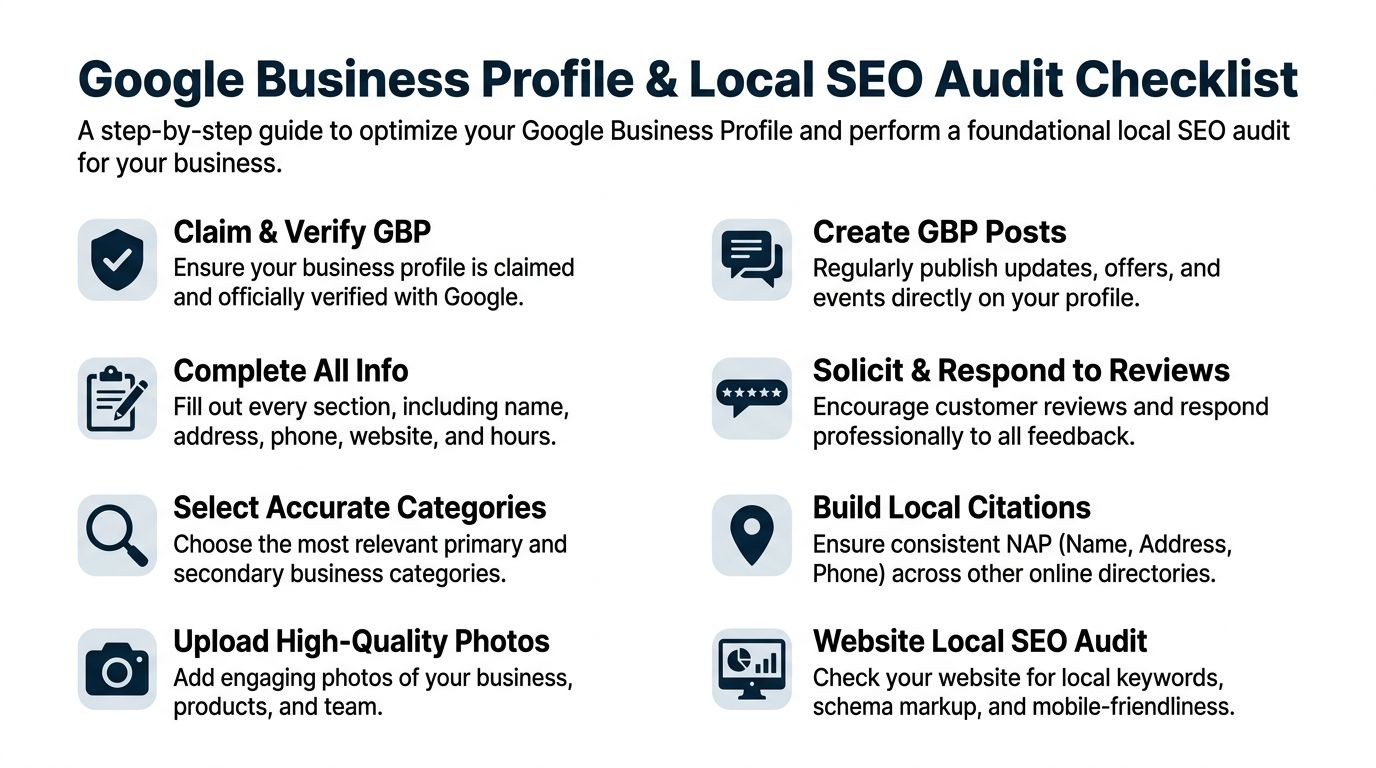
According to Moz’s local SEO guide, around 80% of local SEO failures can be traced back to generic service pages and poorly optimised profiles rather than specific, keyword-targeted content that addresses local customer pain points. That matches what shows up in audits again and again.
Start with the profile basics
Claiming and verifying the profile is step one. If Google doesn’t trust the ownership, every other improvement sits on shaky ground.
After that, complete every field that matters:
- Business name. Use your real trading name. Don’t stuff suburbs or services into it.
- Address or service area. A restaurant needs an accurate physical location. A mobile plumber needs service areas set properly.
- Phone number. Use a number you answer during business hours.
- Website link. Send users to the most relevant page, not always the homepage.
- Opening hours. Keep them current, especially holidays and emergency hours.
A Broadbeach café and a mobile drainage business should not fill out the same profile the same way. One relies on foot traffic, dine-in signals, menu relevance, and opening hours. The other relies on service areas, urgent-call intent, and fast contact.
Choose categories like they matter, because they do
Primary category selection is often handled casually. It shouldn’t be.
If you’re a plumber, “Plumber” is very different from narrowing your profile around the right specialist categories and matching website content to those services. If you’re a restaurant, your main category should reflect what a customer would search for first. The wrong category sends mixed signals before your content even gets considered.
Use secondary categories to support the business, not to chase every possible variation.
Practical rule: choose categories that describe what you want to be found for most often, not everything you could possibly do.
Write the profile for searchers, not for yourself
Business descriptions are often filled with filler. “Family owned.” “Quality service.” “Friendly team.” None of that is harmful, but none of it helps much on its own.
A strong description does three things:
- States the service clearly
- Mentions the local area naturally
- Shows what makes the offer useful
A weak example for a trade:
- “We are a trusted local business offering quality services.”
A stronger example:
- “Emergency plumbing, blocked drains, hot water repairs, and leak detection across Broadbeach, Mermaid Waters, Southport, and nearby Gold Coast suburbs.”
One says almost nothing. The other gives Google and the customer something concrete.
Services, products, photos, posts, and Q&A
These are often left half-done. That’s a mistake.
Services and products
List services with plain descriptions. If pricing is appropriate for your business type, include it. If not, focus on clarity.
Good service entries help two audiences at once. They help Google understand your relevance, and they help a customer decide whether to call.
Photos
Upload current photos of the business, team, vehicles, fit-out, dishes, job types, and storefront. For hospitality, show the dining environment. For trades, show branded vehicles, completed work, and staff in the field.
Avoid stock-style images where possible. People notice the difference.
Posts
Google Posts won’t rescue a weak profile, but they do keep the profile active and useful. Use them for offers, service reminders, special trading periods, event updates, or seasonal demand.
Examples:
- A restaurant can post a weekend special or live music night.
- A plumber can post storm-season emergency availability.
- A solar installer can post a financing option or system upgrade reminder.
Questions and answers
Seed common questions before customers ask them badly. Put clear answers in place for things like parking, booking requirements, call-out areas, payment options, after-hours service, and turnaround times.
Run a local audit beyond Google
Your profile can be solid and still underperform if the rest of your digital footprint is messy.
Use this audit sequence.
Check your NAP consistency
NAP means Name, Address, Phone.
If your site says one phone number, a directory says another, and an old listing still has a former address, Google gets conflicting business identity signals. Consistency matters, especially for local trust.
Look at:
- Your website footer
- Contact page
- Directory listings
- Social profiles
- Old business citations
Review your location pages and service pages
Many local businesses either have no location pages or publish near-duplicate pages with suburb names swapped out. That usually creates thin content and weak intent matching.
Each important service should have its own page. If you serve distinct areas, each location page needs real local detail, not template filler.
This guide on Google My Business and local SEO gives a helpful foundation if you’re checking those elements yourself.
Check mobile performance
A local search often happens from a phone, while someone is on-site, in the car, or comparing options quickly. If your page is slow, hard to tap through, or hides the phone number below clutter, you lose the lead before rankings matter.
The technical side matters too. Growth Minded Marketing notes that inconsistent NAP, duplicate content across locations, weak mobile responsiveness, poor mobile loading speed, and incorrect canonical implementation on location pages are common causes of local ranking failure in this local SEO guide.
What a useful audit should leave you with
By the end of the audit, you should know:
- Whether your profile is fully completed and verified
- Whether your categories match your real services
- Whether your photos and posts support trust
- Whether your website reflects the places you serve
- Whether your business details are consistent everywhere
- Whether mobile users can call or book without friction
That foundation does more work than most business owners expect. Without it, every later tactic struggles.
Build Unshakeable Local Authority and Trust
Once the profile is in shape, authority becomes the next gap. Google doesn’t just want to know you exist. It wants evidence that your business is relevant in the area you claim to serve and trusted by the local market.
That evidence comes from your website, your mentions across the web, and the local organisations or businesses that connect to you.
On the Gold Coast, there’s a practical opportunity here. Only 22% of Gold Coast trades have local authority links, and local links from a Chamber of Commerce or regional newspaper can yield a 3x higher ROI for service businesses, according to this AU-focused local link study summary.
Local authority starts on your own site
Many businesses chase backlinks before fixing the signals they control. That order is backwards.
Your website should make three things obvious:
- What you do
- Where you do it
- Why a local customer should trust you
If you’re a service business, don’t hide everything on one “Services” page. Break it out.
A plumbing site might need separate pages for:
- Emergency plumbing
- Blocked drains
- Hot water systems
- Leak detection
- Gas fitting
Then localise them where it makes sense. Not by jamming suburb names into every sentence, but by matching the way customers search. A page about emergency plumbing on the Gold Coast is useful. A page about emergency plumbing in a specific suburb can also work if the content is specific.
Clean citations matter more than flashy tactics
Citation work isn’t glamorous. It is, however, one of the easiest ways to remove friction from local business seo.
When your business details differ across directories, map listings, industry sites, and social profiles, Google has to reconcile conflicting records. Customers also lose trust if they see different addresses, old numbers, or dead links.
Work through your listings and fix:
- Old trading names
- Outdated addresses
- Tracking numbers used as primary contact numbers
- Wrong opening hours
- Broken website links
This is often where agencies, internal staff, and previous contractors accidentally create a mess. A business changes premises or phone systems and nobody cleans up the old footprint.
If your website says one thing and a directory says another, Google has a trust problem. So does the customer.
The links that move local rankings
National links can be useful. For many local service businesses, though, they’re not the first priority.
A practical local link profile often comes from real-world relationships. That includes organisations and businesses that already operate in your service area and can vouch for your legitimacy through a citation, feature, sponsorship mention, or partner page.
What works on the Gold Coast
For trades, hospitality, and construction businesses, these are usually stronger than generic outreach:
-
Chamber and association listings
If you’re a member of a local chamber or industry body, make sure the listing is complete and links back to the right page. -
Regional media mentions
Community newspapers, local business features, and event coverage often drive stronger local relevance than broad national placements. -
Complementary partnerships
A plumber can partner with an electrician, builder, or property manager. A restaurant can partner with a nearby venue, event organiser, or accommodation provider. -
Community sponsorships
Sponsoring a local school event, surf club activity, or sports side can create legitimate local mentions if handled properly.
What usually wastes time
Some businesses spend months chasing high-authority links from irrelevant websites with no local context. Those links may look impressive in a report but do little for map visibility if your local signals are still thin.
The better question is simple: would this link make sense if Google didn’t exist?
If the answer is yes, it’s often worth pursuing.
Make trust visible on-page
Authority isn’t only about off-site signals. It also needs to show up where customers make decisions.
Add proof where it matters:
- Real suburb mentions where you work
- Service area references on contact and service pages
- Testimonials tied to real jobs or locations
- Clear licensing, accreditations, or memberships where relevant
- Photos of staff, vans, premises, or completed work
For a restaurant, that might mean showcasing location details, booking info, parking guidance, and current menu context. For a plumber, it means showing call-out areas, service capability, and signs that you’re operating locally rather than lead-selling nationally.
A simple way to think about authority
Authority isn’t built by one tactic. It’s built when the same local story appears everywhere.
Your profile says you serve the Gold Coast. Your website has pages that prove it. Local organisations mention you. Reviews mention suburbs and services. Your business details match. The signals line up.
That’s what unshakeable local trust looks like in practice.
Develop Content and Reviews That Convert Locals
Ranking is only half the job. The other half is getting chosen.
That’s where local content and reviews work together. One tells people you handle the exact problem they have in the exact area they’re in. The other removes doubt.

In Australia, 83% of consumers rely on Google for local business reviews, and high ratings rank as the sixth most important factor for local pack visibility and the single most important factor for converting a searcher into a customer, according to these local review findings.
Write pages for real local intent
A page called “Plumbing Services” is better than nothing. It’s rarely enough.
A better local business seo approach is to build pages around the service and the location pattern your customers use. That means pages such as:
- Emergency plumber Gold Coast
- Blocked drain plumber Broadbeach
- Hot water repairs Southport
- Solar panel installation Gold Coast
- Breakfast restaurant Broadbeach
These pages need substance. Not a token suburb swap.
Include:
- The specific problem
- The local context
- What the customer can expect
- Service area detail
- Clear next action
A good page answers the practical question behind the search. Someone searching “emergency blocked drain plumber in Broadbeach” doesn’t want a history of your company. They want to know whether you handle that issue, whether you service the area, and how fast they can contact you.
Generic content loses local jobs
Generic copy is one of the biggest leaks in local conversion.
Weak example:
- “We provide reliable plumbing solutions for residential and commercial customers.”
Useful example:
- “Blocked drain in Broadbeach? We handle urgent drain clearing, CCTV inspection, and overflow issues for homes, units, restaurants, and retail sites across the central Gold Coast.”
The second version gives the customer confidence that you understand the job and the area.
If you’re building that content properly, this guide on content marketing for small business is a solid reference for planning pages that support sales.
A local service page should sound like it belongs to your suburb, your trade, and your customer’s problem. If it could sit on any website in Australia, it’s too vague.
Reviews don’t just support rankings. They finish the sale.
A strong page gets the click. Reviews often decide the call.
Customers read them for proof that your business is reliable, responsive, and consistent. They also scan for clues that your business has handled the same kind of need before.
For a restaurant, that may be comments about food quality, service, and atmosphere. For a plumber, it’s usually speed, communication, and whether the issue was fixed.
Ask in a way that feels natural
Most businesses either never ask, or they ask awkwardly.
The best time is right after a positive outcome:
- after a successful call-out
- after a completed meal experience with good feedback
- after installation and handover
- after a repeat customer thanks the team
Keep the ask simple. Make the review link easy to access. Don’t make customers search for where to leave feedback.
Respond properly
Replying to reviews matters because people read your responses as much as the original comment.
For positive reviews:
- thank them
- mention the service naturally
- keep it human
For negative reviews:
- stay calm
- address the issue directly
- move the resolution offline where appropriate
- don’t argue in public
A measured response can build trust even when the original review isn’t glowing.
Use reviews to improve content
Reviews are full of customer language. They tell you how locals describe the problem, the suburb, the urgency, and the outcome. Many businesses miss an easy win here.
If customers keep praising quick after-hours help, mention your after-hours process. If they mention “hard-to-find café with great coffee near the beach”, that tells you something about how they frame the experience.
A short visual walkthrough can help if you’re trying to tighten up content and review workflows:
The conversion loop to aim for
The strongest local businesses create a loop like this:
- A local search lands on a relevant page
- The page matches the exact service and suburb intent
- The Google profile confirms the basics
- The reviews remove hesitation
- The customer calls or visits
That’s the difference between traffic and enquiries. It’s also why content and reviews shouldn’t be handled as separate tasks.
Future-Proof Your SEO for AI and Voice Search
Many local businesses still think local business seo means one thing. Rank in Google Maps.
That’s now too narrow.
Google still matters, but search behaviour is shifting toward AI summaries, assistants, and answer-driven results where the user may never click through in the old way. If your business only optimises for the map pin and ignores answer engine optimisation, you risk becoming harder to find even with a decent profile.

In Australia, 65% of local searches now end in AI-generated summaries without a click, and voice queries like “near me” via Siri and Alexa have grown 35% in the last year, based on the AI search data cited in this service-area SEO article.
Local SEO is no longer just a map problem
A customer might ask:
- who’s the best emergency plumber near me
- what solar installer services Broadbeach
- where can I get breakfast near Kurrawa
- which restaurant is open now
Those searches can trigger AI-generated summaries, voice results, or featured answer formats. If your content is vague, poorly structured, or missing key business context, you may not be surfaced at all.
That’s why Answer Engine Optimisation, or AEO, now belongs in the local playbook.
Give AI and search engines clearer structure
AI systems need content they can interpret cleanly. So does Google.
That starts with technical clarity on your site:
- Location-specific schema markup
- Review and business structured data where appropriate
- Clear service pages
- Distinct location pages
- Consistent business details
- Proper canonical tags on location pages
If you run multiple locations or service areas, duplication becomes a real risk. Growth Minded Marketing points out that duplicate content across locations, inconsistent NAP information, poor mobile responsiveness, and weak page speed are common causes of local ranking failure in its technical local SEO guidance. The same issues can also weaken AI understanding when systems try to summarise your business.
Build FAQ content for spoken questions
Voice and AI search tend to pull from direct, concise answers.
That means your FAQ content should be built around how customers ask questions, not around internal jargon.
For example, a Gold Coast plumber could add FAQ entries such as:
- Do you offer emergency plumbing in Broadbeach?
- How fast can you attend a blocked drain on the Gold Coast?
- Do you service apartments as well as houses?
- Can you quote hot water replacement on-site?
A restaurant could answer:
- Are you open for breakfast on weekends?
- Do you take walk-ins in Broadbeach?
- Is there nearby parking?
- Do you cater for dietary requirements?
These answers should be short, specific, and easy to parse. Then support them with fuller page content underneath.
One useful test: read your FAQ answer out loud. If it sounds awkward in speech, it probably won’t perform well for voice search either.
Optimise for zero-click visibility
Many owners still measure success only by website clicks. That misses what’s happening now.
If an AI summary mentions your business, confirms your services, lists your hours, or reflects your review strength, that can still drive a call or visit even when the user doesn’t browse your site in the old path. Visibility has become broader than a blue link.
Practical zero-click actions include:
- Keeping opening hours current
- Publishing clear service descriptions
- Maintaining review freshness
- Structuring FAQs around local intent
- Using location details consistently across your site and profile
If you want a broader framework for this shift, Prometheus Agency has a useful guide on how to increase visibility in AI search engines.
For businesses trying to connect traditional local SEO with AI discovery, this resource on AI search for your business is worth reviewing.
What this means for Gold Coast trades and hospitality
For trades, AI search will favour businesses that clearly define services, service areas, emergency availability, and customer proof.
For hospitality, it will reward businesses with accurate hours, strong review signals, clear menu and venue information, and content that answers practical booking and location questions.
Traditional optimisation still matters. It just isn’t sufficient on its own anymore.
One option businesses use when they want support across local SEO, content, and AI search is Titan Blue Australia, which provides those services for Australian businesses from Broadbeach. The important point isn’t the provider. It’s that your local strategy now needs both search engine optimisation and answer engine optimisation working together.
Track What Matters and Measure Your SEO ROI
A local campaign isn’t working because a report says your visibility improved. It’s working when more people call, request directions, book, or submit an enquiry.
That’s the level to measure.
Start with business actions, not vanity metrics
Rankings matter, but they’re not the final score. A number one position that doesn’t produce calls is less useful than a lower position that generates consistent leads.
For local business seo, the most useful signals are usually:
- Phone calls from your Google Business Profile
- Direction requests
- Website contact form submissions
- Bookings or quote requests
- Landing pages that generate enquiries
Google Business Profile insights can show whether people are calling, asking for directions, or interacting with the listing. GA4 helps you measure what happens once they reach the website.
Set up tracking cleanly
If you have multiple locations or service areas, segment them properly. Growth Minded Marketing recommends location-based goal configuration in Google Analytics 4 and conversion tracking segmentation for multi-location local optimisation in its technical local SEO guidance.
A simple setup should include:
- Call click tracking on mobile
- Contact form submission tracking
- Thank-you page or lead event tracking
- Location-specific page tracking if you serve multiple areas
If you’re unsure which reports matter inside GA4, this guide to top Google Analytics metrics is a practical place to start.
Review results like an owner
At the end of each month, ask:
- Did calls increase from local search?
- Which service pages produced enquiries?
- Did direction requests rise for the location?
- Are reviews improving conversion confidence?
- Which suburbs are showing stronger engagement?
That review gives you decisions, not just data. You can double down on pages that drive leads, improve weak areas, and stop spending time on tactics that look busy but don’t move the business.
If you want a clearer local growth plan, Titan Blue Australia helps Gold Coast and Australian businesses improve visibility across Google, Maps, AI search, and content so local searches turn into calls, bookings, and foot traffic.
Make Titan Blue a preferred source in Google
One click tells Google to surface our articles more often in Top Stories, AI Overviews and AI Mode.

AEO and GEO for Australian Businesses: How to Get Recommended by ChatGPT and Google AI Mode
A field guide to getting recommended by AI answer engines in Australia, built on our…

Web Design Mistakes Killing Your AI Visibility (2026)
The web design mistakes killing your AI visibility in 2026, and how to fix each…

AEO Website Design Checklist 2026: The Complete Build Guide
A practical AEO website design checklist for 2026 covering crawlability, schema markup, content structure, Core…