Your business is good. Customers are nearby. Staff are doing the work. Yet when someone in Brisbane searches for a plumber, a lunch spot, a solar installer, or a builder in their suburb, your business barely shows up.
That gap is usually where local SEO becomes real. Not as a marketing buzzword, but as the difference between getting the call and losing it to a business with a better Google Business Profile, cleaner location signals, and stronger local content.
From Broadbeach, we’ve spent 25+ years working with Australian businesses that need practical digital strategy, not vague promises. If you’re looking for a local seo expert brisbane business owners can trust, the hiring decision now needs to go beyond Maps rankings and suburb pages. It also needs to account for AI search, zero-click answers, and how search behaviour is shifting.
Why Local SEO Offers Significant Advantages for Brisbane Businesses
A Fortitude Valley restaurant can serve great food every night and still lose covers to the venue two streets over. A plumber in Carindale can answer the phone, have vans on the road, and still miss urgent jobs. The gap is usually visibility at the moment a customer is ready to act.
Local SEO closes that gap by putting a business in front of nearby searchers who want to book, call, visit, or request a quote now.
For Brisbane businesses, that advantage is practical. Searchers often include suburb names, use mobile phones, and make fast decisions from map results, reviews, opening hours, and service details without visiting many websites at all. For trades, that can mean the first business with a credible local presence gets the call. For hospitality, it can mean winning the booking before a customer scrolls any further. For service businesses, it often decides who gets shortlisted for a quote.
That matters even more now because search behaviour is changing. Google still drives strong local intent, but AI-generated answers are starting to shape discovery as well. A business with clear location signals, accurate service information, strong reviews, and structured website content is easier for both search engines and AI systems to understand. That improves visibility not only in Maps and local packs, but also in answer-driven search experiences.
Why local search converts better than broad traffic
Broad SEO can bring visitors from anywhere. Local SEO focuses on people inside your service area who are closer to a decision.
Someone searching for “electrician West End Brisbane” or “breakfast South Bank open now” is not doing early-stage research in the same way as a broad informational searcher. They usually need a provider, a table, or a quote soon. That changes what matters.
Local intent: The search already includes place, urgency, or service context.
Visibility in decision points: Google Business Profile, map results, reviews, and FAQs often influence the click before the website does.
Higher lead quality: A smaller volume of relevant local visits often produces better enquiry rates than larger volumes of untargeted traffic.
Better fit for AI search: Clear, well-structured local information gives answer engines more confidence in citing or summarising your business.
Brisbane is not one uniform search area. A builder targeting inner-city renovations, a café near South Bank, and a solar installer covering Logan, Ipswich, and the bayside all need different local signals. Good local SEO accounts for suburb intent, travel radius, competition level, and how customers choose.
We see this often at Titan Blue. Businesses assume a decent website is enough, then find they are invisible in the suburbs that produce their best leads. After 25+ years working with Australian SMBs, the pattern is familiar. The winners are rarely the businesses with the flashiest homepage. They are the ones with accurate local data, useful suburb and service content, strong review velocity, and a site structure that search engines and AI tools can interpret without guesswork.
For Brisbane SMBs, local SEO is less about chasing traffic totals and more about owning the commercial moments that count. Calls. Direction requests. Booking actions. Quote forms. Visibility in AI answers will increasingly sit alongside those metrics, because the businesses that are easiest to verify and summarise will have an edge as search keeps shifting.
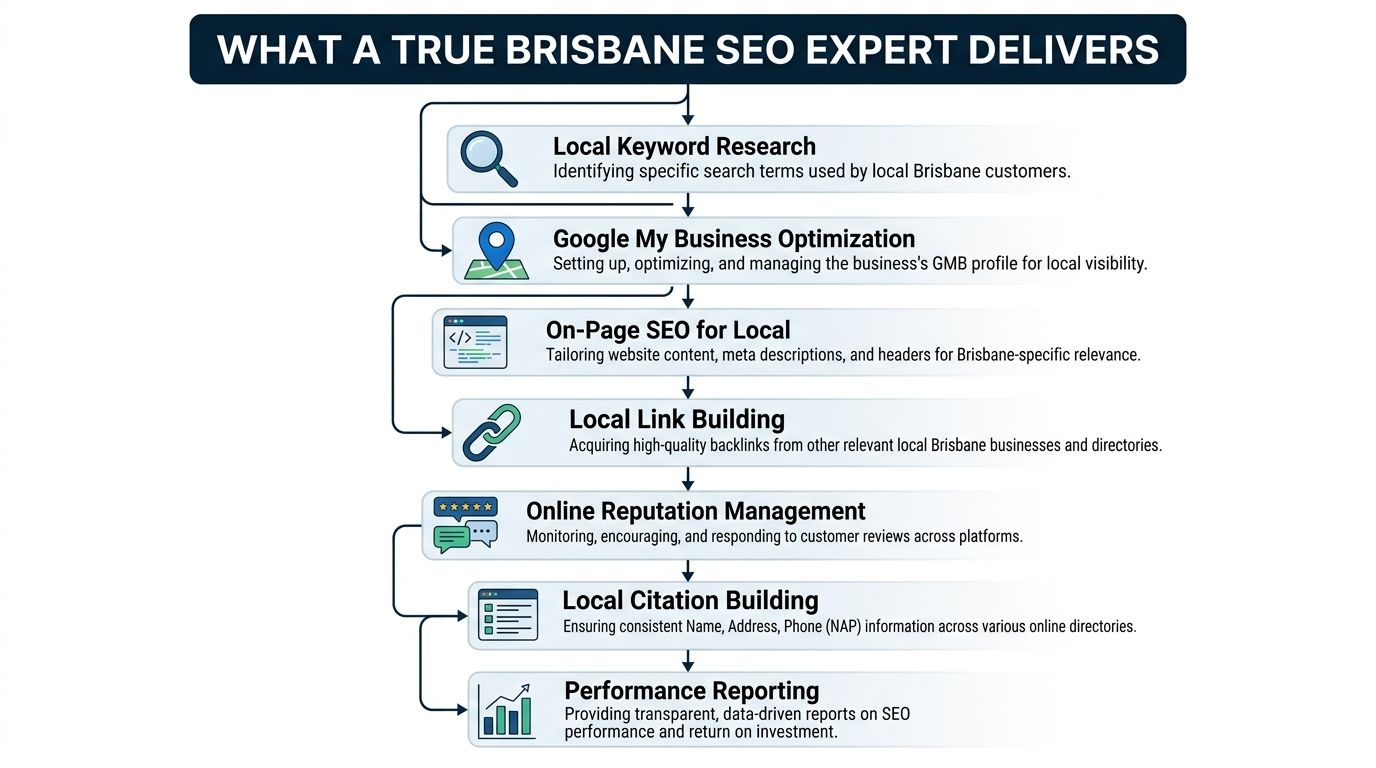
Identifying What a True Brisbane SEO Expert Delivers
Most business owners hear the same pitch. Better rankings. More traffic. More leads. The problem is that weak providers say all of that too.
A real local SEO specialist shows you the moving parts, explains why each one matters, and ties the work to how Brisbane customers search.
A sound methodology includes precise NAP consistency across 50+ directories, suburb-specific keyword targeting, LocalBusiness schema markup, and a review generation protocol. The same source notes that schema markup can increase Map Pack visibility by 25% (Digital8).
The delivery stack that matters
Think of local SEO as a hierarchy. The top result is visibility. Under that sits trust, relevance, and technical clarity.
Google Business Profile management
Many campaigns either gain traction or stall here.
A capable expert doesn’t just “set up” a profile. They refine categories, services, business descriptions, operating hours, photos, posts, and service areas. For a Brisbane trade business, that also means aligning the profile with the suburbs served instead of leaving the listing broad and generic.
For hospitality, they should also think about booking actions, menu or service details, and what a searcher needs to choose you quickly.
NAP and citation control
Your business name, address, and phone number need to match exactly across the web. Not close enough. Exact.
If one directory lists “St” and another lists “Street”, that may seem minor. If multiple listings show old numbers, old addresses, duplicate entries, or inconsistent naming, confidence drops. A real expert treats this as foundational work, not admin fluff.
Content that fits Brisbane search behaviour
Local content isn’t about stuffing “Brisbane” into every heading.
It’s about matching the way customers search in real life. That usually means suburb pages, service-area pages, and practical articles built around intent. A builder might need pages for renovation work in specific suburbs. A restaurant might need content around private dining, group bookings, or location-based dining searches. A plumber might need pages for emergency callouts by area.
Useful local content often includes:
Service plus suburb pages: For example, plumbing or solar services tied to actual service areas.
Location-aware FAQs: Questions customers ask before they call.
Proof from the field: Clear service detail, local relevance, and examples of work types you handle.
Internal linking: Connecting service pages, suburb pages, and supporting articles so Google can understand the site structure.
A local page should help a customer decide, not just help a keyword rank.
Schema and technical local signals
Good experts separate themselves from salespeople here.
Schema markup helps search engines understand your business details in a structured way. A proper setup should include your organisation details, local business data, opening hours, contact information, and relevant service context where appropriate.
That won’t replace content or reviews, but it helps search engines interpret the site correctly. It also becomes more important when search moves toward AI-generated summaries and direct answers.
Reputation management and reporting
Reviews aren’t a side task. They are part of local SEO performance.
A Brisbane SEO expert should have a review acquisition process that’s realistic for your team. For trades, that might mean post-job SMS follow-up. For restaurants, it may involve staff prompts and table-side cues. For service businesses, it can sit inside an automated email flow after the work is complete.
Reporting matters just as much. You should expect clear visibility into:
Lead indicators: Calls, forms, bookings, direction requests.
Search performance: Local keyword movement and page visibility.
Profile activity: Engagement on your Google Business Profile.
Commercial outcomes: Which locations and services are generating enquiries.
If an expert can’t explain their work in plain English, they probably won’t explain your results clearly either.
Finding and Vetting Your Potential SEO Partner
Hiring a local SEO provider is rarely about finding the one with the slickest proposal. It’s about finding the one whose process stands up when you start asking practical questions.
A lot of Brisbane businesses come to this stage after being burnt once already. They’ve paid for “SEO”, received a report full of impressions and ranking screenshots, and still don’t know why leads didn’t improve.
That caution is justified. One local SEO benchmark notes that up to 65% of Brisbane businesses have under-optimised Google Business Profiles and 84% have fewer than 10 reviews, which is exactly why you should ask how a provider plans to fix common local weaknesses rather than “optimise” in general terms (Greenhat).
Start with fit, not claims
Before you review any proposal, decide what kind of business support you need.
A solo tradie with one service area needs a different approach from a hospitality group, and both need something different from a construction company working across multiple suburbs. The right SEO partner should be able to talk comfortably about service areas, lead handling, seasonality, and the constraints of your business model.
Look for someone who asks questions like:
Where do your best customers come from now
Which suburbs matter commercially
Which services produce your best margins
How quickly does your team respond to inbound leads
Do you want more calls, more bookings, more quote requests, or stronger visibility before expansion
Those questions matter because local SEO doesn’t operate in a vacuum. It interacts with operations.
What to ask in the first meeting
A strong interview isn’t technical for the sake of sounding smart. It’s direct.
Here are the questions worth asking a potential local seo expert brisbane businesses are considering:
How will you improve our Google Business Profile specifically Ask for detail. Categories, photos, services, posts, Q&A, review workflow, and suburb alignment should all come up.
How do you decide which suburbs or service areas deserve dedicated pages You want a strategic answer, not “we create pages for everything”.
How will you handle NAP consistency and citation cleanup Good providers treat old listings and duplicates seriously.
What does your reporting focus on If the answer is only rankings and traffic, keep digging.
How do you approach reviews They should discuss both generation and response processes.
How do you adapt local SEO for AI search If they haven’t thought about AI Overviews, structured answers, or content for conversational search, that’s a gap.
The best answer to any SEO question is usually specific, slightly unglamorous, and operational.
What a weak provider sounds like
You can often spot trouble early.
Be cautious if you hear any of the following:
Guaranteed rankings: No credible SEO provider controls Google.
No access needed: Real work usually requires profile, website, analytics, and content access.
One-size-fits-all packages: Brisbane restaurants, plumbers, and solar installers do not need identical campaigns.
Reporting without commercial context: Pretty graphs don’t tell you whether leads improved.
No mention of reviews or GBP: That’s a major blind spot for local campaigns.
A polished strategist can still sit inside a weak delivery system. Ask what happens after you sign.
You should hear a clear workflow that includes audit work, local keyword mapping, profile improvements, content priorities, citation review, technical fixes, tracking setup, and reporting cadence. They should also explain who does the work. Strategy-only sales calls are common. You want to know whether the delivery team understands local search at a suburb level.
Use scenario questions
One of the best ways to vet an SEO partner is to make them solve a practical problem.
Ask them something like this:
A plumber services Brisbane’s inner west and outer west, wants more urgent callout work, and has an older website with sparse suburb content. What would you fix first?
Or this:
A South Bank restaurant has decent foot traffic on weekends but weak weekday bookings. What local SEO work would you prioritise?
The quality of the answer tells you a lot. Strong providers will usually talk through intent, location signals, content gaps, conversion paths, and review strategy. Weak ones will drift back to generic ranking language.
Look for commercial maturity
A seasoned SEO partner knows that not every business should target every suburb, every keyword, or every service equally.
For example, if one service line is profitable and another is a distraction, the SEO plan should reflect that. If your office location is different from your practical service footprint, your strategy needs to account for that. If your phone goes unanswered after hours, there’s no point pretending every local lead has equal value.
That’s where experience matters. After 25+ years in digital, the pattern is consistent. The best campaigns usually come from clear prioritisation, disciplined execution, and honest reporting.
Understanding Pricing and Evaluating SEO Proposals
A Brisbane electrician on a $900 retainer can look like they are saving money for six months. Then the calls stay flat, the reporting shows rankings with no lead context, and a second agency has to rebuild the tracking, clean up citations, and fix thin service pages. Cheap SEO often costs more once rework and lost enquiries are counted.
Local SEO pricing in Brisbane usually sits on a wide range because the scope changes fast. A single-van trade business targeting a tight service area needs a different plan from a restaurant group with multiple venues, or an SMB trying to win across several suburbs and service categories. At Titan Blue, after 25+ years in digital, we have found the proposals that create problems later are usually the ones that hide scope behind vague monthly activities.
What you should be paying for
A solid proposal names the work, the order of attack, and the business reason behind it.
That usually includes:
Audit and setup: Technical issues, local visibility gaps, conversion tracking, call tracking, and baseline measurement.
Google Business Profile management: Category refinement, service updates, photo strategy, review processes, and post management where relevant.
On-site local SEO: Service pages, suburb pages, metadata, internal links, schema, and fixes that help search engines interpret local relevance.
Content production: FAQs, service content, comparison pages, and answer-focused copy that supports both standard search and AI-generated results.
Authority work: Citation correction, duplicate listing cleanup, and locally relevant link acquisition.
Reporting: Leads, calls, form fills, direction requests, booked jobs, and visibility trends by location.
If those items are missing, ask why.
How to read a proposal without getting sold on fluff
The best proposals are specific enough that an operations manager could use them to check whether the work is being done. Generic wording like "ongoing optimisation" or "monthly authority building" is not enough on its own.
Look for four things.
A clear starting point You should see where the business stands now. That includes service gaps, weak suburbs, technical issues, and missed conversion opportunities.
Prioritisation Good SEO plans do not treat every page, suburb, and keyword as equal. A plumber may need emergency service visibility first. A cafe may need map pack visibility and weekday booking pages before anything else.
Reasoning Every inclusion should connect to an outcome. If schema is listed, the proposal should explain what type and why. If suburb pages are recommended, it should explain which suburbs matter commercially.
Measurement tied to business results Ranking reports alone are weak. A practical proposal shows how traffic, calls, quote requests, bookings, and location visibility will be tracked.
One warning sign comes up often. If the proposal spends more time explaining why SEO matters than showing what the agency will do each month, it is still a sales document, not an operating plan.
Compare retainers against scope, not headline price
A lower fee can still be poor value if the provider outsources production, avoids technical fixes, or gives you one templated report each month with no interpretation. A higher fee only makes sense when the work matches the opportunity and the business has the capacity to convert the extra demand.
That trade-off is different by industry. A Fortitude Valley restaurant may need frequent Google Business Profile updates, review support, menu and event content, and structured data for bookings. A trade business in the western suburbs may get better return from tighter service pages, faster mobile performance, after-hours call tracking, and suburb-specific intent targeting. An accountant or clinic may need fewer new pages but stronger trust signals, location clarity, and cleaner authority work.
For a practical benchmark, compare the inclusions in a proposal against this guide to SEO service pricing and scope.
Semrush's agency directory also shows Brisbane has many agencies offering local SEO at different price points. That confirms supply. It does not confirm quality, delivery standards, or whether the agency understands where local search is heading.
That last point matters now. A proposal built only around rankings and traffic is already incomplete. Brisbane businesses also need content structures, schema, entity clarity, and answer-focused pages that can surface in AI summaries and LLM-driven discovery. If AEO is absent from the plan, the proposal is priced for yesterday's search behaviour.
The right question is simple. What work gets done each month, how will it be measured, and does that scope help the business win both local clicks and AI-assisted visibility?
Future-Proofing Your Business for AI Search
Local SEO without an AI search plan is already starting to age badly.
The old model was simple. Someone searched, saw a list of links, clicked through, and compared websites. Now a growing share of local search behaviour happens inside AI-generated summaries, conversational results, and answer-style interfaces that may reduce the number of clicks your site receives.
One Brisbane-focused source says AI Overviews capture 30-40% of local searches, and that businesses not optimised for Answer Engine Optimisation (AEO) can see traffic drop by up to 25%. The same source says 62% of Brisbane trades reported declining organic traffic after AI rollout (Brisbane Local SEO).
Why this changes the hiring decision
A business can rank reasonably well and still lose visibility if its content isn’t structured for AI-assisted search.
That affects trades and hospitality in practical ways. A plumber might lose clicks if AI surfaces a competitor’s service summary first. A restaurant might lose discovery if booking, cuisine, opening hours, and local relevance aren’t easy for search systems to interpret. A solar installer might miss informational searches if content only targets old-style keyword phrasing.
A local SEO expert now needs to think beyond organic blue links.
What AEO looks like in local practice
AEO usually means making your business easier for search engines and AI systems to understand, summarise, and trust.
That includes work such as:
Structured data: Clear schema that supports business information and page meaning.
Question-led content: Pages that answer real local customer questions directly.
Entity clarity: Consistent business details across your site and profiles.
Service specificity: Plain statements about what you do, where you do it, and who it’s for.
Content formatting: Short, well-organised answers that can be surfaced in summaries.
If a provider still treats local SEO as “GBP plus citations”, they’re solving last year’s problem.
Questions to ask a provider about AI search
Don’t settle for “yes, we do AI too”. Ask what they mean.
Useful questions include:
How do you prepare local content for AI Overviews and answer-style search
What role does schema play in your local SEO work
How do you structure pages so they can be cited or summarised clearly
How do you adapt content for conversational local queries
How do you measure traffic shifts when zero-click behaviour increases
At Titan Blue Australia, this is one area where the work has changed materially. Local SEO still matters, but it now sits alongside AI Search and AEO rather than replacing them. If you want a practical overview of that shift, this page covers the broader AI search context: https://titanblue.com.au/ai-search/
The best local seo expert brisbane businesses hire in the next cycle won’t just improve local pack visibility. They’ll help protect discoverability as search engines answer more questions directly.
Onboarding and Measuring Your SEO Success
The first month tells you a lot about whether an SEO partnership will work.
Good onboarding feels organised, slightly forensic, and focused on access, accuracy, and priorities. Bad onboarding feels like a welcome email, a generic questionnaire, and silence.
What onboarding should include
At the start, your SEO partner usually needs access to the systems that show what’s happening now.
That may include:
Google Business Profile access: So profile issues can be reviewed and fixed.
Website access: For technical changes, metadata, content edits, and schema work.
Google Analytics and Search Console: To review performance and establish a baseline.
Call tracking or CRM data if available: So leads can be attributed properly.
Business information: Services, suburbs, hours, imagery, FAQs, and team details.
If access is delayed, strategy is delayed too. Local SEO depends on accurate inputs.
What success should look like
Many Brisbane SMBs still judge SEO through rankings alone, even though that doesn’t tell the full business story.
A more grounded benchmark comes from ROI tracking. One source notes that only 28% of Brisbane SMBs use tools like GA4 or call tracking to measure success, and argues that the focus should be on attributable leads and cost-per-lead rather than inflated ranking reports (Jared Bennett).
That changes the conversation.
Instead of asking “Did we move up for this keyword?”, better questions are:
How many calls came from local search
How many quote requests were attributable
Which suburb pages produced enquiries
Did booking actions increase
What is the trend in qualified leads, not just traffic
Rankings are a signal. Revenue is the result.
What a useful monthly report includes
A proper report should help you make decisions.
It should show what work was completed, how visibility changed, where lead activity came from, and what the next priorities are. For a trade business, that may reveal which service pages drive the strongest calls. For hospitality, it may show whether branded searches are growing or whether local intent pages need refinement.
Useful reporting usually covers three layers.
Search visibility
This includes changes in local keyword presence, page visibility, and profile engagement. It’s helpful, but it shouldn’t dominate the report.
Conversion behaviour
Here, things get more commercial.
Strategic interpretation
Often, this is the missing piece. A good SEO partner explains what the numbers mean and what should happen next.
Give the work enough time to compound
Local SEO isn’t instant, especially when foundational issues need cleanup first.
Some improvements happen early. Others take longer because search systems need to recrawl, reassess, and compare your local signals over time. If you want a practical expectation-setting guide, this resource is useful: https://titanblue.com.au/how-long-does-seo-take-to-work/
The businesses that get the most from local SEO usually treat it as an operating channel, not a campaign they switch on and judge too quickly. They share updates, provide access, respond to review opportunities, and let the strategy mature.
Frequently Asked Questions About Local SEO
How long does local SEO take to show results in Brisbane
It depends on your starting point.
If your Google Business Profile is weak, your site has thin local content, or your citations are inconsistent, early months often go into fixing fundamentals. If the base is already clean, movement can come faster. What matters is whether the work is improving visibility and lead quality over time, not whether one vanity keyword jumps quickly.
Can I do local SEO myself
You can handle parts of it.
Many business owners can update business details, upload photos, ask for reviews, and improve basic service information on their site. The harder work usually sits in strategy, technical implementation, structured data, content architecture, tracking, and prioritisation across suburbs and services.
For a small single-location business, doing some basics in-house can help. For a competitive market, expert guidance usually avoids wasted effort.
What’s the difference between local SEO and standard SEO
Local SEO focuses on location intent.
That includes suburb relevance, Google Business Profile visibility, local citations, reviews, service areas, and conversion actions such as calls or direction requests. Standard SEO can be broader and less tied to geography. A national brand may care more about broad non-local searches, while a Brisbane service business usually needs local relevance first.
What should I expect from a Brisbane SEO expert in the first few months
You should expect clarity.
That means an audit, obvious fixes being prioritised, tracking being set up properly, and a plan for profile optimisation, local pages, review acquisition, and reporting. You should also expect your provider to explain trade-offs. Not every page needs to be built first. Not every suburb deserves equal attention.
Does local SEO still matter if AI search keeps growing
Yes, but the work has to evolve.
Local search signals still feed discovery. What’s changing is how that discovery is presented. A provider who understands both local SEO and answer-oriented search is better positioned to help your business stay visible as search interfaces change.
How do I know if an SEO proposal is too generic
Read it and remove your business name.
If the document could be sent unchanged to a café, a plumber, a builder, and a solar company, it’s probably too generic. Strong proposals reflect your service mix, your location reality, your current gaps, and your business goals.
If you want a practical review of your current local visibility, Titan Blue Australia can assess your Google Business Profile, local content structure, and AI search readiness, then outline what needs attention first and what can wait.
Titan Blue is your go-to digital partner for smart, results-driven solutions. We blend strategy, creativity and tech to grow your brand and get real results fast.