

Last updated:
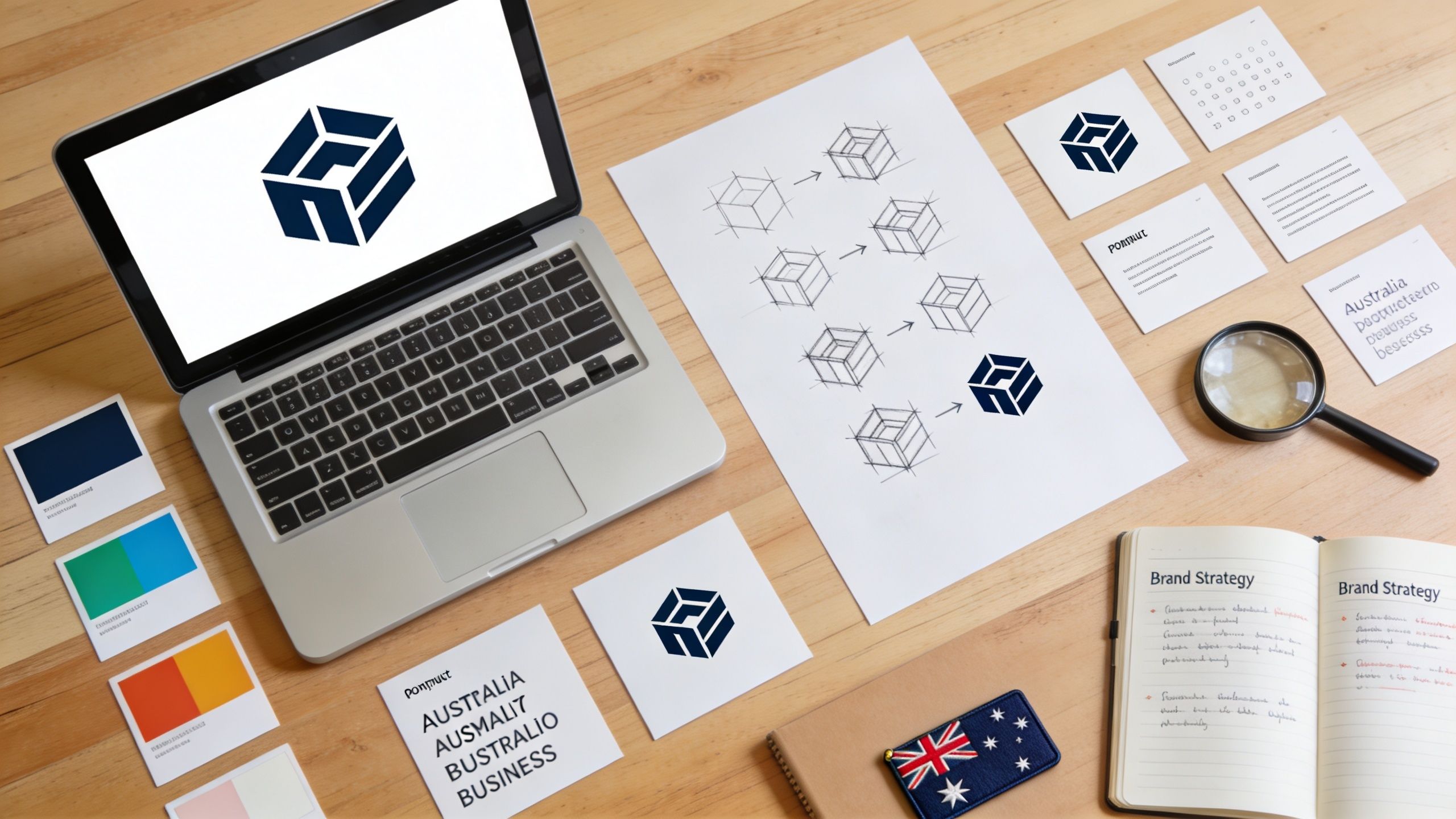
You've probably seen this happen in your own business. A customer finds you on Google, glances at your logo in a tiny circle, taps through to your site, then sees a different colour palette on your socials and different wording on your ute, menu, uniforms, or quote templates. Nothing looks outright broken, but nothing quite lines up either.
For small and medium Australian businesses, that gap costs more than people think. In trades, hospitality, construction, and local services, customers often make fast decisions based on recognition and trust signals. Good logo design and branding doesn't just make a business look polished. It helps people remember you, click you, and feel comfortable contacting you.
Logo vs Brand What Is the Difference
A lot of business owners use logo and brand as if they mean the same thing. They don't.
The simplest way to think about it is this. Your logo is the front door. Your brand is everything a customer experiences once they step inside. The logo gets noticed first. The brand decides whether people stay, buy, return, and recommend you.
What a logo actually does
A logo is a visual shortcut. It usually includes a symbol, wordmark, letterform, or a combination of these, supported by colour and typography choices. Its job is to help people identify your business quickly.
That matters because customers don't study businesses in detail on first contact. They scan. They compare. They make snap calls about whether something feels established, trustworthy, affordable, premium, local, modern, or forgettable.
A strong logo should do a few practical things well:
- Identify fast: It should be easy to recognise at a glance.
- Work small: It needs to hold up on a phone screen, Google listing, or social avatar.
- Fit the category: A boutique restaurant, a plumbing company, and a solar installer shouldn't all look like they bought the same template.
- Support memory: The logo should be simple enough that people can recall it later.
What a brand actually includes
Your brand is much broader. It includes the visual system, but it also includes your tone of voice, your service style, your promises, your reputation, and the feeling people associate with dealing with you.
For a restaurant, branding includes the menu design, booking flow, signage, staff presentation, fit-out, and how the venue feels online before anyone walks in. For a plumber, it includes the way the phone is answered, how the quote is written, how the van is presented, and whether the website feels clear and reliable.
Practical rule: If the logo is the badge on the uniform, the brand is how the team behaves while wearing it.
That's where many businesses get stuck. They commission a logo and assume the brand is done. It isn't. A nice mark on its own won't fix vague positioning, inconsistent messaging, or a poor customer experience.
Why the distinction matters
When owners say, “We need a new brand,” they often really mean one of three things:
- Our current look feels dated
- Customers don't remember us
- We don't look as credible as the businesses we want to compete against
A logo can help with all three, but only if it sits inside a clear branding system. Otherwise, it's like fitting a high-end front door to a house with confusing signage, poor lighting, and no street number. The entrance might look better, but people still won't be sure they're in the right place.
Branding works when the visual identity and the business experience support each other. That's the difference between being noticed and being chosen.
Why Strong Branding Matters for Your Australian Business
In local business, branding isn't a vanity project. It's commercial infrastructure.
If you run a cafe, restaurant, plumbing business, construction firm, motel, or solar company, you're not selling in a vacuum. You're competing against familiar names, local referrals, map listings, social feeds, and customers with very short attention spans. In that environment, the businesses that look coherent tend to feel safer to buy from.
Recognition drives choice
Most customers won't remember every detail about your business. They remember fragments. A colour. A shape. A tone. A name they've seen on a sign, ute, menu, invoice, or Instagram post.
That's why strong branding matters so much. Consistent logo and brand use across all platforms has been linked to a 23% increase in customer loyalty, and 75% of consumers state they recognise a brand by its logo, according to these logo branding statistics. For Australian SMEs that rely on repeat work and reputation, that kind of recognition is hard to dismiss.
If you're a tradie, this is the equivalent of showing up with clean tools, a marked vehicle, and an organised quote. Customers read those signals as competence before you've done a minute of actual work.
Trust is built before contact
Branding often does its work before a lead calls, books, or fills in a form. People look at your Google Business Profile, your website, your reviews, your signage, and your socials. They check whether everything feels like the same business.
When it doesn't, customers hesitate. A cheap-looking logo paired with a premium price creates friction. A polished website with amateur signage creates doubt. A well-designed menu with mismatched social graphics makes a venue feel less established than it may be.
Strong branding reduces that friction. It tells a customer, “This business knows who it is.”
For many owners, that confidence shows up in sales conversations too. Teams speak more clearly when the brand positioning is clear. Quotes become easier to structure. Marketing gets simpler because the visual direction and message aren't changing every week.
It supports long-term growth
Branding also affects what kind of work you attract. A business with a generic identity often competes harder on price because it doesn't stand apart in memory. A business with a clear, professional identity tends to attract customers who want certainty, not just the lowest quote.
That doesn't mean every business needs to look expensive. It means every business should look intentional.
A local operator with a sharp, consistent identity is easier to remember after one quick exposure. That matters in suburbs and regions where people shortlist providers mentally over time. They may not need a plumber today, but when the hot water system fails, they call the name that felt familiar and dependable.
If you want a practical look at how visibility and recognition translate into commercial outcomes, this guide on brand awareness and sales growth is worth reading.
Branding doesn't replace good service. It makes good service easier to notice, easier to trust, and easier to recommend.
For Australian businesses, especially those built on repeat custom and word-of-mouth, that's where the true value lies. Branding helps you become the obvious option before the sales conversation even starts.
A Strategic Process for Building a Cohesive Brand Identity
A lot of small businesses start branding at the wrong end.
They brief a logo first, approve a colour palette second, then try to make the business fit the artwork. It is like choosing the shopfront sign before deciding what kind of customers you want walking through the door. A cohesive identity works better when the strategy is set first, then the design system is built to support it across real-world touchpoints such as Google Business Profile, map results, menus, uniforms, social icons, and mobile search.
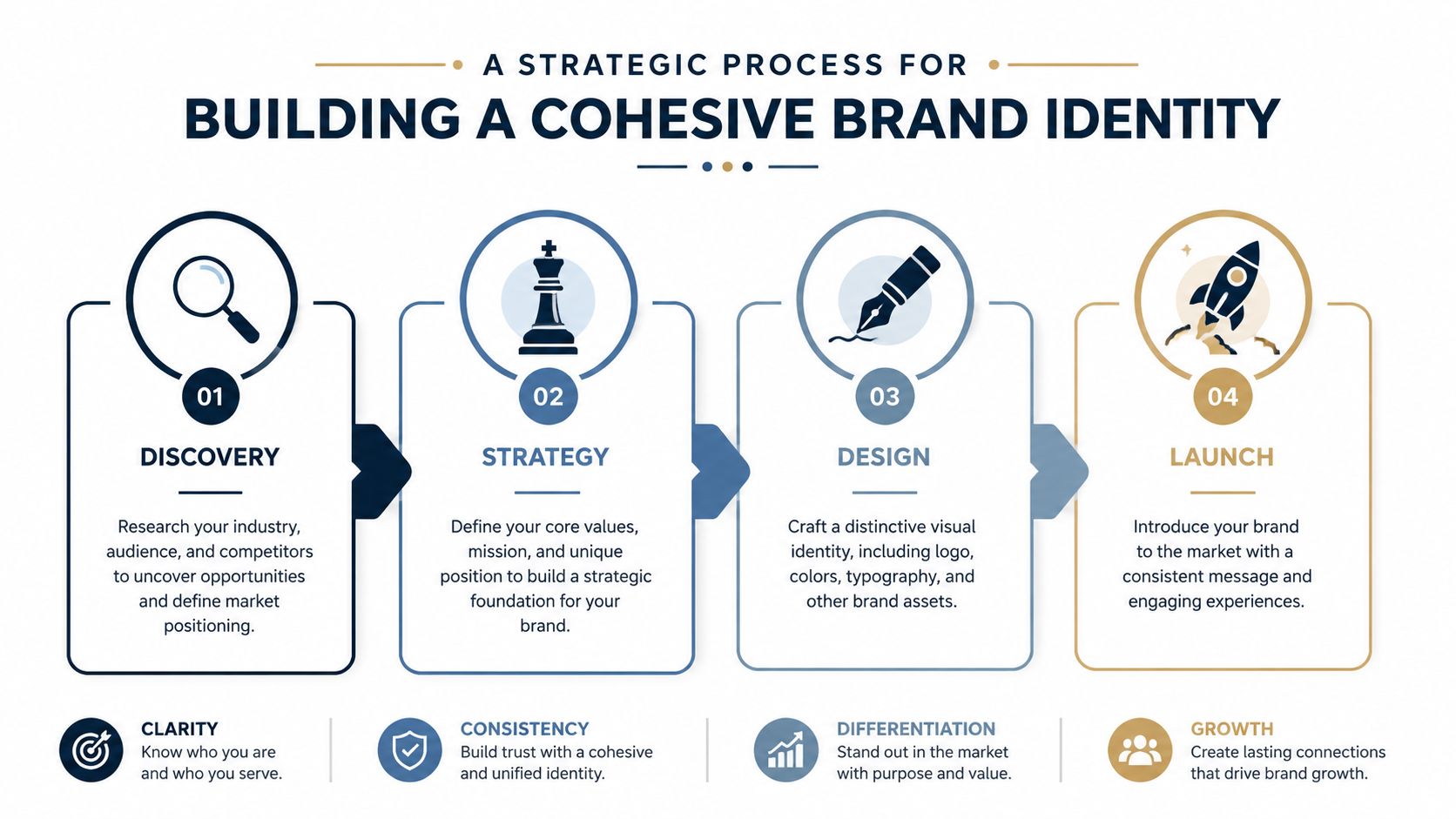
Research and discovery
This stage decides whether the brand will hold up in the market or just look polished in a presentation.
Start with the commercial basics. Who are you trying to attract? What are those customers comparing you against? What do they need to believe before they call, book, or request a quote? For an Australian SMB, that research should include search behaviour as well as competitor visuals. If people first find you through suburb-based searches, map listings, or AI-generated answers, your identity needs to read clearly in small formats and make sense without a long explanation.
That changes design decisions. A restaurant mark that looks stylish on a menu cover can fail badly as a tiny booking-platform icon. A trade logo with too much detail can turn to mush on a ute door, in a Google profile image, or in an AI search citation where only the business name and a small visual cue appear. Good research catches those problems before money gets spent on rollout.
The practical work usually includes reviewing your existing assets, checking direct local competitors, mapping service priorities, and collecting the actual words customers use in reviews, enquiries, and phone calls. Those phrases often help shape both the messaging and the metadata around the brand, which matters for local SEO and discoverability.
Brand positioning
Once the facts are clear, the brand needs a position that people can understand quickly.
That means defining the promise and the tone in plain language. A business owner should be able to answer a few hard questions without drifting into slogans:
- Why choose you over another nearby option?
- What should customers remember after a quick glance at your website or listing?
- What attributes matter most in your category, trust, speed, warmth, expertise, quality, value, or convenience?
- What should your business never sound or look like?
Many projects go off course at this stage. Owners try to appeal to everyone, so the brand ends up broad, safe, and forgettable. In practice, the sharper option usually performs better. A family-run motel does not need to look like a luxury resort. It needs to look clean, credible, easy to book, and true to the experience on arrival. A suburban electrician does not need edgy design. The brand needs to signal reliability, clarity, and response time.
Positioning also keeps internal decisions faster. Without it, every colour, font, headline, and photo choice becomes an argument about taste. With it, the business has a filter.
For a more detailed view of how those decisions connect to performance across channels, this guide to strategic brand identity design is a useful reference.
Visual and verbal identity
Once the position is set, the identity system can be built with some discipline.
The visual side usually includes a primary logo, simplified versions, colour rules, type choices, image direction, and supporting elements such as icons or patterns. The practical requirement is flexibility. The brand has to work on a phone screen, a shop sign, a vehicle, a PDF quote, and a social profile image without changing personality every time.
That is why file setup matters so much. A business needs vector master files, controlled logo variations, readable type choices, and usage rules that stop suppliers from improvising. I have seen good small businesses lose consistency because they only had one low-resolution PNG from an old designer. The first embroidery job looks wrong, the signage supplier redraws the logo, and the website developer picks a different colour because there was no reference file. Small technical misses create visible trust issues.
The verbal identity carries the same weight. Taglines, service descriptions, page titles, quote emails, menu copy, and social captions all shape how the brand is understood. If the visual identity says premium and the writing sounds generic, the business feels uneven. If the visuals feel friendly but the booking flow reads cold, conversion suffers.
There is a strong hospitality example in the MAJC interview with Katie Flannery, which shows how trust is built through naming, story, design, and repeated customer contact rather than logo styling alone.
Rollout and governance
A brand only becomes cohesive when it is applied the same way across the places customers see.
For Australian SMBs, that usually means prioritising the channels that affect discovery first. Website headers and service pages matter. So do Google Business Profile images, social avatars, map listings, review platform branding, and directory consistency. If your business looks one way on the website, another on Instagram, and another on local listings, it creates friction. That weakens recall and can reduce click confidence on mobile.
A sensible rollout plan covers four areas:
-
Website and search assets
Update logos, favicons, page templates, service imagery, schema-linked business details, and on-page copy so the brand and search presence match. -
Local visibility platforms
Refresh Google Business Profile, Apple Maps, booking platforms, directories, and social profiles with the same naming, imagery, and positioning cues. -
Physical customer touchpoints
Apply the identity to signage, menus, uniforms, packaging, brochures, quote folders, and vehicle graphics. -
Usage rules
Create a short brand guide for staff, printers, signwriters, web developers, and marketing suppliers so the identity stays consistent over time.
That governance piece is often overlooked. A builder would not hand four subcontractors different measurements and hope the kitchen fits. Branding works the same way. Clear specifications protect quality.
This is also the point where provider choice matters. Some businesses use a freelance designer. Some use an in-house marketer. Some use an agency that handles branding, web, SEO, and content together. Titan Blue Australia is one option in that mix, offering branding alongside web and search services, which can help when the rollout needs to support discoverability as well as presentation.
Real-World Branding Examples for Australian SMBs
Brand strategy can sound abstract until you see how it changes decisions in a real business. These examples are hypothetical, but they reflect the kinds of branding problems Australian SMBs deal with every week.

A Gold Coast restaurant trying to look worth booking
A new boutique restaurant opens in a busy coastal strip. The food is good, the fit-out is smart, but the original branding feels generic. The logo uses a script font that looks fine on the website banner but becomes hard to read in booking platforms, map listings, and social icons.
The owners shift the identity toward something more structured. They keep the atmosphere warm, but the logo becomes cleaner and easier to read at a glance. The colour palette moves from trendy pastels to a tighter set of tones that work in menus, signage, and digital ads. The copy also changes. Instead of broad lifestyle language, the venue starts describing the experience more clearly.
That branding choice doesn't change the food. It changes the perceived confidence of the business. The restaurant now looks like it knows exactly what kind of night out it's offering.
In hospitality, customers often decide whether a venue feels right before they read a full menu. Branding shapes that instinct.
A Sydney plumbing company moving beyond the cheap-and-fast look
A plumbing business has grown through referrals, but its visual identity still looks like a one-person startup from years ago. The logo is detailed, the van graphics are cluttered, and the website doesn't match the paperwork. Homeowners may tolerate that. Larger property managers and commercial clients often won't.
The rebrand starts with positioning. The business isn't trying to be the cheapest. It wants to look reliable, capable, and easy to deal with. That leads to a more direct name treatment, stronger typography, fewer graphic elements, and a colour scheme that reads clean rather than loud.
The payoff is practical. Quotes look more professional. Vehicle branding becomes readable from a distance. Staff uniforms look part of one operation. The website and Google profile finally look like the same business.
If you want to see how varied branding applications can look across industries, browse recent brand and design portfolio examples.
A short visual explainer can help make these differences easier to spot in the wild:
A regional Victorian motel using warmth instead of slickness
A family-owned motel doesn't need a polished city-hotel identity. In fact, that would probably hurt it. Its edge is familiarity, friendliness, and local character.
The branding work focuses on making that feel organised rather than old-fashioned. The owners keep the warm tone, but replace the dated clip-art style logo with a simpler mark and more legible type. Photography shifts toward honest, welcoming imagery rather than over-staged stock visuals. The website copy leans into local recommendations, easy stays, and personal service.
This is a good reminder that effective branding isn't about making every business look premium. It's about making the right promise clearly. For this motel, the right promise is comfort and sincerity, not luxury.
DIY Branding vs Hiring a Professional Agency
A café owner can get away with a temporary menu printed at Officeworks for a weekend special. They would not build their permanent street sign that way. Branding decisions work the same way. Some are placeholders. Some need to carry the business for years across search, signage, uniforms, vehicles, packaging, and mobile screens.
DIY branding has a place. It suits a new sole trader, a side business testing demand, or a service business that needs to get online fast with a basic presence and a tight budget. In that situation, speed matters more than polish, and a simple identity is often enough to start quoting, set up a Google Business Profile, and look consistent across the first few customer touchpoints.
DIY works best when the scope stays tight:
- Use a clear wordmark: Business name plus strong typography usually performs better than a rushed symbol.
- Pick one font system: One primary typeface and one supporting typeface is enough.
- Keep the palette restrained: Fewer colours means fewer mistakes across print and digital use.
- Test the brand in real places: Website header, Google profile image, social avatar, invoice, van door, staff shirt, and signage matter more than a polished mockup on a black background.
The usual problem is not taste. It is execution. Owners often create one logo file and assume the job is done. Then the printer asks for vector artwork, the signwriter needs a clean one-colour version, the web developer needs an SVG, and the social profile crops the mark into a blur. What looked cheap but acceptable at the start turns into rework, delays, and extra cost.
Professional help becomes the better option when the business is more visible, more complex, or planning to grow. A restaurant group with multiple venues, a trade business with several vans, or a medical clinic with multiple practitioners has more at stake than a simple launch mark. The identity has to hold together across local listings, directional signage, booking platforms, ads, email signatures, staff uniforms, and mobile search results.
That is where experienced agencies earn their fee. They do more than draw a nicer logo.
-
They bring outside judgment. Owners are close to the business. A strategist can spot whether the brand reads as premium, budget, dated, corporate, friendly, or inconsistent before customers make that call for you.
-
They build usable assets. That includes master files, scaled variants, colour controls, typography rules, and practical guidelines your printer, signwriter, web developer, and internal team can actually use.
-
They protect business clarity. Good branding work stops the process from turning into a debate about personal preference. It keeps the focus on the customer, the market, and how the business is found and remembered online.
For Australian SMBs, that digital side matters more every year. A technically sound identity improves consistency across your website, business listings, social profiles, and map-based discovery. It also helps your brand stay recognisable in small spaces, which affects mobile click-through, local search visibility, and how your business appears in AI-generated search summaries.
The practical question is simple. Are you creating a short-term placeholder, or building an identity that needs to perform across every customer touchpoint?
If you are weighing cost against long-term value, this guide on how to choose the right branding agency for your business gives a sensible framework for making that call.
Choose based on workload, visibility, and growth plans. A DIY logo can get a business started. A professionally built brand usually saves money once the business has to scale, compete locally, and stay consistent everywhere customers find it.
Future-Proofing Your Brand for AI and Digital Search
The old test for a logo was whether it looked good on a business card and a sign. That's no longer enough.
Today, many first impressions happen in compressed digital spaces. Your logo may appear as a tiny social avatar, a map pin, a search result thumbnail, or a small image attached to an AI-generated answer. If the mark depends on fine detail, multiple colours, or intricate linework, it can fall apart quickly.

Design for recognition under compression
Most branding advice still leans heavily on aesthetics. It spends plenty of time on style and not enough on performance at small sizes. Yet one of the most useful operational questions is also the simplest: will the logo still be recognisable when it's reduced to a tiny avatar, map pin, or AI-search card?
That issue is especially relevant for local Australian businesses because mobile-first discovery is normal. Customers often encounter the brand before they ever visit the website. This article on logo shape and small-scale recognition highlights that gap well, pointing out that branding guidance often overlooks legibility in these compressed environments.
What holds up better
In practice, the brands that hold up best in digital search usually share a few traits:
- Simple silhouettes: Shapes stay recognisable when details disappear.
- Clear wordmarks: If the name is part of the logo, the type must remain readable.
- Controlled variants: One version for full use, another for tiny applications.
- Consistent deployment: The same mark appears across profile images, site assets, and listings.
Logo design and branding now intersect directly with search visibility. Search engines and AI systems don't experience your business as one polished brand board. They encounter scattered signals across websites, local listings, social profiles, and external mentions. A clear, repeatable visual identity helps those signals line up.
If you're thinking about discoverability beyond traditional SEO, this guide to generative engine optimisation in Australia gives useful context on how AI search changes what “being found” looks like.
A logo doesn't need to be futuristic to be future-proof. It needs to be clear, adaptable, and easy to recognise wherever digital platforms shrink it.
Your Actionable Checklist for Getting Started
Most branding problems don't begin with bad taste. They begin with rushed decisions, inconsistent use, and no system behind the visuals. Start by tightening the basics before you chase a dramatic redesign.
Use this checklist to get moving:
- Define your ideal customer: Write three plain-English sentences about who you want more of.
- Choose your core associations: List three words you want customers to connect with your business.
- Audit your current touchpoints: Review your website, Google profile, social pages, signage, uniforms, quotes, and printed materials.
- Check logo performance at small size: Shrink it down to favicon and profile-image size. If it turns to mush, that's a problem.
- Gather reference examples: Save examples of brands you admire and ones you dislike, then note why.
- Ask for the right files: If you already have a logo, confirm whether you have vector master files and usable variants.
- Test physical production needs: If your brand will go on caps, polos, or workwear, check the hat embroidery file guide so you understand how simplified artwork affects stitch quality.
- Book one focused review session: Spend an hour with your team identifying the biggest mismatch between how the business performs and how it currently looks.
Branding works best when it becomes operational, not theoretical.
If your business needs a clearer identity that works across website design, local search, social channels, and emerging AI discovery, Titan Blue Australia can help align the brand system with the digital channels where customers find you.
Make Titan Blue a preferred source in Google
One click tells Google to surface our articles more often in Top Stories, AI Overviews and AI Mode.

Best Dental Website Design Agencies in Australia: 7 Compared
Best dental website design agencies in Australia 2026: seven compared on dental proof, booking, AHPRA…

Childcare Centre Website Design Australia: The 2026 Guide
Childcare centre website design Australia: show hours, ages and enrolment as text so parents and…

Electrician Website Design Australia: The 2026 Guide
Electrician website design Australia: what to build, what we found on eight Gold Coast electrician…