Effective Marketing for NDIS Providers in Australia
Effective marketing for an NDIS provider isn't about flashy sales pitches or clever slogans. It’s built on a solid foundation of trust, genuine care, and absolute compliance with the rules. This means crafting honest, empowering messages that always respect a participant's dignity and stick to the NDIS Commission's guidelines.
Getting these ethical cornerstones right is the key to building a sustainable reputation that truly resonates with participants, their families, and Support Coordinators.
Building a Compliant and Ethical Marketing Foundation
Marketing in the NDIS space plays by a different set of rules. Here, ethics and compliance aren’t just best practices—they are non-negotiable requirements for long-term success. Unlike selling a product in a store, your marketing efforts directly impact the wellbeing and choices of individuals who may be in vulnerable situations.
Because of this, every single piece of content you create, from a website page to a social media post, must be filtered through the lens of the NDIS Code of Conduct.
This forces you to move beyond simply listing your services. Your messaging has to be crystal clear, truthful, and completely free from any misleading claims. For instance, a vague promise like "the best possible outcomes" is a no-go. A compliant and much more helpful message would be, "We provide evidence-based therapy to help participants work towards their specific NDIS goals." It's specific, honest, and manageable.
Upholding Participant Dignity and Consent
Sharing participant stories or testimonials is one of the most powerful ways to show your impact, but it’s also one of the most sensitive areas. You have to handle this with the utmost care, and informed consent is the non-negotiable first step.
This isn’t just a simple "yes." Proper consent must be:
Voluntary: The participant can never feel pressured or obligated to share their story.
Specific: The consent form needs to state exactly where and how their story, name, or image will be used (e.g., on the website's homepage, in a specific social media campaign for May).
Informed: The participant has to fully understand what they are agreeing to, and it all needs to be documented in writing.
Revocable: Participants must be told they can withdraw their consent at any time, and you need a process in place to honour that request immediately.
Understanding data privacy regulations is also a crucial piece of the puzzle. Rules like GDPR email compliance have set a global standard for protecting personal information, and the principles apply here.
The core principle is simple: prioritise the participant's dignity and privacy above any marketing objective. Their story is a gift, not a commodity.
Avoiding False or Misleading Claims
The NDIS Commission is very clear about prohibiting any marketing that could mislead or exploit participants. This includes making guarantees about outcomes or using language that creates unrealistic expectations. Every claim you make about your service must be accurate and, where possible, backed by evidence.
For any NDIS provider looking to grow, partnering with an NDIS digital marketing agency can be invaluable in making sure your messaging is both effective and compliant.
As a rule of thumb, stay away from statements that:
Guarantee specific results or "cures."
Claim superiority over other providers without objective proof.
Use industry jargon or complex language that a participant might not easily understand.
When you root your marketing in transparency and respect, you’re doing more than just avoiding penalties. You’re building the most valuable asset any NDIS provider can have: a rock-solid reputation for trustworthiness and integrity.
Defining Your Unique Value in a Crowded Market
The NDIS landscape is getting busier by the day. Standing out and catching the eye of participants and Support Coordinators is tougher than ever. Just being a registered provider isn't the golden ticket it once was. To really make an impact, you need to be crystal clear on what makes your service different—and genuinely valuable.
This whole process kicks off with a good, honest look in the mirror. What's the absolute core strength of your organisation? Maybe you have a deep specialisation in psychosocial support, or perhaps you've pioneered an innovative approach to paediatric therapy. It could even be an unmatched system for tracking and reporting on participant goals. Your unique value isn't just what you do; it's how you do it better or differently for a specific group of people.
So many providers fall into the trap of trying to be everything to everyone. It's a classic mistake. This jack-of-all-trades approach just waters down your message until it doesn't really connect with anyone. Pinpointing your niche is the real first step to effective marketing.
Uncovering Your Core Strengths
To find your unique spot in the market, you need to ask some pretty fundamental questions about your service. Don't rush this part. The answers you come up with will be the bedrock of your brand and every marketing move you make from here on out.
Think about these key areas:
Specialised Expertise: Do you have team members with advanced certifications in specific therapies like early childhood intervention or complex behavioural support? This is gold.
Service Delivery Model: Is your approach truly participant-led in a way that stands out? Maybe you offer incredible flexibility with scheduling or use a unique co-design process for support plans.
Participant Outcomes: Can you point to a solid track record of helping participants smash specific, meaningful goals? Tangible results are one of the most powerful differentiators you can have.
Community Connection: Are you deeply embedded in a particular local or cultural community? This offers a level of understanding and trust that bigger, more generic providers just can't replicate.
Getting clear on these points helps you move from generic fluff like "we provide quality care" to a powerful, specific message. Think: "We provide culturally-sensitive in-home support for elderly participants from Vietnamese backgrounds, delivered by bilingual support workers." Now that gets noticed.
Crafting a Compelling Value Proposition
Once you've nailed down your strengths, it's time to bundle them into a clear and compelling value proposition. This is a short, punchy statement that instantly tells a potential participant, family member, or Support Coordinator exactly why they should choose you over anyone else.
A strong value proposition should answer three key questions from the participant's perspective: What do you offer? Who is it for? And why are you the best choice for them?
It’s the promise of value you’re going to deliver. For instance, a provider specialising in assistive technology might have a value proposition like: "We empower NDIS participants with complex physical disabilities to achieve greater independence by providing expert assessments and customised assistive technology solutions, supported by ongoing training."
This kind of clarity is absolutely essential. The NDIS Providers industry in Australia is booming, with revenue growing at an annualised rate of 9.3% over the last five years to hit a market size of $45.0 billion. As this growth continues, providers focusing on specific needs like autism and psychosocial disability are the ones finding real success.
Analysing the Market to Find Your Place
Of course, understanding your own strengths is only half the battle. You also need to get a handle on the market you're operating in to spot service gaps and opportunities. A simple market analysis doesn't have to be a huge, complicated project.
Start by identifying other providers in your local area who offer similar services. Jump on their websites and social media pages and see how they talk about themselves. You can get some incredible insights with a basic competitive analysis template.
Take note of their messaging, the types of participants they seem to be targeting, and any unique features they’re promoting. The point here isn't to copy them—it's to find the empty space where your unique strengths can shine. If every other provider is focused on services for children, maybe your expertise with young adults is the gap you can fill. By positioning your brand where it’s needed most, you’ll build a genuine connection that attracts the right clients without having to shout the loudest.
Crafting a Website That Works as Hard as You Do
Your website is your digital front door. For many participants, families, and Support Coordinators, it’s the very first time they’ll interact with your organisation. Get it wrong, and you can lose trust in an instant. Get it right, and your website becomes your hardest-working team member, attracting and connecting with clients 24/7.
This is more than just an online brochure. A truly effective NDIS website is built from the ground up with the user in mind. It needs to be simple to navigate, provide clear answers, and be accessible to people of all abilities. These aren't just 'nice-to-haves'—they're non-negotiable for building credibility in the NDIS space.
From the second a visitor lands on your homepage, they should know exactly who you are, what you do, and who you support. That means clear, jargon-free language and an intuitive layout that guides people to the information they need without any frustration.
The Cornerstones of an NDIS Website That Converts
Building a website for the NDIS community means focusing on clarity, trust, and accessibility. Think of it as a digital extension of the support you provide—it must be welcoming, helpful, and easy to engage with. A great NDIS provider website nails a few key things that all work together to create a positive experience.
Here’s what you absolutely need to get right:
Simple Navigation & Clear Service Pages: People need to find what they're looking for fast. Organise your services logically (maybe by support type or age group) and give each one its own dedicated page. Detail exactly what's involved so potential clients can see how you'll help them achieve their goals.
A Mobile-First Design: Let's be real—a huge number of users, especially busy family members and Support Coordinators, will be looking you up on their phones. Your site has to be fully responsive, meaning it looks and works perfectly on any device, from a big desktop monitor down to a small smartphone.
Accessibility (WCAG Compliance): This is both a critical and ethical must-do. Your website has to be usable by people with disabilities, including those who rely on screen readers or other assistive tech. Following the Web Content Accessibility Guidelines (WCAG) ensures everyone can access your information.
Clear Calls-to-Action (CTAs): Don't leave visitors wondering what to do next. Use obvious, prominent buttons and links like "Contact Us for a Free Consultation" or "Download Our Service Guide" to guide them on their journey.
If you want to go deeper into the technical side of things, our guide on NDIS website development is a great resource. It walks through the specific design and tech elements you need for a powerful online presence.
SEO for NDIS Providers: Getting Found by the Right People
Having a brilliant website is one thing, but people need to actually find it. That's where Search Engine Optimisation (SEO) comes in. SEO is all about fine-tuning your website so it ranks higher in Google for the phrases your ideal clients are searching for every day.
Being visible at the exact moment someone needs support is what it's all about. Think like a parent or a Support Coordinator. They're not typing in clinical terms.
They’re searching for things like:
"NDIS speech therapy for kids near me"
"psychosocial support Gold Coast"
"autism support services Brisbane"
"help with NDIS plan management"
Your mission is to make sure your website pops up for these kinds of searches. You do this by creating high-quality, genuinely helpful content on your service pages and blog that naturally includes these phrases.
A quick SEO tip: Before you upload images, rename the files with descriptive keywords. Instead of "IMG_4052.jpg," call it something like "NDIS-occupational-therapy-for-children-melbourne.jpg." It’s a small tweak that helps Google understand what your content is about.
Master Local Search with Your Google Business Profile
For most NDIS providers, your clients are in your local community. This makes Local SEO one of the most powerful tools you have. The absolute cornerstone of local SEO is your Google Business Profile (GBP). It's a free tool that lets you manage how your organisation shows up on Google Search and Maps.
When someone searches for "NDIS provider near me," a well-managed GBP gives you the best shot at appearing in that coveted "map pack" at the top of the search results.
A complete and active profile sends strong trust signals to both Google and potential clients. It makes you look professional, established, and ready to help. This isn't a "set it and forget it" task—consistently managing your profile is an ongoing marketing activity that pays off by connecting you directly with local people looking for the exact services you offer.
Activating Your Digital Marketing to Reach Participants
Having a fantastic, user-friendly website is a great start, but honestly, it's only half the journey. The next critical step is actively guiding participants, their families, and Support Coordinators to your digital doorstep. This is where a focused digital marketing strategy turns your online presence from a static brochure into a powerful engine for connection and growth.
This means you’ve got to move beyond just having a website and start using the digital channels where your community actually spends its time. A well-rounded approach ensures you’re visible not just when someone is actively searching for your services, but also when they're looking for advice, community, and reliable information.
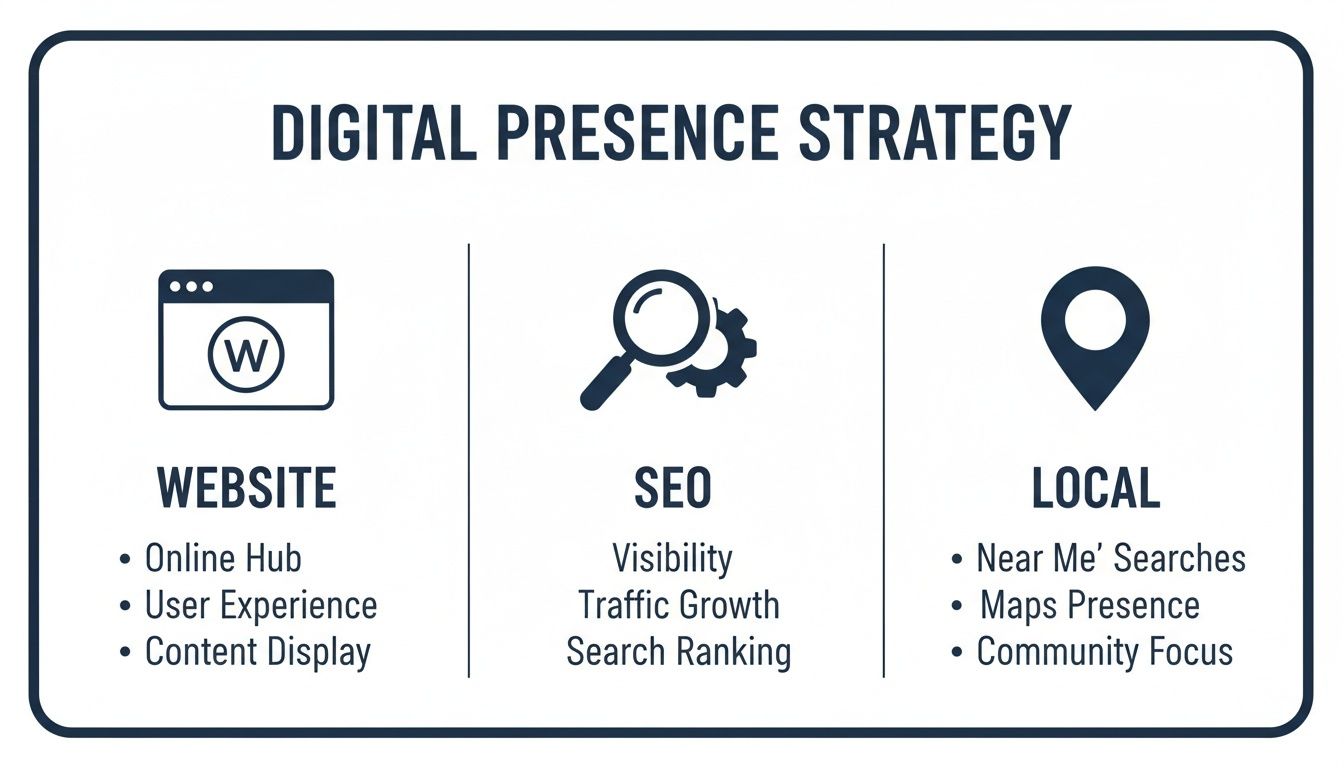
The infographic below breaks down the core digital pillars—your Website, SEO, and Local presence—that all work together to build this visibility.
As you can see, a strong website is amplified by SEO to attract broader search traffic, while a solid local strategy helps you capture high-intent users right in your immediate service area.
Building Community and Trust on Social Media
Social media, particularly platforms like Facebook, offers a unique opportunity for NDIS providers that many miss. The goal isn't just self-promotion; it’s about building a genuine, supportive community. Think of it as your digital community centre—a place to share valuable resources, answer questions, and foster real connections.
A great tactic is creating a private Facebook Group for current participants and their families. It's a powerful way to build loyalty and share important updates in a safe space. For your public-facing page, focus on content that helps, not just sells. Share links to accessible community events, explain confusing NDIS jargon in simple terms, or post short videos showcasing your facilities.
The most effective social media marketing for NDIS providers is rooted in generosity. When you consistently provide value without asking for anything in return, you build the trust that precedes a participant choosing your services.
Reaching High-Intent Users with Paid Search
While building an organic presence takes time, sometimes you need to connect with people who are looking for support right now. This is where targeted paid search campaigns, like Google Ads, come into play. Paid search lets you place your website right at the top of the search results for specific keywords in a defined geographic area.
For example, you could run an ad that only shows to people within a 15-kilometre radius of your office who search for "paediatric occupational therapy." This kind of precision makes your marketing spend incredibly efficient because you're only paying to reach individuals who have already signalled a clear need for your exact services.
The key is to start with a small, manageable budget and focus on a handful of core service keywords to test what works before scaling up.
Establishing Expertise with Content Marketing
Content marketing is the art of demonstrating your expertise and building authority by creating and sharing genuinely helpful information. For marketing for NDIS providers, this is easily one of the most powerful strategies you can use. A regularly updated blog should be the cornerstone of this approach.
Here’s how different content formats can help you hit your goals:
Actionable Blog Posts: Write articles that answer the real-world questions your audience is asking. Think about topics like "How to Prepare for Your NDIS Plan Review Meeting" or "5 Activities to Support Fine Motor Skill Development at Home." This kind of content provides immense value and positions you as a trusted expert. For a deeper dive, you can learn more about how strategic NDIS SEO services leverage content.
Downloadable Guides: Create in-depth resources, like a PDF checklist for choosing a Support Coordinator or a guide to accessing community transport. These are excellent for capturing email addresses, letting you build a direct line of communication with potential clients.
Video Content: Short, informative videos are incredibly engaging and easy to digest. You could film a virtual tour of your facility or have a therapist explain a specific support service in simple, accessible terms.
Simply hoping people will find you isn't a viable option in the current climate. The financial health of NDIS providers shows a challenging landscape where nearly half of all providers reported financial losses. With 21,734 providers competing for visibility, a proactive digital strategy is essential for sustainability and growth. You can discover more insights about the state of the disability sector in the latest report from National Disability Services.
Building Referral Networks and Community Partnerships
While a strong digital presence is a must-have, the real heart of the NDIS sector beats through genuine human connection. In a world full of clicks and search results, nothing beats the power of a trusted, word-of-mouth referral.
Building strong referral networks isn’t just another marketing tactic; it’s a foundational pillar for any NDIS provider looking for sustainable growth.
These relationships are your direct line to the key decision-makers in a participant's journey. We’re talking about the Support Coordinators navigating complex plans, the allied health professionals providing crucial therapies, and the Local Area Coordinators (LACs) who are often the very first point of contact. Earning their trust is everything.
This isn’t about flashy sales pitches or dropping off a stack of brochures. It’s about proving your value, your reliability, and your genuine commitment to participant outcomes, day in and day out.
Connecting with Key NDIS Stakeholders
To build a referral network that actually works, you need to get inside the heads of your key stakeholders. What do Support Coordinators, allied health professionals, and LACs really need from a provider to feel confident sending someone your way?
They're looking for partners who make their jobs easier and, most importantly, deliver exceptional outcomes for the people they support.
They need providers who are:
Responsive: Do you pick up the phone? Do you reply to emails promptly? Quick, clear communication is often the #1 factor they consider.
Reliable: Do you consistently do what you say you’ll do? A solid track record of dependability is your most valuable asset.
Transparent: Are you upfront about your capacity, waitlists, and reporting? Nobody likes unpleasant surprises.
The goal is to become the go-to provider they think of first because they know you are a safe and reliable pair of hands. Your reputation for quality and communication is your best marketing tool.
A great first step is to simply identify and connect with these professionals in your local area. Get out there and attend local disability expos, join the right professional groups on LinkedIn, and make a genuine effort to introduce yourself and what you do—without an immediate 'ask'.
What a Confident Referral Really Requires
Support Coordinators, in particular, are under huge pressure to connect participants with the best possible services. To earn their referrals, you need to give them the tools and information they need to do their job well. This means going way beyond a basic service list.
Think about putting together a dedicated "Referrer Pack" that includes:
A clear, one-page summary of your services, specialisations, and service areas.
Direct contact info for your intake or referrals manager.
Simple, step-by-step instructions on your referral process and typical wait times.
A few anonymised case studies or testimonials that show off your expertise.
By proactively giving them this information, you’re showing them you’re professional and that you understand their needs. You're making it incredibly easy for them to choose you.
Fostering Grassroots Community Engagement
Beyond the professional networks, embedding your organisation within the local community builds a level of trust and visibility you just can't buy. It's about being present, being helpful, and being generous with your knowledge.
Grassroots engagement shows you care about the community you serve, not just the clients you can sign up.
You can establish yourself as a trusted local resource through simple, high-impact activities. Host a free info session at the local library on a topic like "Navigating Your First NDIS Plan." Or, you could partner with a local community group or sports club to sponsor an inclusive event.
These actions do more than just generate leads. They position your organisation as an integral, committed part of the local support ecosystem, building goodwill that pays off for years. To really amplify this, consider implementing more structured programs. Learning about powerful referral marketing strategies can give you the framework to turn these community connections into a consistent stream of quality referrals.
Measuring Your Marketing and Planning for Growth
Effective marketing for NDIS providers isn’t about guesswork. It's about making smart decisions based on real data. If you're not measuring your efforts, you're essentially flying blind—spending time and money without knowing what’s actually connecting with participants and bringing in enquiries.
Tracking your performance is the only way to know what works, what doesn't, and where to put your energy for sustainable growth. This all starts by identifying the numbers that really matter to your organisation. Forget vanity metrics like social media likes; we need to focus on data that directly impacts your ability to support more participants.
Identifying Your Key Performance Indicators
Key Performance Indicators (KPIs) are the specific, measurable data points that tell you if your marketing is hitting the mark. For an NDIS provider, these have to be tied directly to acquiring and serving participants. Vague goals like "increase brand awareness" just don't cut it. You need tangible targets.
Here are the essential KPIs you should be looking at:
Website Conversion Rate: This is the percentage of your website visitors who take a meaningful action, like filling out an enquiry form or calling your office. If this number is low, it could be a sign that your messaging is unclear or your website is just too difficult to navigate.
Cost Per Acquisition (CPA): This is your total marketing spend divided by the number of new participants you’ve successfully onboarded. Knowing your CPA is crucial. It tells you the financial return on your marketing investment and helps you budget effectively for future growth.
Source of Enquiries: You absolutely need to track where your new leads are coming from. Are people finding you through a Google search? A referral from a Support Coordinator? A Facebook post? This data tells you which channels are your most valuable assets.
Local Search Ranking: For your core services, like "occupational therapy in [Your Suburb]," keep an eye on where you appear in Google's local map results. A jump in these rankings directly translates to more local visibility and more enquiries.
Using Data to Make Smarter Decisions
You don't need expensive software to get started. Free tools like Google Analytics are incredibly powerful for understanding how people find and interact with your website. You can see which pages are most popular, how long people stay on your site, and the exact search terms they used to find you. This data is your roadmap for improvement.
Let's say you notice a blog post on "navigating an NDIS plan review" is getting a ton of traffic. That’s a massive clue! It's a clear pain point for your audience. By creating more content around that topic, you build trust and position yourself as the go-to expert.
If you're struggling to pull all this information together in a way that makes sense, our marketing report template can give you a clear and simple framework.
Don’t get bogged down by all the data out there. Just start by tracking two or three core KPIs consistently. The goal is to spot trends and make one small, informed improvement to your marketing each month. It's about progress, not perfection.
Creating a Simple 90-Day Action Plan
Once you have some data, you can stop reacting and start being proactive. A 90-day action plan is a fantastic way to break down your bigger goals into manageable, quarterly sprints. It keeps your team focused and ensures you're always moving forward.
Your plan doesn't need to be some complex, 20-page document. It could be as straightforward as this:
Month 1: Go all-in on the Google Business Profile. Add new photos, update all service descriptions, and start actively requesting reviews.
Month 2: Look at the top questions from recent participant enquiries. Write and publish two practical blog posts that answer them directly.
Month 3: Create an updated referrer information pack and personally reach out to five local Support Coordinators to introduce your services.
This simple, iterative cycle—measure, learn, plan, act—is the engine of successful NDIS marketing. It transforms your marketing from a business expense into a strategic investment that genuinely fuels your mission to support the community.
Your Top NDIS Marketing Questions Answered
When it comes to marketing in the NDIS space, a lot of questions pop up around the rules, best practices, and where to even begin. We hear them all the time from providers who want to grow their services the right way. Let's clear up a few of the most common ones.
How Much Should an NDIS Provider Budget for Marketing?
This is the million-dollar question, isn't it? While a common benchmark you'll hear is 5-10% of your annual revenue, that figure doesn't always tell the whole story.
A brand-new provider trying to get their name out there will naturally need to invest a bit more upfront to build that initial presence. Instead of getting stuck on a percentage, I always advise clients to work backwards from their goals. Do you want to bring on 10 new participants this quarter? Great. Now, let's figure out which channels will get you there and budget accordingly. Your first priorities should always be the foundational stuff, like a professional website and solid local SEO.
Can I Use Testimonials from NDIS Participants?
Yes, you can, but this is an area where you need to tread very, very carefully and follow the NDIS Commission's rules to the letter.
You absolutely must have explicit, written, and informed consent that clearly spells out exactly how and where their story will be used. This has to be completely voluntary and truthful. The participant's dignity and privacy are non-negotiable. Under no circumstances should anyone ever feel pressured or obligated to share their experience.
A key takeaway is that consent is everything. Make sure it's clear, documented, and given without any pressure. When in doubt, prioritise the participant's privacy.
What Is the Most Important First Marketing Step for a New Provider?
For a new provider operating locally, the single most powerful thing you can do is claim and fully deck out your Google Business Profile (GBP). Seriously, don't skip this.
This free tool is the absolute cornerstone of local search. Think about it: when a support coordinator or family member searches for "NDIS providers near me," a well-managed GBP is what gets you on that map. It showcases your reviews, photos, and services, and gives potential clients instant access to your contact details right when they need them most. Before you spend a dollar on ads, make sure your GBP is perfect.
Titan Blue is your go-to digital partner for smart, results-driven solutions. We blend strategy, creativity and tech to grow your brand and get real results fast.