Marketing Law Firms: Grow Your Practice with Proven Strategies
Effective marketing for a law firm isn’t about just one thing; it’s a strategic, multi-channel approach laser-focused on building trust and authority. It all starts with defining your ideal client and brand position. From there, you build a high-performance website optimised for both local and technical SEO, and then establish your expertise through targeted content.
This foundational work is what ensures your firm attracts high-value cases, not just random website traffic.
Defining Your Firm’s Path to Client Acquisition
The most common mistake I see law firms make is jumping straight into tactics like paid ads or social media without a concrete plan. Real success starts with the groundwork: understanding exactly who you want to represent and how your firm is uniquely positioned to help them.
This isn’t about casting a wide net. It’s about creating a magnetic pull for the right clients.
This initial phase is the difference between a marketing budget that generates a trickle of low-quality enquiries and one that becomes a reliable engine for practice growth.
Pinpoint Your Ideal High-Value Client
Before you can attract the right clients, you have to define them with absolute precision. "Anyone who needs a lawyer" is not a marketing strategy. It’s a recipe for wasting money.
Instead, think about the most profitable and fulfilling cases your firm has handled.
Consider these factors to build a crystal-clear client profile:
Practice Area Focus: Are you targeting complex commercial litigation or straightforward residential conveyancing? The client's mindset, budget, and legal needs couldn't be more different.
Demographics and Psychographics: Go way beyond just age and income. What are their real pain points? A business owner facing a messy shareholder dispute has entirely different concerns than a parent navigating a difficult custody battle.
Financial Viability: You need to identify the case value that makes a client profitable for your firm. This simple step helps focus your efforts on attracting people who can actually afford your services and whose cases align with your business goals.
Analyse the Competitive Landscape
Understanding what other local firms are doing is crucial for carving out your unique space in the market. This doesn't require expensive software, just some keen observation.
Start by searching for your primary legal services in your city. Whose websites consistently pop up at the top? Take note of their messaging, the practice areas they highlight, and the types of clients they seem to be chasing.
Are they all fighting to be the biggest, most aggressive firm in town? Maybe there’s a gap for a firm that positions itself as collaborative and focused on mediation. This kind of analysis is where you find the opportunities.
When you're defining your firm's path, it’s also worth looking into how specialised service providers offer tailored industry-specific solutions for law firms and attorneys to sharpen their client acquisition strategies. Seeing what’s out there helps you spot market gaps you can fill.
Build a Brand That Resonates
Your brand is so much more than a logo—it's your firm's reputation and the promise you make to clients.
A strong brand message speaks directly to your ideal client's problems and positions your firm as the obvious solution. For instance, a family law firm might build its brand around empathy and child-focused outcomes, while a corporate firm might project an image of ruthless efficiency and deep industry knowledge.
This branding has to be consistent across every single touchpoint, from your website's homepage right down to your email signature. It’s this consistency that builds trust and makes your firm memorable when it matters most.
Developing a cohesive brand is a core part of any successful plan. You can learn more about how to pull all these pieces together by building a proper digital marketing strategy to guide your efforts.
Building a Digital Presence That Converts Visitors Into Clients
Let's be blunt: your firm's website is its digital front door and its number one sales tool. It's no longer just an online brochure. For most potential clients, it's the very first impression they'll have of your practice, and that first look is critical. A professional-looking site is just the price of entry these days; a website engineered to convert is what separates the thriving firms from everyone else.
This isn't about flashy design. It's about combining a seamless, stress-free user experience with the non-negotiable foundations of technical search engine optimisation (SEO). The goal is to build a digital presence that doesn't just attract visitors—it systematically turns them into qualified enquiries.
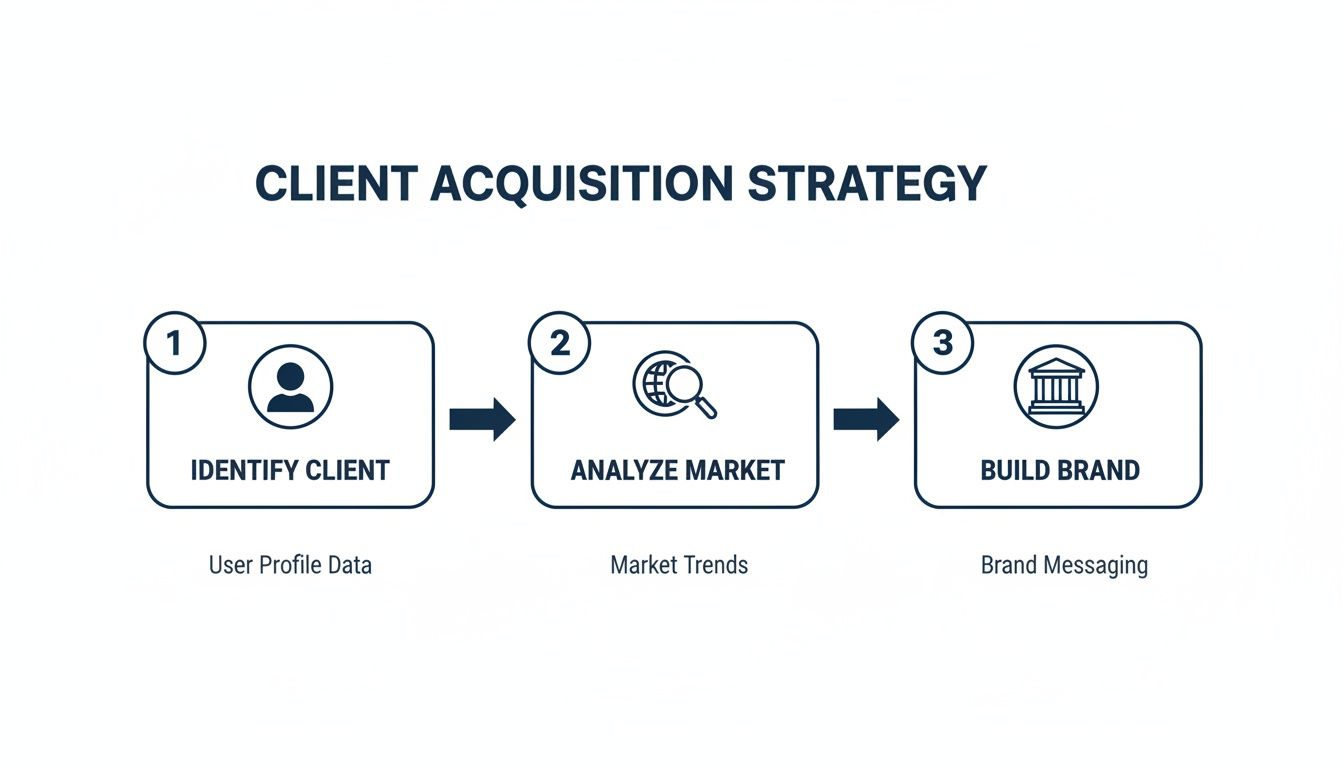
This simple flowchart breaks down the basic process behind a winning client acquisition strategy.
As you can see, building your brand and digital presence is the final piece of the puzzle. It only works after you've nailed down exactly who your ideal client is and what your market looks like.
Engineer Your Website for Trust and Conversion
A potential client usually lands on your website feeling stressed or uncertain. Your site's immediate job is to inspire confidence and make it dead simple for them to find what they need. If they have to hunt for a phone number or can't figure out your practice areas, they're gone.
Effective website design for law firms is about much more than just looking good. It’s about creating a clear, logical structure that guides visitors toward the next step, whether that’s filling out a contact form or calling your office. You can find out more about these crucial design principles in our detailed guide on custom website design for law firms.
Here are the core elements every high-converting legal website needs:
Clear Calls-to-Action (CTAs): Your phone number needs to be front and centre on every single page. Use strong, action-oriented buttons like "Request a Consultation" instead of passive ones like "Learn More."
Easy Navigation: Structure your site around your main practice areas. Someone looking for family law services shouldn't have to click through three different menus to get there.
Mobile-First Design: A huge chunk of your traffic will come from mobile phones. Your website must be flawless on a smaller screen—loading fast and looking professional, no excuses.
Master Technical SEO for Legal Queries
Technical SEO is all the work that happens behind the scenes to help search engines find, crawl, and understand your website. For law firms, this is make-or-break stuff. You’re competing in a crowded local market for some very valuable keywords.
One of the most important (and often ignored) factors is site speed. A slow-loading website is a massive turn-off for potential clients and a huge red flag for Google. Every second really does count.
Another key technical piece is schema markup. This is a special type of code you add to your site to give search engines more context about your content. For example, using "Attorney" or "LocalBusiness" schema helps Google pull your firm’s reviews, address, and hours directly into the search results, making your listing pop.
Dominate Local Search with Google Business Profile
For the vast majority of law firms, attracting local clients is the name of the game. Your Google Business Profile (GBP) is arguably your single most powerful tool for this. It's often the very first interaction a potential client has with your firm.
An optimised and active GBP can land your firm in the coveted "local pack"—those top map results that put you right in front of people actively searching for legal help in your suburb. This isn't just a "set it and forget it" task; you need to manage it actively.
It's important to remember that a well-managed Google Business Profile is no longer a passive business listing; it's an active client engagement platform. Consistent activity signals to both Google and potential clients that your firm is reputable, responsive, and ready to help.
To turn your GBP into a client-generation machine, focus on these actionable tactics:
Gather a Steady Stream of Reviews: Reviews are a massive local ranking factor. Set up a simple, proactive process to ask satisfied clients for their feedback. And just as importantly, respond to every single review—good or bad—to show you’re engaged.
Utilise GBP Posts: Share weekly updates, short articles, or firm news using the Posts feature. This keeps your profile fresh and gives you a chance to highlight specific practice areas or answer common questions.
Use the Q&A Feature: Don't wait for people to ask questions. Proactively populate the Questions & Answers section with the common queries you get during initial consultations, and then answer them yourself. This helps pre-qualify leads and showcases your expertise.
Upload Photos Regularly: Add high-quality photos of your office, your team, and the outside of your building. This builds familiarity and trust before a client even thinks about walking through your door.
Creating Content That Establishes Undeniable Authority
Your content is your first, best chance to prove your legal expertise, long before a potential client even thinks about picking up the phone. For law firms, effective content marketing isn't just about churning out generic blog posts. It's about building a strategic library of resources that cements your practice as the go-to authority in your field.
This means shifting your website's role from a simple digital brochure to an essential resource that answers the real, pressing questions your ideal clients are asking online. Get this right, and every article, guide, and FAQ page becomes a powerful, trust-building asset.
Transform Practice Area Pages into Conversion Assets
Let's be honest: apart from your homepage, your practice area pages are the most critical pages on your entire website. Yet, so many firms treat them like a sterile laundry list of services. This is a massive missed opportunity. A high-performing practice area page should do more than just state what you do; it should prove you’re the best at it.
So, instead of a dry, one-paragraph description of "Family Law Services," build a comprehensive resource. Think about the first five questions a potential client always asks during that initial consultation. Your page needs to answer them clearly and with genuine empathy.
A great practice area page doesn't just sell your services; it educates a potential client and calms their anxieties, making your firm the obvious choice for help. It should be the most helpful resource they find on the topic. This approach builds instant trust and helps pre-qualify your leads. A client who has already read your detailed guide on the conveyancing process in Queensland comes into the first conversation confident in your expertise.
Develop High-Value Lead Magnets
A lead magnet is a valuable resource you offer in exchange for an email address or other contact details. It's a cornerstone of ethical and effective marketing for law firms because the entire exchange is based on providing genuine value upfront.
These aren’t thinly veiled sales brochures. They are practical tools designed to help a potential client solve an immediate problem or better understand a complex situation they're facing.
Here are a few powerful lead magnet ideas that work well for law firms:
Checklists: Something like "The 10-Point Checklist for Preparing Your Will" is a highly practical and downloadable tool for anyone considering estate planning.
Detailed Guides: A downloadable PDF, such as "Navigating Commercial Lease Agreements in NSW: A Tenant's Guide", immediately positions you as a commercial law expert.
Case Study Summaries: An anonymised summary of a complex case you handled can be incredibly powerful. Explain the challenges, the strategy you deployed, and the successful outcome to demonstrate real-world experience.
Yes, creating these resources takes an upfront investment of time. But a well-crafted lead magnet can generate highly qualified leads for your firm for years to come.
Prepare Your Content for Answer Engine Optimisation (AEO)
The way people search for information is fundamentally changing. Traditional SEO was all about ranking a list of blue links on a results page. But with the rise of AI-powered tools like Google's Search Generative Experience (SGE), we need a new approach: Answer Engine Optimisation (AEO).
AEO is all about structuring your content so that AI models can easily understand it and feature it directly in the answers they generate for user questions. The goal is no longer just to rank your webpage; it's to have your firm’s expertise become the answer.
This means your content needs to be:
Clear and Concise: Use simple, direct language and short sentences. Avoid dense legalese wherever possible.
Well-Structured: Use clear headings (H2s, H3s) and bullet points. Break down complex legal topics into digestible, easy-to-scan chunks.
Authoritative: Google’s systems heavily prioritise content that demonstrates Experience, Expertise, Authoritativeness, and Trustworthiness (E-E-A-T), especially for critical "Your Money or Your Life" topics like law.
By optimising for AEO, you're future-proofing your content strategy. You’re ensuring your firm's insights remain visible not just in traditional search results, but within the AI-powered tools that your future clients will increasingly rely on for legal guidance.
Using Paid Ads to Generate Leads on Demand
While a solid SEO and content strategy builds your firm’s value for the long haul, paid advertising is the accelerator. It’s how you get immediate, targeted traffic from potential clients who have an urgent legal problem right now.
Pay-per-click (PPC) advertising, especially through platforms like Google Ads, puts your firm right at the top of the search results the second someone looks for a service you offer. It's a seriously powerful tool for generating qualified leads on demand.
But it demands a careful, strategic touch to avoid burning through your budget. This is especially true in the hyper-competitive world of legal keywords. Get it right, and it’s a direct pipeline to new cases. Get it wrong, and it’s a very expensive lesson.
Targeting Urgent Legal Needs with Keyword Research
The entire foundation of a winning PPC campaign is knowing exactly what your ideal clients are typing into Google when they’re in trouble. The aim is to go after high-intent keywords—phrases that signal someone is looking to hire a lawyer, not just browse for information.
A broad keyword like "family law," for instance, is not only expensive but attracts a very mixed crowd. Contrast that with a long-tail keyword like "emergency child custody lawyer brisbane." That search shows clear, immediate intent.
Your keyword research should zero in on:
Specific Practice Areas: Target phrases directly tied to your services, like "commercial litigation solicitor" or "conveyancing lawyer gold coast".
Location-Based Queries: Always include your city or state to capture local searchers ready to make a call. Think "criminal defence lawyer Sydney" instead of just "criminal defence lawyer".
Problem-Oriented Searches: Get in front of clients by targeting their pain points. People actively seeking legal help search for things like "unfair dismissal claim" or "dispute with business partner".
Crafting Ethical and Compelling Ad Copy
In the legal world, ad copy has to do more than just get clicks; it has to build trust while staying within strict advertising regulations. Your ads need to be both persuasive and completely compliant.
The secret is to highlight what makes your firm different without making prohibited promises or guaranteeing an outcome. Focus on what sets you apart. Do you offer fixed-fee initial consultations? Are your solicitors accredited specialists? This is the stuff that makes a potential client choose you.
An effective legal ad speaks directly to the searcher's problem and offers a clear, ethical path to a solution. It replaces vague promises with tangible benefits, like experience, specialisation, or a commitment to client communication.
The Power of Remarketing for Law Firms
So, what happens when a potential client visits your website but doesn’t call or fill out a form? They leave, and you might never hear from them again. That’s where remarketing (or retargeting) comes in. It’s a subtle but incredibly powerful way to keep your firm top of mind.
It works by showing your ads to people who have already visited your website while they browse other sites or scroll through social media. This is a crucial move because hiring a solicitor is rarely an impulse decision. It’s a process that involves research, thinking it over, and talking with family.
A smart remarketing campaign makes sure that when they’re finally ready to act, your firm is the one they remember. It’s a cost-effective way to re-engage warm leads and seriously boost your conversion rates over time. For firms wanting to squeeze every drop of value from their ad spend, understanding the nuances of platforms like Google Ads on the Gold Coast can offer a real local advantage. By consistently appearing in front of an interested audience, you build familiarity and reinforce your credibility, making your firm the logical choice when the time comes.
In the legal world, your reputation isn't just another line item in your marketing plan; it’s the bedrock of your entire practice. While a slick website and clever ads can get people in the door, it’s your firm’s credibility that seals the deal and fuels long-term growth.
A powerful reputation is built on two fronts: the digital proof of your expertise and the real-world trust you cultivate. This means you need to get serious about managing online reviews and mastering the art of referral networking. One builds your credibility for the masses searching online, while the other creates a pipeline of pre-qualified leads that convert like nothing else. If you drop the ball on either, you’re leaving a massive gap in your ability to attract the best clients.
Cultivate a Five-Star Online Reputation
Let's be blunt: your online reviews are one of the first things a potential client looks at. For many, they’re the ultimate signal of trust and competence. That means you can't just hope for good reviews; you need a proactive strategy to gather and manage them.
The secret is to systematise the process. Don’t leave it to chance. Instead, create a simple, repeatable workflow to ask for feedback from happy clients right after their matter is resolved.
This can be as straightforward as a personalised email with a direct link to your Google review page. The easier you make it for them, the more likely they are to share their positive experience.
Just as important is how you respond. Answering every single review—good and bad—shows you’re engaged and you value what your clients think. If a negative review pops up, a prompt, professional, and empathetic response can often neutralise the damage. It shows prospective clients you take accountability seriously. Building this digital trust is a core part of effective online reputation and Google My Business management, and it has a direct impact on how you show up in local search.
Build a Powerful Referral Network
While digital marketing can bring in new leads, nothing beats the conversion power of a warm referral. These leads come with a layer of trust already baked in—something you simply can’t buy. Building out a strong referral network is a long-game investment in your firm's stability and success.
And this network isn’t just about other lawyers. In fact, some of your best referrals will come from professionals in adjacent fields who serve the exact same clients you do.
Think about building strategic relationships with:
Accountants and Financial Planners: They’re often the first to know when a client is starting a business, selling a property, or needs help with estate planning.
Real Estate Agents: An absolute must for any firm with a conveyancing or property law practice.
Business Consultants: They work hand-in-hand with entrepreneurs and executives who regularly need commercial legal advice.
The best referral partnerships are built on mutual value and can't be a one-way street. Actively look for chances to send business back to your network partners. That’s how you cement a relationship that benefits everyone.
Nurture Past Clients into Advocates
Don't forget the goldmine you're already sitting on: your existing and past clients. A client who had a great experience with your firm is your most credible advocate. A little effort to stay in touch keeps your firm top-of-mind, making it a no-brainer for them to recommend you when a friend or colleague needs legal help.
This doesn’t have to be complicated. A simple quarterly email newsletter with genuinely useful information or the occasional check-in call can work wonders. By maintaining these relationships, you turn satisfied clients into an enthusiastic, informal marketing team for your practice, driving high-quality leads for years to come.
Answering Your Top Questions About Marketing Law Firms
When it comes to marketing a law firm, the questions often pile up faster than the answers. Partners and marketing managers are constantly trying to balance budgets, track what’s actually working, and navigate the minefield of ethical compliance.
This is where we cut through the noise. Think of this as a no-nonsense guide to the most common—and critical—questions we hear from legal professionals every day. We'll tackle everything from budget allocation to the SEO vs. PPC debate, so you can make strategic decisions with confidence.
How Much Should a Law Firm Actually Spend on Marketing?
There’s no magic number, but here’s a reliable benchmark: growth-focused firms should be investing between 7% and 15% of gross revenue. This isn’t an overhead expense; it's a direct investment in bringing in new, high-value cases.
Firms that are stuck in a growth rut are often spending less than 5%. On the flip side, those in hyper-competitive practice areas or launching an aggressive expansion might push that figure closer to 20%. A brand-new firm, for instance, will naturally need a higher initial investment to get its name out there and build momentum.
What Are the Most Important Marketing Metrics to Track?
Forget vanity metrics like raw website traffic or social media likes. The only numbers that truly matter are the ones tied directly to your firm’s bottom line. If you're not tracking the right Key Performance Indicators (KPIs), you're flying blind.
These are the three core metrics you absolutely must monitor:
Cost Per Lead (CPL): This tells you exactly how much you're paying for each new enquiry, whether it comes from a form submission or a phone call.
Cost Per Acquisition (CPA): This is the ultimate measure of success. It calculates the final, all-in cost to sign a new, paying client from your marketing.
Lead-to-Client Conversion Rate: This percentage reveals how effective your intake process is. Are you turning those hard-won leads into actual clients?
Tracking these three metrics shows you the real financial performance of your strategy. It lets you double down on the channels that deliver results and cut the ones that don't.
Should My Firm Focus on SEO or PPC Advertising?
This is a classic "either/or" question that leads firms down the wrong path. The most effective strategy doesn't choose—it blends both for maximum impact. Each channel serves a distinct but complementary purpose.
Search Engine Optimisation (SEO) is your long-term asset. Think of it like owning a property. It builds sustainable, organic visibility and deep-seated trust over time. Done right, SEO creates a reliable flow of inbound leads that compounds in value year after year.
Pay-Per-Click (PPC) advertising, on the other hand, is like renting a prominent billboard. It delivers immediate visibility and generates leads almost instantly. It's perfect for targeting specific, high-intent legal searches or getting the word out about a new practice area. The best approach? Use PPC for immediate results while your SEO builds lasting authority in the background.
How Do We Ensure Our Marketing Is Ethically Compliant?
This is, without a doubt, the most important consideration in law firm marketing. A single misstep can have serious consequences, so every single piece of marketing material has to meet strict professional conduct rules.
Compliance isn't a suggestion; it’s a non-negotiable. Every ad, webpage, and social media post must be scrutinised through the lens of your local law society's guidelines to avoid misleading claims or creating unjustified expectations.
Here are a few best practices to keep you on the straight and narrow:
Avoid Guarantees: Never, ever promise or guarantee a specific outcome in your marketing copy.
Clearly Label Advertisements: If it's promotional content, it needs to be clearly identified as an "advertisement."
Vet Testimonials Carefully: Ensure any client testimonials are factual and don't create a misleading impression of what others can expect.
Get a Compliance Review: Have a qualified solicitor in your jurisdiction review all marketing materials before they go live. It’s a small step that can save you from a massive headache.
At Titan Blue Australia, we understand the unique challenges of marketing law firms. With over 25 years of experience, we build digital strategies that drive measurable growth while upholding the highest standards of professional integrity. https://titanblue.com.au
Titan Blue is your go-to digital partner for smart, results-driven solutions. We blend strategy, creativity and tech to grow your brand and get real results fast.