Choosing an NDIS Digital marketing agency to Grow Your Reach
An NDIS digital marketing agency is a specialised partner that helps disability service providers connect with participants, families, and support coordinators online. They build strategies that are all about trust, compliance, and community engagement—moving way beyond generic sales tactics to create connections that actually mean something. This approach makes sure providers not only reach their audience but do it in a way that’s ethical and genuinely effective.
Why Generic Marketing Fails NDIS Providers
The National Disability Insurance Scheme (NDIS) completely changed the game, shifting the sector to a consumer-directed model. This was a huge deal. It means participants now have choice and control over their supports, turning them from passive recipients into active consumers. Because of this, marketing is no longer about just broadcasting services; it's about building real relationships based on trust and understanding.
A generic marketing agency often misses this critical point. Their standard playbook, which is usually focused on high-volume leads and quick sales, can feel transactional and cold in a sector built on human connection. That approach just doesn't fly when your audience is making deeply personal decisions about care for themselves or their loved ones.
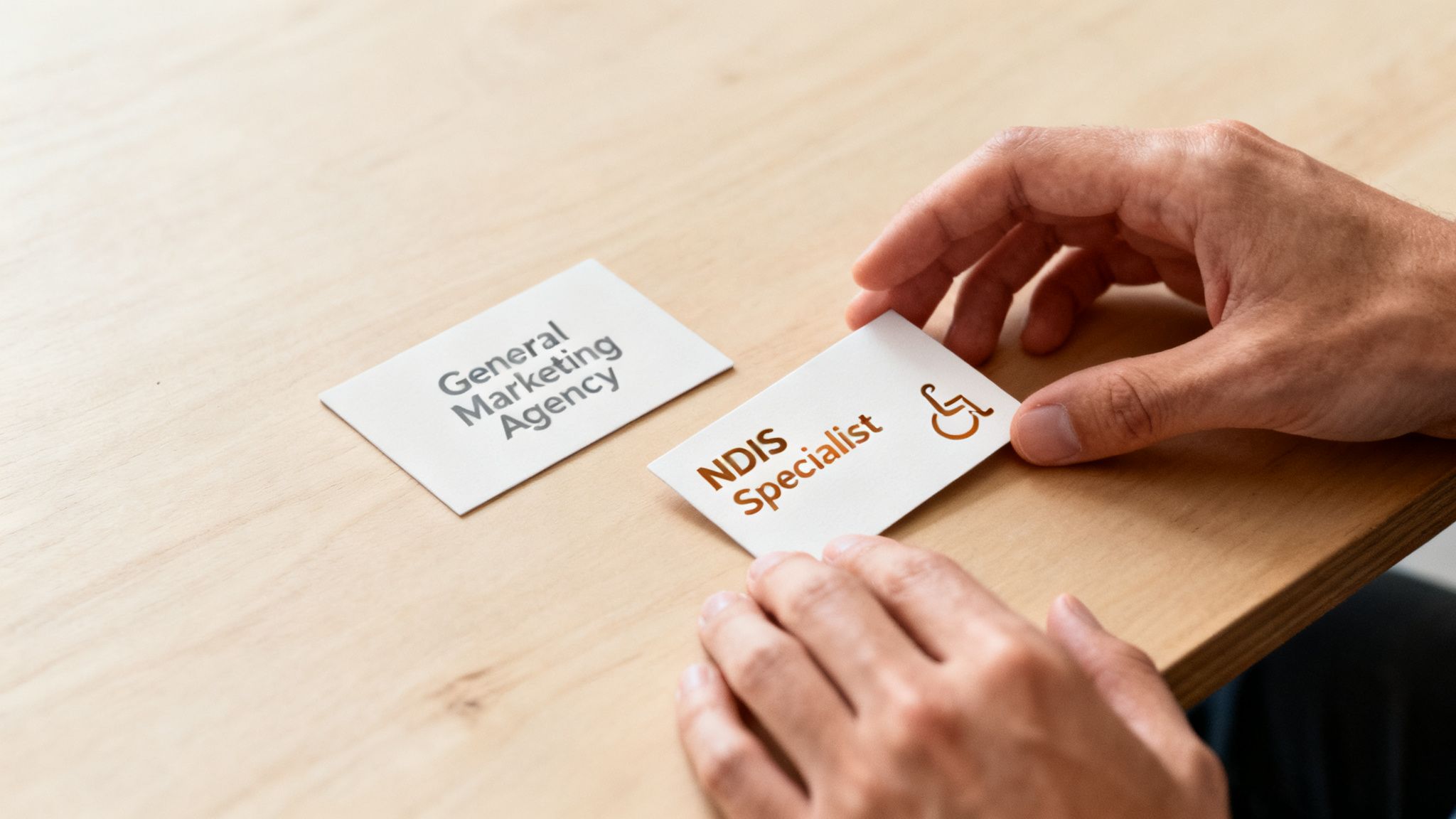
The Specialist vs The Generalist
Think of it like this: a general marketing agency is a bit like a family GP. They have a broad knowledge base and are great for common issues. But if your child needs highly specific neurological care, you’re not going to the GP—you’re finding a paediatric neurologist, a specialist with deep, focused expertise.
An NDIS digital marketing agency is that specialist. They get the nuances needed to navigate this unique environment. They know that marketing in the NDIS space isn't about pushing a product; it’s about communicating empathy, showing your value, and building a community. While general digital marketing for small business offers a good foundation, the NDIS sector demands a much more refined and sensitive strategy.
This specialised knowledge is critical for a few key reasons:
Understanding the Audience: An expert agency knows they aren't just talking to one person. They’re communicating with multiple groups—participants, parents, carers, and support coordinators—each with their own distinct needs and motivations.
Navigating Sensitivities: They're skilled in using person-first language and creating content that empowers people, rather than defining them by a disability. It’s a subtle but hugely important difference.
Building Trust with Coordinators: Support coordinators are essential partners. A specialist agency knows exactly how to create resources and messaging that prove a provider’s reliability and expertise, making them a go-to referral.
Moving Beyond Transactions
At the end of the day, generic strategies fail because they treat NDIS participants like another number in a sales funnel. This transactional mindset completely overlooks the massive amount of trust required for someone to choose you as their provider.
Sustainable growth in the NDIS sector comes from being a valued and respected part of the community. It’s about being a source of helpful information, a reliable support system, and an organisation that clearly lives its values. This is why partnering with an NDIS digital marketing agency isn’t just a nice-to-have; it's fundamental for ethical engagement and long-term success.
Marketing That Meets NDIS Compliance and Ethics
When you’re marketing in the NDIS space, you're playing by a different set of rules. This isn't about flashy sales pitches or creating hype. It’s about building genuine trust with participants, their families, and support coordinators, where every single message is respectful, honest, and strictly compliant.
An expert NDIS digital marketing agency knows the NDIS Code of Conduct isn't just another document—it’s the foundation for every marketing decision. From a simple social media post to a detailed service page on your website, everything has to be created with total integrity and transparency. The real goal is to empower participants with clear, helpful information, not to hook them with promises you can't keep.
Getting this right is fundamental to building a strong, sustainable reputation. Providers who bake compliance into their marketing aren't just avoiding legal trouble; they're showing everyone they genuinely respect the rights and dignity of the people they support.
The Guardrails of Ethical Content
To build that crucial trust, all your digital content needs to stay within clear ethical boundaries. One wrong step, even an accidental one, can damage your credibility in an instant and get you noticed by the NDIS Commission for all the wrong reasons. A specialised agency makes sure your messaging never crosses those critical lines.
Here are the non-negotiable rules for creating ethical NDIS content:
No Promised Outcomes: You can't make claims that guarantee specific results or cures. It’s a huge red flag. Your marketing needs to be realistic, focusing on the support and opportunities you offer, not on promising definitive life changes.
Use Person-First Language: This is non-negotiable. Always put the person before their disability. Say "a person with autism," not "an autistic person." It's a small change in wording that makes a massive difference, showing you see them as an individual first.
Avoid Clinical Jargon: Your audience is made up of participants and their families, not clinicians. They might not understand technical terms. Keep your communication in plain, simple English so everyone can understand what you do.
Ensure Authentic Representation: Ditch the cheesy, generic stock photos. They don’t reflect the real, diverse experiences of participants. Using real stories and images—with explicit consent, of course—is infinitely more powerful and respectful.
The most effective NDIS marketing is really just an extension of your service philosophy. It should be helpful, empowering, and completely transparent. It’s about giving potential participants the confidence to take the next step because they have clear, honest information.
Consent and Storytelling
Sharing testimonials and participant stories can be incredibly powerful, but it comes with a heavy ethical responsibility. A professional NDIS marketing agency will have a rock-solid process for getting explicit and informed consent before any person's story, photo, or personal details are shared. This means making sure the person knows exactly how their information will be used and that they can pull their consent at any time, no questions asked.
This ethical approach is your secret weapon in a very crowded digital space. With Australia's online ad market hitting $17.2 billion for the 2025 fiscal year—a 10.6% jump year-on-year—the internet is a noisy place for NDIS providers. Ethical, consent-driven storytelling helps you cut through that noise, connect authentically, and stand out without ever exploiting the very people you’re here to help. You can read more about the growth in the Australian online ad market to see why compliant marketing is more critical than ever.
The same principles of ethical communication apply across other highly regulated sectors. For example, the strict advertising guidelines in the legal field offer a useful parallel. You might find our guide on marketing for law firms interesting, as it also dives deep into compliance and building trust. At the end of the day, proactive, ethical marketing isn’t a limitation—it’s your greatest asset for building a reputable and trusted NDIS organisation.
Core Digital Strategies for NDIS Provider Growth
To really connect with participants, an NDIS provider needs more than just a basic website and a Facebook page. Genuine growth comes from a smart mix of digital strategies, each one tuned to the unique ethical and practical demands of the disability sector. A savvy NDIS digital marketing agency doesn’t just throw generic tactics at the wall; they customise every move to build trust, provide real value, and make sure every message is respectful and compliant.
Think of these strategies as a well-oiled support team. Each plays a different but vital role in helping participants and their families find and choose the right provider. From making sure you’re found by someone actively searching for help to creating content that actually empowers your community, every piece has to be handled with care and empathy. The goal isn’t just to get noticed, but to be seen as a reliable partner.
Mastering Search with NDIS SEO
Search Engine Optimisation (SEO) is all about making your website show up when people search on Google. For an NDIS provider, this is non-negotiable. When a parent or support coordinator is looking for services, you have to be there with the right answer.
This means going deeper than broad terms like "NDIS provider." A specialised NDIS digital marketing agency will zero in on long-tail keywords—those longer, more specific phrases people actually type when they need help.
Spot the difference in these searches: a general search like "disability services" versus a specific, high-intent search like "autism therapy services for children in Perth".
That second search shows a clear, urgent need. By optimising your website for these detailed queries, you attract people who are looking for the exact services you offer. This targeted approach connects you with a far more relevant audience and cements your reputation as an expert in your field. While NDIS is unique, providers can borrow proven ideas from guides on effective SEO for healthcare to sharpen their approach.
A Foundation of Digital Inclusion
In the NDIS world, website accessibility isn't a "nice-to-have"—it's a fundamental part of being inclusive. An accessible website means people with disabilities can easily navigate, understand, and use your online content. This is all guided by the Web Content Accessibility Guidelines (WCAG).
A specialist agency gets that WCAG compliance is more than a technical checklist. It’s a direct reflection of your organisation’s values. An inaccessible website can send the wrong message, suggesting you aren’t fully committed to supporting everyone in the community. You could be accidentally shutting the door on the very people you’re trying to help.
A truly accessible website is one where everyone, regardless of their ability or the assistive technology they use, can access information with ease and dignity. It's about ensuring your digital front door is open to all.
For small businesses in Australia, the push for better digital engagement is undeniable, with a huge 94% planning to increase their digital marketing budgets. This trend is especially strong in the NDIS sector, where providers are investing more in specialised services like SEO and website accessibility to connect with participants in a competitive space.
Content That Connects and Empowers
Content marketing for NDIS providers isn't about selling; it's about serving. The best approach is to create genuinely helpful resources that answer the real questions your community is asking. This is how you build trust and become a go-to source of reliable information.
Instead of just writing promotional articles, focus on content that empowers participants and their families on their NDIS journey. This could look like:
Guides for Navigating the System: Step-by-step articles explaining how to prepare for a plan review.
Plain English Explanations: Breaking down complex topics like service agreements into easy-to-understand language.
Resource Hubs: Curated lists of local community supports, advocacy groups, or accessible activities.
This kind of content shows you care about the community's well-being beyond just delivering a service. By consistently providing value, you build a loyal following and become the first provider people think of when they need support. A strong content plan is a cornerstone of any successful digital marketing strategy built for the long haul.
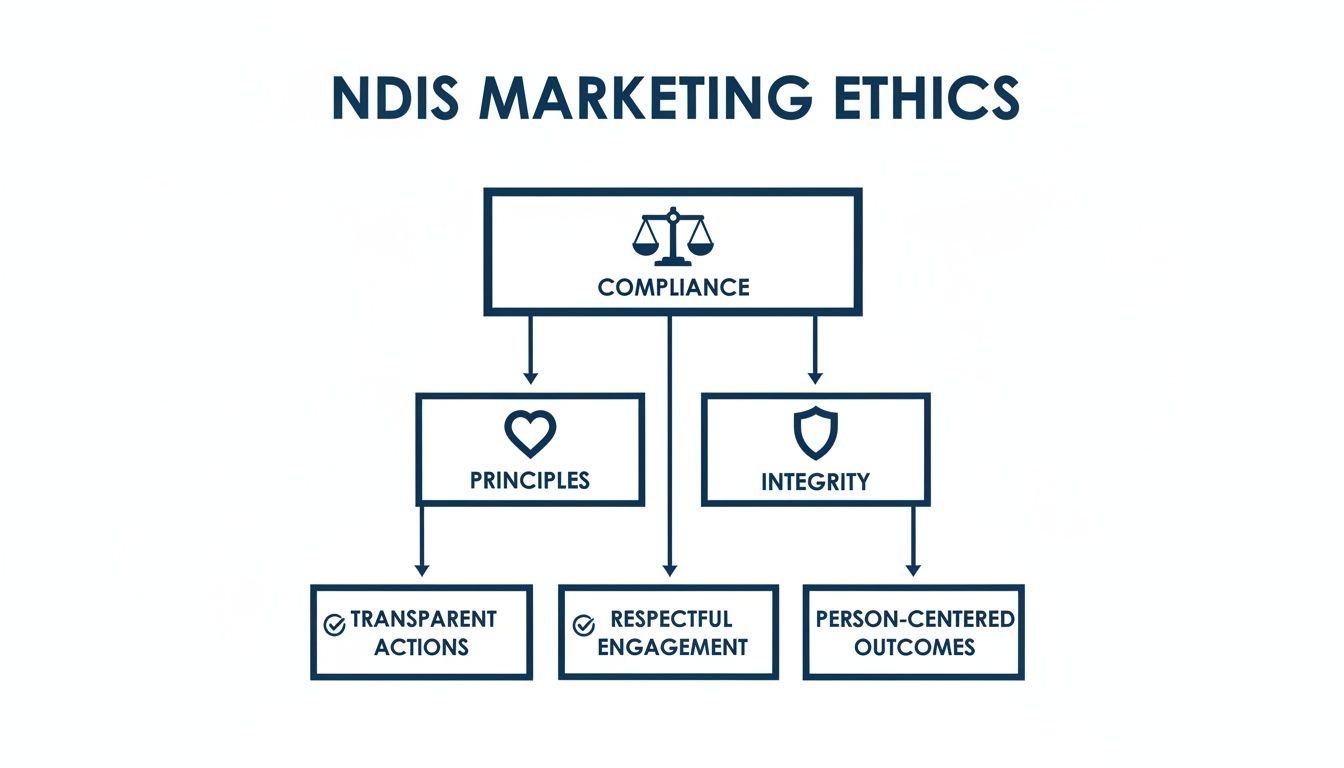
This infographic shows how NDIS marketing ethics are built from a foundation of compliance, guided by principles, and executed through clear actions.
The diagram illustrates that every marketing action must be rooted in core principles and strict compliance to be truly effective and ethical.
Building Community and Respectful Outreach
Social media and paid advertising are powerful tools, but only when used the right way. For NDIS providers, the focus has to be on community building and targeted, respectful outreach. Social media isn't just a megaphone for announcements; it's a place to foster dialogue, share success stories (with full consent, of course), and create a supportive online space.
Paid ads can also work wonders for reaching specific groups, like families in a certain postcode looking for particular supports. An NDIS digital marketing agency will make sure the ad copy is empathetic, compliant, and focused on empowerment, steering clear of any language that could feel exploitative or make false promises. It’s about letting the right people know you’re there to help, exactly when they need it most.
Building Participant Trust in the Age of AI Search
In the NDIS world, trust isn't just a nice-to-have; it's everything. Every click, every page, every piece of content is a chance to either build that trust or see it crumble. This is where smart, helpful content becomes your biggest ally, positioning your organisation as a guide, not just another provider.
The goal is to arm participants and their families with the information they need to feel confident. When you create content that genuinely answers their questions—without the hard sell—you shift the entire dynamic. It stops being a transaction and starts feeling like a partnership.
Preparing for the Future of Search
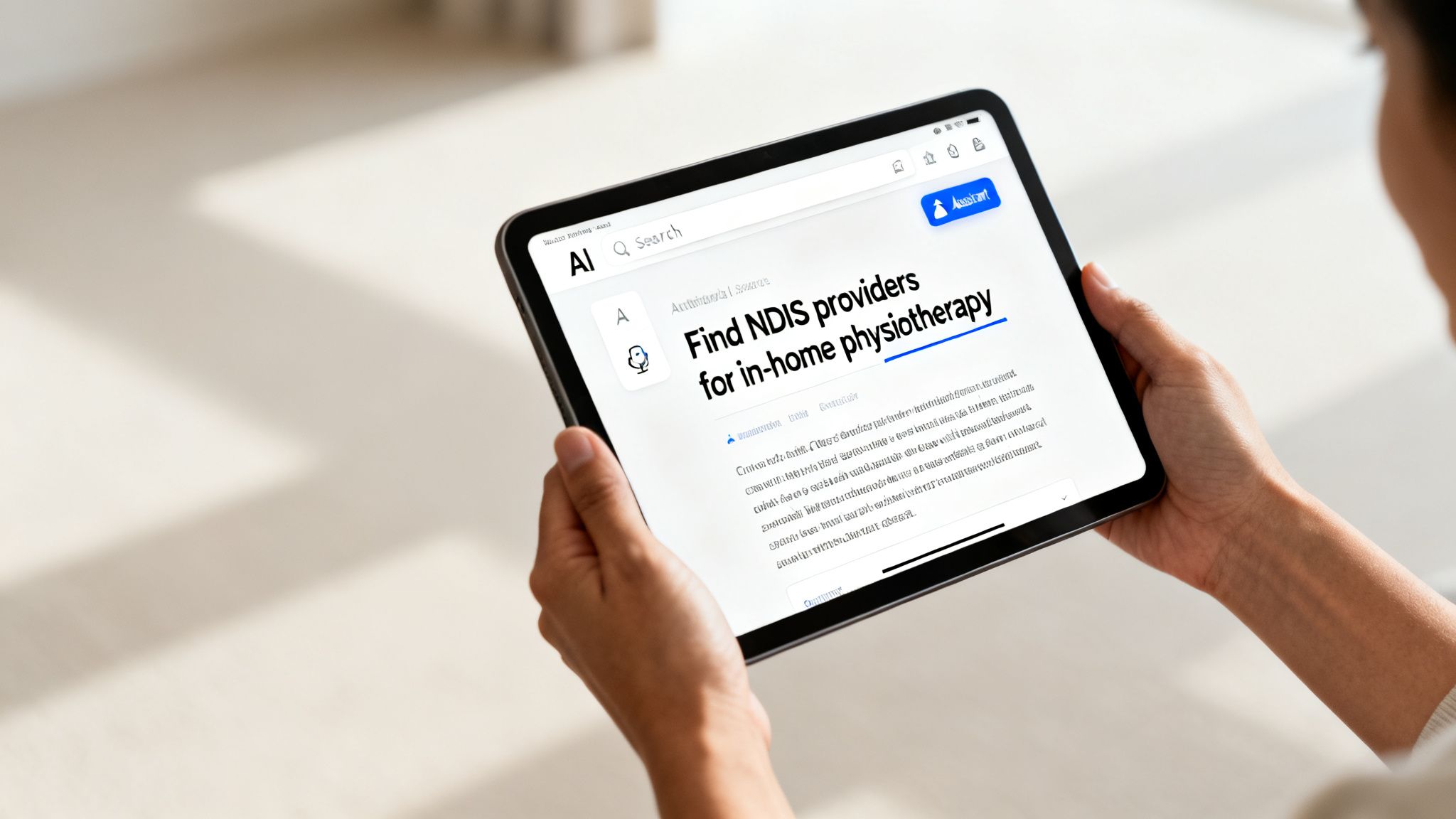
The way people find answers is changing fast. Forget short keywords. People are now asking detailed, conversational questions to AI assistants like ChatGPT and using voice search on their phones and smart speakers. This shift demands a whole new playbook: Answer Engine Optimisation (AEO).
Think about the real questions your potential participants are asking:
"Find NDIS providers near me that offer in-home physiotherapy for adults."
"What are the steps to prepare for an NDIS plan review meeting?"
"Which SIL providers in Brisbane specialise in supporting people with complex needs?"
These aren't just simple searches; they're direct requests for specific, reliable answers. Your website content has to be structured to provide those answers, cleanly and clearly. A specialist NDIS digital marketing agency knows exactly how to format your content so that AI tools and search engines see you as the most credible source. To get a better handle on this, you can learn more about Generative Engine Optimisation and see how it's reshaping the way businesses get found online.
Crafting Content as a Trusted Ally
To become the go-to answer, your content has to be authoritative, straightforward, and perfectly structured. This is more than just blogging; it’s about building a comprehensive resource hub that tackles the real-world challenges your community faces.
Every article, guide, and FAQ should be designed to build trust. Here’s how:
Clarity and Simplicity: Ditch the clinical jargon. Use plain English that everyone can understand.
Demonstrated Expertise: Provide accurate, in-depth information that proves you know your stuff.
Structured Data: Use technical SEO elements like schema markup to give search engines the context they need to understand your content.
When an AI assistant spits out an answer, it’s not just sharing information—it’s making a recommendation. Your goal is to be that recommendation by being the most helpful voice in the room.
This trust-first strategy doesn't stop with your website. While social media ad spending is set to hit a massive AU$7.5 billion in 2025, the real win for NDIS providers isn’t just about running ads. It's about using those platforms to share your educational content, build a genuine community, and spark real conversations.
This investment in trust works hand-in-hand with your AEO efforts, making sure you’re not just visible, but valued. By creating clear, helpful content, you position your organisation to be the trusted answer delivered by the next wave of technology, securing your reputation for years to come.
How to Select the Right Agency Partner
Choosing an NDIS digital marketing agency is a massive decision, and it goes way beyond a slick sales pitch. You're not just hiring a supplier; you're finding a partner who will represent your organisation's values and connect you with the people you serve.
The right agency becomes an extension of your own team. They need to get the sector's ethical demands and strategic needs on a deep level. A flashy presentation means nothing without a proven track record of ethical, effective work in the NDIS space. The goal is to find someone who delivers results while upholding the dignity and respect your participants deserve.
Vetting Potential Partners
Before you even think about signing a contract, you have to dig into an agency’s background. Look for real, tangible proof that they understand the unique world of marketing for NDIS providers. Generic marketing experience just doesn’t cut it; you need a team that lives and breathes this sector.
To properly vet an agency, focus on these key things:
Sector-Specific Portfolio: Ask to see websites they’ve actually built for other NDIS providers. Do these sites meet WCAG accessibility standards? Is the language respectful and person-first? This isn't optional.
Relevant Client Testimonials: Hunt for feedback from other disability support organisations. What do they say about the agency's grasp of compliance and their ability to forge genuine connections?
Deep NDIS Knowledge: A good partner can talk fluently about the NDIS Code of Conduct and what it means for marketing. They should immediately understand the critical importance of compliant messaging and ethical storytelling.
Asking the Right Questions
Once you have a shortlist, it's time to ask direct questions that cut through the marketing fluff. Their answers will tell you everything you need to know. These questions should go beyond standard marketing queries and get to the heart of the ethical responsibilities in the NDIS sector.
Get a list of questions ready for any potential agency. Here are some non-negotiables:
How do you stay current with the NDIS Commission’s guidelines for marketing and communication? This shows if they’re proactive about compliance or just winging it.
Can you walk me through your process for ensuring all content uses respectful, person-first language? This reveals their real commitment to ethical communication.
What is your procedure for obtaining and managing informed consent for participant testimonials and stories? This is a deal-breaker. Protecting participant dignity is paramount.
How do you measure success beyond just website traffic and leads? You’re looking for answers that include community engagement, building brand trust, and information accessibility.
To make sure you get a successful partnership, providers really need to understand the criteria for choosing an SEO company that genuinely delivers results tailored to your specific goals.
Understanding Pricing Models
Finally, it’s crucial to understand how an agency structures its fees so you can line up your budget with your goals. Different models suit different needs, and a transparent agency will explain their approach clearly. Knowing what to expect helps you make a confident investment.
Monthly Retainers: This is the most common model for ongoing work like SEO, content creation, and social media management. A retainer secures a set amount of the agency's time each month for a fixed fee, which is perfect for consistent, long-term strategy.
Project-Based Fees: This model is for one-off projects with a clear start and end, like a complete website redesign or a specific campaign launch. You pay a fixed price for a defined scope of work.
A clear understanding of these options will help you pick a partner that fits your financial planning. For those looking for a specialised partnership, we've also put together a guide on the best digital marketing agencies that might offer some more insights.
Your Top NDIS Marketing Questions Answered
Stepping into the world of NDIS marketing can feel a bit overwhelming. We get it. Providers often ask us where to start, what’s most important, and how to make sure their marketing is both effective and, crucially, ethical. We’ve put together some clear, straight-to-the-point answers to the questions we hear most often.
Getting these fundamentals right is the key to building a strategy that doesn’t just attract participants but builds real trust and respect in the community.
What’s the Real Difference Between General and NDIS Marketing?
The biggest difference comes down to intent. Mainstream marketing is often about driving quick sales and hitting volume targets, sometimes using aggressive tactics to get a signature on the dotted line. An NDIS digital marketing agency, on the other hand, plays a completely different game. The focus shifts to education, trust-building, and ethical communication.
It's less of a sales pitch and more of a supportive conversation. This requires a genuine understanding of NDIS compliance, the critical importance of person-first language, and the sensitive journey participants and their families are on. The goal isn't a fast conversion; it's to empower people with helpful information and build a lasting connection.
How Much Should We Really Be Budgeting for Digital Marketing?
There’s no magic number here. A realistic budget depends on the size of your organisation, how quickly you want to grow, and the services you offer. It’s better to stop thinking of marketing as a cost and start seeing it as an investment in reaching the people who need you most.
A good agency won’t just pluck a figure out of thin air. They’ll work with you to build a budget around a clear strategy designed to deliver a measurable return. This usually involves a monthly retainer for ongoing work like SEO and content, which ensures you’re consistently moving towards your goals.
What Are the Biggest Marketing Mistakes We Should Avoid?
The most damaging mistakes we see usually come from a lack of understanding of the NDIS sector’s strict ethical guidelines and the unique needs of its audience. Getting this wrong can seriously harm your reputation.
Here are the big ones to steer clear of:
Using Clinical Jargon: Always use plain, simple English. Your communication needs to be easily understood by participants and their families, not just other professionals.
Promising Guaranteed Outcomes: This is a major red flag. It’s unethical and non-compliant to promise specific results. Instead, focus on the quality of support you provide.
Using Participant Images Without Full Consent: You must have explicit, informed consent before sharing photos or stories. The person must understand exactly how their image and information will be used.
Forgetting Website Accessibility: An inaccessible website literally puts up a barrier to the very people you’re trying to help. It sends a terrible message about your commitment to inclusivity.
How Long Until We Start Seeing Results?
It’s so important to have realistic expectations. NDIS marketing is a marathon, not a sprint, and the timeline for results depends entirely on the tactics you’re using.
Foundational strategies like SEO and content marketing are about playing the long game. You’re building authority and trust, and that doesn’t happen overnight. It can take several months to see the real, sustainable growth kick in. Paid advertising, on the other hand, can generate visibility and leads much faster. A smart approach almost always involves a mix of both, using short-term tactics to create momentum while building a solid foundation for long-term success.
At Titan Blue Australia, we know the unique challenges and responsibilities that come with marketing in the NDIS space. With over 25 years of experience, we build digital strategies that are compliant, ethical, and actually work. Connect with us today to see how we can help you build trust and grow your reach the right way.
Titan Blue is your go-to digital partner for smart, results-driven solutions. We blend strategy, creativity and tech to grow your brand and get real results fast.